Sant’Anna dei Lombardi: A Renaissance Church in Naples


Site at a Glance
- Rating
- 4.9
- Popularity
- Medium
- Country
- Italy
- Primary era
- Early Modern
- External website
- Open
- Eras represented
- Medieval, Early Modern
- Civilizations
- Kingdom of Naples, Spanish
- Site type
- Religious
- Remains
- Church
On this page29 sections
History
Sant’Anna dei Lombardi is a Roman Catholic church in Naples, Italy, founded by the Olivetan Benedictines in the early fifteenth century and regarded as one of the city’s major settings for Tuscan Renaissance art and architecture. Its history began in 1411, when Gorello Origlia, protonotary to King Ladislas of Durazzo, sponsored a small church called Santa Maria di Monteoliveto. The church was entrusted to the Olivetans, a Benedictine congregation founded around the Abbey of Monte Oliveto in Tuscany, and the connection gave the building its former names, Santa Maria di Monteoliveto and the Church of Monteoliveto.
Olivetan and Aragonese Patronage
The church and monastery expanded through the patronage of Alfonso of Aragon, king of Naples, and the Aragonese court. The Aragonese were the ruling dynasty in Naples during the period of the church’s major fifteenth-century development, and their support helped make Monteoliveto one of the court’s favored churches. Memorials and portraits connected with the dynasty remained part of the church’s artistic and commemorative character.
The complex also reflects Naples’ close links with Tuscany and with the Florentine merchants, artisans, and bankers established in the city. The Strozzi banking family maintained a Neapolitan branch and handled payments associated with Antonio Piccolomini’s commission to Antonio Rossellino and Benedetto da Maiano. Their work, together with the involvement of other Tuscan artists, brought the ordered forms, classical details, sculptural decoration, and chapel designs of the Tuscan Renaissance into a Neapolitan religious setting.
Reconstruction and Baroque Transformation
Further rebuilding took place in 1581 in association with Domenico Fontana. During the seventeenth century, Gaetano Sacco transformed or reconstructed the church and convent. These interventions created the appearance associated with the later Baroque phase while obscuring much of the original Gothic fabric. The resulting building combines surviving medieval elements with Renaissance planning and restrained Baroque alterations.
In 1798, Ferdinand I of the Two Sicilies expelled the Olivetans from the church and monastery. The Archconfraternity of the Lombards then moved to Monteoliveto from its nearby church dedicated to Saint Anne, which had become unusable after damage to its roof. The Monteoliveto church was officially renamed Sant’Anna dei Lombardi in 1801. Three paintings by Caravaggio associated with the former Sant’Anna church were reportedly destroyed during the events surrounding the transfer and the later collapse of the building.
The former monastery was suppressed in 1799 and adapted to private and public uses. It housed the Neapolitan Parliament in 1848. The monastery’s four cloisters were later separated from the church. Three became part of the Pastrengo Carabinieri barracks, while the principal large cloister was converted into private housing, with parts of its entrance facade and interior remaining visible.
Earthquake and War Damage
An earthquake in 1805 caused the collapse of a substantial part of the church. The three Caravaggio paintings associated with the former Sant’Anna church were reportedly destroyed in this collapse. The building suffered further severe damage during Allied bombing in the Second World War, particularly to the facade and its Gothic atrium. Parts of the facade and atrium were reconstructed after the war, including work following the bombing of 1943.
The church and its associated historic urban complex form part of the UNESCO World Heritage area of Naples’ historic centre. Its present character therefore reflects several overlapping phases, from the Olivetan foundation and Aragonese expansion to Renaissance commissions, seventeenth-century rebuilding, earthquake damage, and post-war reconstruction.
Remains
Facade, Atrium, and Nave
Facade and Gothic Atrium
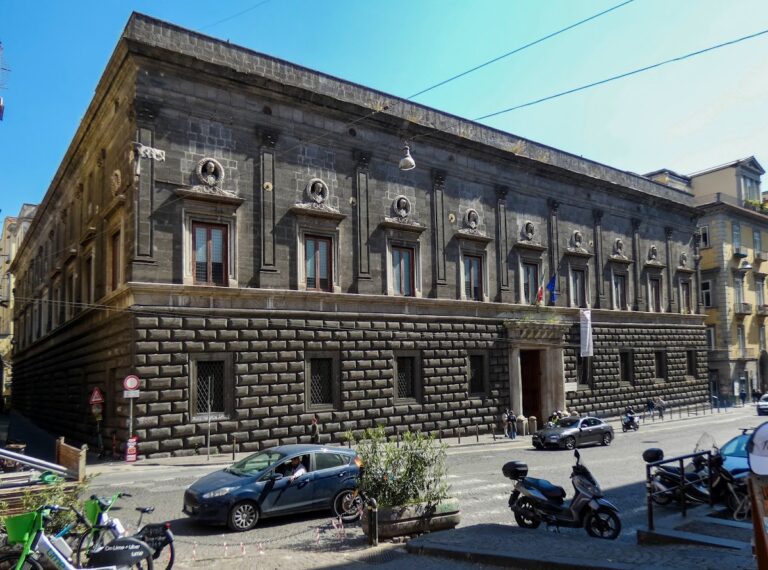
The exterior is faced in piperno, a dark volcanic stone widely used in Neapolitan architecture. Its principal feature is a simple, austere arch, while the severe treatment of the stonework gives the facade a defensive appearance. An arch leads into the Gothic atrium, whose lowered segmental arch belongs to the late Neapolitan Gothic tradition. The atrium contains the funerary monument to Domenico Fontana, made in 1627 by his sons Sebastiano and Giulio Cesare Fontana and transferred from the destroyed church of Sant’Anna. Blocked Gothic windows remain visible on the exterior sides of the building. Parts of the atrium and facade were reconstructed after their wartime destruction.
Nave and Entrance Altars
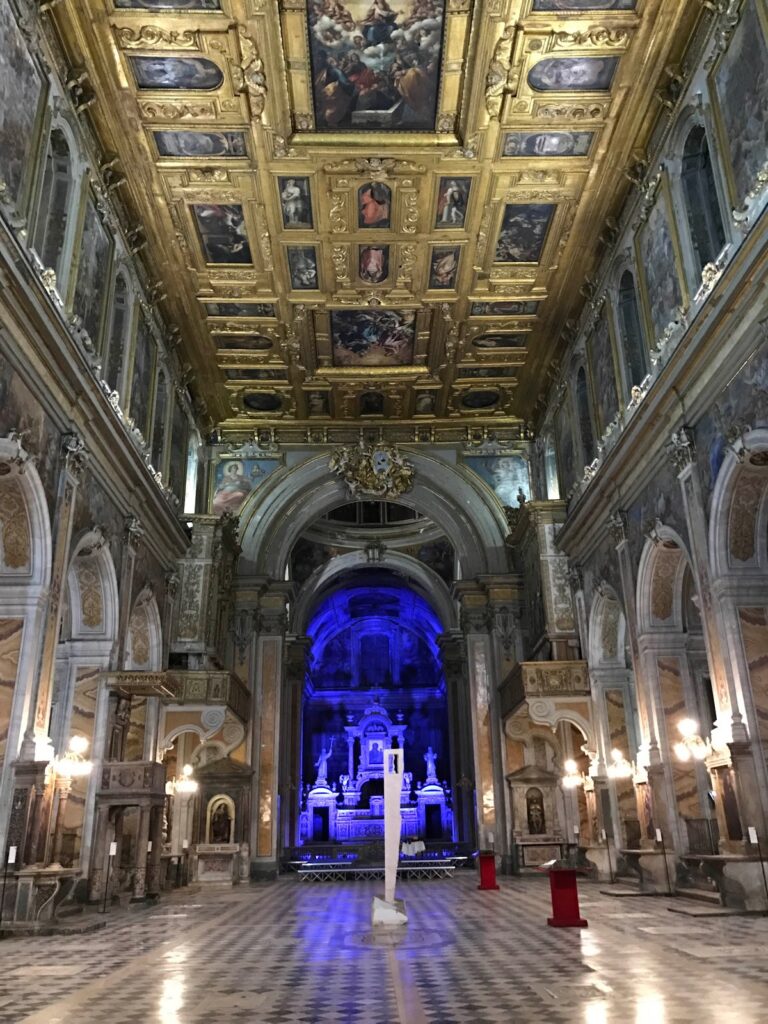
The church is organized around a linear rectangular nave with a vaulted roof concealed by a coffered ceiling. Five lateral chapels line each side, with three further chapels in the presbytery area. White and light-grey walls are articulated by Corinthian pilasters and intervening round arches, while later Baroque modifications remain relatively restrained. Ten oil paintings occupy the upper zone of the nave, five on each side. Gabriele De Sabato painted these works in 1720, presenting scenes from the life of Saint Bernardo Tolomei and the origins of the Olivetan order.
Two Renaissance family altars stand on either side of the entrance. Giovanni da Nola made the Ligorio altar on the left in 1532. Its central Madonna del Soccorso is accompanied by statues of Saints Andrew and Jerome, while the predella, the lower section of an altarpiece, carries a relief of Saint Francis of Paola saving travelers buried by a landslide. Girolamo Santacroce made the Del Pezzo altar on the right in 1524. It presents the Madonna and Child between Saints Peter and John the Baptist, with a predella relief showing Christ and Saint Peter on the waters of the Sea of Tiberias.
Organ and Choir Loft
The organ stands in the choir loft above the entrance. Its richly carved and gilded Mannerist case, a refined late Renaissance style, is attributed to Mario Cartaro and dates from 1591 to 1592. Alessandro Fabri built the instrument and enlarged it in 1607. Andrea Basso began a reconstruction in 1687, which Cesare Catarinozzi completed in 1697. The Fratelli Lingiardi modified it in 1904, followed by further work by Pietro Petillo in 1950. The instrument has mechanical transmission, thirteen stops, two manuals, and a pedal, although the second manual was never activated. Frescoes of angels by Battistello Caracciolo, dating from the beginning of the seventeenth century, flank the organ.
Presbytery and Apse
The presbytery was added in the sixteenth century and contains four chapels with terracotta and sculptural works by Guido Mazzoni, Antonio Rossellino, Benedetto da Maiano, Giovanni da Nola, Pedro de Rubiales, and others. The large main altar was designed by Giovan Domenico Vinaccia and executed by Bartolomeo and Pietro Ghetti in the second half of the seventeenth century. Its elaborate marble inlay reflects the later Baroque furnishing of the church.
Angelo Mozzillo’s painting The Education of the Virgin, from the beginning of the nineteenth century, occupies the apse. Memorial plaques and sculptural groups commemorate Gorello Origlia and Alfonso of Aragon as founders and patrons of the Olivetan church. The apse also has a tribune made in 1591 during work by Giovan Battista Cavagna, a broad frieze of sixteenth- and seventeenth-century frescoes depicting scenes from the life of Saint Benedict, and carved and inlaid choir stalls made by Giovanni Francesco d’Arezzo in the sixteenth century.
Funerary monuments occupy both sides of the apse. The right wall contains monuments to Giovan Paolo Vassalli and Nicola Asciomo, made around 1500 and attributed to the workshop of Tommaso Malvito. The statue of Vassalli on his sarcophagus is specifically associated with that workshop. On the left are the monument to Fabio Barattuccio by Antonino De Marco and Antonino De Palma, and the monument to Giovanni Artaldo by Giovanni Tommaso Malvito.
Side Chapels
Piccolomini Chapel
The Piccolomini Chapel is accessed through the first room on the left, which contains Giulio Mazzoni’s high relief of the Crucifixion with Mary, Saint John, and Mary Magdalene, made about 1550. The room also contains an early sixteenth-century panel of the Ascension with Saints Sebastian and Nicholas of Bari by an unidentified southern Italian artist.
Built between 1475 and 1490 as the funerary chapel of Maria of Aragon, wife of Antonio Piccolomini and daughter of the Neapolitan king, the Piccolomini Chapel is considered one of the accomplished examples of Florentine early Renaissance architecture in Naples. Giuliano da Maiano, Benedetto da Maiano, and Antonio Rossellino worked on the commission, which followed the model of the Chapel of the Cardinal of Portugal at San Miniato al Monte in Florence while placing particular emphasis on sculpture. The chapel’s construction and decoration received financial support from the Strozzi family.
Rossellino’s relief of the Adoration of the Shepherds occupies the main altar, together with statues of Saints James and John and circular panels depicting prophets. On the left wall, Maria of Aragon’s tomb has angels holding a Madonna and Child above it and putti on the sarcophagus. Rossellino began the tomb around 1475, and Benedetto da Maiano completed it after Rossellino’s death. A marble bench, fifteenth-century frescoes of the Annunciation, and a geometric Cosmatesque floor of polychrome marble complete the chapel’s surviving decoration.
d’Avalos Chapel
The elongated d’Avalos Chapel has Fabrizio Santafede’s Madonna and Child with Saints Benedict and Thomas Aquinas, dated 1606, as its altar painting. Giovan Antonio Arditi and Antonio Sarnelli painted frescoes of stories from the Old and New Testaments on the dome, drum, and entrance arch. These frescoes are in an advanced state of deterioration.
Chapel of Saints Mauro and Placido
The Chapel of Saints Mauro and Placido contains Paolo De Matteis’s signed and dated 1708 altarpiece of the Madonna and Child with Saints Maurus and Placidus. Nicola Malinconico painted the vault and lunette frescoes, which depict the glory and lives of the saints. A 1576 funerary monument to Giovanni and Carlo Rapario by an unidentified Neapolitan master includes a marble relief of the Flagellation. The chapel also contains a monument to Grazia Cavaniglia by Jacopo della Pila, dating from about 1470.
Porcinari Chapel
The Porcinari Chapel is decorated with frescoes by Francesco Di Maria depicting the life of Saint Bernardo Tolomei. Carlo De Rosa painted Bernardo Tolomei giving the rule of the order, and Paolo De Matteis painted the vault frescoes.
Chapel of Saint John the Baptist
Giovanni da Nola’s statue of Saint John the Baptist, dated 1516, is the principal sculptural work in the chapel dedicated to the saint. During the first half of the sixteenth century, Jacopo della Pila made the Annunciation and Pietà reliefs on the predella. Paolo De Matteis later painted the vault frescoes of the saint’s glory and life.
Mastrogiudice Chapel
The Mastrogiudice Chapel contains Giovanni da Nola’s sculpture of the Madonna and Child with the young Saint John the Baptist between Saints Jerome and Andrew. Girolamo D’Auria made the early seventeenth-century Mastrogiudice tombs, while Battistello Caracciolo painted the fresco cycles. A monumental organ from the end of the seventeenth century is also preserved in the chapel.
Correale Chapel
Also called the Chapel of the Annunciation, the Correale Chapel has Benedetto da Maiano’s white-marble Annunciation altar, dated 1489. The ensemble includes statues of Saints John the Evangelist and John the Baptist, an Annunciation high relief, circular panels with martyrs, and predella reliefs showing scenes from the life of Jesus. The chapel also contains Marino Correale’s funerary monument, dated 1490, and a fifteenth-century marble bench.
The chapel’s architectural design is closely related to the manner of Giuliano da Maiano. Other young Tuscan artists also worked on the Annunciation altar. Recent studies have proposed the possible participation of a young Michelangelo in a twisting putto, but this remains an attribution rather than an established identification.
Chapel of Saint Frances of Rome
The Chapel of Saint Frances of Rome contains paintings by Vincenzo Fato depicting episodes from the saint’s life, together with frescoes by Giuseppe Simonelli in the lunettes and vault. Giovan Battista Lama painted the altarpiece.
Chapel of Saint Anthony of Padua
Nicola Malinconico painted the frescoes depicting the life of Saint Anthony of Padua. Annibale Caccavello made the statue of Saint Anthony and the predella relief of the saint preaching.
Scala Chapel
The Scala Chapel contains the remains of military members of the Scala family, who were probably of Spanish origin. They lie beneath a central floor plaque set within a pavement of red, white, and black marble. A seventeenth-century reference mentions a plaque to Galzerano and Livio Scala. The chapel also has an eighteenth-century altar surmounted by a wooden crucifix by an unidentified master, along with frescoes by Nicola Malinconico depicting scenes from the life of Christ.
Chapel of Saint Christopher
Francesco Solimena’s painting of Saint Christopher occupies the Chapel of Saint Christopher. The chapel also contains Matteo Bottiglieri’s funerary monument to Cesare Bosco and vault frescoes by Giuseppe Simonelli depicting the life of Saint Christopher.
Tolosa Chapel
Built between 1492 and 1495 for Paolo Tolosa, a Spanish merchant, the Tolosa Chapel is attributed to Giuliano da Maiano. Its architectural arrangement recalls Brunelleschi’s sacristy at San Lorenzo in Florence. Fifteenth-century wall frescoes by Cristoforo Scacco di Verona surround a triptych by Reginaldo Piramo da Monopoli showing the Madonna enthroned between Saints Andrew and Jerome.
The dome contains terracotta circular panels from the Della Robbia workshop depicting the four Evangelists. They were probably originally intended for the Piccolomini Chapel. Inlaid wooden choir stalls formerly used in the chapel are now partly incorporated into the Vasari Sacristy.
Savarese Chapel
The Savarese Chapel contains an early fifteenth-century fresco by an unidentified artist showing the Madonna and Child with Saints Peter and Augustine, with a Pietà below. Carlo Sellitto painted two works dated 1608, The Delivery of the Keys to Saint Peter and Saint Peter Saved from the Waters.
Orefice Chapel
Carrara craftsmen produced the Orefice Chapel’s polychrome marble decoration at the end of the sixteenth century. Luigi Rodriguez painted fresco cycles of stories and virtues of the Virgin, while Girolamo D’Auria made the funerary monuments of Antonio Orefice and his son.
Oratorio and Sacristies
Oratorio del Santo Sacramento
A passage on the right side of the presbytery leads to the Oratorio del Santo Sacramento, the Chapel of the Assumption, the New Sacristy, the Old or Vasari Sacristy, and other former monastic rooms. The oratory consists of three successive interconnected chapels: the Fiodo Chapel, the Origlia Chapel, and the Chapel of the Compianto, or Lamentation.
The Fiodo Chapel contains the funerary monument of Antonio d’Alessandro and his wife Maddalena Riccio. Giovan Tommaso Malvito made it in 1491 for d’Alessandro, Baron of Cardito, diplomat, and jurist, and Riccio, a Neapolitan noblewoman. The chapel also contains the monument of Antonio Fiodo by Francesco da Sangallo and Bernardino del Moro.
Pedro de Rubiales painted the Origlia Chapel’s frescoes, which depict the stories of Jacob and Esau, including Esau selling his birthright. The Chapel of the Compianto contains Guido Mazzoni’s Lamentation over the Dead Christ, made in 1492 for Eleonora of Aragon. The eight-figure group originally had polychrome coloring, which has been lost. Several figures portray members of the Aragonese ruling family, including Joseph of Arimathea, whose features resemble Alfonso II of Aragon.
The Lamentation Chapel also contains Giuseppe Mastroleo’s Calvary on the rear wall, a relief of the Burial of Jesus attributed to Girolamo D’Auria, and a relief of the Resurrection dated 1567.
Chapel of the Assumption
The Chapel of the Assumption has a floor of maiolica tiles, later-style vault fresco cycles, and Fabrizio Santafede’s altarpiece of the Assumption of the Virgin. A fresco portrait of an Olivetan monk by Giorgio Vasari adds a direct reminder of the congregation that originally administered the complex.
Vasari Sacristy
The Old Sacristy, also called the Vasari Sacristy, began as the refectory of the Olivetan monastery. Giorgio Vasari and assistants including Raffaellino del Colle decorated it in 1544 and 1545 with early Mannerist vault frescoes. The vault is divided into three sections devoted to Faith, Religion, and Eternity. Personifications of virtues and other allegories appear within large frames surrounded by refined grotesque ornament, a Mannerist decorative style using fantastical and interlaced motifs.
The walls contain carved and inlaid furniture made by Fra Giovanni da Verona between 1506 and 1510, originally for the Tolosa Chapel. The furniture was moved to the sacristy in 1688, when the former refectory became a sacristy, and was later supplemented with Baroque additions. The altar has three works by Girolamo d’Arena: Saint Charles Borromeo in the centre, with the Archangel Michael and the Virgin Mary on either side. The Saint Charles painting came from the former church of Sant’Anna dei Lombardi and was transferred after that building’s destruction at the beginning of the nineteenth century.
Above the entrance is an Adoration of the Shepherds from the school of Vasari. Small niches beside it contain sculptures of the Archangel Gabriel and the Virgin Mary attributed to Giovan Battista Cavagna. The New Sacristy contains Giuseppe Mastroleo’s altarpiece of the Crucifix with Saints and vault decoration recalling that of the Vasari Sacristy.