Santissima Concezione: A Capuchin Church and Sanctuary in Genoa, Italy
Site at a Glance
- Rating
- 4.4
- Popularity
- Very Low
- Country
- Italy
- Primary era
- Early Modern
- Eras represented
- Early Modern, Modern
- Civilizations
- Genoese, Kingdom of Sardinia
- Site type
- Religious
- Remains
- Monastery
On this page18 sections
History
Santissima Concezione is a Catholic church and convent in Genoa, Italy, founded for the Capuchins after the plague epidemic of 1579. Also known as the Capuchin Church and the Sanctuary of Padre Santo, it is dedicated to the Immaculate Conception, the Catholic doctrine that Mary was preserved from original sin from the moment of her conception. The complex now serves as the seat of the Ligurian provincial curia of the Order of Friars Minor Capuchin.
Foundation after the plague
In 1591, Genoa commissioned a new church and convent as an act of thanksgiving for the end of the epidemic. Debate had considered whether an existing chapel or altar dedicated to the Immaculate Conception could fulfil the city’s vow, but the Senate of the Republic ordered the construction of a new sacred complex. Donations from Genoese citizens were joined by a government contribution through the Bank of Saint George and by money collected by Agostino, a Capuchin from Ventimiglia. He died in 1585, before the church was completed.
The site was acquired on 11 February 1593. A cross marking divine ownership was erected on 21 March, and the foundation stone was laid on 20 May in the presence of Genoa’s archbishop, Alessandro Centurione. The first part of the works was completed in 1596, when the first Mass was celebrated on 1 November. Most of the Capuchins who had lived at the smaller convent of San Barnaba moved into the new convent in April 1598. A tower may previously have stood on the site, possibly known as the Tower of the Wolves, a name preserved in a nearby street.
Capuchin life and expansion
The church and convent were intended for the Capuchins, a reform branch of the Franciscan order that emphasizes poverty, simplicity, preaching, and service. Their ideals shaped the restrained character of the complex. Between 1613 and 1616, the convent housed Lorenzo da Brindisi, who served as provincial superior. Archbishop Domenico de Marini solemnly consecrated the church and convent on 19 October 1620.
The friars participated actively in Genoa’s economic and social life. They operated a pharmacy, maintained one of the city’s important libraries, and established a loan service in 1635. Income from these activities and from donations allowed the church to acquire works by numerous Genoese artists, including Bernardo Strozzi, who had entered the Capuchin order.
From the seventeenth through the nineteenth century, Genoese noble families increasingly used the church as a burial place. In 1669, a donation from the Giustiniani family enabled the creation of a large crypt chapel beneath the choir. Its dispersed tombs include that of the Genoese poet Martin Piaggio.
Suppression, restoration, and the Padre Santo
The Napoleonic government closed the convent in 1810, but it reopened on 16 May 1815. The church was enlarged in 1840 without altering its original structure. In 1842, following the prohibition of burials inside churches issued in 1835, an ossuary was built beside the convent.
Francesco Maria da Camporosso, later known as Padre Santo, lived in the convent for about forty years and died there on 17 September 1866. After the Savoy government’s laws of 1866 suppressed Church property, the friars were expelled, the church was transferred to diocesan clergy, and the convent was adapted as a public school.
The Capuchins gradually returned to part of the convent from 1904. The remaining section later accommodated the Sandro Pertini secondary school and was adapted for that purpose in 1937. The complex housed the Ligurian Capuchin provincial curia from 1934 to 1955. After the curia moved to the convent of Santa Caterina di Portoria, it returned to Santissima Concezione in 1966.
The convent suffered no major structural damage during the aerial bombardments of the Second World War, although explosions destroyed most of its stained-glass windows. The windows were replaced in the following years. In 1962, Pope John XXIII declared Francesco Maria da Camporosso a saint. The church was then elevated to a sanctuary and became known as the Sanctuary of Padre Santo. His body is preserved in a chapel dedicated to him, where it is exposed for the veneration of the faithful.
Remains
Churchyard and exterior
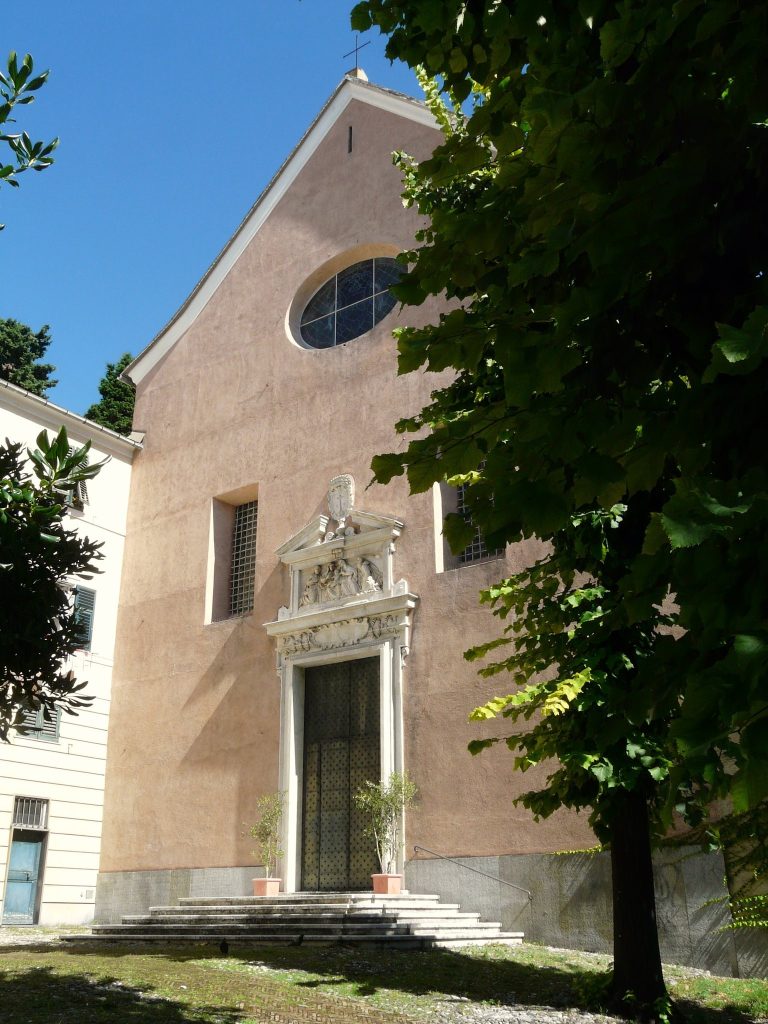
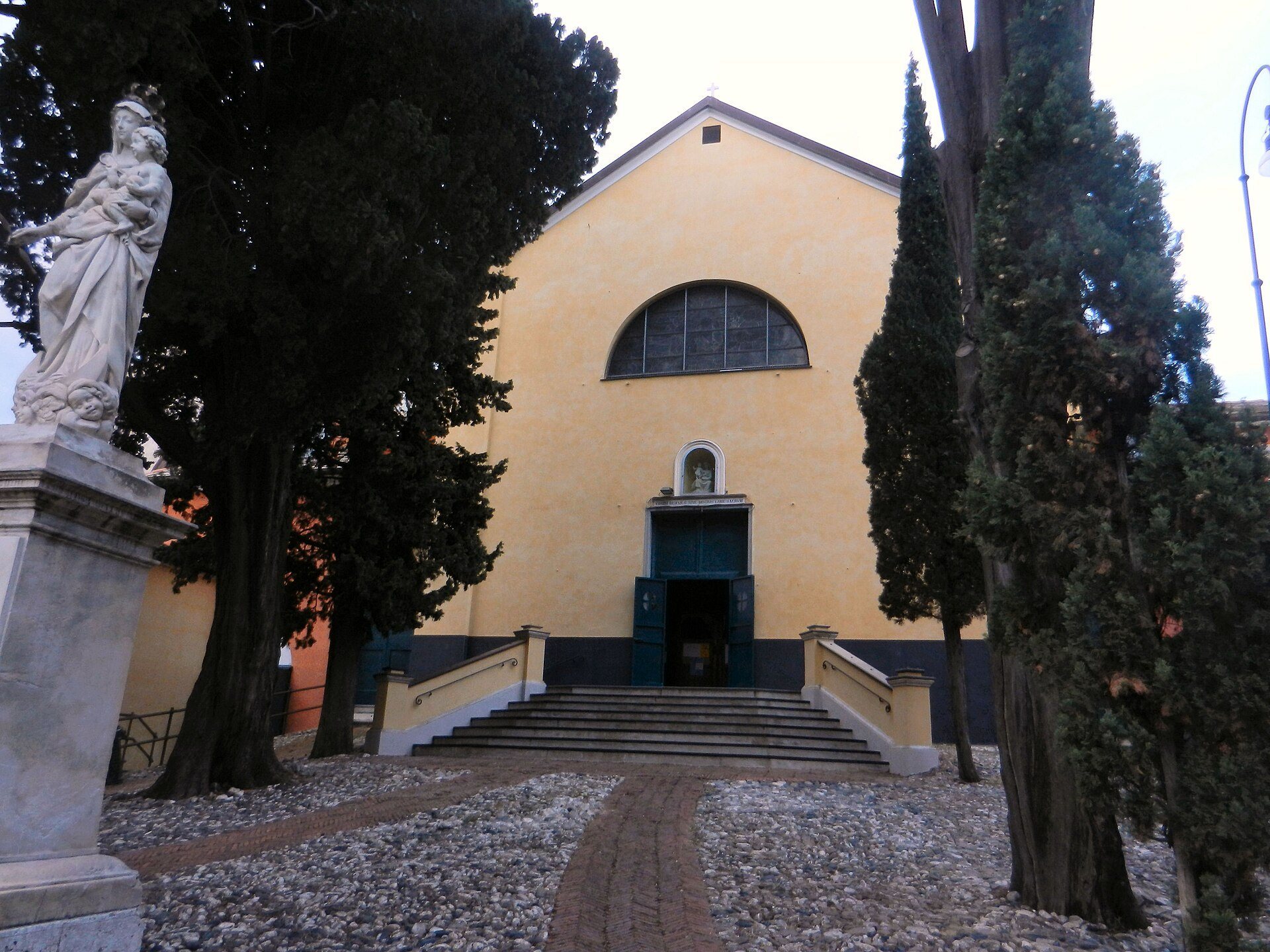
The church stands on a small raised churchyard at the junction of Via Agostino Bertani and Via Goffredo Mameli, near Piazza Corvetto and Villetta Di Negro. Convent buildings surround it on most sides. They extend west towards Via Bertani and south towards Piazza dei Cappuccini, while the former convent school lies to the north and Villa Caumont Caimi to the east. Large cypress trees shade the churchyard.
The facade is exceptionally plain, reflecting Capuchin sacred architecture and its emphasis on simplicity. It has no decorative ornament, a single large semicircular window, and a gabled slate roof with terracotta tiles along the ridge. Above the entrance is the dedication Virgini Deiparae Sine Originis Labe Sacrum. A sixteenth-century statue of the Madonna and Child stands in a niche.
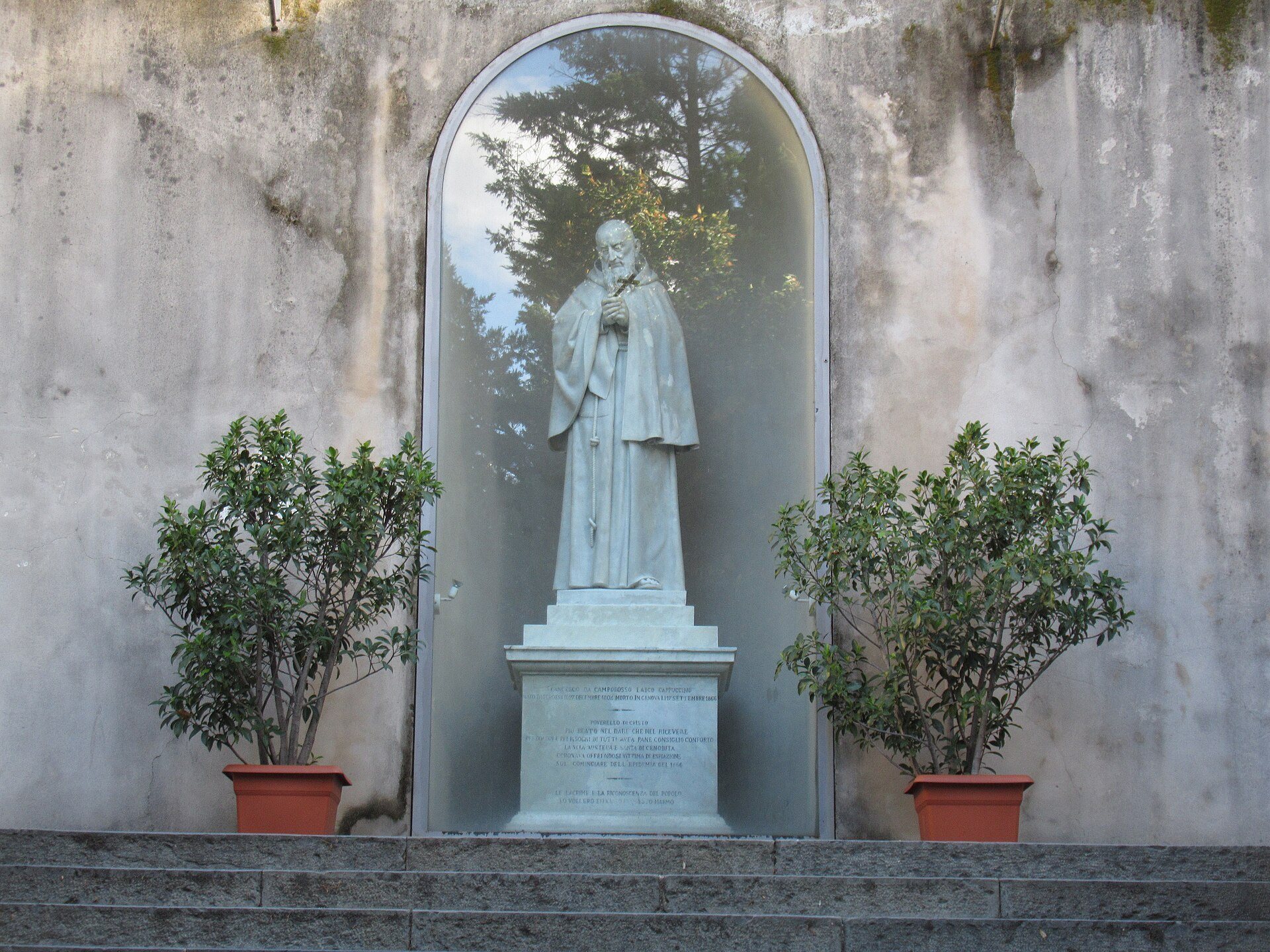
The churchyard contains a statue of the Madonna Regina by the Genoese sculptor Tommaso Orsolino. It is accompanied by a long Latin inscription dated 1841 that refers to renewed adornment in 1954. Between the first and second flights of the access stairs stands a bust of Francesco Maria da Camporosso by Carlo Rubatto, made in 1891.
Nave, altar, and choir
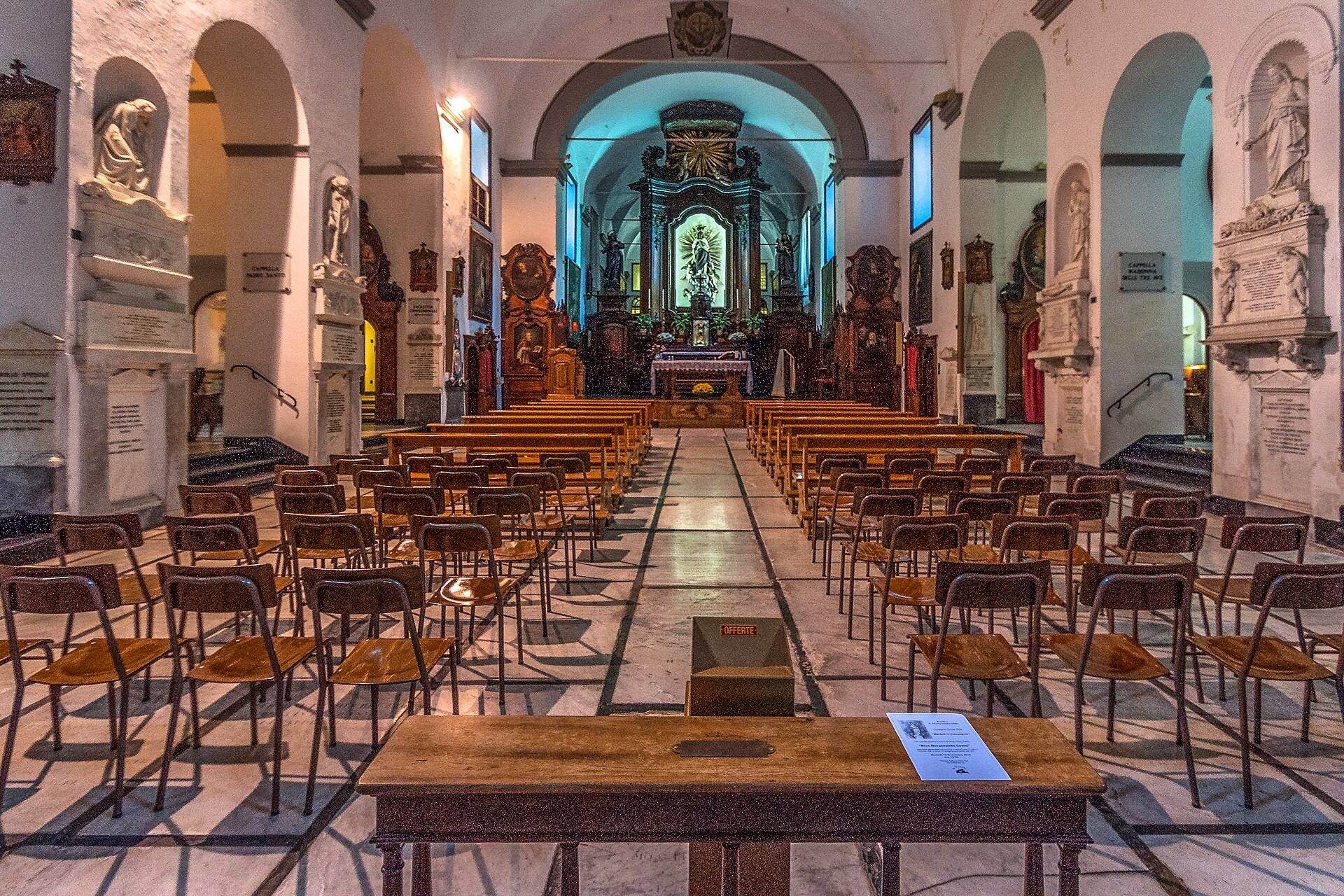
The church has a rectangular plan, a single nave, and a cross-vault. Five lateral chapels line the nave, with three on the right and two on the left. A corridor between the left-hand chapels leads to the Chapel of Padre Santo, while the deep choir lies beyond the sanctuary. White walls and vaults contrast with the dark wooden furnishings.
Main altar and sanctuary
The ebony main altar contains a niche with a wooden Immaculate Conception by Bartolomeo Carrea of Gavi. Wooden statues of Saint Anthony of Padua and Saint Francis by Giulio Casanova stand beside it. The tabernacle, the receptacle for consecrated Eucharistic hosts, takes the form of a small temple and carries a bas-relief of the Resurrection by Gerolamo Pittaluga. A smaller altar facing the congregation was installed after the Second Vatican Council, the Roman Catholic council held from 1962 to 1965 whose reforms encouraged this arrangement for Mass.
Two stained-glass windows and two paintings by Giuseppe Palmieri, the Vision of Saint Francis and the Miracle of Saint Anthony, stand beside the main altar. The choir has simple wooden stalls. Its paintings include an Immaculate Conception by Giovanni Battista Paggi and a Crucifixion by Bernardo Castello.
Counterfacade and associated works
The counterfacade contains Giuseppe Palmieri’s Miracle of Saint Seraphim of Montegranaro and an eighteenth-century Genoese Flagellation of Christ attributed to an unknown artist. It also holds the funerary monument of Gromo Rosazza by Giuseppe Chiapori and collaborators, the monument of Montero Eldman by Santo Varni, and Palmieri’s Martyrdom of Saint Fidelis of Sigmaringen, painted after 1729.
Other works in the church include a copy of Saint Mary Magdalene after Bartolome Esteban Murillo; Saint Lawrence of Brindisi and Blessed Angelo of Acri by Angelo Banchero; Blessed Ludovica of Savoy and Saint Crispin of Viterbo by Santo Tagliafichi; and a copy of an Immaculate Conception after Murillo. A tomb is associated with the parents of Massimo d’Azeglio.
Deep choir and burial room
The deep choir contains Christ at the Column, a replica of a work by Luca Cambiaso, surrounded by eight small paintings attributed to Domenico Fiasella. Other paintings include copies of Murillo’s Adoration of the Shepherds and Joseph Sold into Slavery, an Immaculate Conception by Giovanni Battista Paggi, two miracles of Saint Anthony by Giuseppe Palmieri, and Bernardo Castello’s Crucifixion, formerly the altarpiece of the Chapel of the Sacred Heart. A depiction of the Stigmata of Saint Francis by an unknown artist was formerly attached to the ceiling. The church also contains an organ of relatively recent construction.
Beneath the choir is an underground room approximately the same size as the church. It served for centuries as an internal burial place before the ossuary was built beside the convent. Its small chapel contains an altar and a Deposition by Domenico Piola.
Chapels along the nave
Chapel of Saint Felix of Cantalice
The Chapel of Saint Felix of Cantalice contains a wooden altarpiece with Bernardo Strozzi’s Vision of Blessed Felix Receiving the Child from the Madonna, painted around 1625. Other features include paintings of the Stigmata and Death of Saint Francis, a funerary monument of the Ronco family by Santo Varni, and a monument to Anna Schiaffino Giustiniani.
Chapel of Our Lady of Three Hail Marys
The Chapel of Our Lady of Three Hail Marys has a twentieth-century wooden altar in a faux French Gothic style. A statue of the Virgin is surrounded by Saints Methodius, Anthony of Padua, Alphonsus Maria de Liguori, and Leonard of Porto Maurizio. The chapel also contains funerary monuments to the Lamba Doria family and Antonietta Fagnani Arese.
A large wooden group of Saint Francis Receiving the Stigmata was moved here from the former cemetery chapel of Saint Francis and later transferred to the Chapel of the Stigmata. Bernardo Castello’s 1597 Communion of Saint Clare was formerly associated with this chapel, later moved to the convent, lost, and eventually rediscovered at the church of Our Lady of the Angels in Alassio.
Chapel of the Stigmata
The Chapel of the Stigmata was originally dedicated to Saint Francis and Saint Clare and was rearranged after donations from King Charles Felix of Sardinia. Its principal work is the processional group Saint Francis Receiving the Stigmata by Anton Maria Maragliano, made in 1708 and 1709. Six small paintings by Santo Panario, dating from 1820 to 1831, depict saints and blessed members of the House of Savoy, the dynasty that ruled the Kingdom of Sardinia and later the Kingdom of Italy.
The chapel also contains a Deposition by Giovanni Andrea Ansaldo, a Madonna and Child by Domenico Piola, a medallion by Carlo Rubatto, a funerary monument to Giovanni Maria Cambiaso, and the tomb of the naturalist Domenico Viviani.
Chapel of Saint Anthony
The Chapel of Saint Anthony contains Bernardo Castello’s Saint Anthony of Padua with the Child, one of three paintings made by Castello for the church that remains in its original position. Above the entrance are Saint Joseph with the Child by Marcantonio Franceschini and Madonna and Child by Giovanni Raffaele Badaracco. A small late-sixteenth-century statue of Saint Anthony stands on a pedestal.
Funerary monuments in the chapel commemorate Giuseppina Colan, with a bas-relief by Raggi, and Vittorio Fontana, whose monument was made by Carlo Rubatto. Between this chapel and the adjacent chapel is the funerary monument of Caterina Rossa Barabino by Francesco Canepa, showing a mourning woman at a tomb. The corridor leading to the Chapel of Padre Santo contains the tomb of the Capuchin Padre Umile da Genova, also known as Giovanni Giuseppe Bonzi.
Chapel of the Sacred Heart
The Chapel of the Sacred Heart was formerly called the Chapel of the Crucifix because it once contained Bernardo Castello’s Crucifixion, now in the choir. Its altar has a wooden Sacred Heart statue by Antonio Canepa, made around 1925 to a design by R. Lombardi. Other works include two carved medallions, statues of Saint Joseph and Saint Teresa of the Child Jesus, the Holy Family and Saint John by Badaracco, and Christ Carrying the Cross by Ansaldo.
Its funerary monuments commemorate Zenoin Polucci and Claudia Cobley, the son and wife of Genoa division governor Filippo Polucci. Both monuments were made by Santo Varni.
Chapel and memorials of Padre Santo
The octagonal Chapel of Padre Santo has a domed roof. Its altar and urn by Max Forni hold the saint’s remains. Four bronze angels support the urn, while personifications of Faith, Hope, Patience, and Chastity occupy its corners. The chapel also contains a statue of Padre Santo by Carlo Rubatto, popularly called the “coin monument” because Genoese residents funded it through donations.
The statue was first installed in the cemetery of Staglieno and later brought to Santissima Concezione with the saint’s body. It stood initially on the stair landing leading to the church before returning to the chapel. The chapel gallery contains votive offerings and leads to a small museum renovated with the chapel in 2008. The museum preserves objects associated with Padre Santo and a reconstruction, incorporating original elements, of his cell at the convent of Our Lady of the Angels in Otri, where he stayed in 1824.
Ossuary and oratory
A small ossuary stands beside the church on the western side of the churchyard. Built around 1842 by the architect Vittorio Pittaluga, it served after the prohibition of burials inside churches and remained in use until the opening of the large Staglieno cemetery. Its small altar formerly displayed Luca Cambiaso’s Entombed Christ. Two sixteenth-century statues by B. Carlone, representing Saint Francis and Saint Dominic, stand on the facade beside an inscription about mortality and hope for eternal life.
The adjacent oratory contains a large Genoese-style Nativity scene assembled in December. Its eighteenth-century figurines depict a Ligurian landscape with rural and maritime scenes. Some figures come from the Neapolitan school, while others were traditionally attributed to Anton Maria Maragliano and are more probably by the Genoese sculptor Giulio Casanova. The display incorporates works associated with Casanova, Giovanni Battista Gaggini of Bissone, Maragliano, and Gerolamo Pittaluga.