Santa Passera: An Early Christian Church in Rome


Site at a Glance
- Rating
- 4.5
- Popularity
- Low
- Country
- Italy
- Primary era
- Medieval
- External website
- Open
- Eras represented
- Classical, Medieval
- Civilizations
- Roman
- Site type
- Religious
- Remains
- Church
On this page7 sections
History
Santa Passera is a Roman Catholic church in Rome, Italy, in the Portuense district of the Diocese of Rome. Standing on the right bank of the Tiber between Via Magliana and the river, opposite the Basilica of Saint Paul Outside the Walls, it originated in the early fifth century as an early Christian foundation associated with the relics of the Alexandrian saints Cyrus and John.
Foundation and Medieval Names
According to tradition, the relics of Cyrus and John arrived from Egypt at the riverside site before being transferred to Rome. From the eleventh century, the church belonged to the monastery of Santa Maria in Via Lata, a historic Roman monastery. Documents from the eleventh to the thirteenth century refer to the church as Sancti Abbacyri or Sancti Cyri et Iohannis, names recalling the two saints.
During the fourteenth century, Abbaciro gave way to the forms Santa Pacera and Santa Passera. A document from 1317 mentions land outside the Porta Portuensis in a place called S. Pacera, while Passera became the prevailing form in later centuries. The origin of the name remains uncertain. The leading explanation traces it to Abbas Cyrus, meaning “Father Cyrus,” through the successive forms Abbaciro, Appaciro, Appacero, Pacero, Pacera, and Passera.
Popular tradition later treated Saint Passera as an identification of Saint Praxedes and celebrated the church’s feast on 21 July, the date associated with commemorations of that martyr. The ancient church was completely renovated and raised during the fourteenth century, creating the upper structure that survives above its earlier levels.
Remains
The complex is arranged in three superimposed levels: a fourteenth-century upper church, the remains of a fifth-century oratory, and an underground crypt. Together, these layers preserve the church’s later medieval form as well as structures connected with its earlier religious history.
Upper Church and Roman Mausoleum
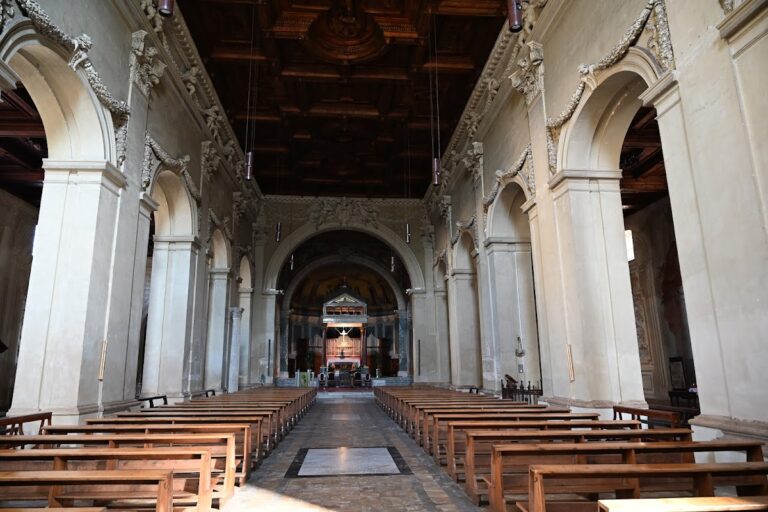
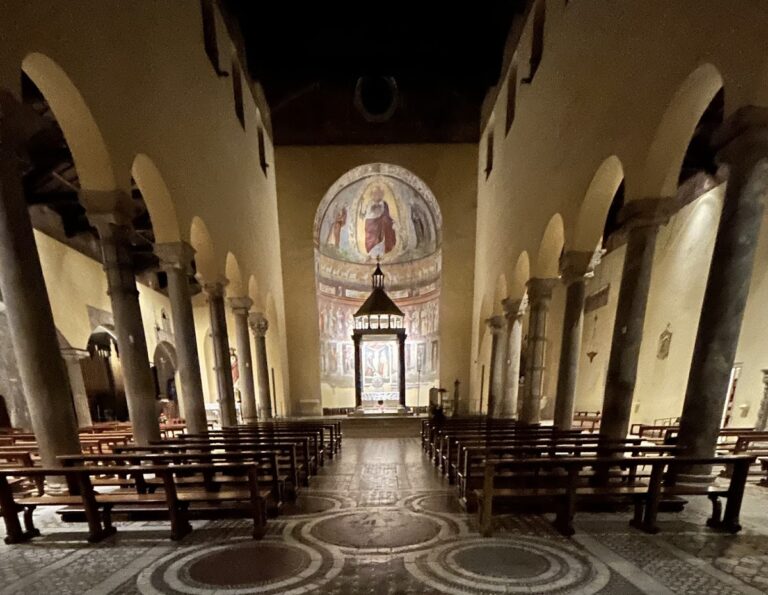
The upper church has a rectangular plan, a single nave, an apse, and a wooden ceiling. Its facade stands above the surrounding ground and is reached across a terrace by two flights of stairs. The semicircular presbytery contains an image of Christ accompanied by saints, while another painting shows Christ with Saints Cyrus and John.
The church rises over a pre-existing Roman mausoleum. Its architectural character remains visible on the exterior left side, where the surviving structure has features closely resembling those of the second-century Cenotaph of Annia Regilla.
Lower Religious Levels
Fifth-Century Oratory
The lower level contains the surviving remains of a fifth-century oratory built in brick. An exterior doorway, raised above ground level, leads into four interconnected rooms. An inscription at the entrance identifies the building’s earlier burial function: “Here rest the holy bodies of Cyrus and John, whom great Alexandria once gave to Rome.”
Underground Crypt
A small staircase descends from the oratory to a narrow, rectangular crypt. This underground chamber, associated with burial and worship, dates from the late second or early third century and originally held the relics of Cyrus and John. It was buried after 1706 and rediscovered in 1904. Light enters through an opening in the vault and through the stairway.
The crypt’s wall paintings have been damaged by repeated flooding from the nearby Tiber and by vandalism, making them difficult to see. Surviving funerary decoration includes glyphs and stars on the vault, the goddess Dike holding a balance, a bird, and a boxer on the north wall, and a sheep with traces of colored pigment on the south wall. Dike was the ancient Greek personification of justice and was commonly shown with scales. A Madonna and Child painted in the crypt toward the end of the thirteenth century was removed and stolen in 1968.