San Pancrazio: A Roman Basilica and Titular Church in Rome


Site at a Glance
- Rating
- 4.6
- Popularity
- Low
- Country
- Italy
- Primary era
- Medieval
- External website
- Open
- Eras represented
- Medieval, Early Modern, Modern
- Civilizations
- Byzantine, Papal States
- Site type
- Religious
- Remains
- Basilica
On this page8 sections
History
San Pancrazio is a Roman Catholic basilica in Rome, Italy, founded around AD 500 by Pope Symmachus on the burial place of Saint Pancras, a young Christian martyr traditionally associated with an early-fourth-century execution in Rome. The church became a place of pilgrimage and later served as a parish, conventual, titular, and stational church within Rome’s ecclesiastical life.
Foundation and early development
The church was initially placed under the care of the clergy of S. Crisogono. Because of their neglect, Pope Gregory I transferred its care to Benedictine monks after Lombard forces sacked the monastery of Montecassino in 580. During the seventh century, Pope Honorius I built a larger church for the growing number of pilgrims and placed Saint Pancras’s relics beneath the high altar.
San Pancrazio was rebuilt or altered several times. Important interventions took place during the pontificate of Honorius I, in the thirteenth century, and during the pontificate of Pope Sixtus IV. These successive phases shaped a church whose foundation belonged to late antiquity but whose fabric continued to change throughout the medieval and Renaissance periods.
Titular church and Carmelite administration
On 6 July 1517, Pope Leo X established San Pancrazio as a cardinal-priest titular church under the title Titulus Sancti Pancratii. A titular church is assigned to a cardinal-priest as his symbolic ecclesiastical title. Its titular cardinals included Pope Paul IV, Pope Clement VIII, and the Polish cardinal and church reformer Stanislaus Hosius. Antonio Cañizares Llovera is the current cardinal-priest.
In the seventeenth century, the church was entrusted to the Discalced Carmelites, a reformed branch of the Carmelite order whose members traditionally followed a stricter contemplative rule. They completely remodeled the building. The adjacent convent may have existed from an early period and has been occupied by the Discalced Carmelites since 1662.
Damage, rebuilding, and later religious life
The church underwent further rebuilding in the nineteenth century. It was heavily damaged during the French attack on the emerging Roman Republic in 1849, and forces associated with Napoleon Bonaparte and Giuseppe Garibaldi also plundered it. Most of Saint Pancras’s relics were destroyed during the nineteenth-century plundering. The saint’s head survived, was kept at the Lateran, and was later returned to San Pancrazio.
San Pancrazio became a parish church in 1931. Since 1997, it has been cared for by Polish Discalced Carmelites, who organized commemorations of the 1,700th anniversary of Saint Pancras’s martyrdom. The basilica stands in Rome’s Gianicolense district on the Janiculum, west of Porta San Pancrazio, and is associated with the Catacomb of San Pancrazio. It is recognized as an Italian national monument. Its liturgical feast is celebrated on 12 May, when Saint Pancras’s head relic is transferred to the high altar.
Remains
Basilica exterior and plan
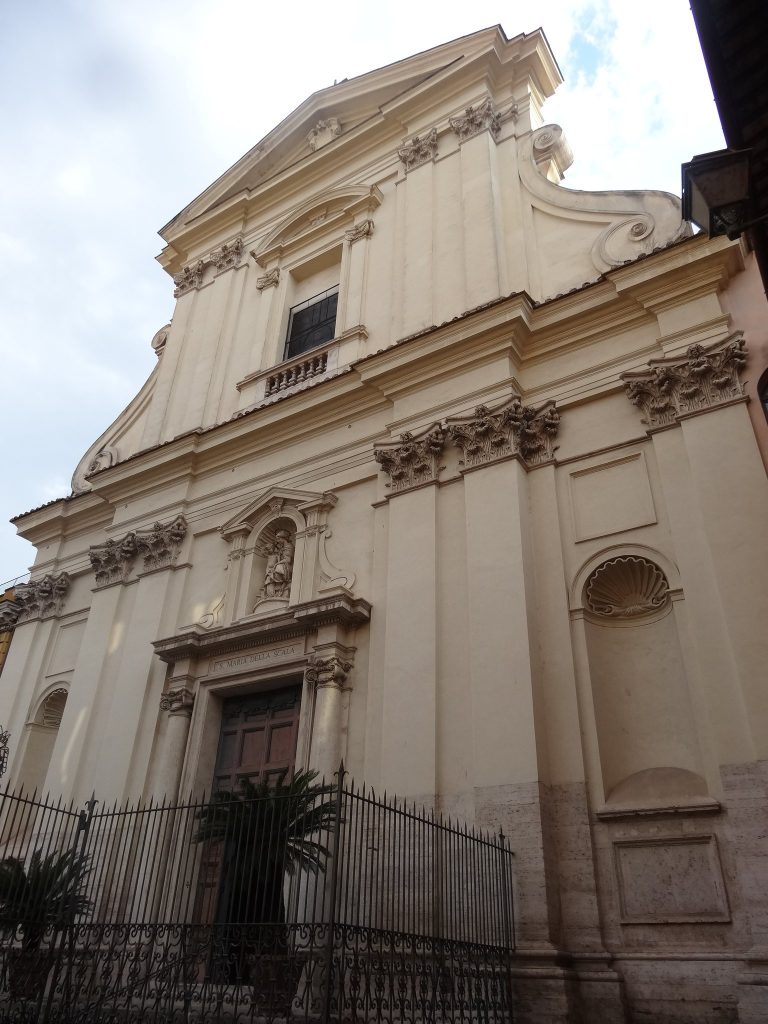
San Pancrazio follows a traditional basilican plan with a central nave, side aisles, and an apse. Its simple facade is dark pink, with white marble surrounds around the doors and windows. The brick facade dates from the late fifteenth century and retains the coat of arms of Pope Innocent VIII. Seventh-century Ionic columns stand beside the entrance.
Interior decoration and altar
The carved ceiling carries a relief of Saint Pancras at its center, together with the coat of arms of Pope Paul V, the arms of the Torres family, and heads of putti, or childlike decorative figures. The apse conch contains a 1959 fresco by Luigi Ciotti depicting Christ in Majesty with Saint Pancras and other saints.
The baldachin over the high altar was erected in 1959 from earlier materials. A baldachin is a canopy placed above an altar. Four porphyry columns support it, each with a gilded capital and a gray-marble base. Porphyry is a hard, highly valued stone often used for prestigious architectural and liturgical elements. The original group of four older columns was looted by the French in 1798 and recovered after papal government was restored in 1815; probably only the rear pair is original.
Beneath the altar, a porphyry sarcophagus once held Saint Pancras’s relics. Its legs are shaped as lions’ paws, while gilded-bronze decoration, palm branches symbolizing the saint’s martyrdom, and a Chi-Rho mark its Christian meaning. The Chi-Rho is an early Christian monogram formed from the first two Greek letters of “Christ.” The surviving head relic is kept in a sixteenth-century reliquary in the right side aisle, with a relief above it showing the saint’s beheading.
Catacomb and museum
Large ancient catacombs extend beneath the church. Known as the Catacomb of San Pancrazio or the Catacomb of Ottavilla, they form an archaeological component of the basilica’s setting. Their entrance is beside the small Museo di San Pancrazio, which contains fragments of sculpture and pagan and early Christian inscriptions.