Santa Maria della Misericordia: A Late Gothic Catholic Church in Ascona, Switzerland


Site at a Glance
- Rating
- 4.5
- Popularity
- Very Low
- Country
- Switzerland
- Primary era
- Medieval
- External website
- Open
- Eras represented
- Medieval, Early Modern
- Civilizations
- Duchy of Milan
- Site type
- Religious
- Remains
- Church
On this page12 sections
History
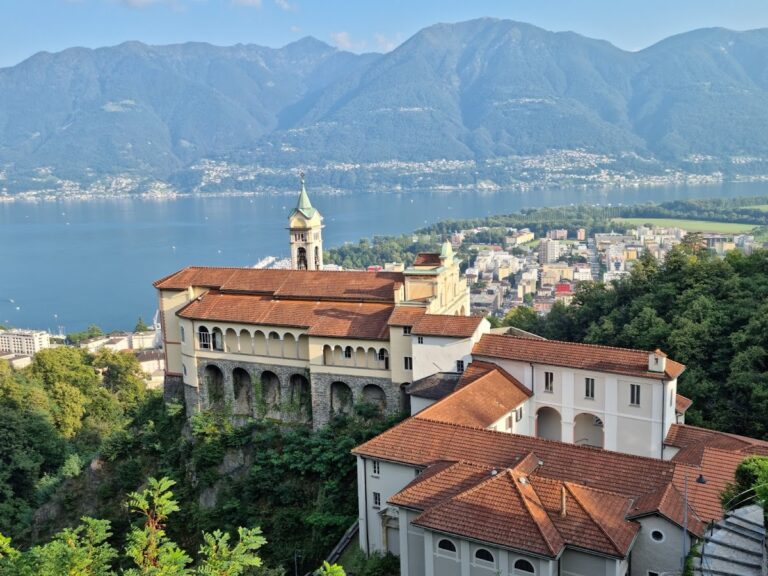
Santa Maria della Misericordia is a Late Gothic Catholic church in Ascona, Switzerland, near Lake Maggiore. Dedicated to the Madonna of Mercy, a Christian image of the Virgin sheltering worshippers beneath her mantle, it reflects the growth of Marian devotion south of the Alps. Its foundation stone was laid on 15 November 1399, the building was completed in 1422, and it was consecrated on 23 October 1442.
Foundation and Dominican administration
In 1510, a notarial document confirmed the municipality of Ascona’s responsibility for the church. On 28 October of that year, the municipality entrusted its spiritual administration to two Sicilian Dominican friars, Fra Nicola and Fra Paolo. The Dominicans, a Catholic order founded for communal religious life, preaching, and theological study, undertook to build a small monastery south of the choir.
An inspection by the bishop of Vercelli led to requirements for improvements, including the removal of the side altars. After Bartolomeo Papio of Ascona left a bequest after 1584, the municipality transferred the church to Cardinal Carlo Borromeo, Papio’s executor. Borromeo, a reforming archbishop of Milan who became an important figure in the Catholic Reformation, dismissed the Dominicans.
The church, college, and seminary
The former Dominican convent was converted into a seminary by Borromeo’s will and on the orders of Pope Gregory XIII, whose papacy lasted from 1572 to 1585 and included major church reforms. The institution became the Collegio Papio, a Catholic college and former seminary named after Bartolomeo Papio. Built onto the church between 1585 and 1620, the college created a lasting institutional connection between the two buildings.
After the change, the complex was divided between the parish church, which came under the Diocese of Como, and the college and seminary, administered by the archbishops of Milan. A nephew of Cardinal Borromeo later restricted Como’s authority to two chapels. Following Carlo Borromeo’s canonization in 1610, a small chapel dedicated to him was added to the north wall of the nave.
Later administration and restoration
On 27 July 1821, papal authority placed the Diocese of Como in charge of the complex after the archbishops of Milan requested the abolition of their territorial exclave. The church was administered by the Salesians from 1894 and by the Assumptionists from 1910. From about 1918 to 1964, Benedictines from Einsiedeln promoted religious renewal there.
In 1911, the church and the Collegio Papio were declared cantonal heritage monuments. A major fire in 1960 severely damaged the college, cloister, and church roof. In 1965, Pope Paul VI gave both buildings to the Diocese of Lugano, the Roman Catholic diocese responsible for Ticino’s Italian-speaking canton. Repeated restoration campaigns followed, including work on the altarpiece in 1996 and on the high-altar retable in 2011.
Remains
Santa Maria della Misericordia is a single-nave Late Gothic building made of rubble stone and loose stone. The nave and choir are covered by gabled roofs. A tall bell tower, added in 1488 and later heightened, rises beside the church, while a portico added to the main facade belongs to the early-modern period. The Collegio Papio is attached to the church, and the complex is enclosed by high stone walls. A lime-tree avenue leads toward the church and its cloister.
Painted decoration
Choir frescoes
The choir preserves an extensive fifteenth-century fresco cycle, regarded as one of the most extensive Late Gothic mural cycles in Switzerland. Its left wall contains 66 panels illustrating stories from the Old Testament. The opposite wall has 36 panels showing the life and Passion of Christ, painted by a second workshop of itinerant artists.
On the rear choir wall, a Crucifixion is placed below the Madonna of Mercy, who is flanked by Saints Peter and Paul. The vault compartments show the Fathers of the Church, Christ surrounded by the tetramorph, and Saints Peter, Maternus of Milan, and Fabian. The tetramorph represents the four Gospel Evangelists through four associated living beings.
Nave and altar paintings
To the right of the triumphal arch is a Deposition dated 1466 and signed at its base by Cristoforo and Nicolao da Seregno, whose workshop was based in Lugano. The south wall carries saints within painted arcades: Anthony the Abbot, Roch, Anthony of Padua, an enthroned and blessing Madonna with Child, and Sebastian. These figures are attributed to Antonio da Tradate and dated 1506.
The high altar contains a polyptych painted by Giovanni Antonio de Lagaia in 1519. This multi-panel altarpiece has an upper register showing the Assumption of the Virgin surrounded by angels, with the Apostles below. Its lower register presents the Madonna of Mercy between Saints Dominic and Peter Martyr.
Church furnishings and adjoining college
Facade and bell tower
Above the entrance portal is a sixteenth-century fresco of the Madonna of Mercy. It has been attributed to the Maestro di San Rocco a Pallanza, described as a pupil of Leonardo da Vinci. The entrance portico belongs to a later early-modern alteration, while the bell tower represents the principal medieval addition to the church exterior.
Collegio Papio and cloister
Attached to the church, the Collegio Papio includes a Renaissance cloister considered one of the finest in Switzerland. The college was built onto the church between 1585 and 1620 as part of the complex’s transformation from a Dominican convent into a seminary.
Organ
The present organ was built in 1993 by the Swiss firm Mathis Orgelbau. It has 24 stops distributed across two manuals and a pedal, with mechanical action, meaning that the keys and stop controls operate through physical mechanisms. Its distinctive features include upright short-cup reed pipes called Tromboncini, positioned in front of the case, and a Fiffaro stop. The couplers are II/I, I/P, and II/P, and the stop controls include cancelers for Tromba 8′ on the Great, Fagotto 16′, Tromba 8′ on the pedal, and Organo Pleno.