Madonna del Sasso: A Marian Sanctuary and Pilgrimage Complex in Switzerland


Site at a Glance
- Rating
- 4.7
- Popularity
- Medium
- Country
- Switzerland
- Primary era
- Early Modern
- External website
- Open
- Eras represented
- Medieval, Early Modern, Modern
- Civilizations
- Duchy of Milan, Swiss
- Site type
- Religious
- Remains
- Sanctuary
On this page16 sections
History
Madonna del Sasso is a Roman Catholic Marian sanctuary and pilgrimage site in Switzerland, extending between Orselina and Muralto above Locarno. Its origins reach back to the late fifteenth century, when the Franciscan friar Bartolomeo Piatti of Ivrea settled as a hermit beside the rocky spur above the valley of the Ramogna stream. The sanctuary is administered by the Capuchin Friars Minor within the Diocese of Lugano.
The hermitage and foundation of the sanctuary
Piatti came from the Franciscan convent of San Francesco in Locarno and established himself at the foot of the rock. According to tradition, the Virgin Mary appeared to him there on 15 August 1480. The reported apparition led to the creation of a place of worship and helped establish devotion to the Virgin at the site.
From about 1485, Piatti built a church and an oratory. Rolando, bishop of Antarado, consecrated them in 1487. One became the Chapel of the Pietà, while the other formed the nucleus of the upper sanctuary. Both were placed under the authority of the Franciscan convent in Locarno, with Piatti responsible for the site until his death. He was later buried in the lower church of Santa Maria Annunciata, and his ascetic life remained closely associated with the sanctuary’s early devotional identity.
In 1497, the Masina del Monte family gave the Orselina rock to the Friars Minor. Pope Alexander VI confirmed the donation on 16 February 1498 and authorized the establishment of a sanctuary there. A notarial deed concerning land for the lower church preserves an early form of the site’s name, “Santa Maria del Saxo.”
Expansion in the sixteenth and seventeenth centuries
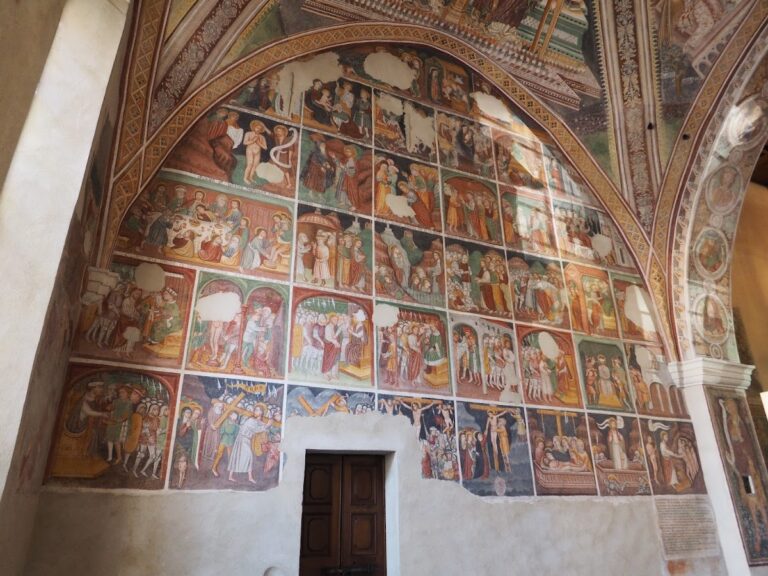
The lower church, Santa Maria Annunciata, was built between 1497 and 1499 and consecrated in 1502. On 10 January 1514, Pope Leo X exempted the mountain from servitudes and jurisdiction, strengthening the sanctuary’s institutional position. A major campaign of fresco decoration followed in 1522.
After a decline in devotion and resources at the end of the sixteenth century, the original upper Chapel of Santa Maria Avvocata was enlarged into a larger church dedicated to Santa Maria Assunta. Filippo Archinti, bishop of Como, consecrated the expanded church on 1 May 1616. It was enlarged again during the seventeenth century, and the Madonna del Sasso was ceremonially crowned in 1617. On 14 August 1880, Pope Leo XIII issued the decree for the pontifical coronation of the venerated Marian image. A minor basilica is a church granted an honorary title by the pope because of its religious or historical importance, and the upper church received that status in 1918.
The Sacro Monte took shape through a sequence of seventeenth-century works. A Sacro Monte is a Catholic devotional complex that joins churches, chapels, sculpture, and a pilgrimage route representing sacred events within a landscape. Access from the Pietà to the upper church was enlarged in 1617, and a tower or open portico with guest rooms followed in 1618. In 1619, a route with chapels dedicated to the Mysteries of the Rosary was established. Chapels for Calvary, Veronica, the Resurrection, and the Ascension were added in 1620, 1625, 1670, and 1677. The sanctuary’s origins and the 1616 consecration were also commemorated on a Latin marble plaque dated 10 July 1624.
Suppression, Capuchin administration, and modern restoration
During the late eighteenth and early nineteenth centuries, declining personnel and resources contributed to the deterioration of the buildings and a serious institutional crisis. On 25 July 1848, the canton of Ticino suppressed and secularized the convent, expelled the Franciscan friars from the canton, and assumed ownership of the sanctuary. The Capuchin father Alessandro da Giornico was appointed to safeguard it, and the Capuchins took over its religious and administrative management from 1852.
Between 1891 and 1912, the Capuchins carried out extensive alterations to the upper complex. The work was designed by Friar Angelo Osio of Pesaro and supported financially by the local population. The changes reshaped both the monastery and the architectural setting of the upper church.
The sanctuary continued to hold a public religious role in the twentieth century. During the 1925 Locarno peace conference, lamps on the façade formed the word “PAX.” In 1949, the Madonna del Sasso image was taken on a pilgrimage visit to all the parishes of Ticino. Restoration campaigns directed by the Swiss architect Luigi Snozzi took place from the 1970s into the 1980s, followed by major cantonally supported work during the 2000s and early 2010s. Restoration of Santa Maria Annunciata in 2010 revealed sixteenth-century frescoes. The sanctuary and its museum collection are classified as cultural property of national importance in Switzerland.
Remains
The complex occupies a rocky spur of the Orselina cliff above the Ramogna valley. Its buildings and devotional route extend through a marked change in height, from the Chapel of the Annunciation at 285 metres above sea level to the Chapel of the Resurrection at 404 metres. The sanctuary includes the monastery, the lower and upper churches, the Chapel of the Pietà, the chapels along the former access road, the Portico of the Cross, the Via Crucis, a staircase, cemetery cross, cemetery, processional forecourt, museum, library, and archives.
The lower sanctuary and its decoration
Santa Maria Annunciata
Santa Maria Annunciata stands at the foot of the rocky spur. Its nave was shortened by about half in 1814, creating a larger exterior space and the processional square. The church now presents a Neo-Gothic façade from 1885. Inside, a single nave is divided into two bays and covered by groin vaults, which are vaults formed where intersecting barrel vaults meet. A slightly raised choir is surmounted by a dome. The adjoining sacristy appears to be later than the church, although it is recorded by 1578.
Sixteenth-century frescoes
The frescoes painted in 1522 include a Madonna and Child on the north wall of the choir. This work is attributed to Domenico Pezzi of Puria, known as Furgnicus. On the south wall of the nave, Christ among the Doctors is attributed to Giovanni Battista and Giovanni Mauro della Rovere, known as the Fiammenghini. Their restoration and revelation in the 2010 campaign added important evidence of the lower church’s early decoration.
The upper church and monastery
Santa Maria Assunta
Santa Maria Assunta occupies the summit of the rock and developed from the fifteenth-century Chapel of Santa Maria Avvocata. It has three naves covered by groin vaults. In the mid-nineteenth century, the floor of the church and its forecourt was lowered by 70 centimetres.
Late nineteenth-century remodelling
The upper complex was substantially remodelled between 1891 and 1912. The monastery was enlarged and given a reconstructed Neo-Renaissance façade in 1892. Loggias and terraces were added on the east side in 1895, the bell tower was rebuilt, and the choir was enlarged. In 1903, a retaining wall completely covered the rocky spur supporting the church. A loggia on the north side, completed in 1912, provides direct access to the choir from the monastery.
Artworks and devotional objects
The upper church contains the venerated wooden Madonna del Sasso, a late-fifteenth-century work attributed to the sculptor Merzagora. The image is kept on the high altar, whose present form dates from 1792. A wooden Deposition group, also called the Lamentation, is approximately contemporary with the Madonna and is attributed to the workshop of the De Donati brothers. It has been restored.
A related Lamentation or burial scene consists of eight wooden statues and is probably by Martino Benzoni. It was originally made for the Chapel of the Holy Sepulchre in the Franciscan conventual church of San Francesco in Locarno, then transferred to a dedicated chapel at Madonna del Sasso. The south nave contains Bramantino’s altarpiece of the Flight into Egypt, painted in 1520. In the third chapel of the north nave, Antonio Ciseri’s altarpiece Christ Being Carried to the Tomb dates from 1870. Bernardino de Conti’s Annunciation for the Rusca altar was painted about 1502.
The pilgrimage route and chapels
Via Crucis
The route established along the hill ridge in 1619 developed into the present Via Crucis. A Via Crucis commemorates the Passion of Christ through a series of stations. Here, its fourteen stations are housed in small aedicules, or shrine-like structures for devotional images and scenes. The route passes through a tunnel incorporated into the retaining wall before reaching the monastery, museum, and upper church.
Seventeenth-century chapels
The devotional complex includes the chapels of the Lamentation over the Dead Christ, the Last Supper, the Holy Spirit, Calvary, Veronica, the Resurrection, and the Ascension. Terracotta sculpture forms part of the seventeenth-century scenes. Francesco Silva created the terracotta statues of the Last Supper and is also credited with groups representing the Nativity and Pentecost.
Other surviving features
Numerous votive offerings from different periods remain within the complex, while the museum displays many additional ex-votos. An ex-voto is an offering made in fulfillment of a vow or in thanksgiving for perceived divine assistance. A sundial is set into one of the exterior walls.
The organ was built in 1961 by Balbiani, Vegezzi and Bossi. It is divided between two cases and has 45 stops on three manuals and pedal, with electrically operated key and stop actions.