Castelli di Cannero: Fortified Islets in Lake Maggiore, Italy


Site at a Glance
- Rating
- 4.5
- Popularity
- Very Low
- Country
- Italy
- Primary era
- Early Modern
- Eras represented
- Early Modern
- Civilizations
- Duchy of Milan
- Site type
- Military
- Remains
- Fort
On this page8 sections
History
The Castelli di Cannero are three rocky islets in Lake Maggiore, Italy, offshore from Cannero Riviera and administered by Cannobio. Two islets hold the ruins of fortifications, while the Italian word castelli means “castles.” Their history extends from the medieval stronghold of Malpaga to the sixteenth-century Rocca Vitaliana, built by the Borromeo family to defend the northern shore of the lake.
Malpaga and the Mazzarditi
The earliest fortress, known as Castello della Malpaga or Malpaga, is traditionally dated to the eleventh or twelfth century. In the late fourteenth and early fifteenth centuries, the Mazzardi brothers, called the Mazzarditi, occupied Cannobio and invaded Cannero. They used Malpaga as a base for raids along the lake while attempting to establish a small private dominion. Their demands included privileges normally reserved for feudal lords.
In 1414, Duke Filippo Maria Visconti of Milan responded to appeals from lakeside inhabitants by sending an army of 500 men under Giovanni Lonati. After a brief siege, Malpaga was destroyed, and the Mazzarditi went into exile. The later Rocca Vitaliana was built over the earlier fortress’s ruins.
The Borromeo fortress
In 1441, the fief of Cannobio and the Cannero islands passed from the Visconti, a ruling dynasty of Milan, to the Borromeo family, a prominent Italian noble family. The fief subsequently passed through Vitaliano I Borromeo, his son Filippo, Giovanni III “the Just,” and Giovanni III’s sons Giberto, Camillo, Ludovico, and Francesco.
Between 1519 and 1521, Ludovico Borromeo constructed Rocca Vitaliana, a defensive fortress named for his ancestor Vitaliano Borromeo. Its purpose was to protect the northern shore of Lake Maggiore from incursions by Switzerland after the Duchy of Milan lost the canton of Ticino. In 1523 and 1524, Duke Francesco II Sforza of Milan, then in conflict with the Borromeo family, sent a naval squadron to besiege the two fortified islets on two occasions. Both attacks failed.
After Ludovico Borromeo’s death, Rocca Vitaliana was progressively neglected. Its position close to the shore was considered difficult to defend, and the fortress was abandoned during the eighteenth century before gradually falling into ruin. Later occupants and users included a priest, soldiers, fishermen, farmers who raised rabbits and cultivated citrus fruits, smugglers seeking refuge, and a reported gang of counterfeiters.
Memory, legends, and modern recovery
The Castelli di Cannero continued to attract historical and artistic attention. In 1815, Caroline, Princess of Wales, considered settling in the fortress but chose Isola Bella instead. William Turner depicted the islets in a watercolor in 1843. Giuseppe Garibaldi reportedly took refuge there in 1848 after the Battle of Luino, while returning to Piedmont following his defeat by Austrian forces.
During Queen Victoria’s visit to Lake Maggiore in 1879, she described the site as a “strange old castle in ruins,” while also noting the charm of its towers and deteriorated walls. Legends say that the Mazzarditi threw their treasure into the lake rather than surrender it to Filippo Maria Visconti, and that they were later thrown into the water with stones tied around their necks. A ghost ship is said to appear in the mist in search of the buried treasure. An alleged creature seen near the castle in the early 1930s also caused alarm around the lake.
In the twentieth century, a statue of the Virgin by Giannino Castiglioni was placed on the western islet. A restoration and recovery program initiated by Vitaliano XI Borromeo in 2011 led to the opening of the Castelli di Cannero to the public in 2025. The islets now form part of the Terre Borromeo group of cultural and historic sites, alongside Rocca di Angera, the Borromean Islands, Villa Pallavicino in Stresa, and Parco del Mottarone. A proposal to restore Rocca Vitaliana as a tourist attraction was rejected by local environmental organizations.
Remains
The site comprises three rocky islets in Lake Maggiore. The fortification ruins occupy two of them, while the western islet is the smallest. The surviving defensive complex is formed by Rocca Vitaliana, with deteriorated walls and towers built over the earlier Malpaga stronghold. Its position near the lakeshore shaped its defensive history and contributed to the difficulties of maintaining the fortress.
Fortifications and island features
Rocca Vitaliana
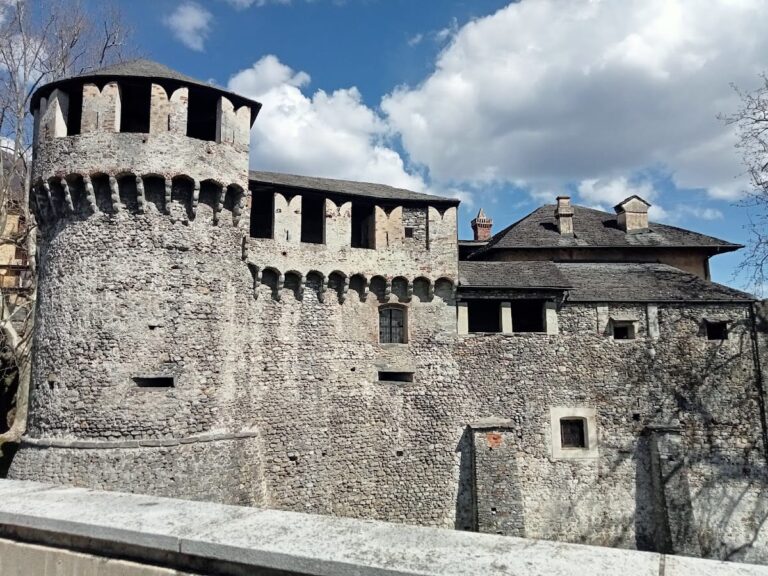
Rocca Vitaliana is a defensive fortress constructed between 1519 and 1521 by Ludovico Borromeo. The surviving remains consist of towers and deteriorated walls. The fortress was built over the ruins of Malpaga and occupies one of the two islets containing fortification remains. Recesses within the ruined walls provide nesting sites for aquatic birds, including mute swans, yellow-legged gulls, and goosanders.
Western islet
The western islet, the smallest of the three rocky islands, bears a twentieth-century statue of the Virgin sculpted by Giannino Castiglioni. Its presence forms a later religious feature within the island group, distinct from the medieval and early modern fortifications on the other islets.