Brøns Church: A Romanesque Lutheran Village Church in Denmark


Site at a Glance
- Rating
- 4.6
- Popularity
- Very Low
- Country
- Denmark
- Primary era
- Medieval
- Eras represented
- Medieval, Early Modern, Modern
- Civilizations
- Danish
- Site type
- Religious
- Remains
- Church
On this page12 sections
History
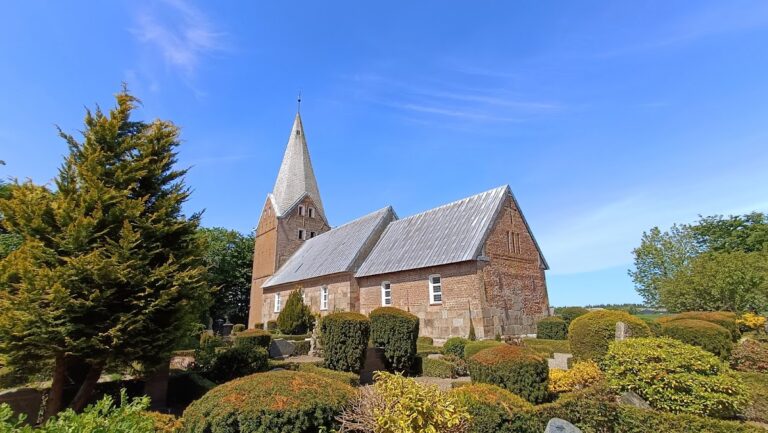
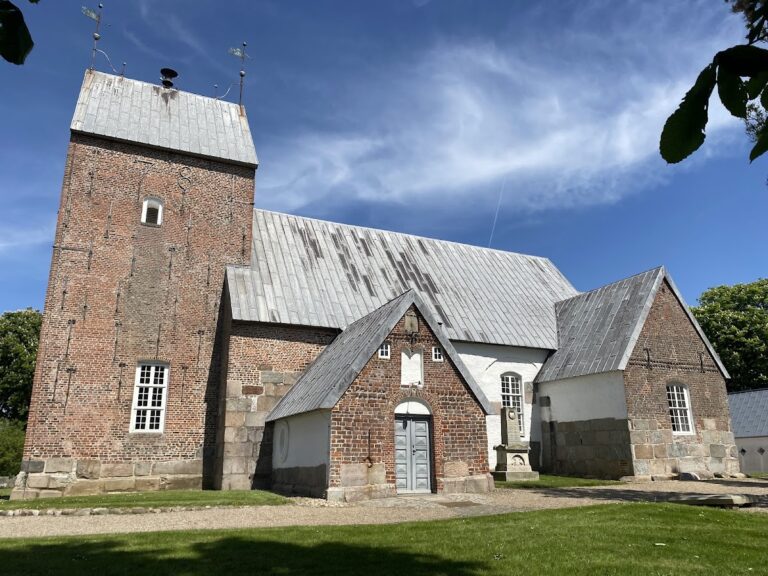
Brøns Church is a Lutheran church in Denmark, located in Brøns about 15 kilometres south of Ribe. Built around 1200 in the Romanesque style, a medieval form known for heavy masonry and rounded arches, it was originally dedicated to Saint Willehadus, an early medieval missionary and bishop associated with the Christianization of parts of northern Europe. The church belongs to the Diocese of Ribe and Brøns Parish and is regarded as one of Denmark’s largest Romanesque village churches.
Medieval foundation and later additions
The apse, choir, and nave formed the medieval core of the church. The apse and choir were built around 1200 from tuff, a relatively soft volcanic stone made from compacted ash. A Late Gothic tower of brick was added around 1500, extending the building’s architectural history into the later medieval period.
The church’s interior also preserves evidence of changing religious traditions. Its oldest wall paintings combine Catholic subjects with imagery associated with the Protestant Reformation, the sixteenth-century movement that challenged Catholic authority and reshaped Western Christianity. The organ dates from 1699 and has been renewed several times, most recently in 1936 and 1937.
Reconstruction and modern renewal
Extensive restoration and reconstruction between 1854 and 1857 produced much of the present building. The medieval north portal and the south portal added in 1733 were demolished during the work. The nave’s south wall was reclad in 1855, and a new masonry altar was built that same year.
August Wilckens restored or renewed the large interior wall paintings between 1900 and 1907. The two angels above the chancel arch, which separates the nave from the choir, and the decorations in the choir and apse were added in 1907. A stained-glass window made by Johan Thomas Skovgaard in 1927 commemorates Lydik Jacobsen, a miller and enterprising local figure. It was commissioned at the initiative of his wife, Nicoline.
Remains
Brøns Church is organized around a Romanesque apse, choir, and nave, with a Late Gothic brick tower at the west end. The oldest parts use tuff, while later elements include brick, sandstone, granite, lead, and painted plaster. The original roof structure survives beneath its lead covering, linking the present church to its medieval construction.
Romanesque church
Apse and choir
The apse, the curved end of the church, has a round-arched frieze and pilasters, shallow vertical strips attached to the wall, that divide its exterior into five fields. Three of these fields contain closed, round-arched windows framed by slender columns. The choir retains numerous architectural details from the medieval building.
Nave and roof
Many architectural details remain on the nave, particularly on its north wall. Its south wall was reclad in 1855. The roof structure is original and has a lead covering. Above the choir stands a roof turret dated 1651, incorporating older beams that originally supported the Romanesque roof turret. Its lower, hexagonal section was formerly a lantern and was closed in 1739. The present weather vane dates from 1846 and replaced an earlier vane from 1651.
Late Gothic tower
The brick tower was built around 1500. Its tall square shaft is crowned by a four-sided spire with triangular gables and a weather vane dated 1631. The entrance portal has a sandstone round arch with columns and dates from 1854. Wall anchors on the tower bear the dates 1810 and 1816. Three bells are housed inside, including a Gothic bell from around 1350.
Painted and sculptural interior
Wall paintings
Large frescoes, wall paintings applied to plaster, dominate the interior. Their subjects include Saint Christopher carrying the infant Jesus, Christ in the winepress, and Saint George fighting the dragon. A broad frieze presents scenes from the Passion of Jesus.
Two large frescoes above the Passion frieze express an explicitly anti-Catholic message. One, based on an engraving by Sebald Beham, shows the pope on horseback with his entourage attempting to enter the Heavenly Jerusalem. In the other, Christ refuses the pope entry before its gates. Another mural depicts an empty papal bull, a formal document issued by a pope.
Chancel arch and furnishings
The large chancel arch contains a Crucifixion group from around 1500, a sculptural representation of Christ on the cross with associated figures. The Renaissance altarpiece dates from 1631 and stands on the masonry altar built in 1855. Its original paintings depict Communion, baptism, the Crucifixion, and the Resurrection.
Sculptures from earlier altarpieces are also preserved through different parts of the church and in the National Museum. A statue of the Virgin Mary from the oldest altarpiece, dated 1275, is held there, as is the original base of the Gothic monstrance cabinet from around 1300. A bishop statue comes from an altarpiece dating from around 1400, while the twelve apostles on the organ gallery come from a Late Gothic altarpiece made around 1500.
Liturgical and congregational furnishings
The choir contains the Gothic monstrance cabinet from around 1300, a secure architectural cupboard once used to store a monstrance, the vessel used in Catholic worship to display the consecrated host. The Romanesque granite baptismal font is decorated with friezes and five male heads, with additional heads at the corners of its square base. Its cover dates from 1651 and was restored in 1857.
The pulpit and sounding board are Renaissance works from 1605. The pews date from 1855, while their ends and doors date from 1730. Several former seigneurial pews, reserved seats associated with local lords or prominent patrons, were removed during the restoration of 1855 to 1857. One remains behind the altar.