Santa Maria d’Àneu: Romanesque Sanctuary and Former Monastery
Site at a Glance
- Rating
- 4
- Popularity
- Very Low
- Country
- Spain
- Primary era
- Medieval
- External website
- Open
- Eras represented
- Medieval, Modern
- Civilizations
- Unclassified
- Site type
- Religious
- Remains
- Monastery
On this page8 sections
History
Santa Maria d’Àneu is a Romanesque church and former monastery in Escalarre, Spain, whose origins are believed to lie in a Visigothic monastery dedicated to Saint Deodata. The church was constructed during the first half of the eleventh century, and the foundation is documented by 839 in the record of the consecration of the Cathedral of Santa Maria d’Urgell. Until the end of the tenth century, the institution was dedicated to Saint Peter.
Early medieval foundation
The Visigoths, a Germanic people whose kingdom ruled much of the Iberian Peninsula before the Muslim conquest, are associated with the monastery’s earliest phase. In 1064, the count of Pallars transferred the monastery, together with Saint Peter of Burgal and Saint Peter of Les Maleses, to the count of Pallars Jussà. The exchange included the Abbey of Lavaix and other possessions. Between 1087 and 1088, Santa Maria d’Àneu returned to the Diocese of Urgell after the count’s father had usurped the church of Urgell.
Benedictine monastery and Augustinian canonry
A Benedictine monastery was established at the site in the eleventh century. Benedictines follow the Rule of Saint Benedict, a monastic tradition governing religious life. In 1216, Santa Maria d’Àneu became a canonry of the Augustinian order. Augustinian canons were religious clerics organized in a canonry and following the Rule of Saint Augustine.
Decline and regional pilgrimage
The institution gradually declined. By 1723, it had only a prior, a subprior, and a lay brother, and it later ceased to function as a convent. It became part of the deanery of Àneu, an administrative subdivision of a diocese generally comprising neighboring churches or parishes, and developed into a regional pilgrimage center.
During the Spanish Civil War in 1936, the thirteenth-century wooden statue of the Virgin and Child was burned and replaced with a reproduction. Santa Maria d’Àneu now functions as a sanctuary dedicated to the Mother of God of Àneu, regarded as the patron of the Àneu Valleys. Her celebration takes place on 1 May. The monastery belongs to the Diocese of Urgell and the Catholic Church, and it has been protected as a Cultural Asset of National Interest in Catalonia since 15 March 1962.
Preservation of the murals
The church murals were removed from its walls in 1921 during a preservation campaign. They were exhibited from 1924 at the Museu Nacional d’Art de Catalunya in Barcelona. The building underwent restoration between February and September 2014.
Remains
Romanesque church
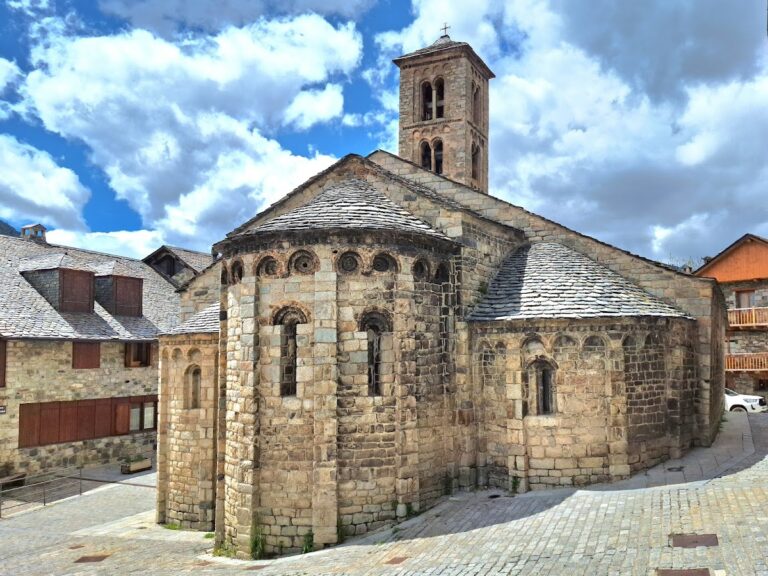
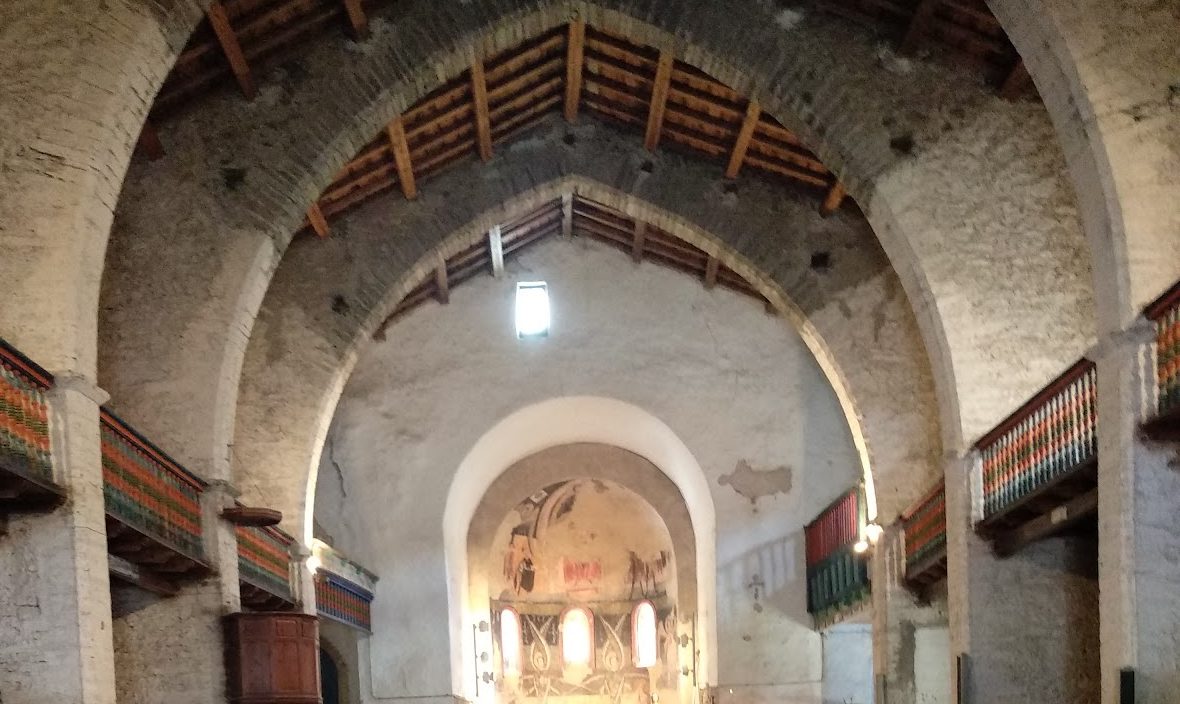
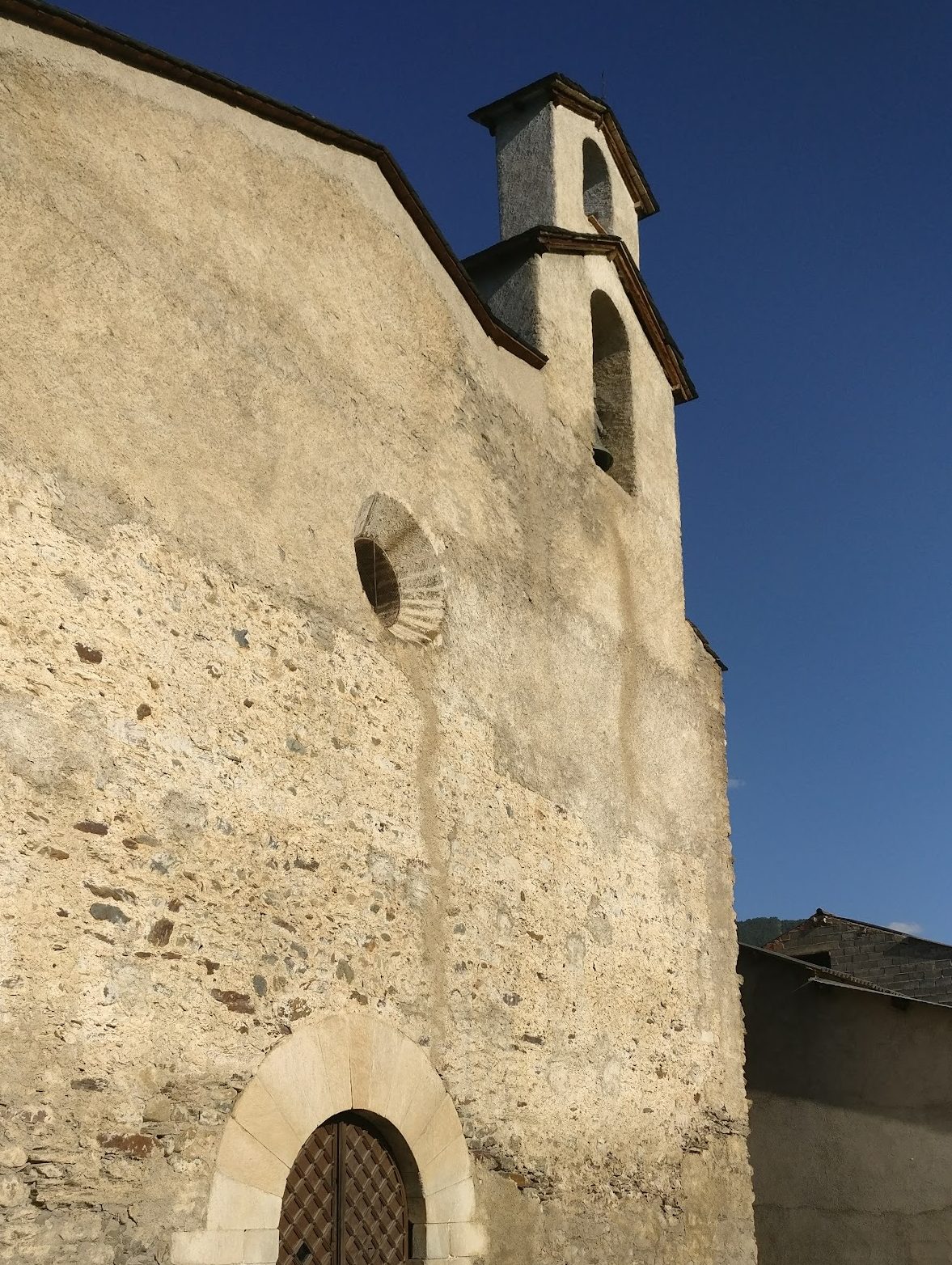
The church follows a three-nave plan. A nave is one of the principal lengthwise spaces of a church. The plan also includes a central apse, a rounded termination at the eastern end, and two lateral apses with cross vaults. The central apse is the only one preserved. Its exterior is articulated with Lombard-style arcades and lesenes, which are shallow vertical strips used to structure the wall surface. A small bell tower with a bell gable survives, while the facade was completely rebuilt in the twentieth century.
Presbytery and apse murals
The murals originally covered the presbytery, the area around the high altar, and the apse. They were made after 1088. The central scene is badly deteriorated and represented the Epiphany, the Christian feast commemorating the manifestation of Christ through the visit and adoration of the Magi. The vault shows Mary in Majesty with the Magi.
The lower zone preserves a well-preserved group of polychrome seraphim. Their wings are covered with eyes, symbolizing vigilance, and they are surrounded by the letters of the Sanctus, the liturgical acclamation beginning “Holy, holy, holy,” repeated three times. The same area includes representations of the visions of Isaiah and Ezekiel. The paintings are attributed to the Master of Pedret, the conventional name for an unidentified Romanesque painter or workshop associated with mural painting in the Catalan and Pyrenean regions, although they may be later works. Their style shows Lombard influence in the treatment of faces and also draws on painting from southern Italy and Latium. The Bibles of Ripoll and Rodes are regarded as probable sources for the depictions of Isaiah’s and Ezekiel’s visions.