Santa Maria de Taüll: A Romanesque Parish Church in Catalonia


Site at a Glance
- Rating
- 4.7
- Popularity
- Low
- Country
- Spain
- Primary era
- Medieval
- External website
- Open
- Eras represented
- Medieval
- Civilizations
- Crown of Aragon
- Site type
- Religious
- Remains
- Church
On this page14 sections
History
Santa Maria de Taüll is a Roman Catholic parish church in Spain, in the historic centre of Taüll in Catalonia’s Vall de Boí. Largely built in the twelfth century in the Romanesque period, it belongs to the group of Romanesque churches in the valley and helped consolidate the settlement around it.
From the Eleventh-Century Church to the Romanesque Building
The church occupies the site of an eleventh-century predecessor, probably promoted by the lords of Erill. Only the lower part of that earlier bell tower survives, incorporated into the later structure. A new building phase began during the second decade of the twelfth century, when Santa Maria and Sant Climent de Taüll were erected at roughly the same time.
Santa Maria was consecrated on 11 December 1123 by Raymond of Roda, bishop of Barbastro-Roda. The consecration document is the first surviving written record of the church. Santa Maria and Sant Climent shared parish functions during earlier centuries. The involvement of the local lords in feudal conflicts and campaigns against the Taifa of Zaragoza, a Muslim-ruled state centred on Zaragoza, probably influenced the forms of the valley churches and contributed to reducing the number of entrances into the settlement.
Parish Use and Eighteenth-Century Alterations
During the eighteenth century, Santa Maria became Taüll’s only parish church, while Sant Climent was used as a chapel for the modern cemetery. The building itself was substantially altered. The southern side apse was replaced by a sacristy, the aisles were converted into chapels, and a lantern tower was added above the eastern part of the nave.
Restoration during the 1970s recreated the twelfth-century arrangement. Santa Maria was declared a nationally important cultural property in 1931. In 2000, it was included with eight other Romanesque churches of the Vall de Boí in the UNESCO World Heritage Site known as the Catalan Romanesque Churches of the Vall de Boí.
The Murals and Their Conservation
The Romanesque murals were removed in stages. Between 1919 and 1923, part of the decoration was detached and transferred to the Museu Nacional d’Art de Catalunya in Barcelona. Further paintings were removed in 1960 and 1971. Copies replaced the originals, and additional copies were installed on the southern side of the nave in 2013. The original murals from Santa Maria are displayed at the Museu Nacional d’Art de Catalunya, while a replica now covers the vault and semicircular wall of the principal apse at Taüll.
The first transfer formed part of a wider campaign by the Barcelona Museums Board to protect Romanesque murals threatened with sale. Joaquim Folch i Torres directed the operation with the support of the Board and Josep Puig i Cadafalch, while Emili Gandia supervised the removal work at Santa Maria de Taüll. The transferred paintings were first displayed at the Museum of the Citadel in 1924 and moved to the Palau Nacional, the present museum site, in 1934.
The paintings in the principal apse are attributed to a single unidentified medieval painter conventionally called the Master of Taüll, formerly also known as the Master of Maderuelo. The painter’s origin remains uncertain. Some interpretations place the artist in Italy, while features considered distinctly Hispanic have supported the possibility of a local origin. The nave and perimeter-wall murals were made by a different workshop, generally called the Master of the Last Judgment. They were painted after the 1123 consecration and were probably completed around the middle of the twelfth century. Stylistic traces of this workshop also appear in other nearby churches.
Remains
Plan and Exterior
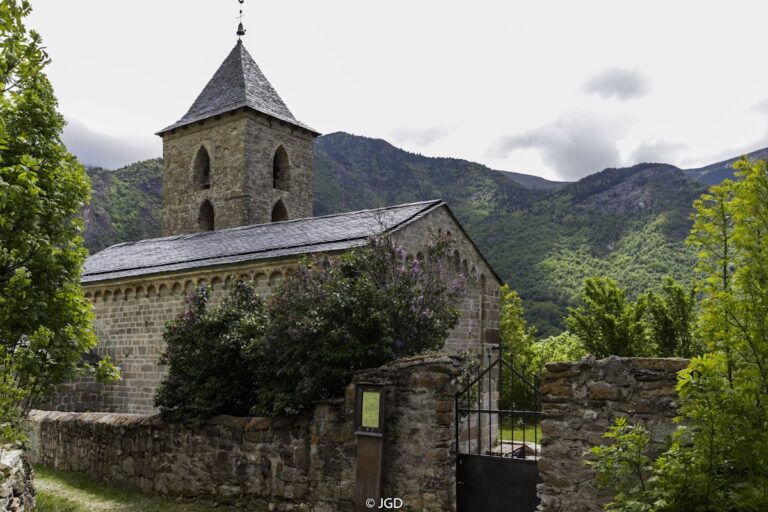
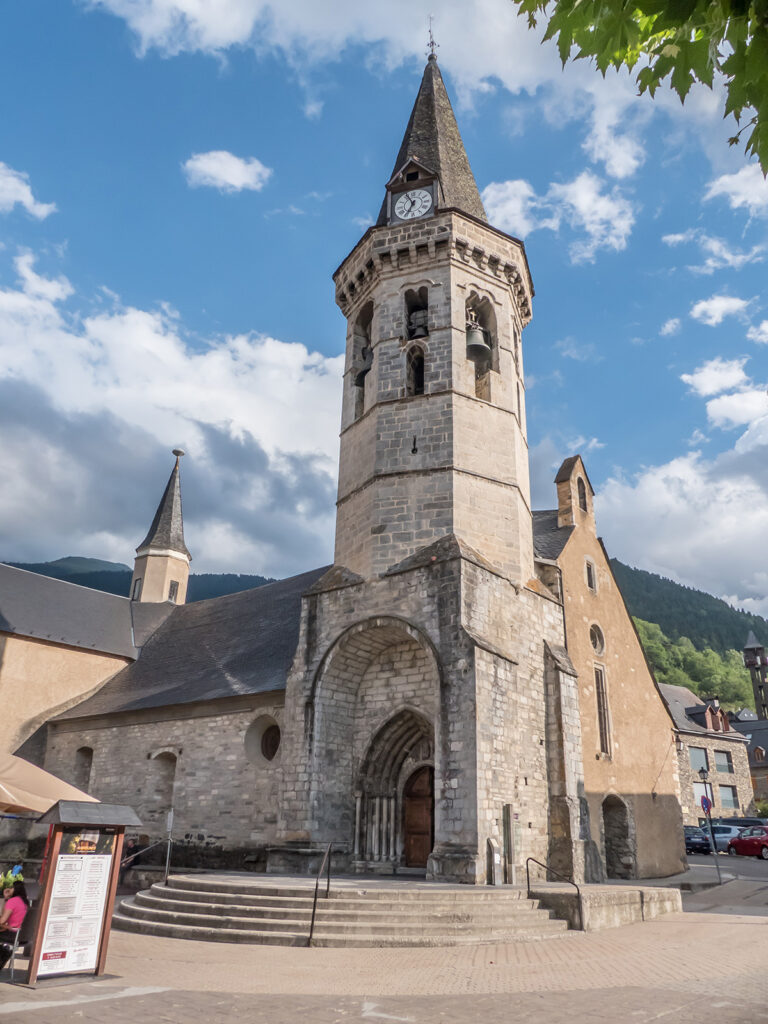
Santa Maria has a basilical plan with three naves ending in three semicircular apses. The lateral apses are smaller than the central one. Its Romanesque exterior combines carefully laid stonework with Lombard-style decoration, including narrow vertical bands and blind arcades. The church has two plain round-arched portals, with the principal entrance in the west facade and a side entrance in the southern nave. The west, north, and south facades otherwise have little ornament.
Broad round arches divide the nave and rest on massive columns. The central and lateral naves retain an open timber roof structure, while the apses are covered by semi-domes. Narrow round-arched windows in the apses and another window above the west portal provide the documented sources of light within the building.
Bell Tower
The bell tower is integrated into the church at the western end of the nave rather than standing separately. Its irregular lower masonry preserves the appearance of the eleventh-century predecessor, while its upper structure belongs to the later Romanesque building. The tower rises through five levels above a high, solid base and ends in a pyramidal roof.
The four upper levels are built from regularly coursed, carefully cut stone blocks. Blind arcades, Lombard bands, and occasional sawtooth friezes divide the elevations. All four sides contain windows. The upper three levels have paired openings, while the level below has a single round-arched window. Columns separate the openings, with their capitals set perpendicular to the tower walls. The tower base has one window and five blind arches, and the decoration of the three highest levels continues the motif used on the apses. Sparse traces of the original painting survive on the upper levels.
Apses and Mural Decoration
Central Apse
The exterior of the apses has blind arcades and Lombard bands. Near the top of the central apse are small round windows, with three narrow openings between the bands. These openings resemble arrow slits and are framed by carved arch surrounds. The apse vault contains an Adoration of the Magi. Mary sits on a gem-decorated throne within a concentric oval halo, or mandorla, holding the Christ Child. She wears a broad blue tunic and a short veil beneath a yellow halo. The Child wears richly decorated clothing, bears a cross-shaped halo, holds a scroll identified with the New Law, and raises his other hand in blessing.
Melchior approaches from the left, while Caspar and Balthasar approach from the right with their offerings. The three figures represent old age, youth, and maturity. Their names appear beside them, and two stars are placed above the scene. The stars symbolize Mary’s mediation and the transition from the Old Law to the New Law.
A meander border separates the vault from the lower decoration. Six Apostles stand beneath arcades on either side of the axial window. Andrew, Peter, Paul, and John can be identified by inscriptions. The barefoot figures wear tunics and halos and hold their attributes with hands covered by their mantles. Beneath them is a broad band of circular medallions containing real and fantastic animals, including an eagle with spread wings, a walking bird, a feline, a feline-bodied creature with a fish’s tail, and a walking deer. The lowest partly preserved register imitates curtains decorated with semicircles and palmettes, while geometric and floral ornament appears on the outer curve of the apse.
Arches Before the Apse
The first arch before the apse shows the Agnus Dei, the symbolic Lamb of God, inside a circle. The Lamb wears a cross-shaped halo and holds a cross with its forelegs. It receives the offerings of Cain and Abel. Abel’s offering is better preserved and is blessed by the right hand of God emerging from clouds. Only pigment traces remain of the Apostles, animal medallions, and curtain decoration that continued along the lower part of the arch.
The larger apsidal arch may originally have shown Christ in Majesty within a mandorla. Fragments remain of the angels who supported the image. The surrounding area contained the symbols of the Evangelists with archangels, cherubim, and seraphim. Luke and John, the seraph, and the Archangel Gabriel remain identifiable on the right. The corresponding left side probably showed Mark, a cherub, Matthew, and Michael.
An inscription identifies Gabriel, who wears the loros, a richly decorated ceremonial garment associated with high Byzantine dignitaries. The symbols of the Evangelists appear in human form. Further Apostles, animal medallions, including a walking deer, and curtain motifs occupy the area below them, much of which is badly faded.
Side Apses
The side apses retain more limited decoration. In the Gospel-side apse, fragments survive around a window and in the apse vault. On the wall separating the central apse from the Epistle-side apse, part of a capital and fragments of two figures remain.
The outer face of the southern side-apse arch shows two peacocks drinking from the fountain of grace. The inner surface of the arch contains the right hand of God within a circle, supported by two angels and flanked by prophets. Each side apse has a narrow stepped window, and a sawtooth frieze runs beneath the roofline.
Southern Nave Wall
The southern nave wall, extending from the apse toward the bell tower, was divided into three registers. The upper register includes four episodes, among them a boat guided by an angel, a figure confronting a four-legged animal, and a figure sharing a cloak with a poor man, possibly an episode from the life of Saint Martin. The first three scenes have also been interpreted, with uncertainty, as episodes from the legend of Saint Clement.
The central register presents Herod, the three Magi, Mary with the Child, the naming of John involving Zechariah and an acolyte, and Zechariah’s vision before the altar of incense. A door separates the final scene. Its spandrels contain serpent-like forms, while a cross flanked by fish inside the doorway creates a Eucharistic allegory. The lower register imitates curtains.
Between the bell tower and the west end, fragments depict an inferno. Naked figures are tormented by grotesque human-like demons whose mouths are set in their bellies and whose limbs turn into snakes. A large central devil catches condemned souls with tentacles. The lower band preserves the head of an old man. Simple scene borders and flat red, yellow, and black bands frame the decoration.
Near the west end of the southern nave are two scenes of David and Goliath. David, wearing a short tunic and helmet, grasps Goliath by the hair and cuts his throat. The giant’s body is inclined, with disproportionately large limbs. Above them, a wolf stalks a gazelle, while two angels formerly occupied the lower area. A zigzag border in red, yellow, blue, and green separates the scenes.
West Wall and Last Judgment
The interior west wall contains a Last Judgment between the columns. The surviving composition has two registers set against bands of colour. Six figures appear in the upper register, some winged and holding books; one carries a large cross on his back. The central image of Christ as Judge belonged to the lost part of the painting.
In the lower register, Saint Michael weighs the moral actions of a naked figure representing a deceased soul. Another figure assists him while holding an open book. Beside this scene is a small hell containing four naked souls suffering in fire. Beneath the Last Judgment, in the inner tympanum, a male figure holds two cups. He may represent John, the author of the Apocalypse, or an Eucharistic image symbolizing good and evil actions. A consecration cross found beneath the scene of Herod confirms that the nave and west-wall paintings were made after the 1123 consecration. The murals at Taüll are the only surviving Catalan example of a Last Judgment theme that commonly formed part of the full Romanesque church program.
Associated Works
Works associated with Santa Maria include an antependium and a sculptural group representing the Descent from the Cross. Both are identified in connection with the Museu Nacional d’Art de Catalunya, where the original mural paintings from the church are also displayed.
Nearby sites