Santa Giustina, Venice: A Former Church and Convent
Site at a Glance
- Popularity
- Medium
- Country
- Italy
- Primary era
- Early Modern
- Eras represented
- Medieval, Early Modern, Modern
- Civilizations
- Austrian Empire, Habsburg, Venetian
- Site type
- Religious
- Remains
- Church
On this page10 sections
History
Santa Giustina is a former Christian church in Venice, Italy, traditionally founded in the seventh century. Its surviving Baroque façade was refashioned in 1640.
Origins and medieval church
Tradition says that St Magnus of Oderzo founded the church after Santa Giustina, a Christian martyr associated with Padua, appeared to him in a dream. The date of the earliest building is uncertain, but Santa Giustina was probably a parish by the eleventh century.
By 1219, the church was a collegiate church, served by a community of clergy, and depended on the Basilica of San Pietro di Castello. It was consecrated that year and served by regular canons, clergy who lived under a religious rule, though their order is unknown. For a short time, canons of the Savior of Saint Bridget served there.
Augustinian convent and Baroque façade
In 1448, an apostolic bull transferred the church to Augustinian nuns from the monastery of Santa Maria degli Angeli on Murano. The nuns were required to maintain two priests and rebuilt the church in the second half of the fifteenth century. Santa Giustina was among a group of convents built around Venice’s outskirts as part of a defensive belt.
In 1640, the Venetian Baroque architect Baldassare Longhena refashioned the façade at the expense of the Soranzo family. Giovanni Soranzo, a senior Venetian official known as a procurator of St Mark, commissioned the work to glorify his family.
The church also had a place in Venetian public observance. Each year on 7 October, the feast day of Santa Giustina and the anniversary of the Battle of Lepanto, a major naval battle fought in 1571, the Doge visited. The Doge was the elected head of the Venetian Republic. Coins showing the saint were repeatedly minted for the occasion and later became known as “Giustina” coins.
Suppression and later uses
In 1807, the parish was suppressed and joined to Santa Ternita. The religious order was suppressed in 1810, when the church was deconsecrated and closed. In 1844, the building became a military school; it was divided into three floors, and its pediment was demolished. From 1924, it housed the Giovanni Battista Benedetti Scientific High School.
Remains
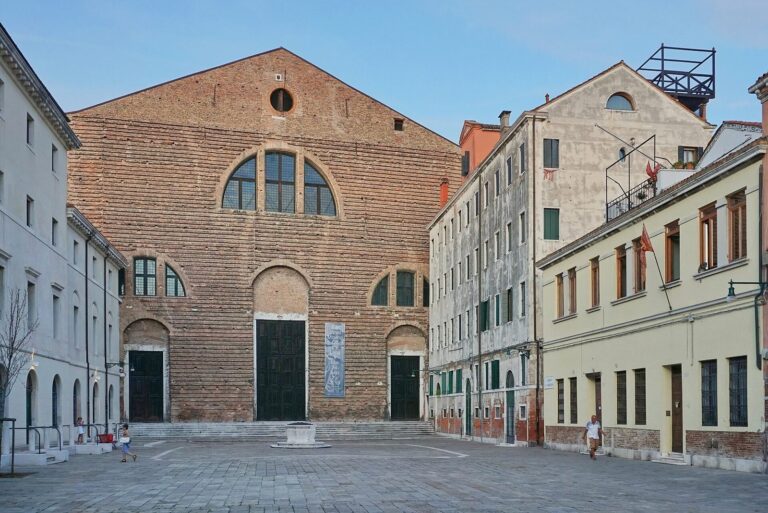
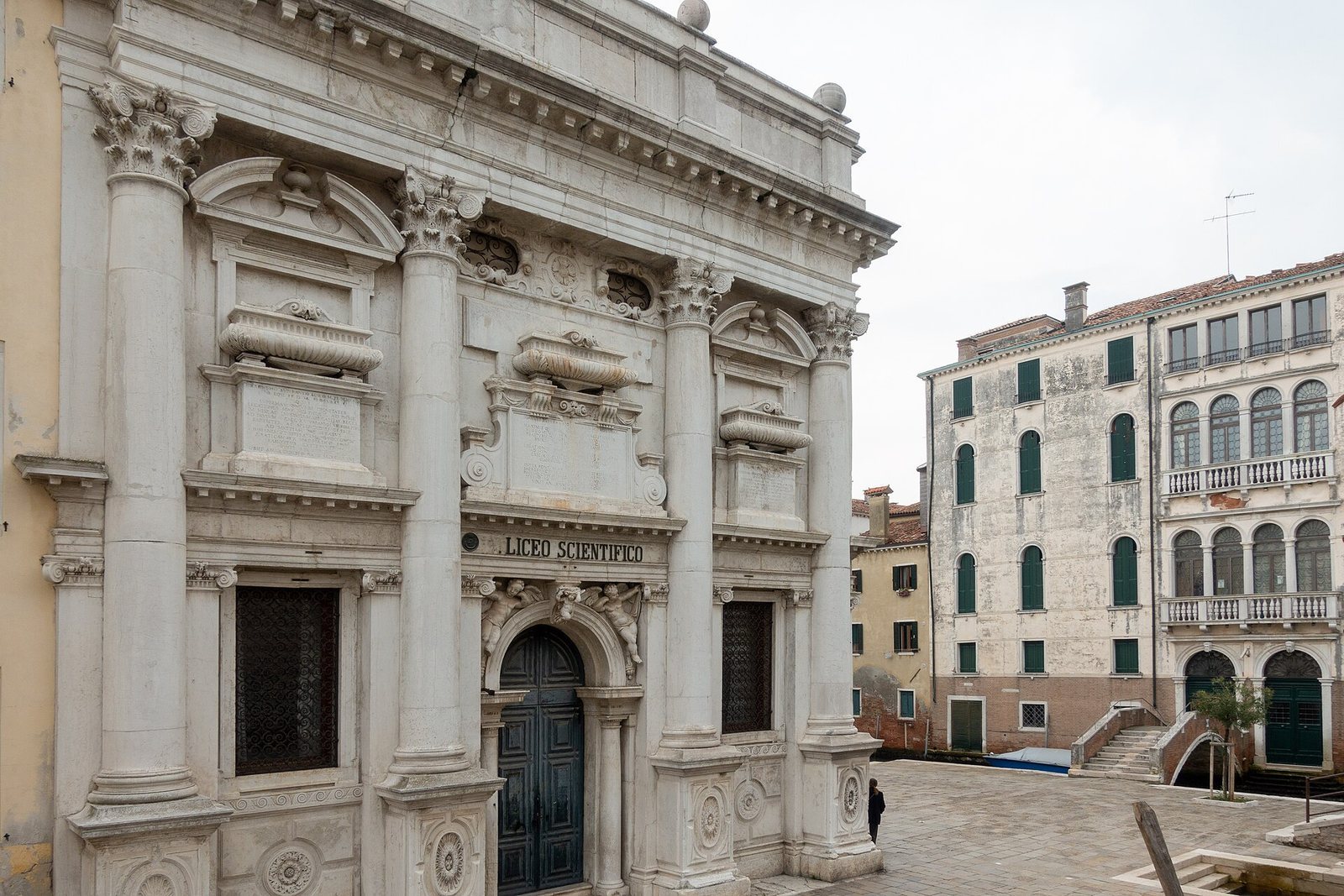
The former church stands at Campo Santa Giustina in Venice’s Castello district, near a canal of the same name. Its surviving fabric is chiefly an elaborate façade of Istrian stone. Two blocked Gothic windows with delicate tracery also remain from the earlier church.
Façade
Composition
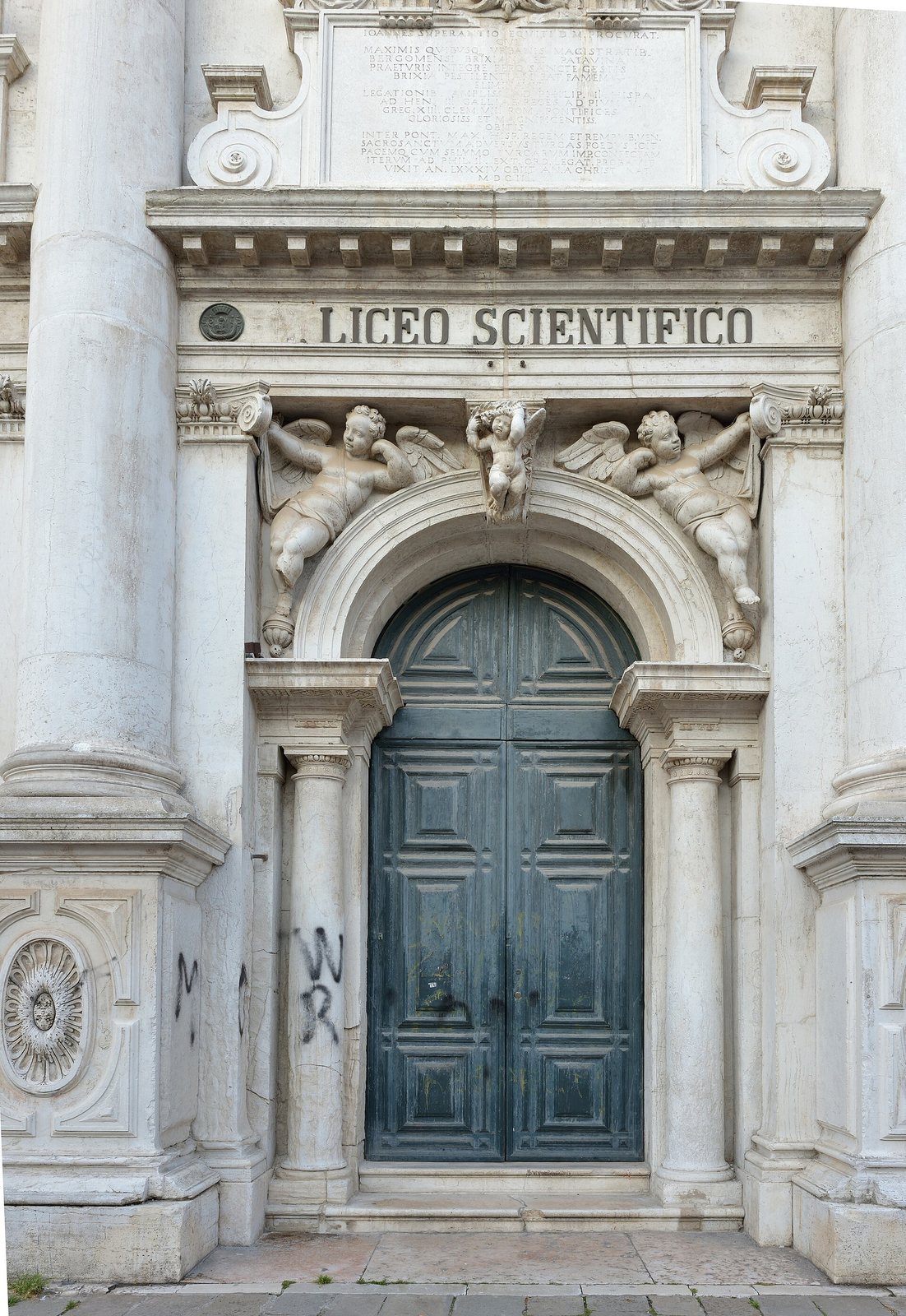
Tall half-columns in the Corinthian order, a classical architectural style, rise from decorated bases and divide the façade into three parts. Below them, Ionic, another classical order, appears in shallow wall supports. A horizontal band separates the façade into two levels. The lower level has square windows at either side and a central round-arched entrance framed by short Tuscan columns, a classical column style. Winged child figures decorate the spaces beside the arch and its central stone.
The façade is incomplete. Its upper section now ends in a plain wall with decorative spheres at the edges. These features replaced the original crowning structure.
Original crowning structure
The façade originally ended in a large curved pediment, a decorative crowning feature, bearing the Soranzo emblem and topped with sculptures. Engravings by Domenico Lovisa and Carlevarijs show a figure of the Redeemer between two seated allegorical figures, with two saints above the outer corners beyond scroll-shaped projections.
Soranzo memorials
Three cenotaphs, memorials that need not contain the commemorated person’s remains, are incorporated into the façade. The two side monuments stand against blocked window openings beneath broken curved pediments. Each has a substantial base and an urn decorated with fluting and plant motifs, with a large scroll-shaped ornament at its centre. Their inscriptions commemorate Gerolamo and Francesco Soranzo. Busts that once stood above the urns are now dispersed.
The slightly wider central cenotaph commemorates Giovanni Soranzo. Its surviving elements include two scroll-shaped ornaments at the foot of the base, a more elaborate support for the urn, and round openings in the background above. A bust once stood above the urn; seated female figures representing Peace and War once flanked the base and urn. Those allegorical sculptures are now held in a heritage authority’s depot. Clemente Molli of Bologna made all the façade sculptures.
Interior features and paintings
The church once held a substantial collection of paintings, which is now dispersed. The artists included Sante Peranda, Palma the Younger, Marco Vecellio, Pietro Liberi, Giovanni Contarini, Antonio Vassilacchi, Alessandro Varotari, Matteo Ponzone, Francesco Ruschi, Pietro Della Vecchia, Baldassarre D’Anna, and Filippo Zaniberti.