Sant’Antonin: A Roman Catholic Church in Italy
Site at a Glance
- Popularity
- Medium
- Country
- Italy
- Primary era
- Early Modern
- Eras represented
- Medieval, Early Modern
- Civilizations
- Venetian
- Site type
- Religious
- Remains
- Church
On this page11 sections
History
Early church and relics
Sant’Antonin is a Roman Catholic church in Italy, dedicated to Antoninus of Amatea, an early Christian martyr. It belongs to the Patriarchate of Venice, the Catholic jurisdiction led by Venice’s patriarch. The church’s origins are uncertain. Tradition credits the Venetian Badoer family with its foundation in the seventh century, while another proposed date is 817. It was rebuilt in 1030, and its first secure documentary reference dates to 1147.
Relics of St Saba, a Christian monk and monastic leader, were kept at the church from the tenth century. Traditions differ about their arrival. One associates them with Doge Pietro I Orseolo around 976–978; another says Doge Pietro Centranico transferred them in 979. A third account places their arrival in the mid-thirteenth century, when Doge Lorenzo Tiepolo is said to have brought them from Acre. In 1965, Pope Paul VI returned the relics to the Greek Orthodox monastery in Istanbul from which Venetians had taken them.
Renovations and seventeenth-century rebuilding
The church underwent further changes over the following centuries. Its bell tower was renewed in 1466, and the church was renovated in 1583. From 1591 to 1594, Francesco Tiepolo oversaw work on the chapel dedicated to St Saba, whose decoration was renewed in 1593.
A larger rebuilding campaign began in 1620, when parish priest Nicolò Zorzi commissioned work on the main chapel. The three chapels at the church’s apsed end were remodeled between 1636 and 1662 and completed in the latter year. Under parish priest Nicolò Brunelli, the church’s right side was rebuilt from 1663 to 1672. A further campaign, designed by Venetian Baroque architect Baldassare Longhena and carried out under parish priest Domenico David, ran from 1672 to 1679. The medieval church was demolished in 1674, with some of its remains incorporated into the new building. The church was reconsecrated in 1680, while work on the facade and adjoining buildings continued until 1685.
Later changes and restoration
The presbytery, the area around the main altar reserved for clergy, was enlarged and restored in 1777 to a design by Bernardino Maccaruzzi. The bell tower was rebuilt during the eighteenth century, with work recorded from 1736 to 1749 and completion around 1750. In 1711, Sant’Antonin was elevated from parish church to collegiate church, served by an organized body of clergy called canons. In the reorganization of Venetian churches under Napoleon after 1805, it lost its parish status and had become a subsidiary church of San Giovanni in Bragora by 1810.
On 16 March 1819, an elephant being transported to Milan escaped, killed its keeper, Camillo Rosa, and took refuge inside Sant’Antonin after fleeing soldiers. It barricaded itself with benches and was killed by a cannon fired through an opening made in the church wall. In the twentieth century, the tower’s dome was renovated in 1943–1944, the roof in 1962, and the St Saba chapel in 1970. The church was deconsecrated, meaning officially removed from use for worship, and closed in 1982. A comprehensive restoration from 1988 to 2010 included archaeological work and repairs to the building’s surfaces, altars, sculpture, paintings, wooden furnishings, and bell tower. It reopened in June 2010; the church is closed to worship, but its central chapel continues to host religious celebrations.
Remains
The present church has a square plan, a single nave, and a flat ceiling, with three rectangular chapels extending from the apse, the recessed end of the building. The earlier church followed Byzantine principles and later acquired Gothic features. A view of the church made by Jacopo de’ Barbari in 1500 suggests that it then had three aisles.
Setting and exterior
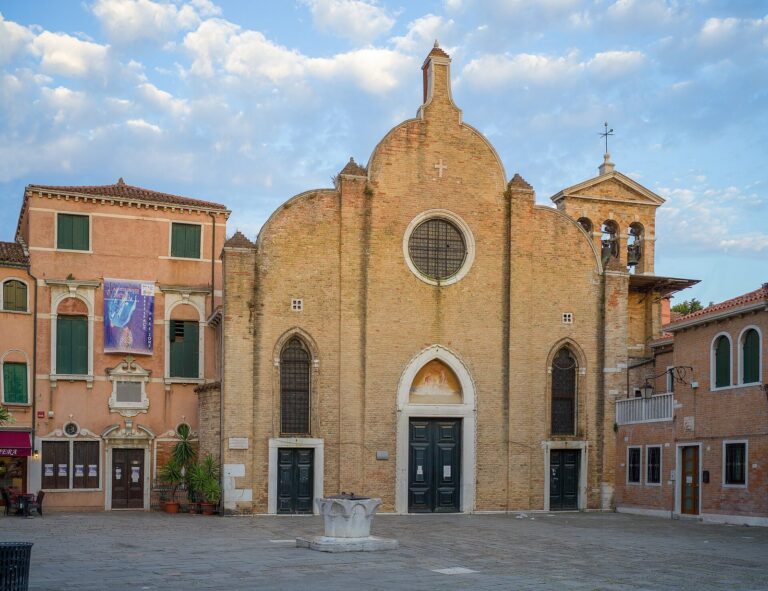
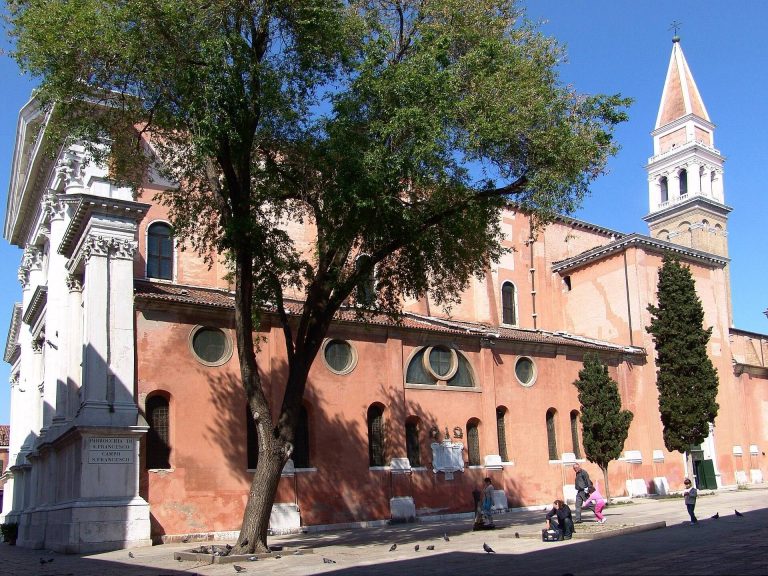
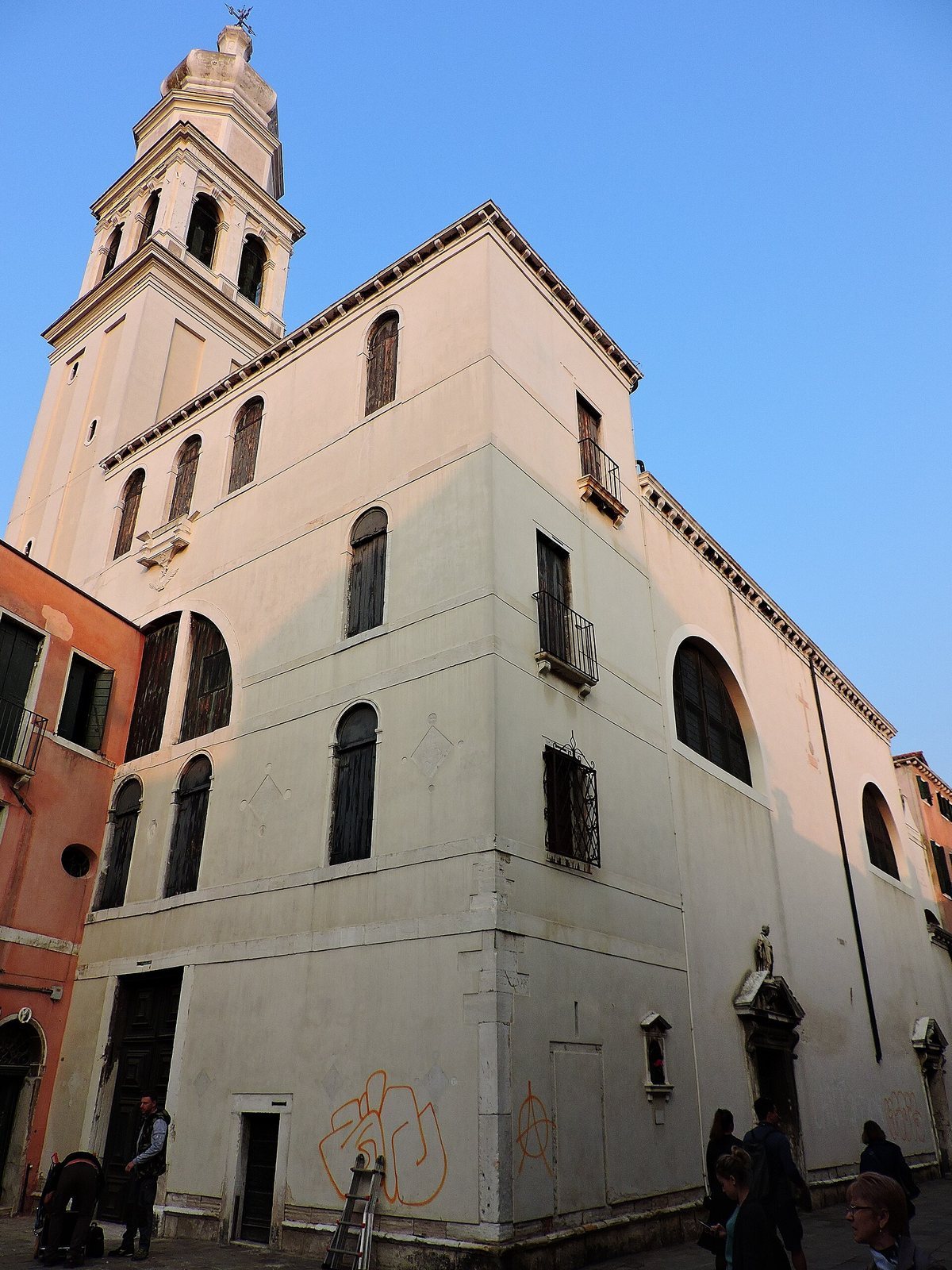
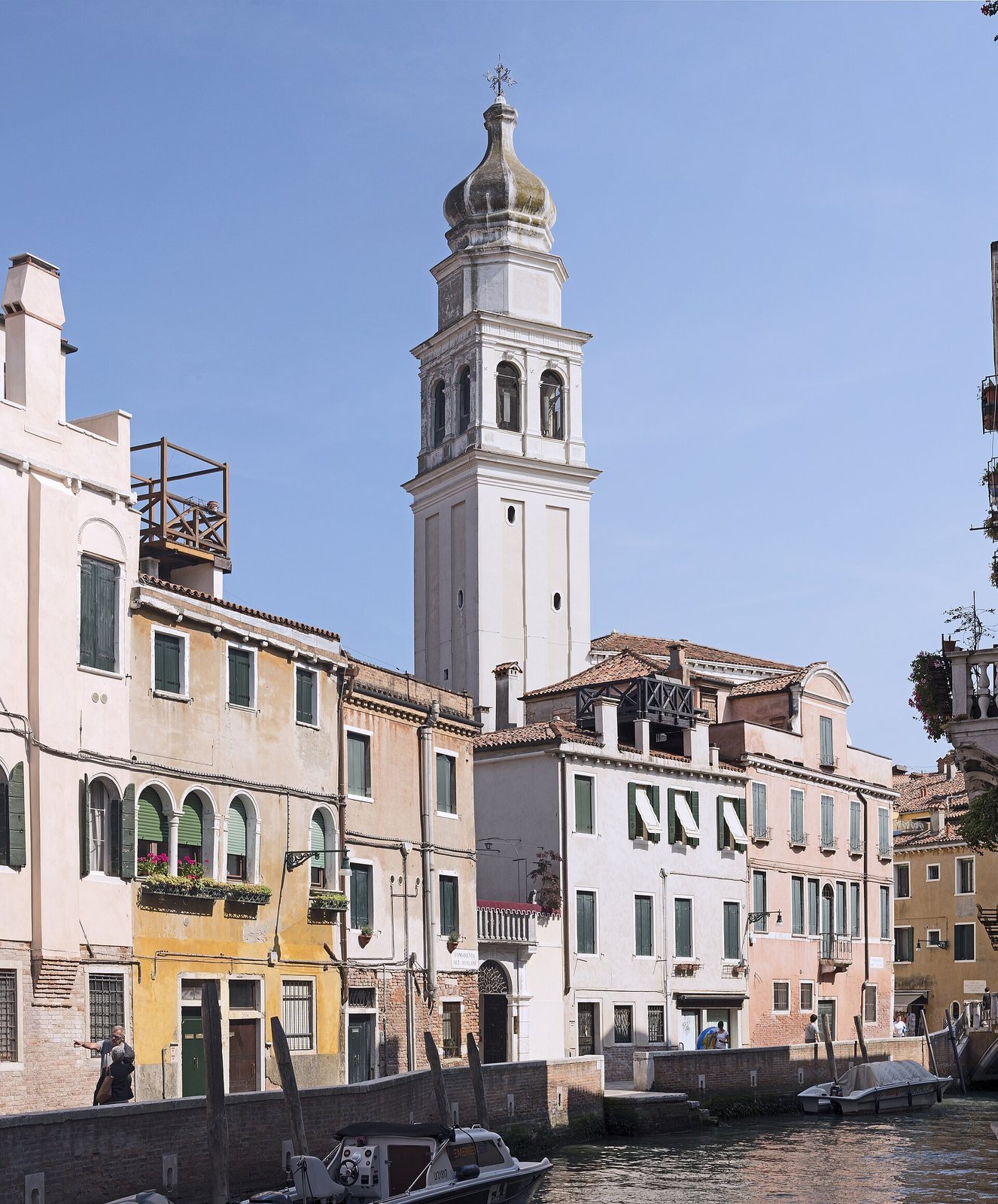
Sant’Antonin stood where the Sant’Antonin canal met the canal called Rio della Pietà. The namesake canal was filled in, as was the canal that once ran beside the church’s right side; the resulting paved street is known as Salizada Sant’Antonin. The church’s south side faces a filled canal. Its facade is partly obscured by an adjoining building for clergy and contains rooms for clergy and the lay religious associations that managed the church. The bell tower stands to the left of the facade. Below a large semicircular-headed window, the entrance portal is flanked by arched windows.
Interior and furnishings
Shallow wall supports, or pilasters, divide the nave walls between large semicircular-headed windows. Their capitals have the foliage decoration associated with the Corinthian style. The entrance opens into a small vestibule leading to the nave, with side chapels on either side and an ornamental organ above. A wooden choir gallery built in 1467 by a craftsman known as Master Jacopo served as a gathering place for women.
Bell tower
The bell tower is 32 metres high. Its rounded, bulb-shaped dome rests on an eight-sided drum, and its bells are operated electromechanically.
Chapel of St Saba
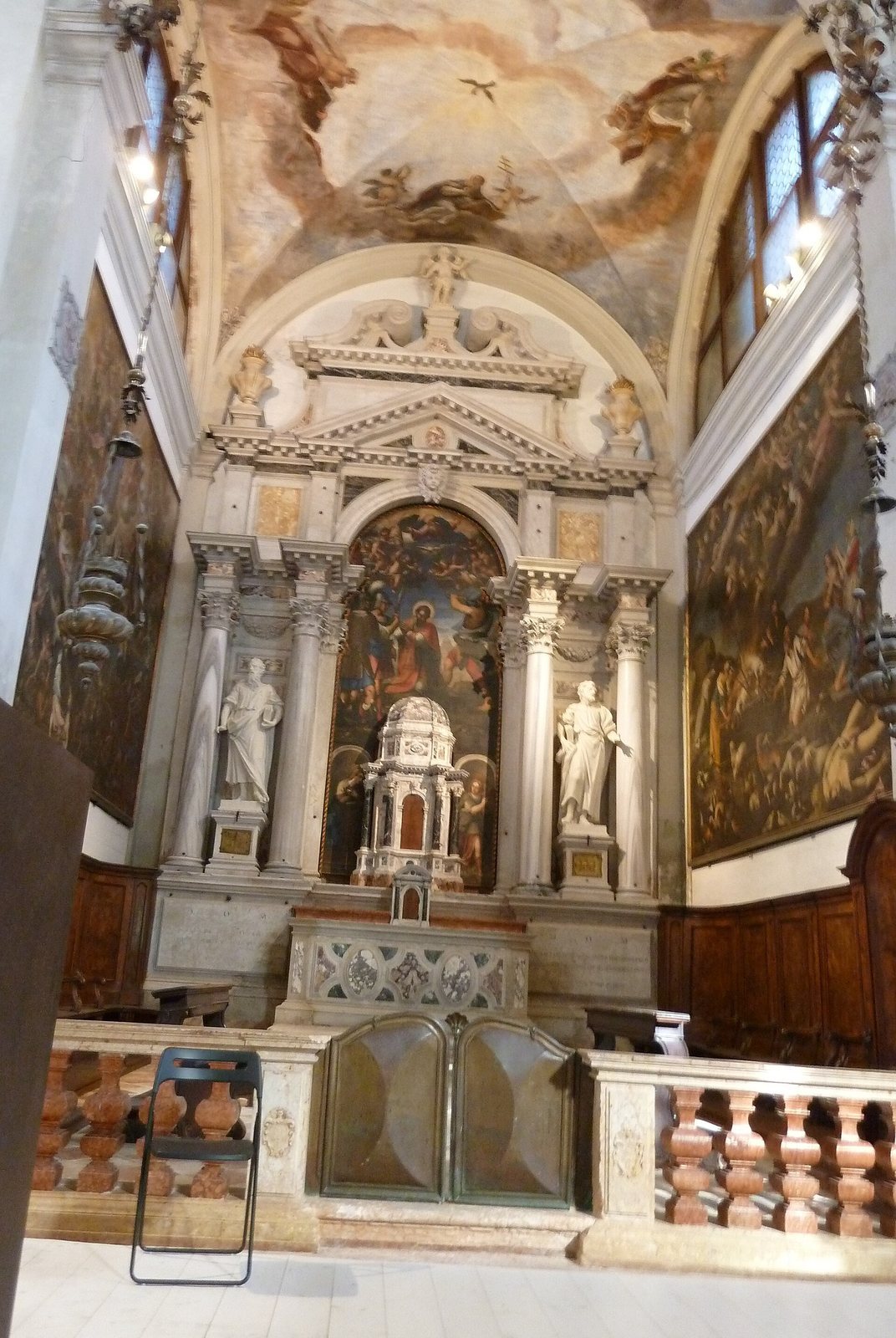
The deep chapel on the left side of the nave is dedicated to St Saba and was under the patronage of the Tiepolo family. Eight paintings by Palma the Younger, dated to 1593, show episodes from the saint’s life. They were moved to the Diocesan Museum of Sant’Apollonia during restoration and returned to the chapel in 2010. Stucco work in the chapel is attributed to sculptor Alessandro Vittoria. The altar holds a fifteenth-century Pietà by Lazzaro Bastiani, originally from the church of San Severo, suppressed in 1808. The chapel also contains a funerary monument and bust of procurator Alvise Tiepolo, a senior official of the Venetian Republic, made by Vittoria.
Paintings and sculpture
A ceiling fresco showing the Meeting of St Saba and St Antonin dates to the eighteenth century and is attributed to a pupil of Sebastiano Ricci. In the central apse, Joseph Heintz the Younger’s Last Judgment, dated 1661, hangs on the left wall; Pietro Della Vecchia’s seventeenth-century Noah’s Departure from the Ark is on the right. A Madonna and Child on the nave’s right-hand wall is attributed to a sculptor from the Marinali family and dates broadly to the late seventeenth or eighteenth century.
Archaeological remains
Archaeological work revealed foundations belonging to earlier church buildings, along with tombs, a sarcophagus from the early fourteenth century, and fifteenth-century ceramics. The ceramics are displayed in a separate room within the church.