Santi Giovanni e Paolo: A Dominican Basilica in Venice
Site at a Glance
- Popularity
- Very High
- Country
- Italy
- Primary era
- Medieval
- Eras represented
- Medieval, Early Modern
- Civilizations
- Venetian
- Site type
- Religious
- Remains
- Basilica
On this page41 sections
History
Santi Giovanni e Paolo is a Dominican basilica in Venice, Italy, built in the Venetian Gothic style chiefly from the fourteenth century. It became one of the Venetian Republic’s principal burial churches, including for its doges, the elected heads of state. The church is dedicated to John and Paul, early Christian Roman martyrs traditionally said to have been executed in 362, not to the apostles of the same names.
Origins and construction
A church may have stood on the site by 983, while a church there is securely attested in 1184. Tradition connects the later basilica’s foundation to a vision of Doge Jacopo Tiepolo. He reportedly saw white doves above a marsh and heard a divine voice identify the place as one for preachers. In 1234, Tiepolo granted the land to the Dominicans, a Catholic order known especially for preaching. They had been in Venice for more than a decade and had lived at San Martino since 1226.
Construction of the first Dominican church began in the mid-thirteenth century. Work on a larger replacement started in 1333, in response to the church’s growing importance as a burial place and the expansion of Dominican activity. The main campaign was substantially complete by 1343. Building may have paused the following year, perhaps because of plague, before resuming in 1355. The central and side aisles were finished around 1368, and the roof was completed in 1417. Antonio Correr, bishop of Ceneda, consecrated the church on 14 November 1430.
The Dominican friars Benvenuto da Bologna and Nicolò da Imola directed the work, although their individual responsibilities are not known with certainty. Government donations supported construction between 1333 and 1344. In the early fifteenth century, Venetian aristocrats were appointed as procurators, senior officials with administrative duties, to supervise the basilica’s completion and decoration.
Convent, burials, and religious ceremonies
The adjoining Dominican convent was completed in 1293. By 1581, it housed 35 religious and ranked among Venice’s largest convents. The basilica also acquired a central role in public commemoration. From the fifteenth century onward, state funeral services for doges were held there, and 25 doges were buried in the church. Religious ceremonies organized by the Scuola Grande di San Marco also took place in the basilica. In Venice, a Scuola was a lay religious confraternity rather than a school in the modern sense.
The chapel now called the Chapel of the Rosary was rebuilt in 1582 from an earlier, fourteenth-century chapel dedicated to Saint Dominic. The Rosary confraternity rededicated it to the Virgin of the Rosary in memory of the Venetian victory at the Battle of Lepanto on 7 October 1571. The battle fell on the feast of Our Lady of the Rosary.
Suppression, fire, and restoration
In 1806, under Napoleon Bonaparte, the Dominican convent was suppressed and its friars expelled. The former convent served as a military hospital from 1809 and a civilian hospital from 1819. The church became a parish church in 1810 and was entrusted to the Dominicans who remained. The suppression also brought the removal of many artworks and the transfer to the basilica of monuments from churches that had closed.
A fire on the night of 15–16 August 1867 destroyed the Chapel of the Rosary and its decoration, including a gilded wooden ceiling and 34 paintings. Two works temporarily kept there for restoration were also lost: Titian’s Martyrdom of Saint Peter and Giovanni Bellini’s Madonna and Saints. The chapel was rebuilt and restored during the twentieth century, with the restoration completed in 1959.
Extensive restoration of the church took place in the early twentieth century. Austrian bombing during the First World War caused minor damage, repaired by 1922. In September of that year, Pope Pius XI granted the church the title of minor basilica, an honorific designation awarded by the pope.
Remains
Plan and construction
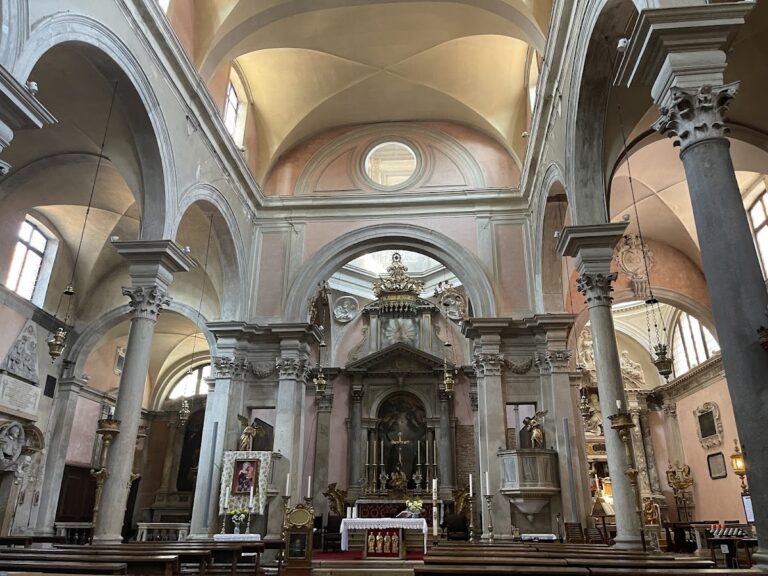
The brick basilica has a Latin-cross plan, with a crosswise arm called a transept, three aisles, and five polygonal apses, projecting spaces at the church’s eastern end. It measures 101.6 metres long, 45.8 metres across the transept, and 32.2 metres high. The brick walls have a patterned surface that imitates brickwork.
Ten large cylindrical columns support the arcades and high ribbed Gothic vaults. Horizontal wooden ties connect the vaults and help resist the outward pressure exerted by the arches. At the fourth support from the entrance in each arcade, a group of three slimmer columns takes the place of a single column.
Exterior
Western facade
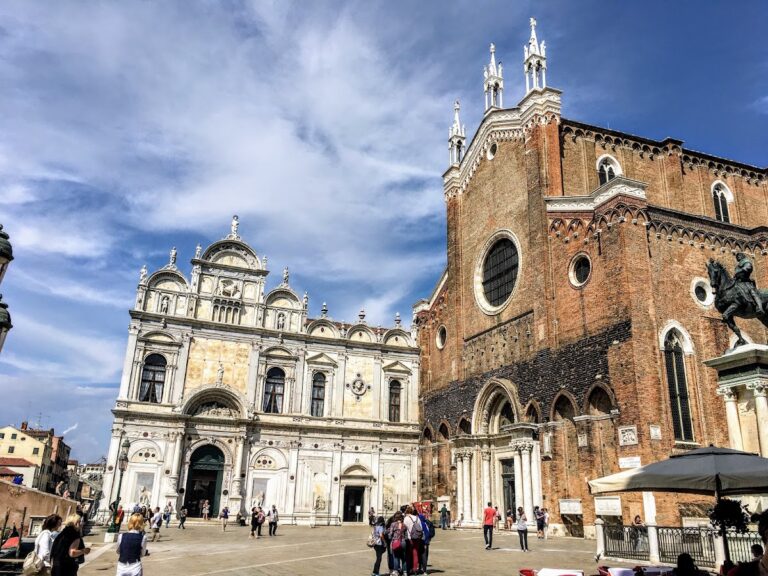
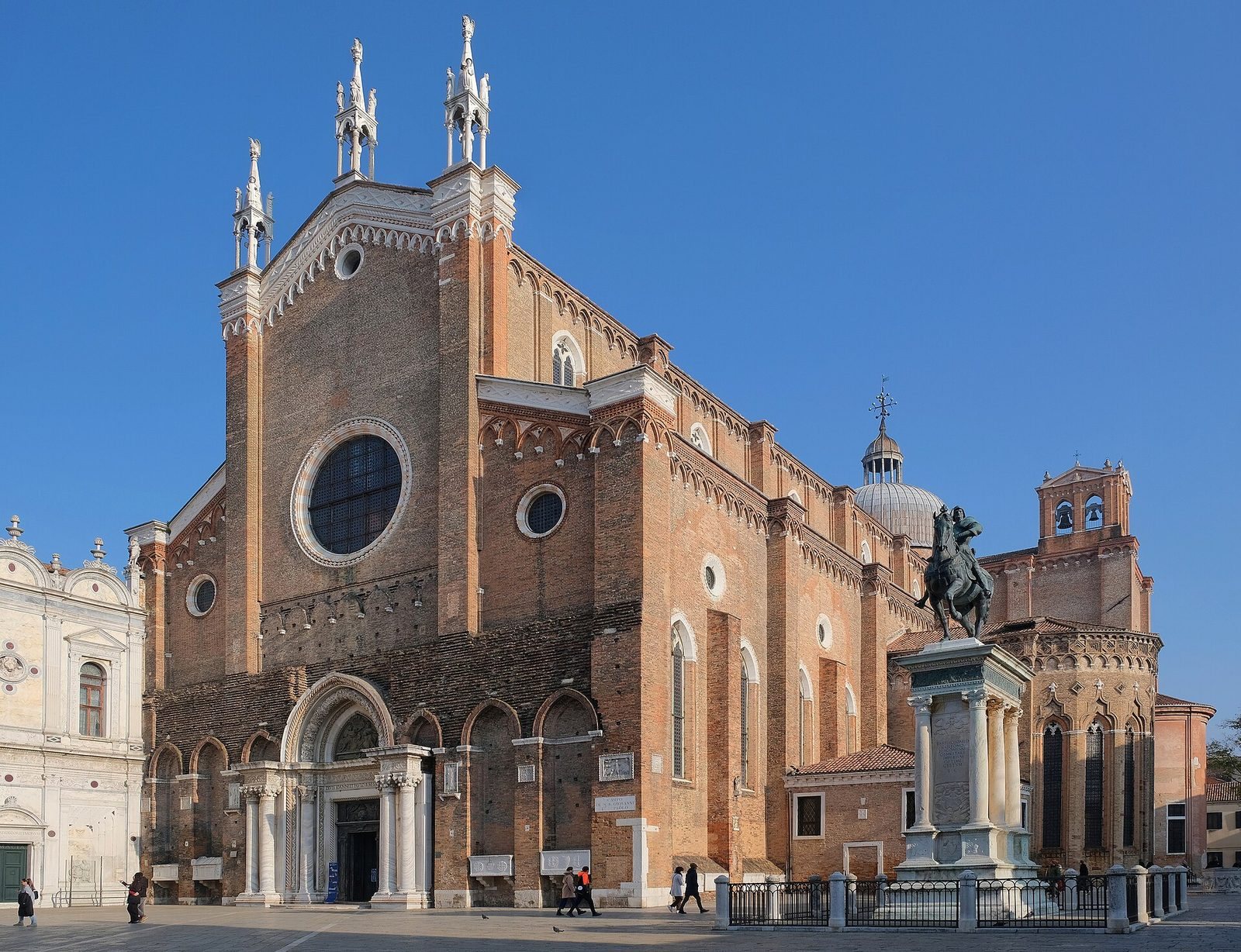
The western brick facade is divided into three sections by vertical pilasters. A large central rose window and two smaller circular windows illuminate the front. Six Gothic niches contain sarcophagi associated with Marino Morosini; the doges Jacopo and Lorenzo Tiepolo; Marco Michieli; and the brothers Daniele and Pietro Buono. The facade remains unfinished.
Central portal
The central entrance was built between 1458 and 1464 under Bartolomeo Bon. Six marble columns brought from Torcello were installed in 1459. Bon worked on the capitals, Domenico Fiorentino on the band of decoration above them, and Master Luce on the cornice and upper ornament. Statues of Thomas Aquinas, Dominic, and Peter of Verona stand in three narrow, shrine-like pinnacles above the entrance.
South side and campo
The church’s south side faces the campo and has attached chapels and other buildings. Among them are the low, rectangular former School of the Name of Jesus, a side entrance, and two portals of the former School of Saint Peter Martyr. The exterior also includes the apse of the Chapel of the Blessed James Salomoni, the Chapel of Our Lady of Peace, and the Chapel of Saint Dominic. Original paving around the Chapel of the Name of Jesus includes terracotta blocks known in Italian as cotto.
Eastern end and dome
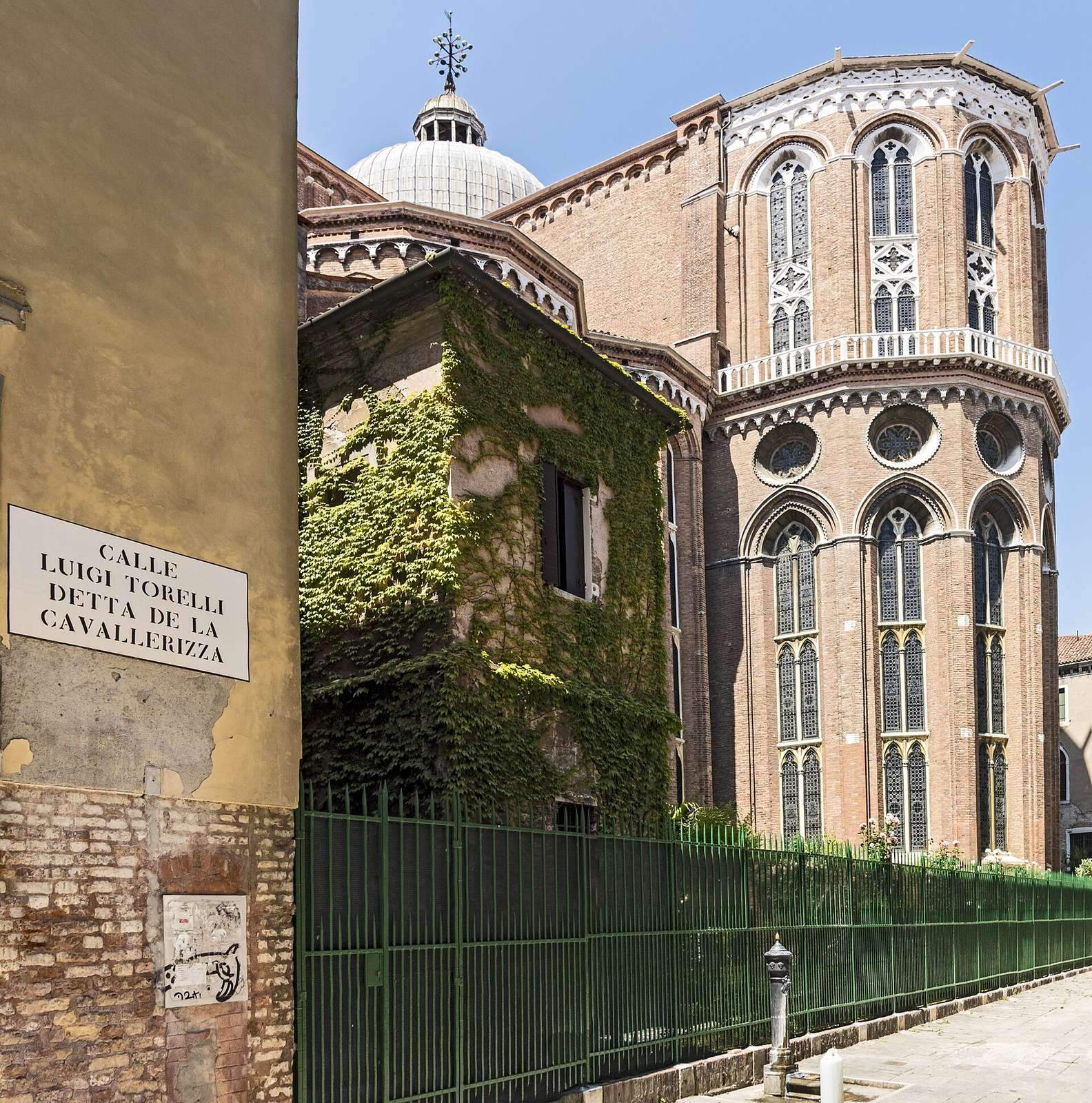
The eastern end has a two-storey polygonal apse with tall, pointed Gothic windows. Smaller round windows sit above the lower windows, and a cornice and balustrade divide the two levels. Two smaller apses flank the presbytery, the area around the high altar, on each side. The double-shell dome was built late in the fifteenth century. It rises 41 metres on the interior and 55.4 metres externally.
Nave and western interior wall
Former choir and crossing altars
A friars’ choir once extended across the main aisle, dividing it from side to side. It was removed in the seventeenth century to provide space for solemn services, including funerals for doges. The altars of Saint Catherine of Siena and Saint Joseph, now at the crossing of the nave and transept, survive from the choir.
Mocenigo family monuments
The inner western wall is dominated by monuments to members of the Mocenigo family. The central tomb commemorates Doge Alvise I Mocenigo and Loredana Marcello. Girolamo Grapiglia began it in 1580, and Francesco Contin completed it in 1646. Six fluted pilasters frame a central coat of arms and reliefs, attributed to G. Campagna, showing the doge at prayer and receiving an audience. Grey-marble sarcophagi hold the doge and his wife. Statues of the Virgin, the Savior, and Saint Peter stand between them; statues of Saint Peter and Saint George, originally connected with another Mocenigo monument, occupy the lower outer sections.
The tomb of Doge Giovanni Mocenigo, carved in Carrara marble by Tullio Lombardo in the early sixteenth century, has smooth surfaces and carefully balanced proportions. Its capitals draw on those of Rome’s Arch of Titus. A relief shows John the Baptist presenting the doge to the Virgin, while three further reliefs depict cities conquered in the Po valley. Nearby, the tomb of Doge Pietro Mocenigo, completed by Pietro Lombardo in 1481, combines a broad arch and warrior figures with a recumbent statue of the doge in armour. Its reliefs show the capture of Smyrna and the surrender of Famagusta to Caterina Cornaro. Three floor slabs cover the burials of Alvise I, Alvise III Sebastiano, and Alvise IV Giovanni Mocenigo.
Bartolomeo Bragadin’s monument
The monument to the poet Bartolomeo Bragadin, made by Lorenzo Bregno, includes a sarcophagus in the Lombard style and statues of Saints Mark, John the Baptist, and Bartholomew. A statue of the Virgin stands above them.
Right aisle
Renier Zeno’s urn and Bellini altarpiece
A raised funerary urn commemorates Doge Renier Zeno. Its relief, attributed to a stoneworker, shows two angels supporting the Savior in a Byzantine style. Nearby, a Renaissance altar supported by two sphinxes holds Madonna and Child with Saints, brought from the Accademia in 1881. It replaced Giovanni Bellini’s original altarpiece, which was destroyed in the 1867 fire; the surviving painting is attributed to an unidentified fifteenth-century artist.
Marcantonio Bragadin’s monument
The monument to Marcantonio Bragadin is generally attributed architecturally to Vincenzo Scamozzi. It includes a bust made by a pupil of Alessandro Vittoria and a painting in light and dark tones of Bragadin’s flaying, whose maker is uncertain. Bragadin was executed in 1571, and his flayed skin was taken to Constantinople. Girolamo Polidoro secretly recovered it in 1580, and it reached the basilica on 18 May 1596. When a lead casket in a niche behind the monument’s urn was opened in 1961, it held fragments of burned human skin. They were reburied on 24 March 1962.
Saint Vincent Ferrer altar
The altar of Saint Vincent Ferrer holds Giovanni Bellini’s nine-panel Polyptych of Saint Vincent Ferrer, a multi-part altarpiece dated to around 1464. Its central section shows Vincent between Saints Christopher and Sebastian. Above are the dead Christ supported by angels, the Archangel Gabriel, and the Virgin of the Annunciation. Five scenes in the lower panels depict miracles, including rescues from a river and a building collapse, preaching in Toledo, and the raising of a child and release of prisoners. A tenth panel showing God the Father once occupied the space above the centre. The frame dates to the early sixteenth century. The remains of Blessed Tommaso Caffarini, confessor and first biographer of Catherine of Siena, lie below the altar. Roberto Longhi established Bellini’s authorship in 1914, and the work was restored in 1994.
Right transept
Stained-glass window
A large Gothic window in the right transept contains stained glass made with Murano glass. Giovanni Antonio Licinio painted part of it, and Bartolomeo Vivarini, Cima da Conegliano, and Girolamo Mocetto are associated with other sections. God the Father appears above six registers. The registers depict the Annunciation with David and Isaiah; Saints Paul, Mary with the Child, John the Baptist, and Peter; the symbols of the four Evangelists; four Doctors of the Church; Dominican saints; and warrior saints, including John and Paul.
Altars, memorials, and chair
Below the window is a monument to the military commander Dionigi Naldi, made by Lorenzo Bregno. It stands between two Renaissance altars: Lorenzo Lotto’s Alms of Saint Antoninus, painted around 1542, and Rocco Marconi’s Christ between Saints Peter and Andrew. A doge’s chair made in the late seventeenth century is also beneath the window. The side wall holds Cima da Conegliano’s Coronation of the Virgin and the monument to Niccolò Orsini, Count of Pitigliano. The monument includes a gilded wooden equestrian statue of uncertain authorship and two figures representing virtues by Tullio Lombardo.
Presbytery
Windows, vault, and high altar
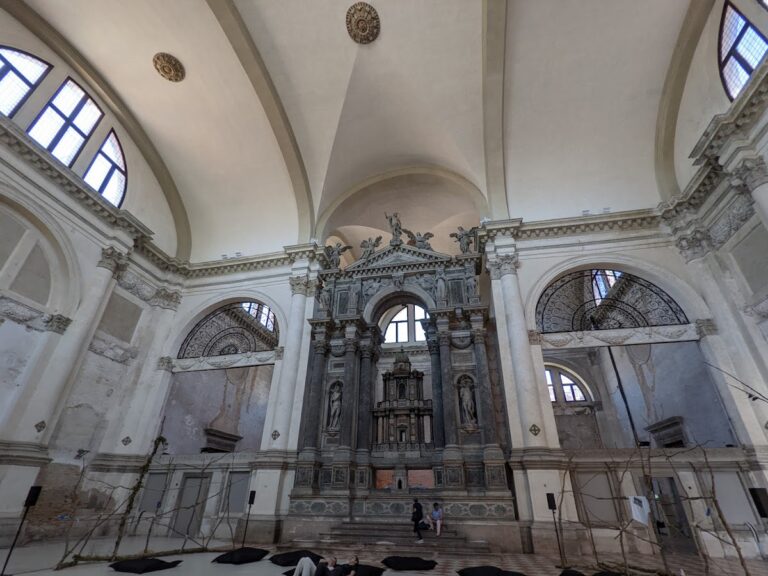
Tall Gothic windows light the presbytery in two tiers, separated by a horizontal band of small round windows. Red-brick ribs meet at the centre of the vault, where the arms of the Scuola Grande di San Marco are carved. The Baroque high altar was begun by Mattia Carneri in 1619 and completed by Baldassare Longhena. Its statues represent the Virgin of the Rosary and Child, Saint Dominic, Saint Catherine of Siena, and Saints John and Paul. Ten Dominican bishops are buried in front of the altar’s first step. The statues at the altar are attributed to Clemente Moli and Francesco Cavrioli.
Tombs of Michele Morosini and Leonardo Loredan
The tomb of Doge Michele Morosini includes a recumbent figure and two angels. An early-fifteenth-century mosaic shows the Crucifixion, with saints presenting the doge and dogaressa. Doge Leonardo Loredan’s monument, erected in 1572, combines architecture by Girolamo Grapiglia, a central statue by Girolamo Campagna, and allegorical figures by Danese Cattaneo.
Vendramin and Corner monuments
The white-marble monument to Doge Andrea Vendramin was made between 1493 and 1499, chiefly by Tullio Lombardo, and brought here in 1817 from the suppressed church of Santa Maria dei Servi. Its sculptural program includes a reclining doge, figures representing virtues, a relief of Saint Andrew presenting the doge to the Virgin, and mythological scenes. The monument is incomplete: its original statues of Adam and Eve and other parts are elsewhere or represented by copies. A nearby monument to Doge Marco Corner includes the Virgin and Child, Saints Peter and Paul, and two angels. Its figures are attributed to Nino Pisano and his pupils.
Left transept
Venier monuments and memorials
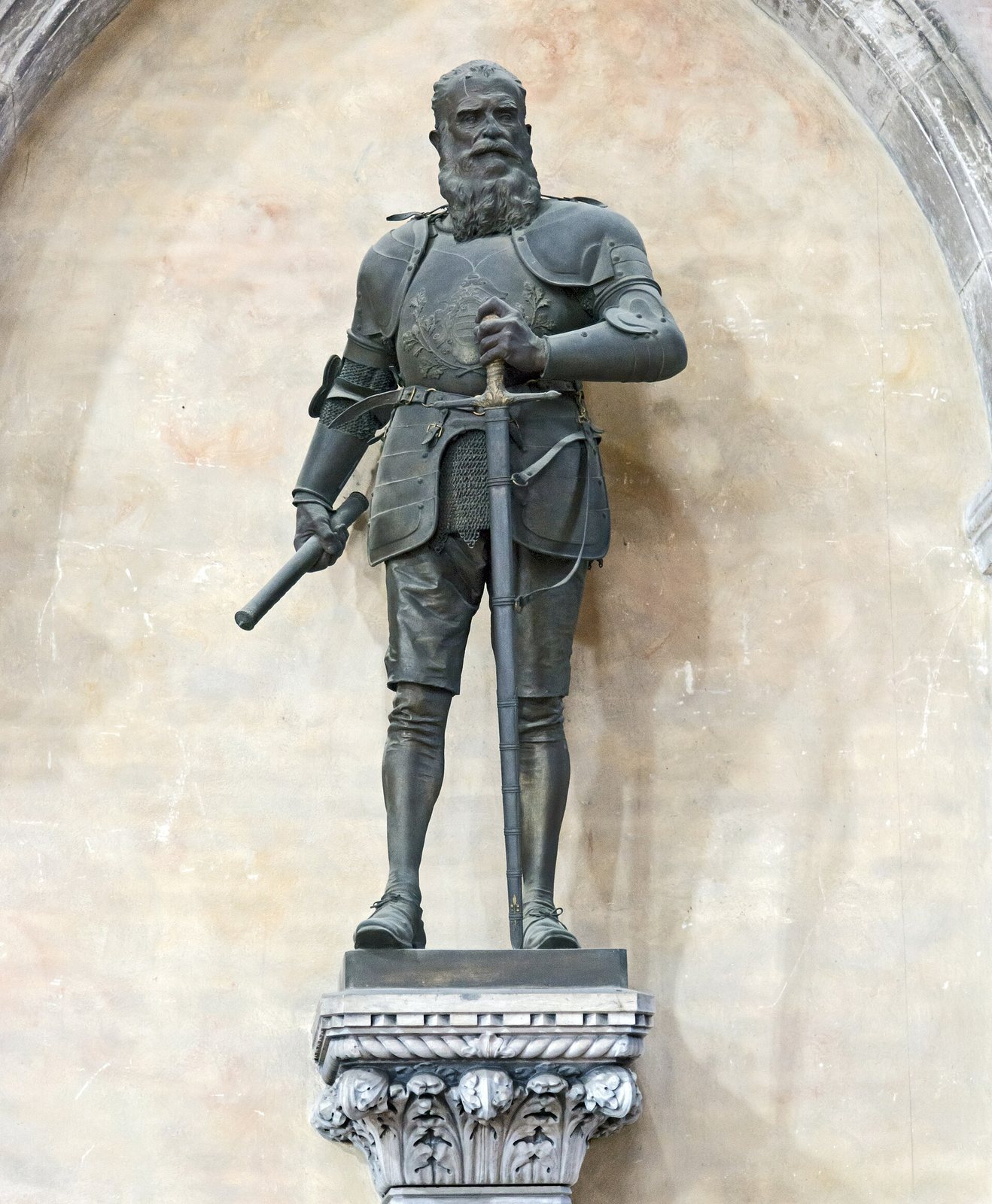
A large clock in the left transept dates from the late fifteenth or early sixteenth century. Below it is the tomb of Doge Antonio Venier, attributed to the Dalle Masegne workshop. It includes a recumbent figure of the doge, statues of the Virgin and Saints Peter and Paul, and figures representing virtues. Nearby are the tombs of Agnese Venier, her daughter Orsola, and Petronilla de Tocco. A bronze statue of Doge Sebastiano Venier by Antonio Dal Zotto was installed in 1907, when the doge’s remains were transferred from Murano. A gilded equestrian statue commemorates Leonardo Prato, who died defending Padua in 1511.
Chapel of the Rosary entrance
A door from the left transept leads to the Chapel of the Rosary. The chapel’s surviving interior includes works and architectural features described below.
Side chapels
Chapel of the Holy Cross
The Chapel of the Holy Cross was used by a confraternity that cared for people sentenced to death; its cemetery lay beyond the apse. Alessandro Vittoria made the black-marble altar and bronze statues of the Sorrowing Virgin and Saint John the Evangelist. Francesco Cavrioli made the Crucifix from Carrara marble. A monument in a classical style commemorates the English baron Edward Windsor, who died in Venice in 1574. A fourteenth-century sarcophagus on the opposite side may contain the remains of Paolo Loredano.
Chapel of Saint Mary Magdalene
The chapel has an early-sixteenth-century altar in the Lombard Renaissance style, arranged like a three-part screen. Bartolomeo Bergamasco made its central statue of Mary Magdalene, flanked by Saints Andrew and Philip. A fresco of the four Evangelists above the window is attributed to Palma the Younger. Other works include the original statue of Vettor Pisani, whose larger monument was reconstructed in the early 1920s after transfer from the former church of Sant’Antonio di Castello; a fourteenth-century urn for Marco Giustiniani della Bragora; a pyramid-shaped monument to painter Melchiorre Lanza; Melchior Barthel’s statue Melancholy; and Lattanzio Querena’s Deposition.
Chapel of the Blessed James Salomoni
Built in Gothic form in 1563 in association with the School of the Name of Jesus, this chapel was remodeled in the Baroque style in 1639. Its vault has black-and-white stucco and paintings by Giovanni Battista Lorenzetti. A glass sarcophagus above the altar holds Salomoni’s remains, and the altarpiece, The Crucifixion and Magdalene, is by Pietro Liberi. Pietro de Mera painted the side-wall scenes of the Circumcision and Baptism of Christ; Matteo Ingoli painted angels and God the Father above. Before the entrance, a niello burial slab by Pietro Lombardo covers the remains of Alvise Diedo, who helped save the Venetian fleet at Constantinople in 1453. Niello is a decoration formed by filling engraved lines in metal with a dark material.
Valier mausoleum and Chapel of Our Lady of Peace
The Baroque Valier mausoleum, designed by Andrea Tirali, has four pairs of Corinthian columns and a large yellow-marble drapery supported by four angels. Statues commemorate Doge Bertuccio Valier, his son Doge Silvestro, and Silvestro’s wife Elisabetta Querini. The monument also includes allegorical figures and reliefs, among them an image of the Venetian victory at the Dardanelles.
An arch in the mausoleum opens into the Chapel of Our Lady of Peace, also called the Chapel of the Blessed Sacrament. Above its altar is a Byzantine icon brought from the East in 1349 and given to the Dominicans by Paolo Morosini in 1503. It was placed in the chapel in the nineteenth century. The chapel also contains paintings by Palma the Younger, Leandro Bassano, and Antonio Vassilacchi.
Chapel of Saint Dominic
Andrea Tirali built the Chapel of Saint Dominic in 1690. Francesco Bernardoni carved the ceiling’s ornament, which centres on Giovanni Battista Piazzetta’s Triumph of Saint Dominic, completed in 1727 and restored in 1968–69. Eight nearly life-size angels surround the painting, while four corner medallions depict virtues in light and dark tones. Six wall reliefs show episodes from Dominic’s life. Giuseppe Mazza made five in bronze; Giobatta della Meduna made the sixth in wood, and it was installed in 1770.
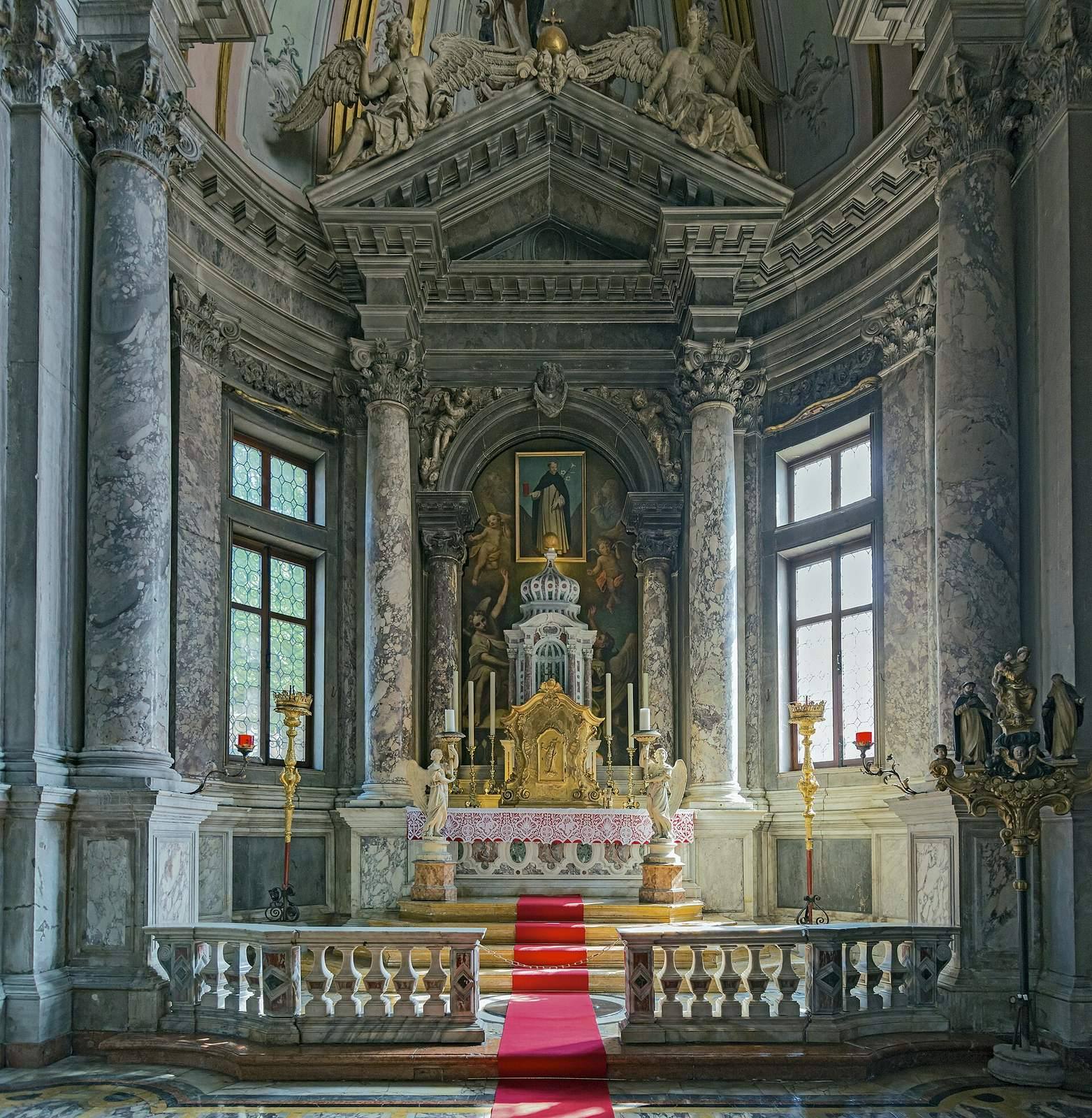
Chapel of the Rosary
The Chapel of the Rosary has a rectangular nave and a square presbytery. Carlo Lorenzetti’s carved ceiling in the nave was inaugurated in 1932 and incorporates three paintings by Veronese: Adoration of the Shepherds, Assumption, and Annunciation. Removed from the suppressed church of Santa Maria dell’Umiltà, they were taken to Vienna in 1838, returned to Venice in 1919, and installed in the basilica in 1925. The chapel’s other paintings include a second Veronese Adoration of the Shepherds and works by Giovanni Battista Zelotti, Carlo Caliari, Bonifacio de’ Pitati, Sante Peranda, Benedetto Caliari, and Alessandro Varotari. Giacomo Piazzetta’s wooden panels show episodes from the lives of Jesus and Mary.
In the presbytery, Veronese’s Adoration of the Magi, dated 1582, is surrounded by depictions of the four Evangelists. The altar, designed by Girolamo Campagna as a domed temple, contains a polychrome terracotta statue of the Virgin of the Rosary. Its decoration includes ten eighteenth-century reliefs, partly restored after the fire, and sculptures of prophets and sibyls. Four statues behind the altar were damaged in the fire. Giuseppe Porta’s Assumption of the Virgin came from the basilica of Santa Maria Gloriosa dei Frari.
Sacristy
The entrance to the sacristy forms part of a funerary monument Palma the Younger planned for himself, Palma the Elder, and Titian. Vincenzo Scamozzi designed its architecture, Jacopo Alberti carved busts of the two Palmas, and the bust of Titian is attributed to Alessandro Vittoria. Palma the Younger’s Allegory of Glory hangs above his grave, set into the floor. The sacristy contains paintings on Dominican themes by Marco Vecellio, Leandro Bassano, Palma the Younger, Odoardo Fialetti, and Andrea Vicentino. Vicentino’s 1606 painting depicts Jacopo Tiepolo granting land to the Dominicans for their church and convent.
Left aisle
Altars, organ gallery, and panels
A fifteenth-century marble altar of Saint Joseph, formerly part of the friars’ choir, stands in the left aisle, along with a monumental organ gallery. Three surviving panels by Bartolomeo Vivarini, dated 1473, depict Saints Augustine, Lawrence, and Dominic. They are remnants of a nine-part altarpiece.
Tombs and memorials
The aisle contains tombs and monuments to Doges Pasquale Malipiero, Michele Steno, Tommaso Mocenigo, and Nicolò Marcello, as well as senator Giambattista Bonzio; writer and benefactor Alvise Trevisan; generals Pompeo Giustiniani and Orazio Baglioni; and the Italian patriots Attilio and Emilio Bandiera and Domenico Moro. The Bandiera brothers and Moro were executed in 1844. Their remains were transferred to the basilica in 1867, and their pyramid-shaped monument was unveiled in 1890.
Doge Tommaso Mocenigo’s tomb, dated 1423, combines Gothic and Renaissance forms and is attributed to Pietro di Nicolò Lamberti and Giovanni di Martino da Fiesole. Pietro Lombardo made the Renaissance monuments to Malipiero and Nicolò Marcello. Francesco Terilli made the gilded wooden equestrian statue of Pompeo Giustiniani. The altar of Verde della Scala, daughter of Mastino della Scala, came from Santa Maria dei Servi and includes a 1576 statue of Saint Jerome by Alessandro Vittoria. A monumental memorial to Venetian admiral Girolamo Canal is also in the aisle.
Dominican convent
The convent, completed in 1293 and rebuilt by Baldassare Longhena between 1660 and 1675, is arranged around two cloisters and a courtyard. Its eastern section included the friars’ dormitory, where a long corridor opened onto cells. Longhena’s staircase has marble inlay. The library retains a wooden ceiling made by Giacomo Piazzetta in 1682, with paintings by Federico Cervelli. The former convent now houses Venice’s civic hospital, while the Dominican community’s present convent occupies the former School of Saint Ursula.