Santa Maria del Pianto, Venice: A Seventeenth-Century Servite Church
Site at a Glance
- Popularity
- Low
- Country
- Italy
- Primary era
- Early Modern
- Eras represented
- Early Modern, Modern
- Civilizations
- Austrian Empire, Habsburg, Venetian
- Site type
- Religious
- Remains
- Church
On this page11 sections
History
Origins and foundation
Santa Maria del Pianto, also known as the Church of the Seven Sorrows, is a Roman Catholic church in Venice, Italy, established in the seventeenth century alongside a convent of Servite nuns. The Servites, or Order of Servants of Mary, followed an Augustinian rule, a form of communal religious life based on the teachings of Augustine of Hippo. The project was an unusual, perhaps unique, instance of female religious patronage in Venice.
During the plague of 1630, Maria Benedetta De Rossi, abbess (head of a convent) of a Servite house on Burano, dreamed that a small convent and church should be founded in Venice, where nuns would pray continually for the plague to end. Her initial efforts to gain support came to nothing. During the Candian War, the Venetian-Ottoman conflict over Candia, Venice’s name for Crete, she reportedly had the same dream again.
On 23 May 1646, De Rossi wrote to Doge Francesco Molin, the elected head of the Venetian Republic, proposing a modest convent and church. The Senate approved a state-funded votive church, a foundation made in response to danger or in the hope of deliverance, as a prayer for the Republic’s success in its war with the Ottomans. Proposed locations near Santa Maria della Salute and in Cannaregio were considered. Concern that a nearby theatre would disrupt worship led to the choice of a site at the end of Fondamente Nove in Castello.
Construction and consecration
Architect Francesco Contin was commissioned to design the complex. The Senate sought a modest, penitential place of prayer, unlike the more publicly celebratory character associated with Santa Maria della Salute and the Redentore. In January 1649, senators reprimanded Contin for laying foundations wider than the approved plan, which would have raised costs and delayed the work; he was required to reduce the design. Later writers sometimes attributed the church to Baldassare Longhena, whose work it resembles, especially Santa Maria della Salute. Earlier commentators, however, had identified Contin as its architect.
Patriarch Gianfrancesco Morosini, a senior Catholic church leader, laid the first stone on 13 November 1647 in the presence of the doge and senators. De Rossi had died in January of that year and did not see the project built. Maria Innocenza Contarini succeeded her as abbess and founder. Construction was complete by April 1658. Three Servite nuns came from the Burano convent to establish the community, following Pope Alexander VII’s authorization of the convent in a bull dated 21 November 1657.
The church was consecrated on 7 May 1687 and dedicated to Our Lady of the Seven Sorrows and Saint Joseph. Venice had lost Candia in 1669, during the Candian War; the consecration took place in 1687, the year of the Venetian conquest of the Morea.
Suppression and changing uses
In 1810, during the Napoleonic suppression of religious houses in the former Venetian territories, the convent closed and the church was stripped of its sacred furnishings. Antonio de Martiis bought the complex in 1814. The former convent became a school, while some of its buildings were rented as housing. The church was divided between a small theatre on the upper floor and a pot factory below.
Abbot Daniele Canal reacquired the complex in 1841 to restore its religious use. Following restoration, the church reopened for worship in 1851. The convent remained active until 1970, when the last nuns left and the complex was transferred. The healthcare authority ULSS 12 later owned the buildings and used the former convent for outpatient services, while the church fell out of use.
In 2001, the Municipality of Venice proposed using the church for secular funerals. The Curia objected in 2005 because the church remained consecrated and it did not intend to deconsecrate it for that purpose. After a period of poor maintenance, the building underwent restoration.
Remains
Plan and exterior
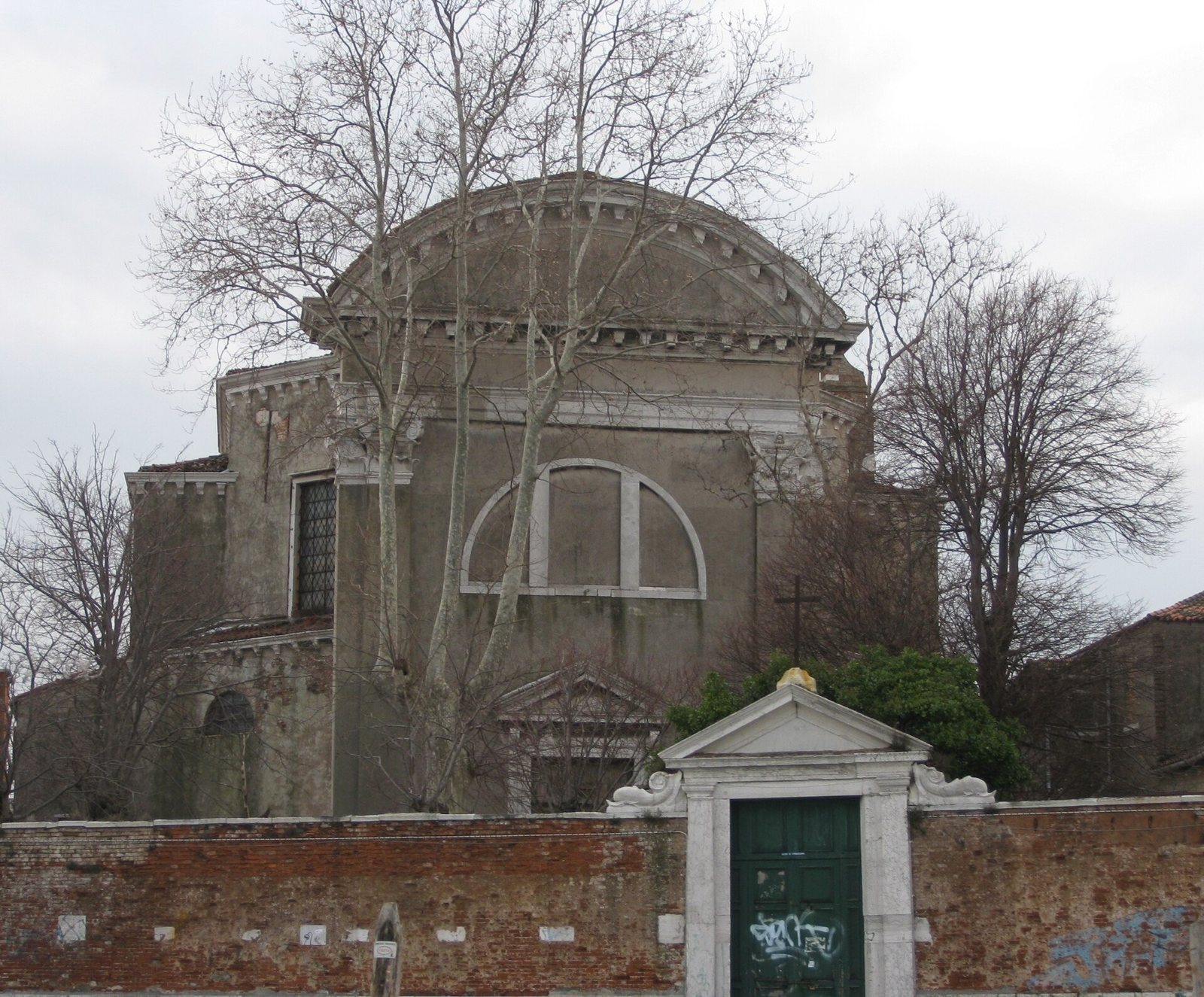
The church and convent stand at Fondamente Nove in Castello, within an enclosure formed by a high wall and a small garden. The church has a centralized octagonal plan, also used at Santa Maria della Salute. Although classified as Baroque, its restrained exterior draws on sixteenth-century architectural studies by Sebastiano Serlio and has an almost Neoclassical character. The plain facade has a portal approached by five steps and framed by pilasters, shallow attached columns, with Composite Corinthian capitals. A large semicircular-headed window above it is bricked up, and a curved pediment crowns the facade. A small bell gable of uncertain date rises at the rear. The exterior can be seen only from the waterway.
Interior and artworks
Chapels and side altars
Seven chapels were arranged around the octagonal interior. Two larger spaces occupied the transverse axis, while four smaller chapels had lower arches and rectangular windows above them. By 1664, the church had seven altars and altarpieces. The first altar on the left held Sebastiano Mazzoni’s Madonna and Child with Saints Dominic and Francis; by 1733, Andrea Celesti had replaced it with a painting of the same subject. The next, larger chapel was dedicated to the founder of the Servite order and contained Pietro Ricchi’s Madonna and Child with Blessed Philip Benizi. A third altar held Francesco Ruschi’s work for the Zon family, showing Saints Francis of Paola and Anthony of Padua with the Christ Child.
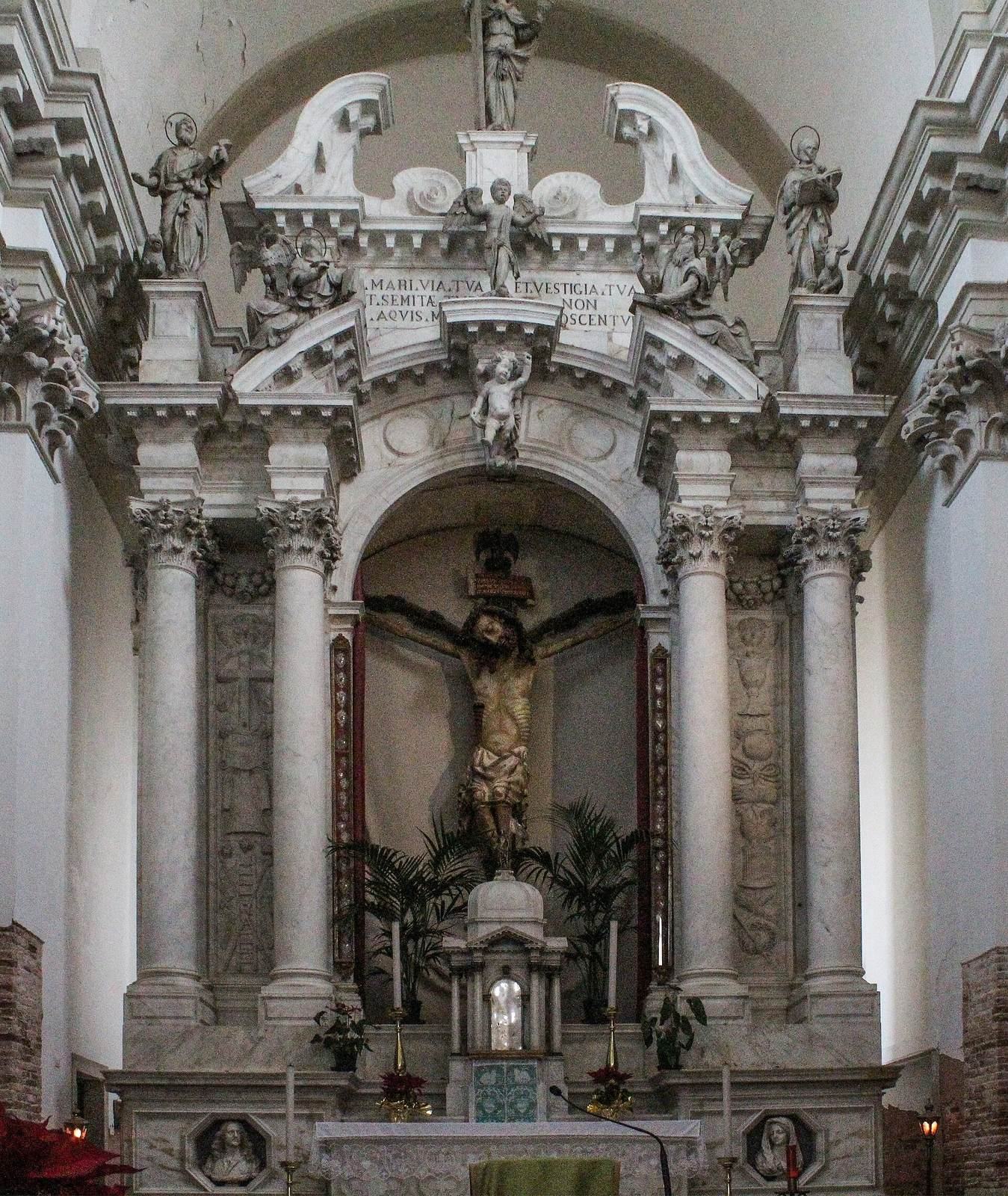
Two smaller chapels on the right contained an Annunciation by Pietro Liberi and a Madonna and Child with Saints Peter, Andrew, James, and Bartholomew by Pietro Della Vecchia. The larger chapel on that side held a large wooden crucifix set against a stone background. An inscription named the Van Axel family as donors and attributed the sculpture to Albrecht Dürer, though Andrea Brustolon is considered the more plausible sculptor. An account from 1663 describes the altars’ marble work as using African, green, and French red marbles, dark paragone stone, and other materials.
Main altar
The main altar was made of white Carrara marble and held Luca Giordano’s large painting Deposition. Three muscular men lower Christ’s lifeless body, while Mary Magdalene kisses one of his feet and John supports the grieving Virgin as he wipes his tears with his cloak. Childlike figures fill the upper part of the composition. Giordano’s painting is now in the Gallerie dell’Accademia. The marble altar was dismantled and reassembled in the altar area of San Domenico in Chioggia.
Sacristy sculptures
The sacristy, a room for storing objects used in worship, held fifteen wooden sculptures by Brustolon representing the Mysteries of the Rosary. They are now in the Diocesan Museum of Chioggia.
Nineteenth-century changes and wall paintings
For the church’s 1851 reopening, three altars from the suppressed church of Santa Maria Maggiore in Santa Croce were installed, and the floor was relaid with material from the demolished church of Saints Biagio and Cataldo on Giudecca. The smaller chapels were bricked up. Paintings added after the restoration included Lattanzio Querena’s Sacred Heart of Jesus and Eugenio Bosa’s Virgin adored by Saints Jerome Emiliani and Aloysius Gonzaga; both were later removed.
Sebastiano Santi’s nineteenth-century wall paintings remain. On the central ceiling, Doge Molin and Abbess De Rossi offer the church to the Virgin. The Evangelists, the writers of the Gospels, appear in the lunettes, crescent-shaped wall areas, above the bricked-up chapels. Another lunette above the main altar area shows Jesus welcoming children.