Santa Cruz Palace: A Historic Court Prison and Government Palace in Madrid


Site at a Glance
- Rating
- 4.5
- Popularity
- Very Low
- Country
- Spain
- Primary era
- Early Modern
- External website
- Open
- Eras represented
- Early Modern
- Civilizations
- Spanish
- Site type
- Civic
- Remains
- Palace
On this page7 sections
History
Santa Cruz Palace is a historic government building in Madrid, Spain, ordered by King Philip IV in 1629 for the royal court’s judicial administration and Court Prison. Built in the Herrerian and Baroque traditions of seventeenth-century Spanish court architecture, it replaced Madrid’s first city prison, which had been established in 1543 and demolished in 1621.
Foundation and construction
Philip IV ordered the palace to accommodate the Sala de Alcaldes de Casa y Corte, a royal judicial body responsible for justice within the monarch’s household and court jurisdiction, together with the Court Prison. Its foundation stone was laid on 14 September 1629. Accounts differ over whether the king attended the ceremony or whether it was presided over by Gabriel Trejo y Paniagua, cardinal-bishop of Malaga and president of the Council of Castile, the monarchy’s principal advisory and administrative institution.
Alonso Carbonel supervised the works from 1629 to 1636, and the building was completed in the early 1640s. The design is generally attributed to Juan Gómez de Mora, a leading architect of the Madrid court associated with the Herrerian tradition, although an earlier attribution to Juan Bautista Crescenci and other proposed attributions reflect continuing uncertainty about the building’s authorship. José de Villarreal, Bartolomé Hurtado García, and José del Olmo contributed to its completion, while Cristóbal de Aguilera, Bartolomé Díaz Arias, and Juan del Río have also been associated with aspects of the work.
Prison and palace
The building initially served both as a prison and as the setting for the court of the Sala de Alcaldes de Casa y Corte. During the reign of Philip V, the first Bourbon king of Spain, it was converted into a palace. Until 1767, the prison remained part of the complex. Afterward, the building was used solely by the Sala de Alcaldes, while the prison moved to an adjacent structure. The name Santa Cruz Palace came from the building’s proximity to the former parish church of Santa Cruz, which was demolished in 1869.
The prison’s history shaped Madrid’s language and literature. The statue of the Archangel Michael above the facade gave rise to the expression “sleeping under the angel,” meaning to go to prison. Until 1674, prisoners were fed once every 24 hours; from that year, poor prisoners also received an evening meal. Among those held there were Salustiano Olózaga, Lope de Vega, Pascual Madoz, José de Espronceda, the liberal councillor Pablo Iglesias González after the events of 7 July 1822, General Rafael del Riego before his execution in the Plaza de la Cebada, and the bandit Luis Candelas. Benito Pérez Galdós’s 1877 novel The Terror of 1824 describes the former Court Prison, including its death-row chapel, conditions, visitors, and condemned prisoners awaiting execution.
Fire, reconstruction, and government use
A fire in 1791 destroyed the upper floor as well as the building’s historical and judicial archives. Juan de Villanueva, chief architect of the Kingdom and a major Spanish neoclassical architect, reconstructed the palace, with particular attention to the facade. When the work ended in 1793, the building officially became the Palace of the Audiencia. An Audiencia was a high court, and the palace then housed Madrid’s Audiencia and courts.
From 1885 to 1898, the building housed the Ministry of Overseas Territories, and its two courtyards were renamed the Colon and Elcano courtyards. Pedro Muguruza renovated the palace in 1930 and restored it in 1941 after damage during the Spanish Civil War. Since 1939, it has been known as Santa Cruz Palace and has served as one of the seats of Spain’s Ministry of Foreign Affairs, European Union and Cooperation. An extension designed by Muguruza opened in 1950. The Spanish state owns the building, which has been protected as an Asset of Cultural Interest, in the monument category, since 1996.
Remains
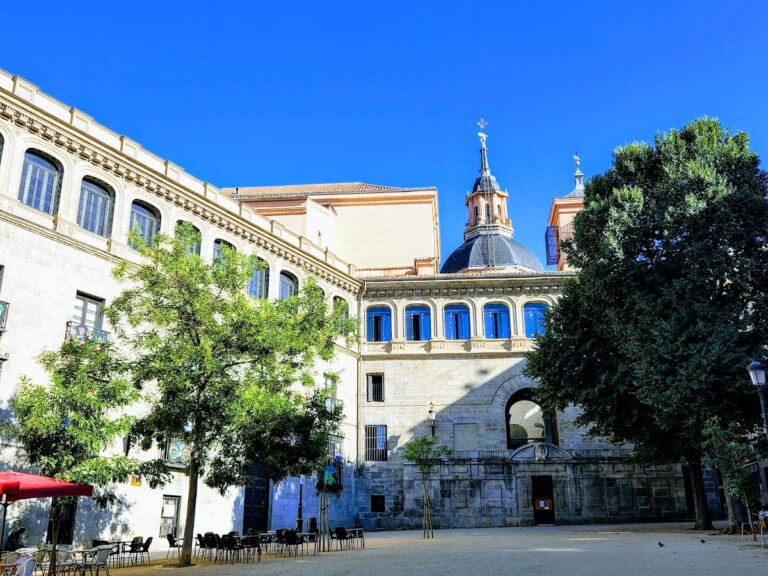
Santa Cruz Palace occupies a rectangular plan near Madrid’s Plaza Mayor, on the Plaza de la Provincia. Corner towers frame the building, while two symmetrical courtyards organize its interior. Inspired by the Tavera Hospital in Toledo, the courtyards supplied ventilation and natural light. They were historically known as the Audiencia Courtyard and the Cells Courtyard, and one provided access to the Audiencia, the principal courtroom where the Sala de Alcaldes heard cases. The reconstructed Fountain of Orpheus stands in the square alongside the palace.
Materials and architectural character
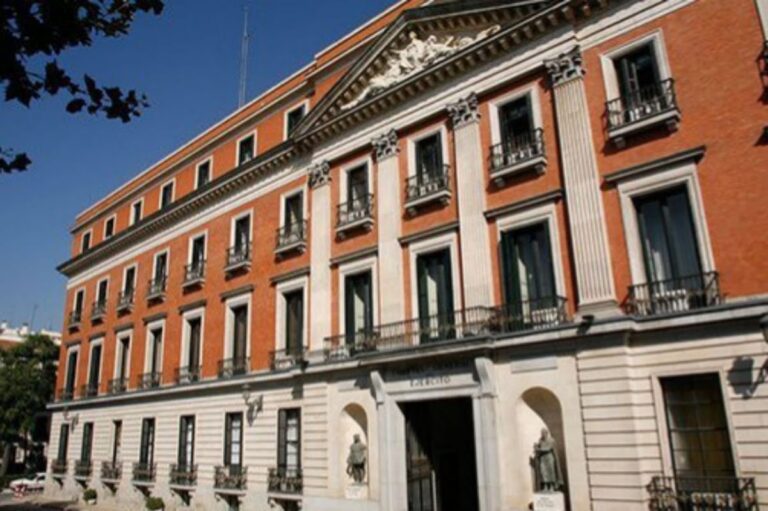
The palace combines exposed brick with granite. Granite forms the corners, portals, door and window lintels, window sills, and the spires that crown the towers. Its architectural character joins Herrerian severity, a style marked by geometric compositions, restrained decoration, and strong masonry forms, with Baroque treatment. This combination reflects Gómez de Mora’s training and the persistence of late Renaissance forms in seventeenth-century court architecture. The use of brick and granite became influential in court architecture and was imitated in other buildings.
Principal facade and sculpture
The principal facade is centered on a severe, altar-like stone composition. A pediment with side scrolls crowns the central arrangement, with a large imperial coat of arms carved beneath it. The monumental portal uses columns whose movement and rhythm give classical elements a more dynamic treatment. A 1675 engraving shows the original portal sculptures, including the Archangel Michael above the main pediment. That sculpture is attributed to Antonio Herrera Barnuevo, a Spanish sculptor, architect, and painter associated with the seventeenth-century court.
Nearby sites