Santa Caterina in Porto: A Catholic Church in Vicenza
Site at a Glance
- Popularity
- Very Low
- Country
- Italy
- Primary era
- Early Modern
- Eras represented
- Medieval, Early Modern
- Civilizations
- Venetian
- Site type
- Religious
- Remains
- Church
On this page8 sections
History
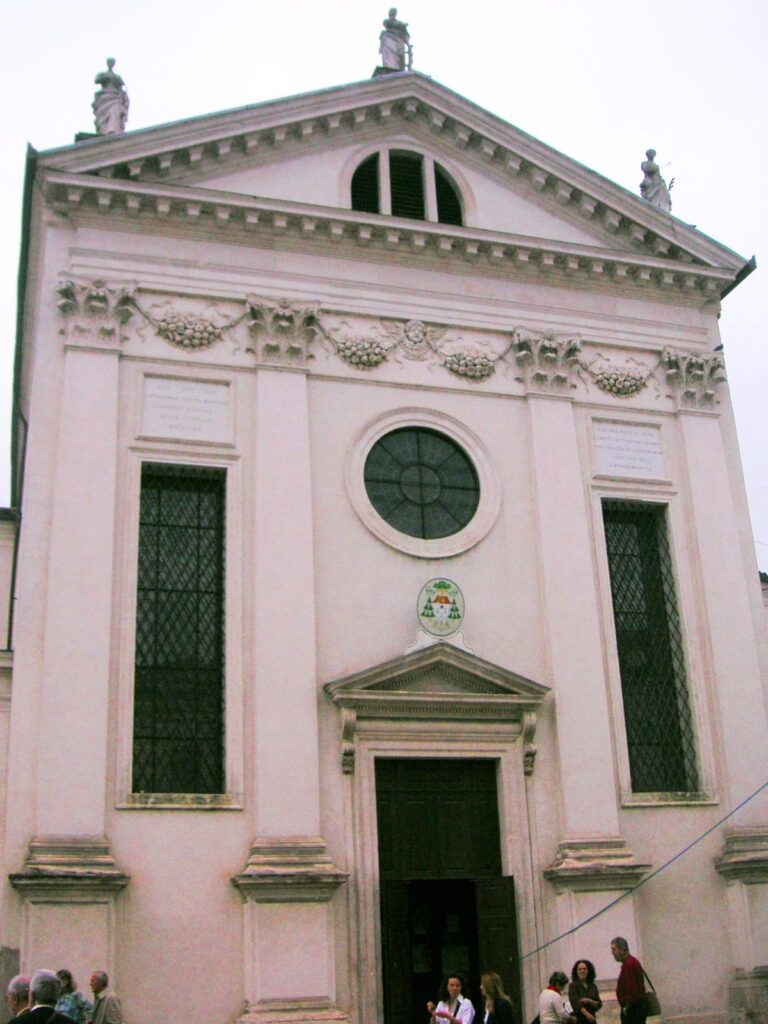
Santa Caterina in Porto is a Roman Catholic church in Borgo Berga, Vicenza, Italy, with medieval origins and a Renaissance-style renovation and enlargement in 1677. Dedicated to Catherine of Alexandria, a Christian saint and martyr, it later served residents of the borough beyond Monte Gate.
Medieval chapel and civic change
A chapel attached to a hospice for pilgrims and poor people stood here during the Middle Ages, perhaps as early as 1309. A local confraternity, an association of worshippers, managed the hospice outside the city. The church was probably rebuilt in 1423. Its name, “in Porto,” distinguishes it from a larger convent church dedicated to the same saint and refers to a nearby landing for boats. For centuries, river travel was more important than the road. After Vicenza came under the Republic of Venice, a maritime state centered on Venice, in the fifteenth century, and the city extended its defensive walls, the hospice ceased to appear in references to the site. The church provided pastoral care to the borough that had grown beyond Monte Gate.
Renovation and restoration
In 1677, the Vicentine jurist Giovanni Maria Bertolo paid for the church to be completely renovated and enlarged. The work gave it a Renaissance design, part of a European movement that renewed interest in classical art and architecture. Count Gaetano Valmarana acquired the church in 1845 and arranged its restoration. At the same time, the road in front was raised and the church floor was relaid in brick, resulting in the loss of earlier tomb slabs.
Remains
Church layout and fittings
The church stands on the Bacchiglione River’s bank in Borgo Berga, near the former landing and the route of the ancient Riviera Berica road. Its layout pairs a restrained façade with a single nave, or main worship space, beneath a trussed ceiling, a roof-supporting frame of connected members.
Façade and entrance
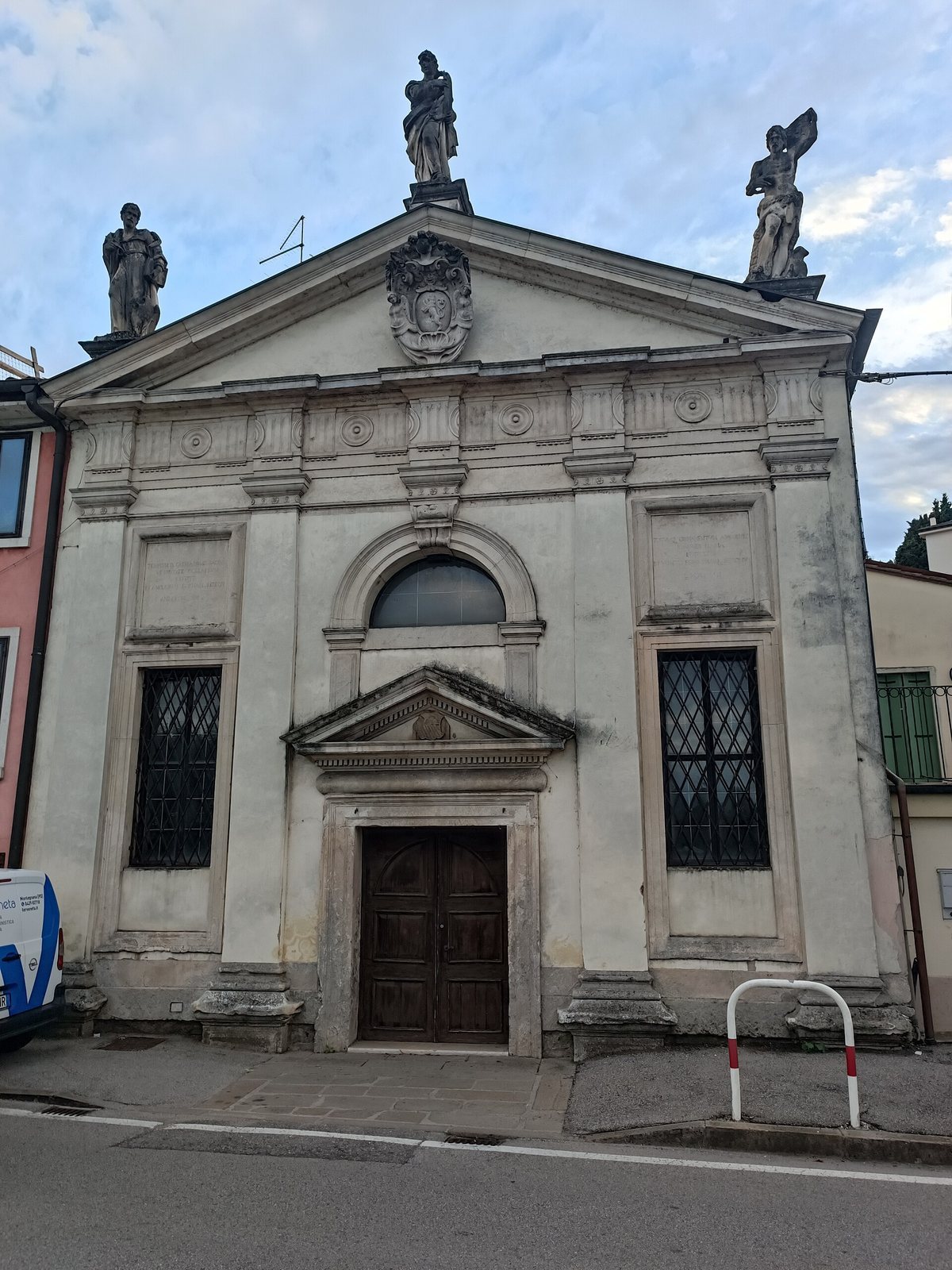
The simple, balanced façade has a pediment, the triangular section crowning its front. Bertolo’s coat of arms appears there, showing a lion standing on its hind legs with two tails. The emblem refers to his training in civil and church law. Three statues carved from soft stone stand above the pediment and are tentatively attributed to the school of sculptor Orazio Marinali. The façade’s design has a Palladian basis, drawing on Andrea Palladio’s classical architectural principles, while using sculptural decoration with restraint.
Nave and altar
The form of the trussed ceiling recalls the church’s fifteenth-century origins. An altar of wood painted to imitate marble remains inside.
Sculpture above the choir doors
A painted sculpture carved from soft stone depicts the Madonna seated on a throne with the Child. It occupies the central niche above the doors leading to the choir area.