San Francesco, Arezzo: A Franciscan Church and Renaissance Art Museum


Site at a Glance
- Rating
- 4.6
- Popularity
- Medium
- Country
- Italy
- Primary era
- Medieval
- External website
- Open
- Eras represented
- Medieval, Early Modern, Modern
- Civilizations
- Grand Duchy of Tuscany, Holy Roman Empire, Italian
- Site type
- Religious
- Remains
- Basilica
On this page22 sections
History
San Francesco, Arezzo, in Italy, is a late-medieval Franciscan church begun in the early fourteenth century and shaped by the Order of Friars Minor, whose members combined communal religious life, preaching, and service in urban communities. Its history reflects the movement of the Franciscans into the city, the development of their church and convent, and the later transformation of the building into both a place of worship and a state museum.
From the first Franciscan settlement to the city church
The Franciscans established themselves in Arezzo in 1211, first occupying a site in the Maccagnolo area. In 1232 they moved to Poggio del Sole, outside the city walls, where they built a church and convent. Hostile or mercenary forces later destroyed that first church, prompting the friars to seek a new position within the urban centre.
In 1290 the commune of Arezzo formally invited the Franciscans inside the city walls. Idino Cacciaconti, who was in exile because of his affiliation with the Guelphs, a medieval Italian faction generally aligned with the papacy, donated a house in the area where the present convent complex would rise. Plans for a new church and convent were prepared between the late thirteenth and early fourteenth centuries. A parchment drawing preserved in the Chapter Archive of Arezzo, attributed on its verso to Fra Giovanni da Pistoia, is regarded as one of the oldest surviving architectural drawings in Italy.
Construction began in the early fourteenth century, but the completed church differed substantially from the first plan. The building acquired its definitive fourteenth-century form as the Franciscans adapted the project to changing needs. In 1322 the friars began transferring works of art from the earlier church to the new one. Among them were Guido da Siena’s Maesta and a large painted Franciscan cross. The transfer of such works also influenced the scale and arrangement of the new building.
The major chapel and the Bacci commission
An adjoining property was purchased in 1348 to make room for the major chapel, which was completed in 1374. The Bacci family held its patronage and commissioned the decoration. Their choice of the True Cross as the central subject connected the chapel to Franciscan devotion, in which the cross and the Crucifixion held particular importance. The order was also associated with the Holy Land and with the promotion of the Crusades.
Bicci di Lorenzo began the fresco decoration, painting the four Evangelists in the vault and the Last Judgement with two Doctors of the Church on the triumphal arch. He died in 1452, and Piero della Francesca then took over the commission. Piero, an Early Renaissance painter known for controlled perspective, monumental figures, and balanced compositions, worked on the chapel from 1453 into the 1460s. The project paused in 1458 and 1459 and was completed in 1466.
The resulting cycle, the Legends of the True Cross, draws its narrative from Jacobus de Voragine’s Golden Legend, a thirteenth-century collection of saints’ lives and legends. Its story begins with the death of Adam and Seth’s meeting with the Archangel Michael, then follows the history of the Cross through its burial, rediscovery, and return to Jerusalem after the Byzantine emperor Heraclius defeated the Sasanian king Khosrau II. The scenes are arranged through thematic and symmetrical relationships rather than in strict chronological sequence.
Alterations, damage, and restoration
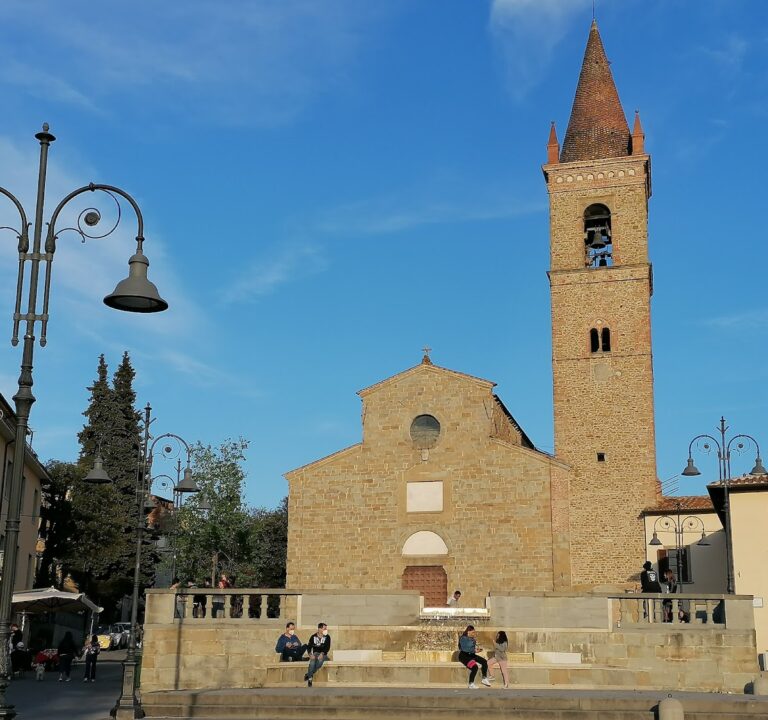
Monna Tessa left 300 lire for the facade during the second half of the fourteenth century. Construction began but stopped at the base because the bequest did not provide enough money to complete it. Around 1600 the campanile, or bell tower, was built. During the seventeenth century, several Gothic chapels were destroyed, frescoes were covered with whitewash, Gothic windows were changed into rectangular openings, and new altars and Baroque decoration altered the church’s appearance.
In 1799 the church was used as military quarters, and frescoes suffered serious damage in several places. Structural difficulties and earthquake-related problems also affected the building. A restoration campaign in the mid-nineteenth century removed the Baroque additions and uncovered frescoes from the fourteenth and fifteenth centuries. Around 1990, an unsuitable intervention carried out after 1870 was corrected. That earlier work had altered the level of the facade by almost two metres and rebuilt its supporting base in a modern form.
Restoration of Piero della Francesca’s frescoes began in 1992 and was completed in 1997, with the cycle receiving specific attention in 1992. The church became a minor basilica in February 1955, a title granted by the pope to recognize a church’s religious and historical importance without making it a cathedral. It remains a Roman Catholic place of worship dedicated to Saint Francis of Assisi and is also a state museum administered through Tuscany’s regional museums authority.
Remains
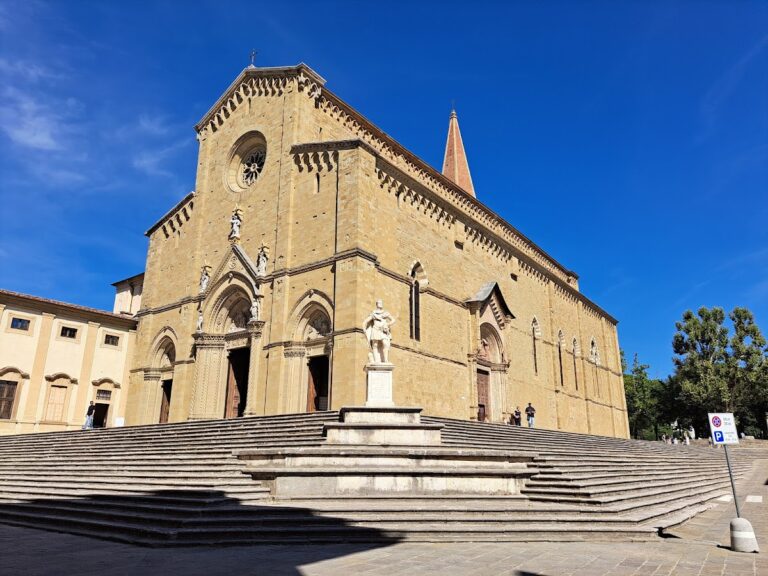
San Francesco is a large, simply designed mendicant church, built principally of brick and stone. A mendicant church belongs to a religious order whose members traditionally depended on communal support and preaching rather than monastic landed wealth. The unfinished facade retains cladding only across its lower base. Inside, the church extends for approximately 17 by 53 metres and is organized around a broad single nave, with chapels opening on the left and niches and Gothic-style shrine frames on the right.
The nave and lower church
Main nave
The nave has an open timber roof structure, while the square chancel is covered by a groin vault, a ceiling formed by intersecting barrel vaults. The three choir chapels are the principal vaulted areas of the upper church. Side altars and chapels contain frescoes by artists active mainly in the fourteenth and fifteenth centuries, including works by Spinello Aretino, Lorentino d’Andrea, and their workshops. Some of these paintings survive in fragmentary condition.
Lower church
Beneath the main church is a smaller lower church, or Chiesa inferiore, divided into three aisles. It has a central nave and two side aisles and is currently used as an exhibition space. Its position beneath the principal church forms a distinct lower level within the Franciscan complex.
Counterfacade and early works
The counterfacade brings together paintings, sculpture, and glass from several periods. Early fifteenth-century frescoes attributed to Giovanni d’Agnolo di Balduccio show the Supper in the House of the Pharisee, Saint Francis giving the Rule and the cord of penance to the two Franciscan orders, and the Ecce Homo. Above the principal portal is Giovanni di Ser Giovanni’s Mystic Marriage of Saint Catherine with Saint Christopher.
The circular oculus, or round window, above the portal contains a stained-glass window made by Guillaume de Marcillat in 1524. It depicts the granting of the indulgence of the Portiuncula. To the right of the portal are a fourteenth-century image of Saint Sebastian and a Madonna and Child frescoed by Domenico Pecori in the early sixteenth century.
Chapels along the nave
Carbonati Chapel
At the beginning of the right wall, the Carbonati Chapel contains Lorentino d’Andrea’s 1463 frescoes of episodes from the life of Saint Anthony of Padua. Between the first and second chapels is a youthful Madonna and Child with Saints and Angels by Niccolò Soggi.
Lambardi Chapel
The Lambardi Chapel preserves fragmentary frescoes attributed to Lorentino d’Andrea depicting the life of Saint Bartholomew. Beyond it are perspectival frescoes by Antonio di Anghiari, showing a Crucifixion with Saint Francis and two warriors above. These works date from 1454 to 1462.
Roselli funerary monument
The final chapel on the left contains the terracotta funerary monument of the jurist Francesco Roselli, made by Michele da Firenze after Roselli’s death in 1430. Its aedicule, a small shrine-like architectural frame, has pilasters, twisted colonnettes, a gable bearing the Roselli arms, and a trilobed opening. Below are Roselli’s sarcophagus and effigy, together with a relief of the Crucifixion and mourners. The monument is in poor condition and no longer retains its original painted appearance. Its terracotta construction is unusual in Tuscany and reflects models influenced by Venice.
Muratori Chapel
The Muratori Chapel contains Bernardino Santino’s painting of Saint Francis in ecstasy before the Virgin. It also holds Giovanni Antonio Lappoli’s Adoration of the Magi with Saints Francis and Anthony of Padua, painted between 1528 and 1531 after a design by Rosso Fiorentino. The latter work was originally made for the high altar.
Catenacci Chapel
The Catenacci Chapel contains a late-fourteenth- or early-fifteenth-century fresco by Spinello Aretino and his workshop. It combines the Crucifixion with mourners, Saint Francis giving the Rule, and Saint Michael the Archangel. A long fresco of Pentecost covers the wall separating this chapel from the next.
Chapel of Saint Anthony of Padua
The Chapel of Saint Anthony of Padua contains Lorentino d’Andrea’s fresco cycle of 1480. The Visitation with Saints Sebastian and Bernard appears above the saint, while four scenes from his life and miracles occupy the sides.
First World War votive chapel
The first chapel on the left was decorated in the 1920s as a votive chapel for those who died in the First World War. It contains a large altarpiece by Giuseppe Cassioli and stained glass made by the Chini Manufactory of Borgo San Lorenzo.
Chapels beside the apse
Guasconi Chapel
The Guasconi Chapel, to the right of the apse, contains Spinello Aretino’s frescoes of the stories of Saints Michael and Giles, completed by 1404. Its altar has a triptych by Niccolò di Pietro Gerini showing the Madonna giving the girdle to Saint Thomas, accompanied by Saints George, Gualberto, Lawrence, and Francis.
Tarlati Chapel
The Tarlati Chapel, to the left of the apse, belonged to the family of Guido Tarlati, bishop and later absolute lord of Arezzo. It contains a detached Annunciation attributed either to the young Luca Signorelli or to Matteo Lappoli. Another Annunciation, with Saints Francis and Jerome and the prophets David and Isaiah, was painted by Neri di Bicci around 1470 and originated in the Florentine galleries.
Bacci Chapel
The major chapel, also called the Bacci Chapel, is the principal setting for Piero della Francesca’s fresco cycle. The paintings occupy three levels of the side walls and continue around the large window on the eastern wall. Among the scenes are the death of Adam, the meeting of the Queen of Sheba and Solomon, the burial and discovery of the True Cross, the Annunciation, and Constantine’s dream.
The cycle also shows Constantine’s victory over Maxentius at the Milvian Bridge, the torture of Judah, the battle between Heraclius and Khosrau, and the return of the Cross to Jerusalem. The prophets Jeremiah and Isaiah appear among the paintings. Battle scenes dominate the lower register, while courtly scenes occupy the upper register. Suspended before the chapel is a very large painted crucifix by the anonymous Master of San Francesco of Arezzo, an artist close in style to Cimabue and probably active in the 1270s or 1280s.
Later furnishings
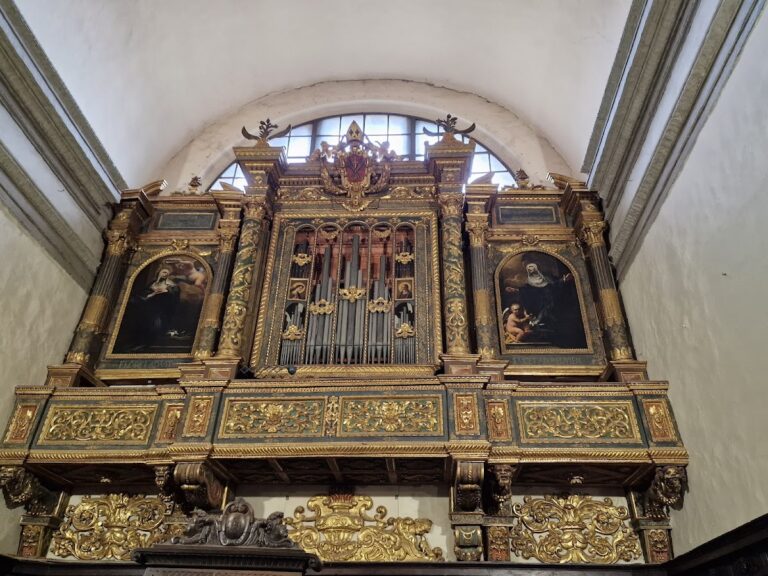
An organ made by the Costamagna firm was installed in 1969 and donated by the commune of Arezzo on 4 October of that year. It has two manuals, a pedalboard, and electric transmission. Together with the surviving frescoes, altarpieces, stained glass, sculpture, and transferred works from the earlier Franciscan church, it forms part of the building’s accumulated interior furnishings.
Nearby sites