Sant’Agostino: An Augustinian Church in Arezzo, Italy


Site at a Glance
- Rating
- 4.5
- Popularity
- Low
- Country
- Italy
- Primary era
- Early Modern
- Eras represented
- Medieval, Early Modern, Modern
- Civilizations
- Republic of Florence
- Site type
- Religious
- Remains
- Church
On this page13 sections
History
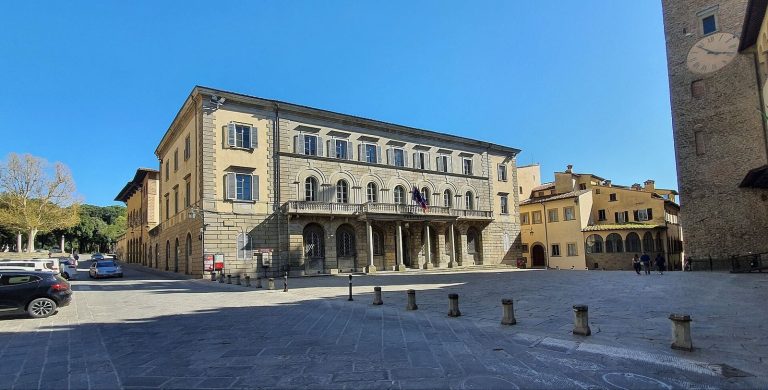
Sant’Agostino is a Catholic church in Arezzo, Italy, founded by the Augustinian Hermits in 1257. The order, a Catholic mendicant community following the rule associated with Saint Augustine, established the church in the medieval period. Sant’Agostino now gives its name to the square where it stands and serves as the official place of worship for Arezzo’s Porta Sant’Andrea district. It belongs to the Diocese of Arezzo-Cortona-Sansepolcro, a geographic ecclesiastical jurisdiction overseen by a bishop.
Foundation and medieval expansion
The original church was small, but construction of a larger building with three aisles began in 1330. By 1341, the new church was regarded as one of the largest buildings in Arezzo. The complex also included a large convent, although the work remained incomplete through the fifteenth century. Bequests from Mariotto di Cristoforo Cofani and his sons revived the project from 1491 and enabled the completion of the building.
Between the late fourteenth and early sixteenth centuries, the church received fresco cycles and panel paintings by artists including Barna of Siena, Iacopo del Casentino, Parri Spinello, Taddeo di Bartolo, Bartolomeo della Gatta, and Luca Signorelli. Tradition also holds that Martin Luther, then an Augustinian monk and later the central reformer of the Protestant Reformation, stayed at the Arezzo monastery in 1510 while travelling to Rome.
The eighteenth-century remodelling
Between 1761 and 1766, Sant’Agostino underwent a radical transformation. Its dimensions were reduced by half, and the interior was completely remodelled according to Baroque and Rococo principles. Baroque decoration commonly emphasizes theatrical movement and rich ornament, while Rococo is lighter and highly decorative. Francesco and Giuliano Rusca and Carlo Speroni carried out the work under a design by Filippo Giustini. The earlier paintings and frescoes disappeared during this transformation, while the fifteenth-century facade remained unchanged.
Later history
Lightning damaged the tip of the bell tower in 1825. Its summit was rebuilt in the early 1920s, and four small pinnacles were added later. In 1922, a thief from Lucca stole the fragmented altarpiece of the Circumcision of Jesus and divided it into five sections for possible sale on the black market. The thief was discovered and arrested. The work then remained for decades in the storage rooms of Arezzo’s State Museum of Medieval and Modern Art before being restored and returned to Sant’Agostino. Three sections were also stolen in an act of vandalism attributed to the Genoese art dealer Ildebrando Bossi.
Remains
Exterior and structural features
Facade
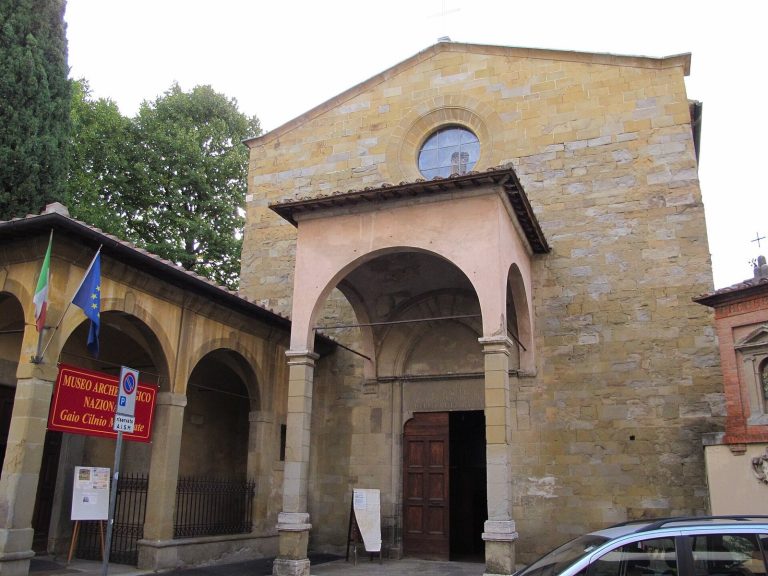
The church retains a fifteenth-century facade built of dressed stone. Its exterior combines Romanesque elements with the later Baroque and Rococo architectural vocabulary of the remodelled interior. The facade was not altered during the work of 1761 to 1766, preserving its medieval appearance while the building behind it was reduced to half its former dimensions.
Bell tower
An imposing quadrangular bell tower rises beside the church. Lightning struck its tip in 1825, after which the summit was rebuilt in the early 1920s. Four small pinnacles were added at a later date, completing the tower’s present form.
Interior decoration and artworks
Stucco and choir loft
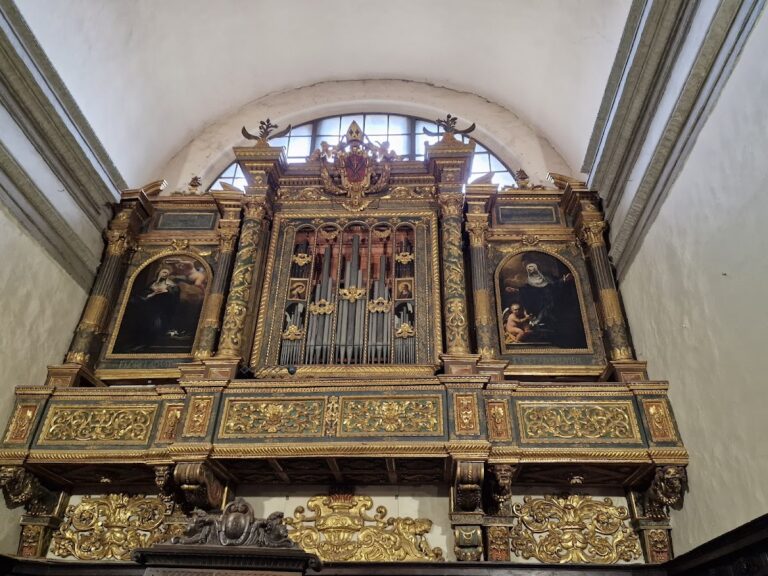
The interior is richly ornamented with elaborate stucco work by Francesco and Giuliano Rusca and Carlo Speroni. Stucco is a plaster material shaped into architectural decoration. On the counterfacade, Francesco Rusca designed a cantoria, or choir loft, dated 1765. The apse, the church’s terminal area, contains a carved wooden choir made by Ludovico Paci in 1771.
Paintings near the entrance and along the walls
Near the entrance is Bernardino Santini’s 1642 painting of a wooden Crucifix on canvas with Saint John the Evangelist and Saint Francis. To the right stands Franco Fedeli’s 1982 Nativity, made by the Arezzo artist. The left wall contains Jesus as the Good Shepherd from 1770, a 2003 stained-glass Pentecost commissioned from Vetrate Artistiche Fiorentine, and a Madonna and Child with Saint Augustine begun in the early sixteenth century and repainted in the eighteenth century.
One of the oldest surviving works is a 1498 fresco showing Saint Bernardino between Saint Jerome and Saint Ignatius of Antioch. The painting is attributed probably to the local artist Lorentino d’Andrea, whose work was influenced by Piero della Francesca. The left wall also displays Bernardino Santini’s 1650 Madonna and Child between Saint Augustine and Saint Monica, together with an eighteenth-century allegorical figure. Beside the altar are Santini’s 1650 Blessed Cristina Visconti and Mattia de Mare’s Saint Augustine from 1770.
The right wall begins with a large anonymous fresco from the late fifteenth century, again showing Saint Bernardino between Saint Jerome and Saint Ignatius of Antioch. It continues with statues of the Immaculate Madonna and the Sacred Heart of Jesus, Bernardino Santini’s 1650 Saint Augustine between the Crucifix, the Madonna, and Saints Nicholas of Tolentino and William of Aquitaine, and another eighteenth-century allegorical figure. To the right of the altar are Santini’s 1650 Blessed Giles Colonna and Mattia de Mare’s Saint Donatus from 1770.
Altarpiece and chapel paintings
The fragmented Circumcision of Jesus, dated 1506, was created jointly by Niccolò Soggi, Domenico Pecori of Arezzo, and the Spanish artist Fernando De Coca. The altarpiece was first made for the church of the Holy Trinity, also known as the Misericordia, and was moved to Sant’Agostino during the eighteenth century. Following its theft, division, long storage, restoration, and return, it remained visibly incomplete.
The high altar carries five paintings. They include Blessed Bonventura and Saint Clare of Montefalco by Salvi Castellucci, dated 1660; Saint Augustine and Saint Mary Magdalene by Matteo Lappoli, from the early sixteenth century; and the central Madonna of Consolation, an anonymous work from the late eighteenth century. The winter chapel contains Bernardino Santini’s 1650 Saint John of Sahagún Saving a Child. Saint John of Sahagún was a fifteenth-century Spanish Augustinian friar and preacher later venerated as a saint.
Sacristy works
The sacristy contains a mid-seventeenth-century Penitent Saint Mary Magdalene and Supper at Emmaus, a twentieth-century work by the Ravenna artist Orazio Toschi. Together with the paintings and sculpture in the nave, these works preserve layers of artistic patronage from the early sixteenth century through the modern period.