Palazzo della Fraternita dei Laici: Arezzo’s Charitable Brotherhood Headquarters


Site at a Glance
- Rating
- 4.6
- Popularity
- Low
- Country
- Italy
- Primary era
- Medieval
- External website
- Open
- Eras represented
- Medieval, Early Modern
- Civilizations
- Republic of Florence
- Site type
- Civic
- Remains
- Palace
On this page15 sections
History
Palazzo della Fraternita dei Laici is a Gothic and Renaissance civic palace in Arezzo, Italy, built and expanded by the Fraternita dei Laici, a lay charitable religious association, from the late fourteenth century onward. Located in Piazza Grande, it became the headquarters of an institution that assisted the poor and sick and held an important place in the civic life of the city.
The charitable confraternity
The Fraternita dei Laici was active in Arezzo by the first half of the thirteenth century. Its members initially collected alms in the streets and distributed them twice each week to people in need. Bishop Guglielmino degli Ubertini granted the institution a formal statute in 1262. It then became known as the Pious Confraternity of Mercy, a lay congregation with religious inspiration and a particular devotion to the Virgin Mary.
Bequests and donations allowed the confraternity to acquire land, workshops, houses, mills, hospitals, and shelters. Some gifts came from wealthy nobles, including individuals whose fortunes or reputations had suffered. As its resources grew, the confraternity administered hospitals and other charitable institutions, extending its activities well beyond the original distribution of alms.
Construction in Piazza Grande
During the fourteenth century, the confraternity’s growing wealth and civic responsibilities led to plans for a prestigious headquarters in Piazza Grande, the political and economic center of Arezzo. A design was prepared in 1363, and construction began in 1375 with support from benefactors such as the goldsmith Paolo Ghiselli and the merchant Lazzaro Bacci.
The first design and the initial building work were entrusted to the Florentine masters Baldino di Cino and Niccolò di Francesco. The first level of the facade was completed in 1377, but construction was then interrupted by the conflict between Ghibelline Arezzo and Guelf-aligned Florence. Ghibellines generally supported imperial authority, while Guelfs generally supported the papacy, and their rivalry often affected the government and building projects of Italian cities.
Work resumed in 1433 after the confraternity had recovered its wealth following the wars. The palace developed through successive Gothic, Renaissance, and sixteenth-century phases, generally dated to 1375–1377, 1433–1460, and the mid-sixteenth century. The building was enlarged toward the rear, away from Piazza Grande, and a new audience hall was created.
Renaissance and Vasarian additions
The facade’s artistic program expanded during the fifteenth century. Bernardo Rossellino’s Madonna della Misericordia was installed at its center in 1434, and figures of saints were subsequently added. This image type shows the Virgin extending a protective mantle over those under her care, an especially appropriate subject for a confraternity devoted to helping the poor and sick.
In 1460, Giuliano and Algozzo da Settignano added the palace’s loggetta, a small upper loggia, with a balustrade decorated by an amphora pattern. The final major phase took place under Giorgio Vasari, the Aretine painter, architect, and art historian. Between 1550 and 1560 he directed the completion of the upper bell structure that closes the facade. The astronomical clock was installed in 1552.
The confraternity also commissioned the adjacent Logge Vasariane and the Church of Saints Lorentino and Pergentino, built over the saints’ tomb beside an ancient Roman road. These projects formed part of its wider role in the religious and civic landscape of Arezzo.
Later institutional use
In the late fourteenth century, Spinello Aretino painted Christ in Pietà in the portal lunette. The original fresco was transferred in 1952 and preserved inside the palace, while a copy was placed above the portal in the 1870s.
Grand Duke Pietro Leopoldo of Lorraine supported a renovation that began in 1781, when several interiors were redecorated. From 1786, the palace was rented to the Civil Court of Arezzo, known as the Civil Tribunal of the Ruota, and the confraternity moved its administration to the Palazzo del Comune. The building remained the city courthouse until 2008, when the court moved to a new building outside the walls. The change enabled the Fraternita dei Laici to return to its historic headquarters.
After restoration, the palace again housed the confraternity and its historical archive. It has also housed a museum since 2010, including the permanent exhibition Treasures of Arezzo since 2017. The building provides space for temporary exhibitions and houses the Casa della Musica di Arezzo, an institution devoted to musical education and research that also organizes concerts.
Remains
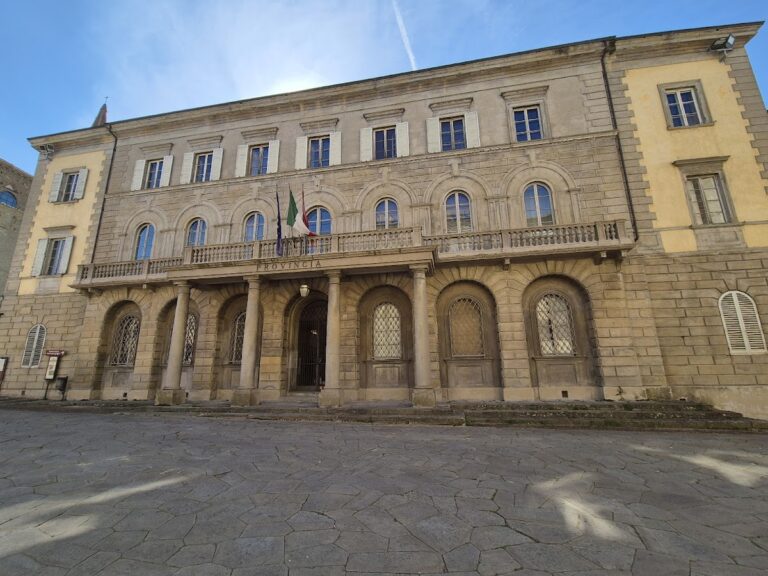
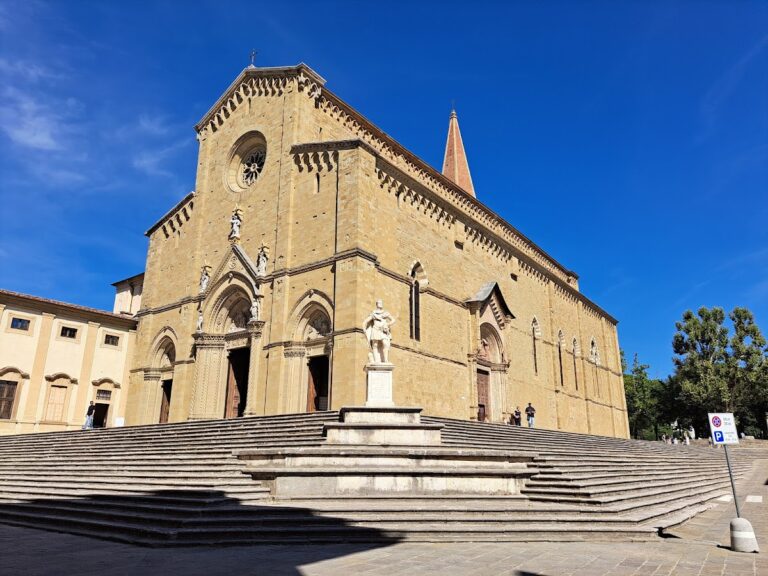
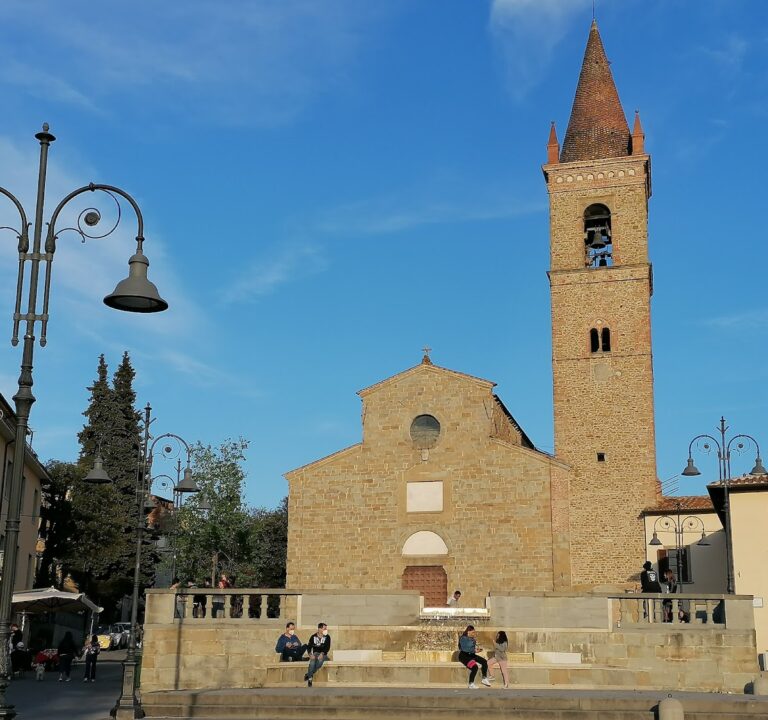
The palace occupies the northwest corner of Piazza Grande, between the apse of Santa Maria della Pieve and the Logge Vasariane. Its facade brings together fourteenth-century Gothic construction, fifteenth-century Renaissance sculpture and loggia work, and the sixteenth-century bell structure designed by Vasari. The building extends toward the rear, where the enlarged complex includes the audience hall and other interior spaces.
Facade and upper structure
Portal and sculptural program
The ground-floor facade has a large, strongly splayed central portal flanked by two single-light windows. A lunette above the entrance contains the copy of Spinello Aretino’s Christ in Pietà, while the original fresco is preserved inside the palace. Above it, Bernardo Rossellino’s Madonna della Misericordia shows the Virgin with the Christ Child beneath a protective mantle. The facade also includes figures of Saints Lorentino and Pergentino and statues identified as Saints Donato and Gregorio, attributed to Rossellino.
Loggetta and bell structure
The loggetta added in 1460 has a balustrade decorated with an amphora motif. Behind the upper bell structure is a terrace overlooking the historic center, surrounding hills, and valleys. Vasari’s bell gable contains three bells as well as the astronomical clock, integrating timekeeping and astronomical display into the upper composition of the facade.
Astronomical clock
Felice di Salvatore da Fossato made the astronomical clock in 1552. It displays the hour, the position of the Sun, and the Moon’s position in the lunar calendar according to a sixteenth-century Ptolemaic model. This was a geocentric explanation of the cosmos that placed Earth at the center and represented the Sun and Moon as moving around it.
The clock operates manually through weights and counterweights. Its central bell, installed in 1578, strikes the hours in a six-hour cycle and rings once at the half-hour. The oldest bell, on the left, marks each quarter-hour, while the bell on the right doubles the first quarter-hour strike. Sundials once provided a means of resetting the time. Interventions in 1998 and 2002 restored the clock’s timekeeping and astronomical functions.
Painted interiors
Audience hall fresco
The ground-floor audience hall contains Parri di Spinello’s large 1448 fresco of the Madonna della Misericordia. The Virgin stands with the Child and extends a mantle held by two angels. Its subject continues the confraternity’s repeated use of Marian protection in its religious commissions.
Sala Torri and related paintings
The Sala Torri contains a detached fresco of the Madonna della Misericordia by Bartolomeo della Gatta. The museum also preserves his Saint Roch before the Palazzo della Fraternita, commissioned to commemorate the end of the plague of 1477.
Museum collections
The museum displays paintings, sculptures, armor, and drawings. Its permanent exhibition, Treasures of Arezzo, includes jewelry and works associated with artists and designers such as Ettore Sottsass, Giò Pomodoro, Dolce and Gabbana, and Salvatore Fiume. Approximately 6,000 works from the Bartolini Collection are preserved in the palace and displayed on a rotating basis. The collection belonged to the Aretine sculptor Ranieri Bartolini, who bequeathed it to the confraternity, and consists mainly of works by Neoclassical artists.
Among the Bartolini drawings is Giorgio Vasari’s preparatory study for the 1542 Allegory of Hilaritas, intended for a fresco in the Palazzo della Cancelleria in Rome. The study was found while the collection was being catalogued. The palace also contains Giovan Battista Girelli’s 1696 painting of the Plan of the Vasarian Aqueduct of Arezzo and the Piazza Fountain, displayed near an eighteenth-century view of Piazza Grande attributed to Donato Conti.
Opposite the entrance, at the foot of the staircase, is Angelo Ricci’s 1782 painting of Pallas Athena, or Italic Minerva. The palace’s principal staircase leads to a gallery and the exhibition route, whose first section includes Parri di Spinello’s Maestà, also called Madonna della Misericordia with Saints Donato and Gregorio, followed by Spinello Aretino’s original Pietà fresco.
Piazza Fountain
The palace is associated with the ancient Piazza Fountain behind the apse of Santa Maria della Pieve. The fountain is supplied by the ancient aqueduct represented in Girelli’s 1696 map and is attributed to Vasari.
Nearby sites