Arezzo Cathedral: Gothic Cathedral of Saints Peter and Donatus in Italy


Site at a Glance
- Rating
- 4.7
- Popularity
- Medium
- Country
- Italy
- Primary era
- Medieval
- External website
- Open
- Eras represented
- Medieval, Early Modern, Modern
- Civilizations
- Grand Duchy of Tuscany, Italian, Republic of Florence
- Site type
- Religious
- Remains
- Cathedral
On this page28 sections
History
Arezzo Cathedral, officially the Cathedral of Saints Peter and Donatus, is the principal Roman Catholic church of Arezzo, Italy, and a Gothic basilica built through several medieval and later phases. It became the cathedral of the Diocese of Arezzo-Cortona-Sansepolcro in 1986, after serving as the cathedral of the Diocese of Arezzo from 1203. The church stands on the summit of the city hill, on the site of an early Christian church and probably the former urban acropolis.
From Colle del Pionta to the city hill
Arezzo’s first cathedral stood outside the city walls on Colle del Pionta, beside the tomb and cult site of Donatus, a fourth-century bishop and martyr regarded as the city’s patron saint. In 1203, Pope Innocent III ordered the cathedral transferred within the walls. Its new seat was the Benedictine church of San Pietro Maggiore, which stood in front of the present cathedral and is documented as early as 876.
Pope Gregory X visited Arezzo in December 1275 while returning from the Second Council of Lyon, a major church council concerned with relations between the western and eastern churches. He died in the city on 10 January 1276. Gregory left 30,000 gold florins for a new cathedral, was first buried in San Pietro Maggiore, and was later transferred to the completed church.
Medieval construction
Construction began in 1278 under Bishop Guglielmino degli Ubertini. Repeated interruptions slowed the work, and the cathedral was consecrated in 1289 with only the apse and the first two bays completed. After Ubertini’s death, building resumed under Bishop Guido Tarlati, who governed Arezzo from 1312 to 1327. The third bay was built during his episcopate, while the side portal was completed after his death.
Tarlati was both a bishop and a political lord of Arezzo, associated with the Ghibelline faction. His commemorative monument inside the cathedral presents these ecclesiastical, military, and political dimensions together. The sale of Arezzo to the Florentine Signoria in 1384 caused another interruption in construction. Work restarted in 1471 and continued until 1511, bringing the nave as far as the facade.
Later changes and continuing devotion
The facade remained unfinished until a new sandstone elevation was built and partly reconstructed between 1901 and 1914. The cathedral retained its dedication to Saint Donatus, whose body is preserved in the fourteenth-century marble ark behind the main altar. His head is kept in a reliquary bust at the church of Santa Maria della Pieve in Arezzo.
On 15 February 1796, during a period of violent earthquakes in central Italy, worshippers believed that a soot-blackened ceramic image of the Madonna in an Arezzo inn had miraculously turned white. The image was brought to the cathedral, and the Chapel of Madonna del Conforto was built beside the north aisle in the following years. The chapel became an important place of pilgrimage and prayer.
The cathedral’s original stained-glass windows in the polygonal apse were lost during the Second World War, when the blast from a bomb displaced the air and caused the windows to fall. They were later reconstructed. The wooden choir designed by Giorgio Vasari in 1554 was removed in 2012 during the creation of a new presbytery area. The principal organ, built by Luca di Bernardino da Cortona in 1534 to 1536, was reconstructed by Pier Paolo Donati in 1990. A Tamburini organ had been installed in the Chapel of Madonna del Conforto in 1922, and Paolo Ciabatti built a choir organ in 2022.
The detached bell tower
The campanile, or separate bell tower, also has a prolonged history. Earlier bell structures were demolished because they affected nearby buildings or the supporting wall of Guillaume de Marcillat’s windows. A later detached tower was abandoned when an underground aquifer threatened its stability. Construction of the present Neo-Gothic tower began in the mid-nineteenth century under Bishop Monsignor Fiascaini, to a design by Luigi Mercanti, but stopped after the bishop’s death in 1860. Giuseppe Castellucci completed the upper section and its 21-metre spire between 1931 and 1937. The tower was then connected to the cathedral by building apartments for custodians.
Remains
Plan, facade, and bell tower
Gothic structure
The cathedral is a three-aisled Gothic basilica with six bays in each aisle and no transept. Cross-ribbed vaults cover the bays, carrying their loads through intersecting ribs. Large pointed arches rest on compound piers, substantial supports formed from several attached shafts, whose capitals bear carved decoration. Circular oculi, or round windows, illuminate the central nave, while those along the left wall are blocked.
Apse and facade
The central nave ends in a thirteenth-century polygonal apse. Three tall two-light windows, each divided by a central shaft, carry polychrome glazing. The central window represents the Assumption of the Virgin among saints, while the side windows show other saints. Traces of frescoes belong to the earlier thirteenth-century structure.
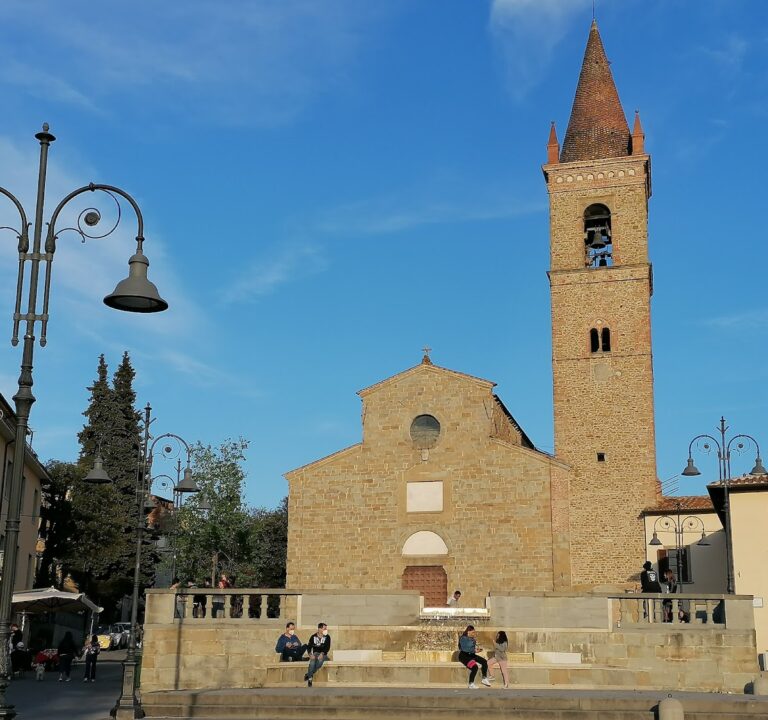
The present facade was built from sandstone between 1901 and 1914 in a Neo-Gothic design by Dante Viviani, replacing the unfinished earlier elevation. Giuseppe Cassioli, Enrico Quattrini, and Viviani produced its sculptural decoration. Slightly projecting rectangular pilasters express the division into three aisles, while a line of corbelled arches crowns the elevation. Three splayed portals have sculpted relief lunettes, semicircular fields above the doorways. The central portal also has a gable containing Christ the Redeemer above Saint Donatus and Blessed Gregory, each beneath an individual canopy. A circular rose window occupies the central-aisle zone.
Right side and medieval portal
The right side preserves the original fourteenth-century structure, faced with sandstone blocks. Several metres from the facade, a visible boundary separates the twentieth-century sandstone from the older masonry. The large right-side portal, built in sandstone around 1325 to 1340, has a round arch, an upper cusp, and two reused sections of porphyry columns taken from a pagan temple. Its structure has affinities with the main portal of the Palazzo dei Priori in Perugia.
The front piers of the portal carry low-relief Allegories of the Vices and Virtues. In the stucco lunette, the enthroned and nursing Madonna and Child appear between Blessed Gregory X and Saint Donatus, while two angels hold a curtain. The sculptures are attributed to an artist from Orvieto or Perugia.
Campanile
The present campanile stands separately north of the choir. Its hexagonal plan rises through four superimposed stages divided by cornices. The lower stage has no openings, and each of the two middle stages has a tall pointed lancet window on each side. The fourth stage and spire belong to the twentieth-century completion and contain splayed circular rose windows with elaborate stone frames. The tower reaches 76.8 metres in height.
Nave, apse, and west-end works
Windows and pulpits
Circular rose windows in the counterfacade and along the right wall illuminate the central nave. Guillaume de Marcillat created the 3.5-metre-wide rose window in 1518 for the Opera del Duomo, the institution responsible for commissioning and supervising works connected with the cathedral. It depicts Pentecost, with the Apostles seated around the Madonna, two angels, and the dove of the Holy Spirit above. Marcillat and Salvi Castellucci also painted frescoes on the upper walls and vaults of the nave.
Two Renaissance marble pulpits with relief decoration stand near the piers between the third and fourth bays. Two other fifteenth-century pulpits of the Marchigian school are attached to the central-nave piers.
Main altar and Ark of Saint Donatus
The main altar predates 1289 and is decorated on three sides with pointed arches supported by small columns. Behind it stands the marble Ark of Saint Donatus, mentioned in 1362 but assembled through several earlier stages. Its twelve supports end in Gothic pinnacles and finials. Artists from Siena, Florence, and Arezzo contributed to the ark during the fourteenth century. Agostino di Giovanni and Agnolo di Ventura produced the lower zone, while Giovanni di Francesco and Betto di Francesco created much of the upper zone and its large, formerly painted marble panel of the Madonna and Child. The rear, supported by six Corinthian columns, shows scenes from the life of Saint Donatus.
Baptismal font and organ loft
At the beginning of the interior, a hexagonal baptismal font carries reliefs associated with Donatello’s school. The Baptism of Christ is attributed to Donatello with workshop participation. Francesco di Simone Ferrucci is associated with the scenes of Saint Ilarian baptizing Donatus and Donatus baptizing an unbeliever. A seventeenth-century altar and the eighteenth-century tomb of Francesco Redi stand nearby.
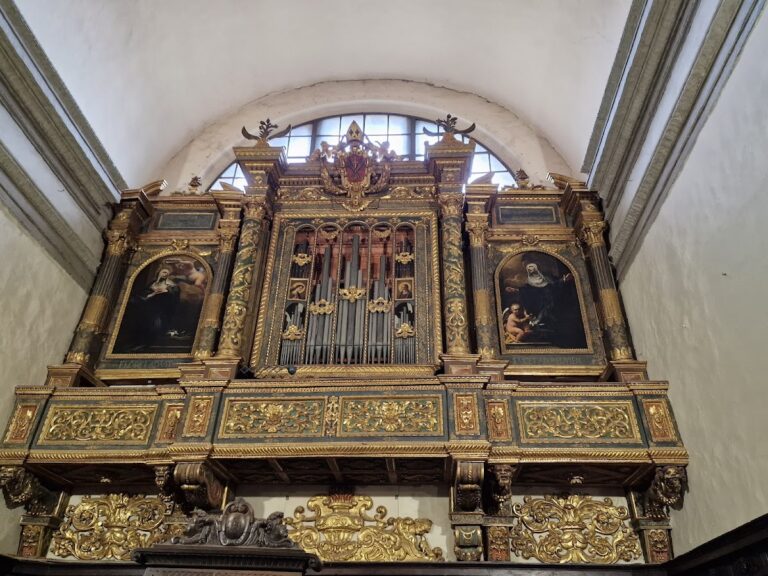
A further seventeenth-century altar carries Pietro Benvenuti’s The Martyrdom of Saint Donatus, dated 1794. The Renaissance organ by Luca da Cortona stands on a choir loft supported by brackets of pietra serena stone. The loft was the first known architectural work of the young Giorgio Vasari.
Madonna and Child aedicule
Beneath the organ loft is a glazed aedicule, a small architectural shrine, containing a venerated wooden Madonna and Child blessing. An Arezzo sculptor made the image in the 1280s, and it was brought from the church of San Martino after that church was demolished in 1539. Fragments of early fourteenth-century frescoes around the shrine depict the Madonna and episodes from the lives of Saints Anne, Joachim, and Julian. They are attributed to Gregorio d’Arezzo and Donato d’Arezzo.
Memorials and paintings in the aisles
Cenotaph of Guido Tarlati
Beyond a side portal stands the cenotaph of Guido Tarlati, a commemorative monument for the bishop that does not necessarily contain his body. Made in 1330 by the Sienese sculptors Agostino di Giovanni and Agnolo di Ventura, possibly to a design by Giotto, it takes the form of an aedicule with a round arch, pediment, and Gothic pinnacles. Beneath it are sixteen narrative reliefs with explanatory inscriptions describing Tarlati’s life.
Magdalene and Saint Sylvester works
Nearby is Piero della Francesca’s Magdalene, painted between 1460 and 1466. Its treatment of light gives the figure unusual vitality and sculptural force, presenting her as if emerging from an arch.
The wall behind the altar of Saint Sylvester contains two frescoes by Giuseppe Servolini, representing Pope Leo the Great and Pope John I, together with a fresco of the enthroned Madonna and Child among angels. The central stained-glass window, made by Guillaume de Marcillat in 1516, depicts an Allegory of Charity, Saint Sylvester, and Saint Lucy.
Fourteenth-century frescoes and tombs
The right aisle contains fragments of a fourteenth-century fresco by Buonamico Buffalmacco, painted around 1321 to 1327 in the arched opening of an earlier Gothic chapel. Its two registers show Saint Francis, Pope Gregory X, the enthroned Virgin and Child, and two other saints above, with Christ as the Man of Sorrows and the Instruments of the Passion below. The accompanying wall painting was attributed to Margaritone d’Arezzo, but it was lost after alterations and the monument’s relocation.
Another right-aisle fresco shows the Madonna and Child among six scenes from the lives of Saints Christopher and James the Greater. An anonymous master painted it in the second half of the fourteenth century. The tomb monument of Ciuto Tarlati, dated 1334, incorporates a fourth-century fluted marble sarcophagus and reliefs by the Sienese sculptor Giovanni di Agostino. Above it is a fresco of the Crucifixion between the Madonna and saints, with the donor Ciuccio di Vanni Tarlati di Pietramala, by the Arezzo painter known as the Master of the Bishopric. The monument is the surviving one of the twenty-six chapels recorded in the cathedral during the fourteenth century.
Passion cycle and stained glass
The final bay of the right aisle contains Giuseppe Servolini’s fresco cycle of the Passion. Christ Carrying the Cross occupies the side wall, while Ecce Homo and The Crucifixion are on the rear wall. The Baroque altar of the Blessed Sacrament stands before it. The same wall has a lancet window showing the Redeemer above and Saint Donatus below.
Five large two-light windows in the right aisle contain stained glass by Guillaume de Marcillat. Their subjects are The Calling of Saint Matthew, dated 1519 to 1520; The Baptism of Christ, dated 1519; The Expulsion of the Merchants from the Temple, dated 1522 to 1524; Christ and the Adulteress, dated 1522 to 1524; and The Raising of Lazarus, dated 1519 to 1520. The first two were commissioned by the Opera del Duomo.
Chapel of Madonna del Conforto
Architecture and decoration
Giuseppe Del Rosso designed the Chapel of Madonna del Conforto, which was built between 1796 and 1817. Its cruciform plan combines Neo-Gothic features with Neoclassical elements. Two ambulatory passages lead around a presbytery bay and a three-lobed apse with rectangular single-light windows. Above is a coffered hemispherical dome with a lantern but no drum. A marble screen with four supporting piers and an eighteenth-century wrought-iron grille forms the entrance.
Luigi Ademollo and Luigi Catani painted the chapel’s vault frescoes between 1799 and 1802. Their scenes come from the Old and New Testaments, while monochrome frescoes of Isaiah, Ezekiel, Daniel, and Jeremiah occupy the pendentives, curved triangular supports that carry a dome above a polygonal or square space.
Altar and devotional image
The presbytery contains a polychrome-marble altar completed in 1823 to a design by Valadier. Its altarpiece is flanked by marble angels holding candlesticks and crowned by a triangular pediment resting on Corinthian columns. The image of Madonna del Conforto is housed within it.
Works transferred to the chapel
The chapel contains works transferred from other churches in Arezzo, including glazed terracottas by Andrea della Robbia and his workshop. They include The Trinity between Saints Bernard and Donatus, dated 1485 to 1486; The Madonna and Child between Saints Donatus, Magdalene, Apollonia, and Bernardino of Siena, dated 1493 to 1495, with a predella, the lower section of an altarpiece, showing the Communion of Saint Mary Magdalene, the Nativity, and the Martyrdom of Saint Apollonia; and The Assumption of the Virgin, made by the workshop in the last decade of the fifteenth century. Another glazed work, The Madonna in Adoration of the Child, dates to around 1480.
Other works in the chapel are Pietro Benvenuti’s Judith Showing the Head of Holofernes, dated 1804, and Luigi Sabatelli’s Abigail Appeasing David, dated 1806. Their subjects were conceived as typological references to Mary’s intercession. The chapel also contains the marble funerary monument of Nicolò Marcacci and the Neoclassical entrance to the bishops’ burial vault.
Tombs and organs
Tomb of Pope Gregory X
The marble tomb of Pope Gregory X has a Gothic canopy with a pointed arch resting on columns with carved capitals. Its sarcophagus carries reliefs of the Agnus Dei and the Evangelists within almond-shaped frames called mandorlas. A reclining statue of the pope lies above it. Angels, a trilobed medallion of blessing Christ, and floral and vegetal ornament enrich the canopy, whose columns use African, Lunense, and Apuan marble. Further reliefs on the sarcophagus represent the Annunciation, Saints Peter and Paul, and the Evangelists. The monument’s attribution remains uncertain, with Gano di Fazio or his workshop and Camaino di Crescentino proposed.
Musical instruments
The cathedral’s three organs represent different stages of its musical history. The principal Renaissance organ by Luca di Bernardino da Cortona has one manual and seven stops after its reconstruction. The Chapel of Madonna del Conforto contains the Tamburini opus 76 organ of 1922. Paolo Ciabatti built the choir organ in 2022, with two manuals, pedal, and twenty-seven stops.
Nearby sites