Saint George Church, Sopron: A Historic Catholic Parish and Collegiate Church
Site at a Glance
- Rating
- 4.7
- Popularity
- Low
- Country
- Hungary
- Primary era
- Early Modern
- Eras represented
- Medieval, Early Modern, Modern
- Civilizations
- Habsburg, Hungarian
- Site type
- Religious
- Remains
- Church
On this page14 sections
History
Saint George Church is a Roman Catholic Latin-rite church in Sopron, Hungary, dedicated to Saint George and serving as both a city parish church and collegiate church. Its Gothic origins date to around 1380, while another construction record places the building’s work in 1393–1398. The church belongs to the Diocese of Győr and has developed through successive Protestant, Catholic, Jesuit, and collegiate phases.
Gothic foundation and Protestant use
The foundation is attributed to János Schmuckenpfennig, who established the church as penance for a murder he had committed. A papal bull issued by Pope Boniface IX in 1398, a formal document from the pope, mentions the Chapel of Saint George and Saint Margaret. The original building was a Gothic single-nave church.
During the sixteenth century, Protestants took over the church. By the end of that century it served as an Evangelical parish church. In 1633, the Protestant community acquired an organ made by Johann Wöckherl, an organ builder from Passau.
Catholic return and Jesuit rebuilding
The church returned to Catholic ownership in 1674 during the Counter-Reformation, the Catholic Church’s program of renewal in response to the spread of Protestant movements. Leopold Karl von Kollonitsch transferred it to the Jesuits, a Catholic religious order that became a major force in this renewal.
A fire destroyed the building in 1676. It was enlarged and rebuilt between 1685 and 1694, when its interior received a Baroque treatment and the side chapels were added. The rebuilt church was consecrated in 1694. Pietro Antonio Conti remodelled it in 1705–1706, including its stucco decoration.
The church was damaged during the Kuruc siege of 1705. The Kuruc were anti-Habsburg insurgents and political-military opponents active in the Kingdom of Hungary during the late seventeenth and early eighteenth centuries. The facade was rebuilt in 1714, and a tower was erected in 1720.
Collegiate church and modern restoration
After the suppression of the Jesuit order, the church passed to the Collegiate Chapter of Saint George in 1780 and became its seat. A collegiate chapter is a corporate body of clergy attached to a collegiate church and responsible for its worship and religious administration.
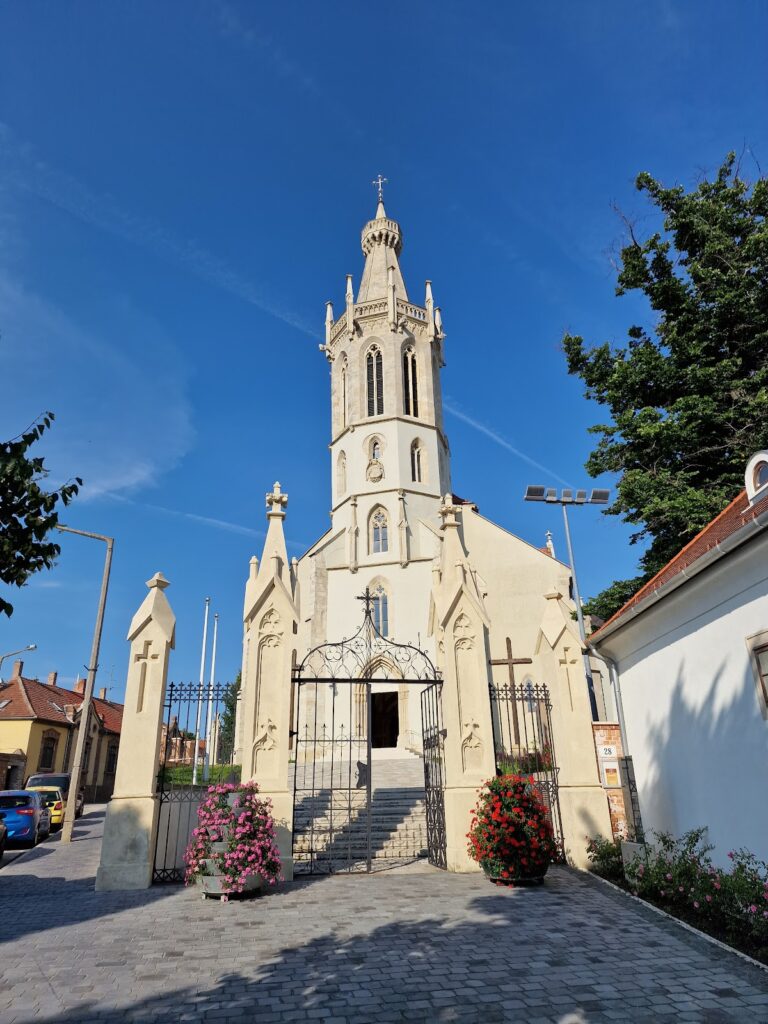
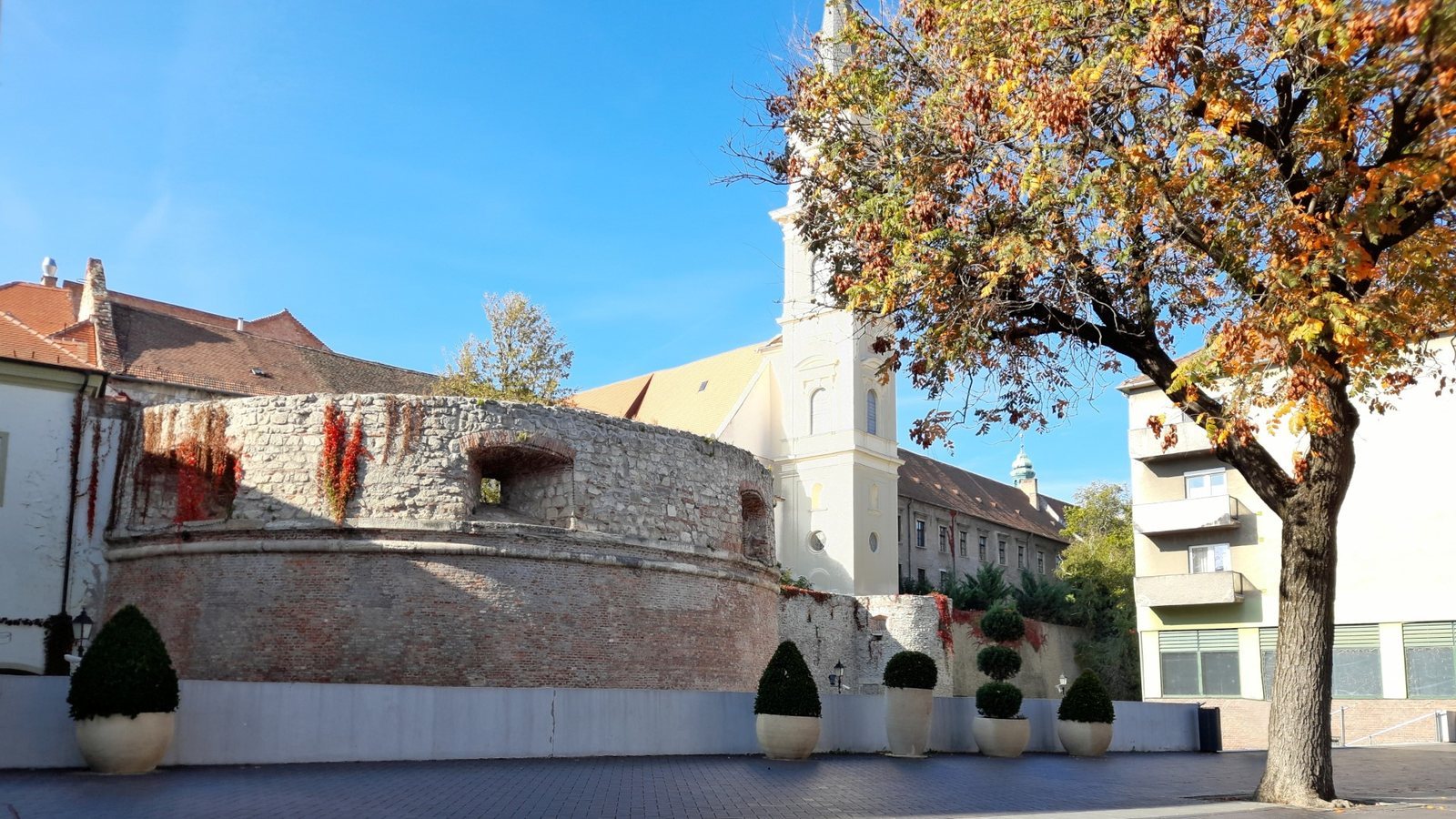
The building was restored in 1839. Its tower collapsed in 1869, and a replacement was built in 1882 to designs by Ferdinand Spach in the Neo-Renaissance style. Severe damage in 1944 was followed by restorations in 1948 and 1959. From 2003 to 2008, the organ was restored and its original 1756 disposition was reconstructed.
Remains
The surviving church combines the pointed-arch termination and other elements of its Gothic single-nave beginning with a Baroque interior and a later Neo-Renaissance tower. Eight Baroque chapels adjoin the nave, four on each side, while galleries above them carry the coats of arms of their founders.
Facade and medieval survivals
Seventeenth-century facade
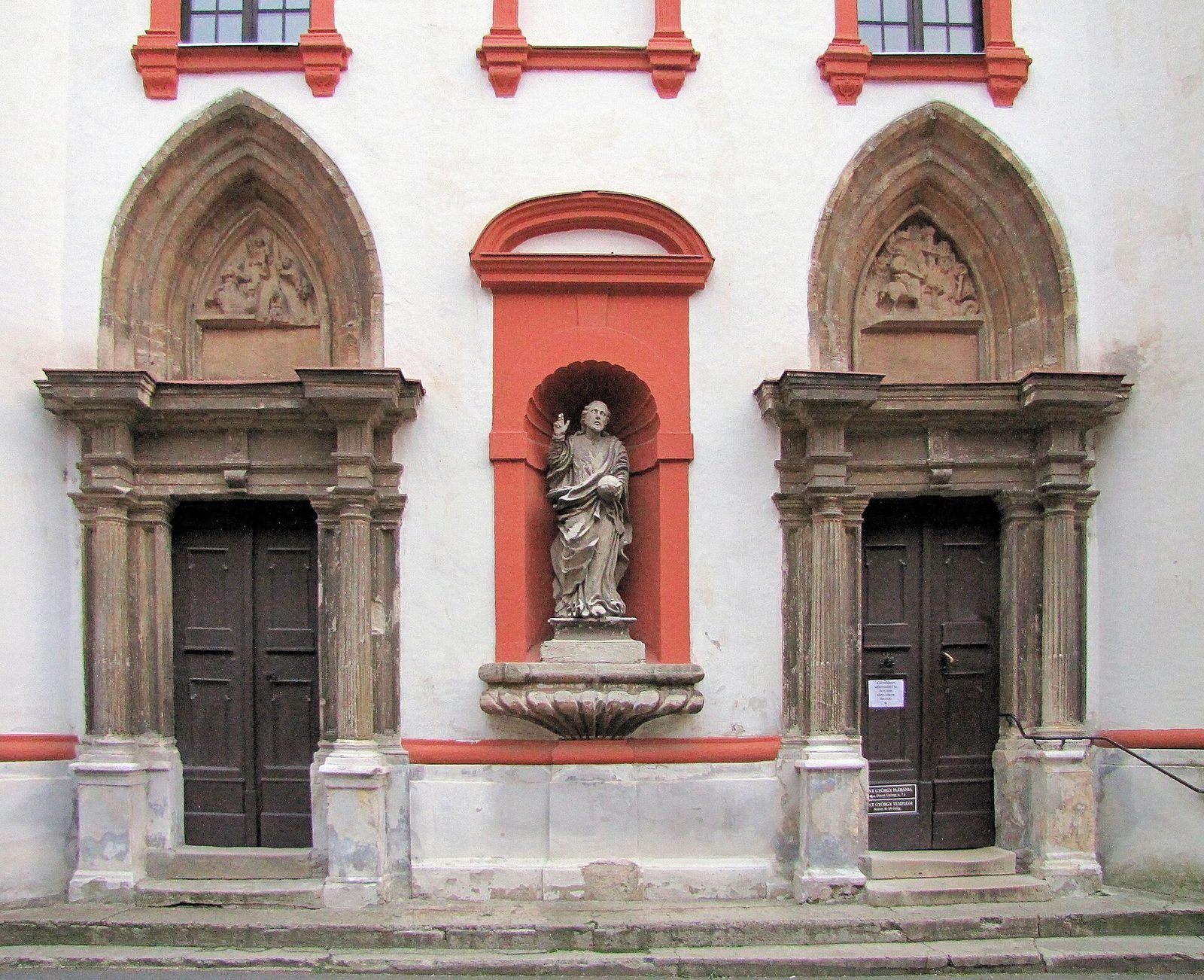
The present facade has a dynamic Italianate appearance dating from the seventeenth century. Two cornices divide it horizontally, and a pediment crowns the elevation. The lower level contains two portals. Their tympana preserve Gothic scenes, with the life of Saint Margaret shown on the left and Saint George fighting on the right. A niche between the portals contains a figure of Jesus Christ.
Upper niches and fresco fragment
Two further niches occupy the upper facade. The left holds a sculpture of the Virgin Mary, and the right contains a sculpture of Saint Joseph. Inside, a baptistery chapel beside the sanctuary retains fragments of a medieval fresco.
Baroque interior and furnishings
Main altar and presbytery
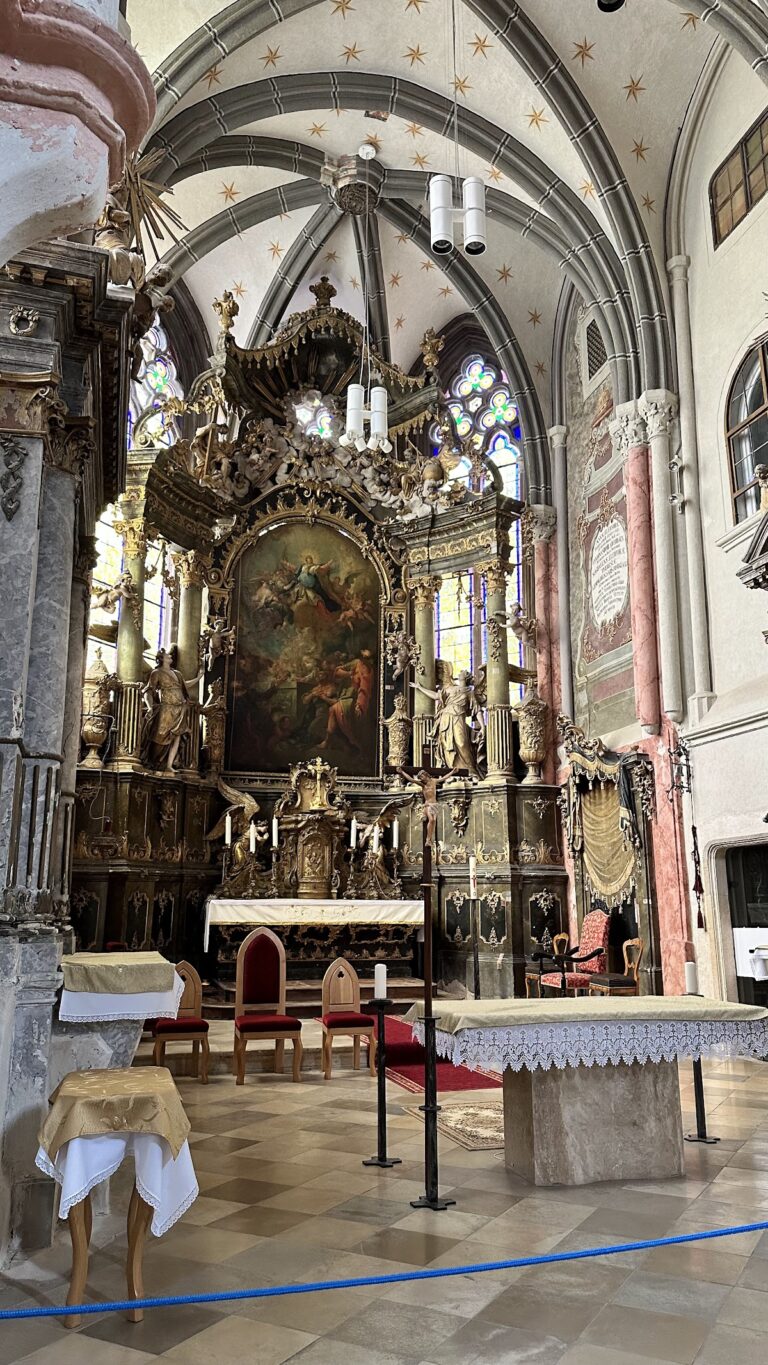
The interior is richly decorated with stucco produced by Pietro Antonio Conti in 1705–1706, and most of the furnishings date from the eighteenth century. Mihály Esterházy made the main altar in 1713. Its 1761 painting by Martin Altomonte depicts Saint George, including the saint’s martyrdom and transfiguration. Sculptures of Saints Ignatius of Loyola and Francis Xavier stand beside the altar.
Devotional and liturgical furnishings
The Rococo tabernacle dates from 1765. Choir stalls beside the presbytery, the area around the main altar reserved for clergy, date from 1780. The pulpit was made in 1693 and remodelled in 1765. Figures of Christ and the Evangelists decorate it.
Organ and tower
Wöckherl organ
Johann Wöckherl built the organ in 1633, and part of that instrument survives. Its organ case dates from 1756. The restoration carried out between 2003 and 2008 reconstructed the instrument’s original 1756 disposition. The church is described as having one of the oldest surviving organs in the world and as housing Hungary’s oldest organ.
Tower and bells
The church has a single tower with an attached belfry, where three bells are hung. Its bell is described as the oldest in Sopron.