Goat Church, Sopron: A Gothic Roman Catholic Church in Hungary


Site at a Glance
- Rating
- 4.7
- Popularity
- Low
- Country
- Hungary
- Primary era
- Medieval
- External website
- Open
- Eras represented
- Medieval, Early Modern, Modern
- Civilizations
- Habsburg, Hungarian
- Site type
- Religious
- Remains
- Church
On this page9 sections
History
Goat Church is a Roman Catholic church in Hungary, built in the medieval period by Franciscan friars in Sopron. Construction probably began in the 1270s and was completed around 1280, making the church one of the outstanding works of early Gothic architecture in Hungary. Also called the Church of the Assumption of the Virgin Mary or the Benedictine Church, it belongs to the Diocese of Győr and is dedicated to the Assumption, celebrated liturgically on August 15.
Franciscan foundation and medieval construction
The Franciscans, a Catholic mendicant order founded by Saint Francis of Assisi, first established a monastery in the center of Sopron. The church was then built beside it. The friars are first documented in Sopron in 1280, while construction of the church probably started in the preceding decade.
Work proceeded in stages. Builders completed the sanctuary first, followed by the nave and the rood screen around 1300. The rood screen was a medieval partition separating the sanctuary from the main body of the church. Work on the nave continued into the fourteenth century. Between 1379 and 1409, Henrik Gaissel financed the nave pillars, vault, and tower, with the vault and tower completed around 1400.
A royal and political setting
The church later became a venue for major political and dynastic ceremonies. The Hungarian Diet, the kingdom’s representative political assembly, met there five times, in 1553, 1622, 1625, 1635, and 1681. Ferdinand III was crowned king of Hungary in the church in 1625. Eleonora of Palatinate-Neuburg, a German princess who became queen through her marriage to the Habsburg ruler Leopold I, was crowned queen there in 1681.
Fire, religious change, and restoration
In 1676, the church roof was destroyed by fire. Reconstruction added a new Baroque gable, and the interior was subsequently furnished in the Baroque style. This created the combination of medieval Gothic fabric and later Baroque decoration that characterizes the church today.
Emperor Joseph II dissolved the Franciscan monastery in 1787. The church then remained unused for more than a decade before being entrusted to the Benedictines, a monastic order following the Rule of Saint Benedict, in 1802. Ferenc Storno designed the side altars made in 1852. A major rebuilding campaign from 1884 to 1894 added the upper stories of the tower. Further repairs and restoration took place between 2007 and 2011.
The name and local traditions
The name “Goat Church” comes from the goat on the coat of arms of the Gaissel family, whose donation paid for major construction work. A local tradition offers another explanation, saying that a goat scratched at the ground and revealed buried treasure that financed the church.
Another penitential tradition concerns Henrik Gaissel, described as one of Sopron’s wealthiest citizens. According to the story, he donated his fortune after killing another citizen and then moved to Austria. One version names the victim as János Büki, but this remains a tradition rather than an established fact.
Remains
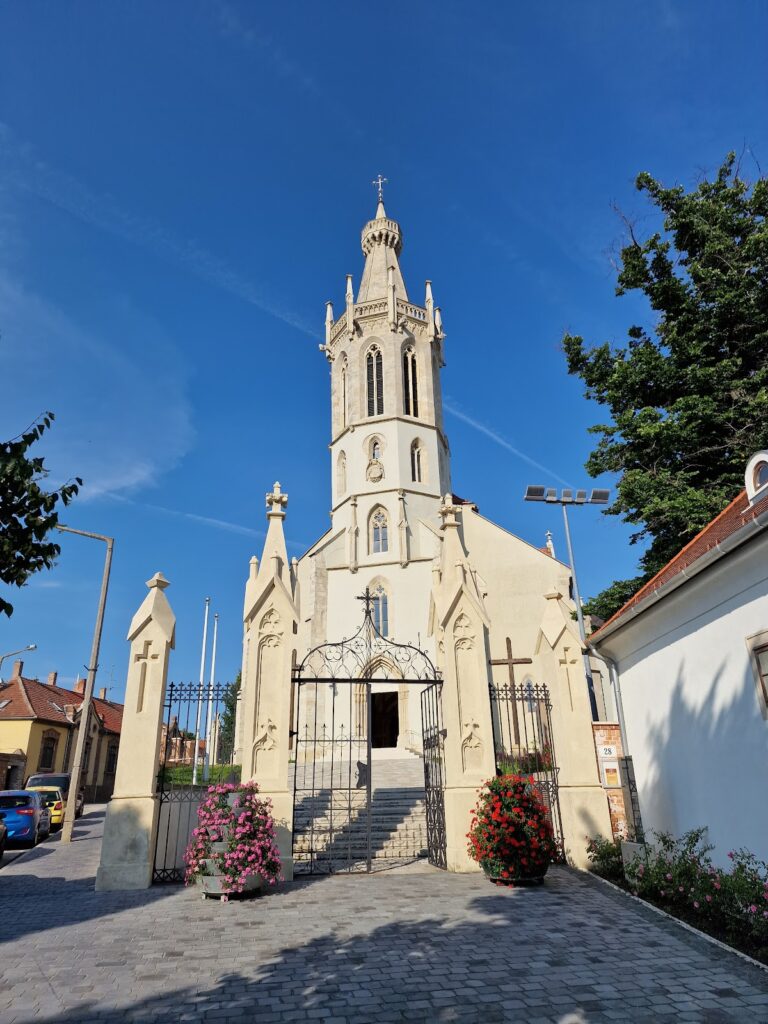
Goat Church is a Gothic, three-aisled hall church with one tower. In a hall church, the nave and side aisles are approximately the same height, creating a unified interior space. The building combines medieval stonework, pointed arches, vaulting, and tracery with later Baroque furnishings. Its tower rises approximately 47 meters on the north side, facing Sopron’s main square.
Sanctuary and nave
The long sanctuary has a polygonal plan, a vault, and large tracery windows. Its thirteenth-century stone carvings closely resemble those in the western part of the Church of the Assumption in Buda. The square-plan nave is supported by massive round pillars. Leaf-decorated corbels encircle them and carry the cross-vaults, while their simpler capitals resemble those in the sanctuary.
Opposing statue niches occupy the sides of the four nave pillars. One pillar carries the carved goat-headed coat of arms associated with Henrik Gaissel. The rood screen has finely articulated pillars and pointed-arch arcades, while thin partition walls once separated its chapels.
Tower and portals
The tower has a richly moulded pointed-arch portal without a separate capital zone. Its projecting front is crowned by a steep vimperg, a pointed Gothic gable above a portal or window. The decoration includes the Gaissel goat coat of arms, and the tower’s form follows that of Saint Michael’s Church in Sopron. A nineteenth-century bell named Saint Benedict hangs in the tower. Frigyes Seltenhofer cast the bell.
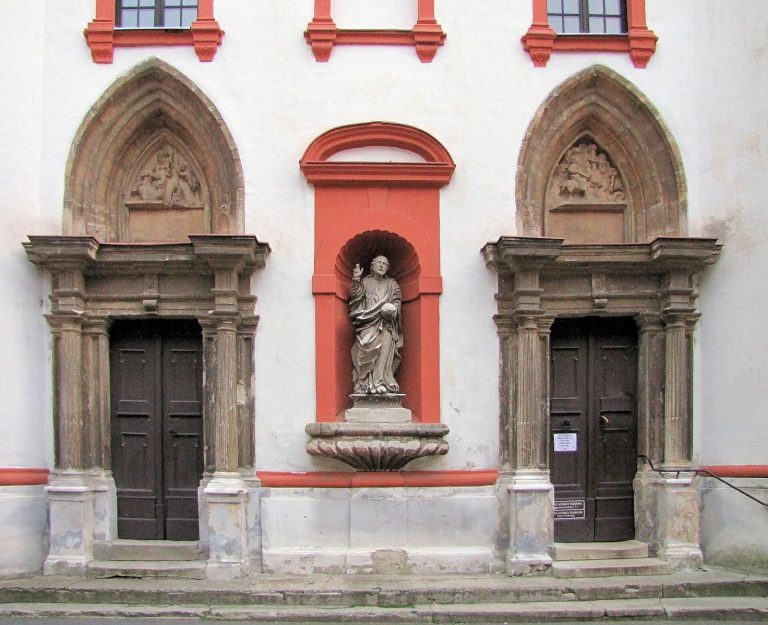
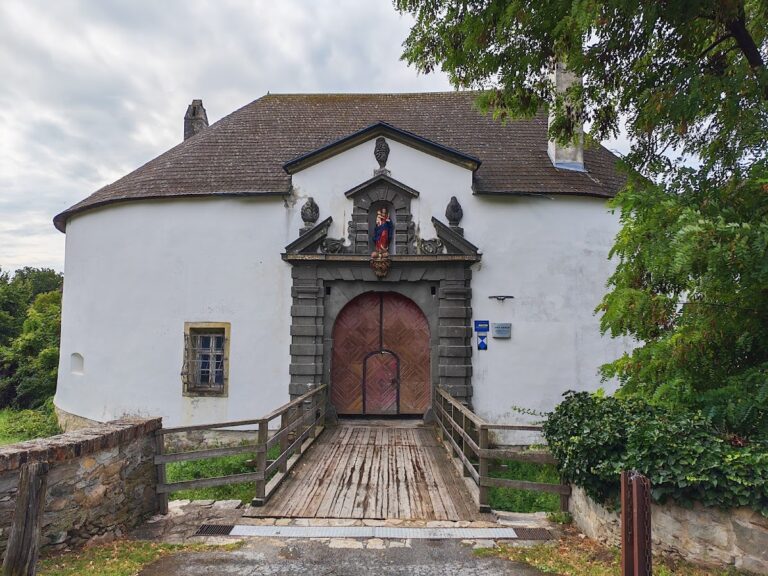
The south-portal tympanum contains a fifteenth-century Gothic statue of Mary beneath a protective mantle. A plague column stands in front of the church.
Furnishings and interior decoration
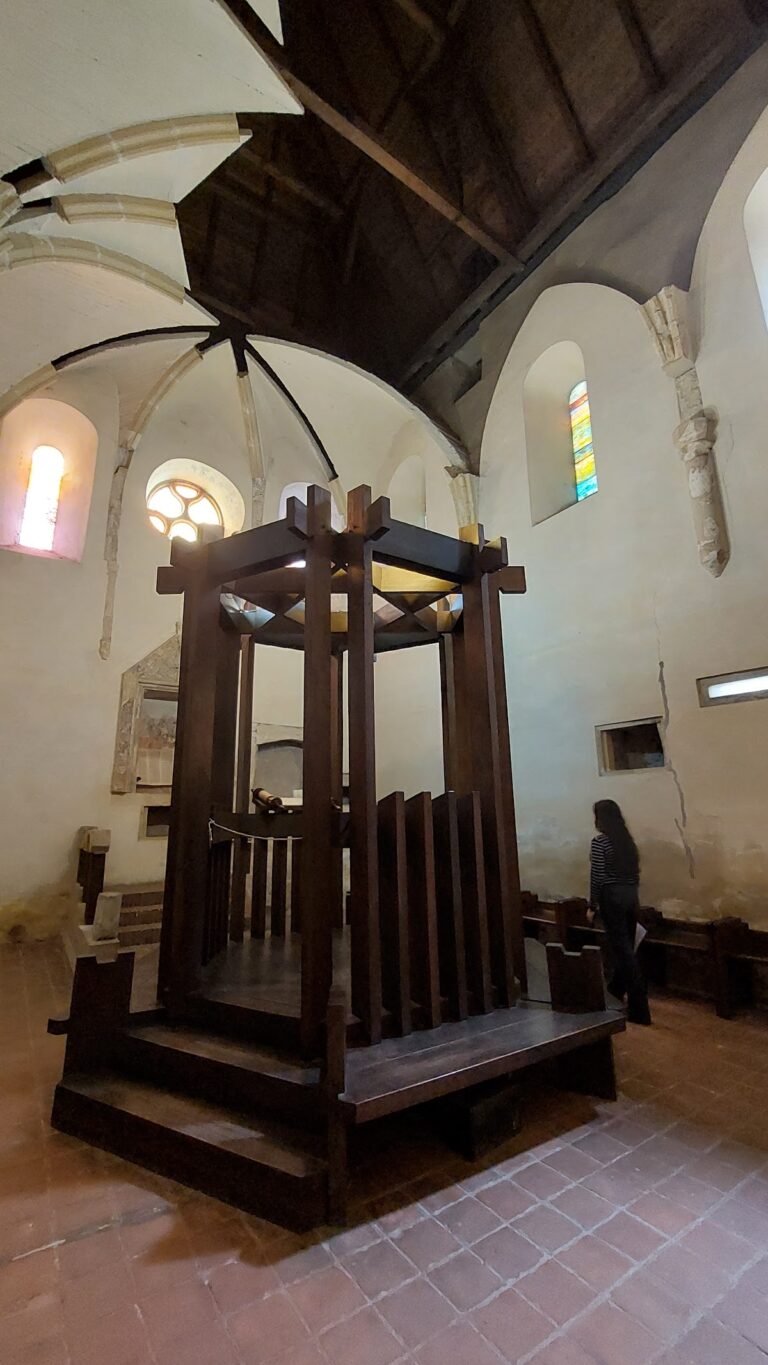
The interior contains Baroque altars, side chapels, frescoes or surviving fragments of medieval fresco decoration, and two pulpits. The richly sculpted altarpiece beneath the Gothic net vault reflects eighteenth-century Baroque taste. The more austere pulpit was originally wooden and was later covered with marble. Tradition associates it with preaching by John of Capistrano, the fifteenth-century Franciscan preacher and religious leader who organized Christian resistance against the Ottoman Turks and participated in the Christian victory at Belgrade in 1456.
The other pulpit is an eighteenth-century work decorated with foliage, sculptures, and reliefs. Together with the altars and later interior decoration, these furnishings occupy a church whose principal structural character remains medieval, including its vaulting, tracery, pointed-arch windows, and leaf-decorated and grotesque human-headed corbels.