Church of St. Lucy: A Romanesque Catholic Church in Croatia


Site at a Glance
- Rating
- 4.7
- Popularity
- Medium
- Country
- Croatia
- Primary era
- Medieval
- External website
- Open
- Eras represented
- Classical, Medieval, Modern
- Civilizations
- Habsburg, Kingdom of Croatia, Roman, Venetian
- Site type
- Religious
- Remains
- Church
On this page12 sections
History
The Church of St. Lucy is a Romanesque Catholic church in Jurandvor near Baška, Croatia, built on a site with earlier Roman and Christian use. Its construction is traditionally dated to around 1100 or the eleventh and twelfth centuries, although the art historian Pavuša Vežić has argued that the artistic elements incorporated into the building belong to the late Romanesque period of the thirteenth and fourteenth centuries.
Earlier site and foundation
Archaeological research established that the church stands on the site of a sixth-century church. The locality had earlier contained a villa rustica, a rural Roman estate combining agricultural, residential, and service buildings. During the ninth and tenth centuries, Christianized Croats used the area as a cemetery.
The Baška Tablet states that Croatian King Dmitar Zvonimir granted land to Abbot Držiha, on which Abbot Dobrovit built the Church of St. Lucy and its monastery. The monastery may have occupied the site of the Roman estate, while the church may have been raised on the foundations of an early Christian basilica. Several renovations took place between the church’s early period and the fourteenth century.
The Benedictine monastery
By the twelfth century, the monastery was associated with the Benedictines, a Western Christian monastic order governed by the Rule of Saint Benedict. Another interpretation holds that it initially belonged to a different institution and was later taken over by the Benedictines.
In 1308, the papal envoy Gentilis described the Benedictine monastery as extremely old and dilapidated and recommended that the faithful contribute to its repair. The parish priest of Baška directed the work, which suggests that the monastery then had no abbot. Two further abbots are recorded between the late fourteenth and mid-fifteenth centuries.
The Benedictines left for Italy in 1465, although the monastery continued to exist until 1590. It was already described as ruinous, and irregular abbots, generally foreigners, remained associated with it. On 8 December 1817, the Austrian government transferred its use to Ivan Šantić, bishop of the Diocese of Krk, and his successors. The bishops of Krk continue to bear the title “Abbot of St. Lucy.”
Later religious life and discovery
In 1498, the Juranić noble family commissioned a chapel dedicated to the Holy Rosary on the church’s south side. The family was believed to have originated in Bosnia and to have come to Jurandvor from Poljica in Dalmatia. After the Benedictines departed, local priests from Baška celebrated Masses in the church. Its care was entrusted to two confraternities, Saint Mary of Gorica, associated with the nearby Marian sanctuary of Gorice, and Our Lady of the Rosary.
In 1851, the seminarian Petar Dorčić found the Baška Tablet built into the church floor and brought it to the attention of Ivan Kukuljević Sakcinski. The discovery began efforts to restore the stone and decipher its inscription. Written in the Glagolitic script, the medieval Croatian inscription is an important monument of Croatian language and writing.
On Saint Lucy’s Day, 13 December, a small loaf called a hlipcić is thrown from the bell tower after Mass. The centuries-old custom derives from the period when a nearby mill on the Suha Ričina stream belonged to the church. Flour was distributed to local inhabitants, who baked the loaves and threw them from the tower to the assembled faithful. The practice continues today.
Remains
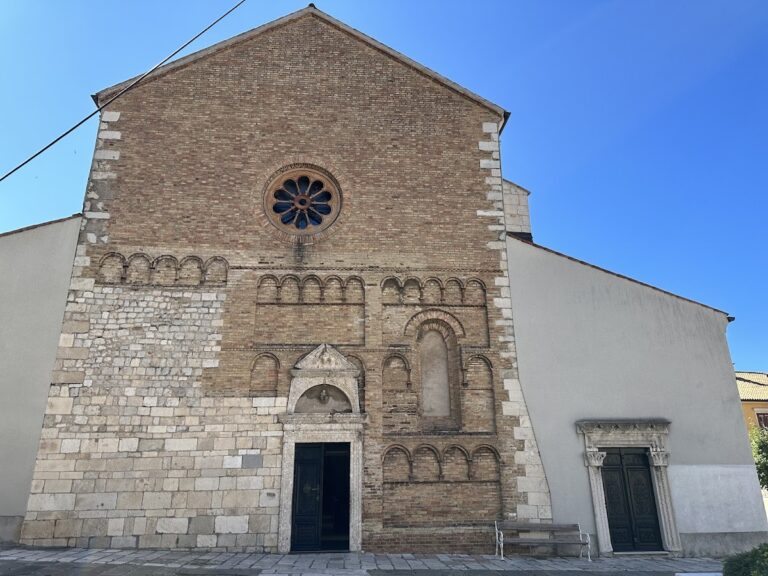
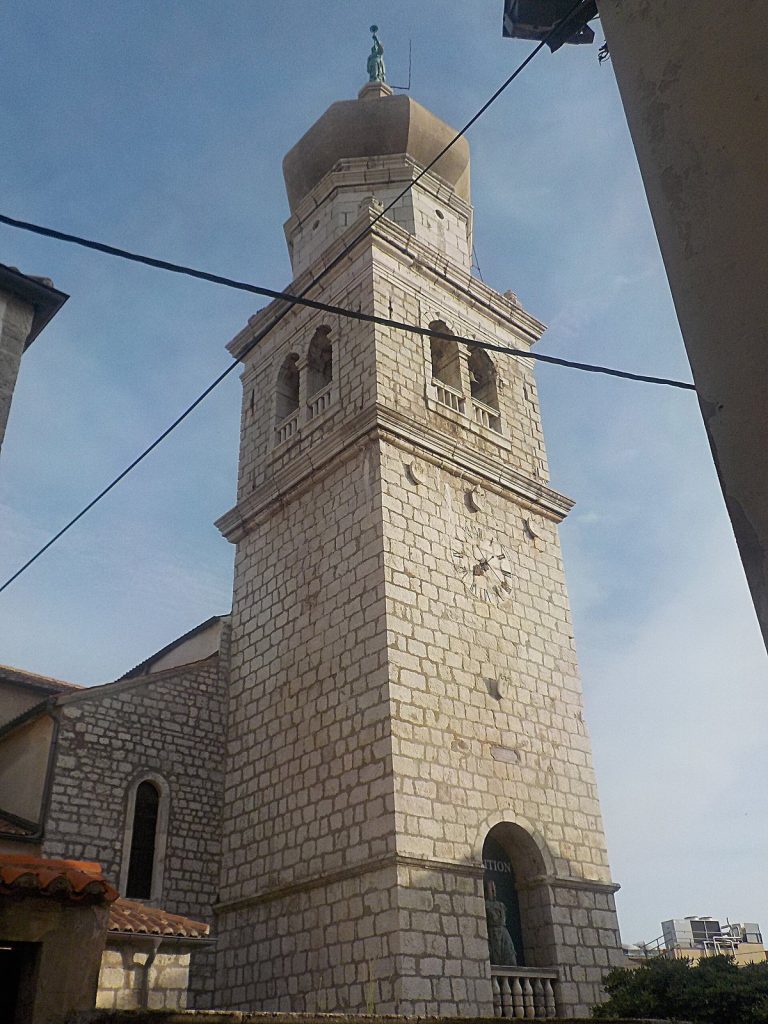
The surviving complex is centered on a small Romanesque church with a single nave ending in a semicircular apse. A bell tower forms part of the façade and serves as the entrance. The church stands among remains of the former monastic complex, including the abbot’s house, courtyard, storage areas, and remains of an ancient Roman rural estate.
Church and bell tower
Bell tower
The Romanesque bell tower was built in the thirteenth century by Andrija of Krk. His inscription, “MAISTER ANDREAS ME FECIT,” survives on the tower. It originally rose one storey higher, but Bishop Ivan Vitezić of Krk ordered the removal of that storey during the 1863 restoration. Stone sculpture representing the four Evangelists was inserted at the tower’s corners during the same intervention. The tower also carries a checkerboard-pattern carving that has been suspected as one of the earliest examples of the Croatian coat of arms.
Holy Rosary chapel
The small Holy Rosary chapel projects from the church’s south side. The Juranić family commissioned it in 1498, creating a distinct devotional space within the church complex.
Monastery and earlier remains
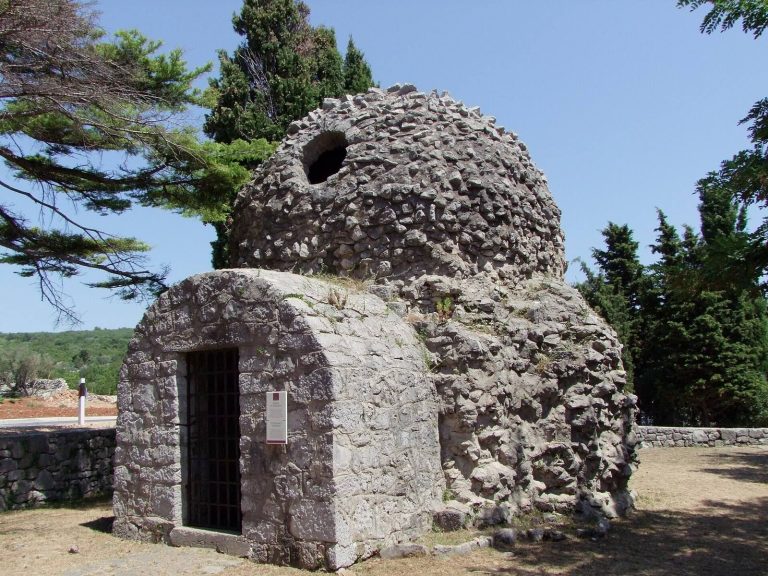
Beside the church are the remains of the abbot’s house, a courtyard, storage areas, and other parts of the Benedictine monastery. An ancient Roman villa rustica also survives in the surrounding archaeological remains, connecting the medieval complex with the locality’s earlier rural estate use.
Interior features and inscriptions
Polyptych
Until the First World War, the main altar carried a wooden polyptych, a multi-panel altarpiece, set within a Gothic frame. It is attributed to Paolo Veneziano, a major fourteenth-century Venetian painter associated with Byzantine-influenced Gothic art, and is dated to the first half of the fourteenth century. Because of its artistic value, the polyptych was restored in Vienna during the First World War and again in 1967 by the institution then known as JAZU, now the Croatian Academy of Sciences and Arts. It is currently kept in the bishop’s palace in Krk.
Baška Tablet and Glagolitic fragments
The Baška Tablet originally served as the church’s left pluteus, a carved partition separating the clergy’s area from the space for lay worshippers. The original stone is now in the atrium of the Croatian Academy of Sciences and Arts in Zagreb, while the church contains a cast. Several fragments of Glagolitic inscriptions were also found inside the church.