Kobersdorf Castle: A Renaissance Castle in Austria


Site at a Glance
- Rating
- 4.6
- Popularity
- Low
- Country
- Austria
- Primary era
- Early Modern
- External website
- Open
- Eras represented
- Medieval, Early Modern
- Civilizations
- Habsburg, Hungarian
- Site type
- Military
- Remains
- Castle
On this page13 sections
History
Kobersdorf Castle is a historic castle in Kobersdorf, Austria, developed around 1528 from a medieval fortification in the Renaissance period. Its position near Wiener Neustadt gave it strategic value during conflicts between the Austrian and Hungarian realms, while later rebuilding created a complex that also preserves Gothic and Mannerist phases.
Medieval origins and early records
The castle’s beginnings may reach back to the period of Louis the German, a ninth-century Carolingian ruler and king of East Francia, the kingdom that developed into the medieval German realm. An entry from 860 mentioning “Kundpoldesdorf” may refer to Kobersdorf, although that identification is uncertain. The associated suggestion that a refuge fortress against the Avars occupied the site at that time remains conjectural.
In 1222, King Andrew II of Hungary granted the area around Kobersdorf to Count Pousa, son of Botus. Pousa then began constructing the castle. In 1229, Kobersdorf was first recorded in writing as a settlement beside a castle, linking the community and fortress in the historical record.
Border warfare and Habsburg control
Kobersdorf was first captured in 1289 during the Güssing Feud, a late-thirteenth-century conflict involving the Hungarian crown and the powerful Güssing lords. The castle later passed by sale to the Mattersdorf-Forchtenstein family. When that family died out around 1450, Duke Albrecht VI acquired the lordships of Kobersdorf and Forchtenstein. He sold them in 1451 to his brother, Emperor Frederick III, the Habsburg ruler who became Holy Roman Emperor in 1452.
For Frederick III, the castles of Forchtenstein, Kobersdorf, and present-day Landsee Castle Ruin were particularly valuable because they lay a few kilometres east of Wiener Neustadt, where he resided. King Matthias Corvinus of Hungary, who ruled from 1458 to 1490 and campaigned along the Austrian-Hungarian frontier, temporarily seized Kobersdorf in 1458 during the border wars.
The Peace Treaties of Ödenburg in 1463 left the castle in the possession of the House of Austria, the Habsburg dynastic branch that controlled the Austrian lands. Matthias’s pledged holders, the Weisspriach family, later sided with him. In circumstances that remain unclear, Matthias granted them the castle in 1466 even though it remained legally Austrian property.
Gothic and Renaissance transformation
From 1482, the new owners expanded the fortress with a late Gothic outer bailey, an enclosed area outside the main stronghold, and a Protestant chapel. In 1529, Hans von Weisspriach developed the outer bailey into a Renaissance-style castle. Renaissance architecture drew on classical forms revived in Europe from the fifteenth century onward.
The Weisspriach line died out in 1553, and the lordship, a territorial estate governed by a noble lord, was progressively divided among its heirs. Unclear ownership and debt brought an end to the formerly elaborate court life. The castle became a headquarters for robbers and a site for counterfeit minting. In 1599, a peasant woman accused of witchcraft was burned in the castle courtyard.
Kery ownership and Mannerist rebuilding
In 1648, Johann I Kery de Ipoliker married a great-granddaughter of the last Weisspriach. He restored unified ownership by purchasing the fragmented shares of the lordship and continued the castle’s expansion. The work was completed in 1656 in the Mannerist style, a later Renaissance form known for sophisticated and highly decorative designs.
Ottoman forces captured Kobersdorf in 1683 during the Ottoman military pressure on the Habsburg lands associated with the Great Turkish War. They destroyed the original medieval fortress, which had continued to stand beside the later castle. The Kery family consequently sold the lordship in 1704 to Prince Paul I Esterházy de Galantha.
Esterházy ownership and modern restoration
After 1704, Kobersdorf was overshadowed by the Esterházy residences at Eisenstadt and Fertőd. The Esterházys were a prominent Hungarian noble family that became one of the leading aristocratic houses of the Habsburg lands. Neglect prevented the extensive Baroque alterations common in the eighteenth century, but the castle increasingly deteriorated. By 1963, demolition of the ruin was being considered.
That year, Martha Bolldorf-Reitstätter, Austria’s first female academically trained architect, acquired the severely damaged castle and began its restoration. The work culminated in 2001 with the completion of the Mannerist Knights’ Hall, which had required almost complete reconstruction. After Bolldorf-Reitstätter died in 2001 at the age of 89, the castle passed in its then-present condition to her daughter, Anna Schlanitz.
The owners also sought to develop Kobersdorf as a cultural centre. The Kobersdorf Castle Festival, established in 1972, advanced that aim. The castle chapel continues to retain a religious function, with occasional Masses and the possibility of weddings and baptisms.
Remains
Kobersdorf Castle preserves successive forms of a medieval fortress, a late Gothic outer bailey, and a Renaissance castle. The complex is organized around fortified entrances, later castle buildings, the Mannerist Knights’ Hall, and a free-standing chapel formed by two adjoining chapels. A water-filled moat remains part of the defensive arrangement.
Entrances and defensive works
The complex includes a north entrance protected by a barbican, a fortified outer defence for a gate, together with a corner tower. A Renaissance portal, a south portal, and a second gate mark further stages in the castle’s development. These entrances are associated with the surviving castle complex and its successive medieval, Gothic, and Renaissance forms.
Mannerist interiors
The Mannerist Knights’ Hall was completed in 1656 during Johann I Kery’s rebuilding campaign. Its decoration includes frescoes, wall and ceiling paintings made on fresh plaster, by the Italian painter Carpoforo Tencalla, who worked in Central Europe on aristocratic and ecclesiastical interiors. The hall was almost entirely reconstructed during the restoration completed in 2001.
Castle chapel
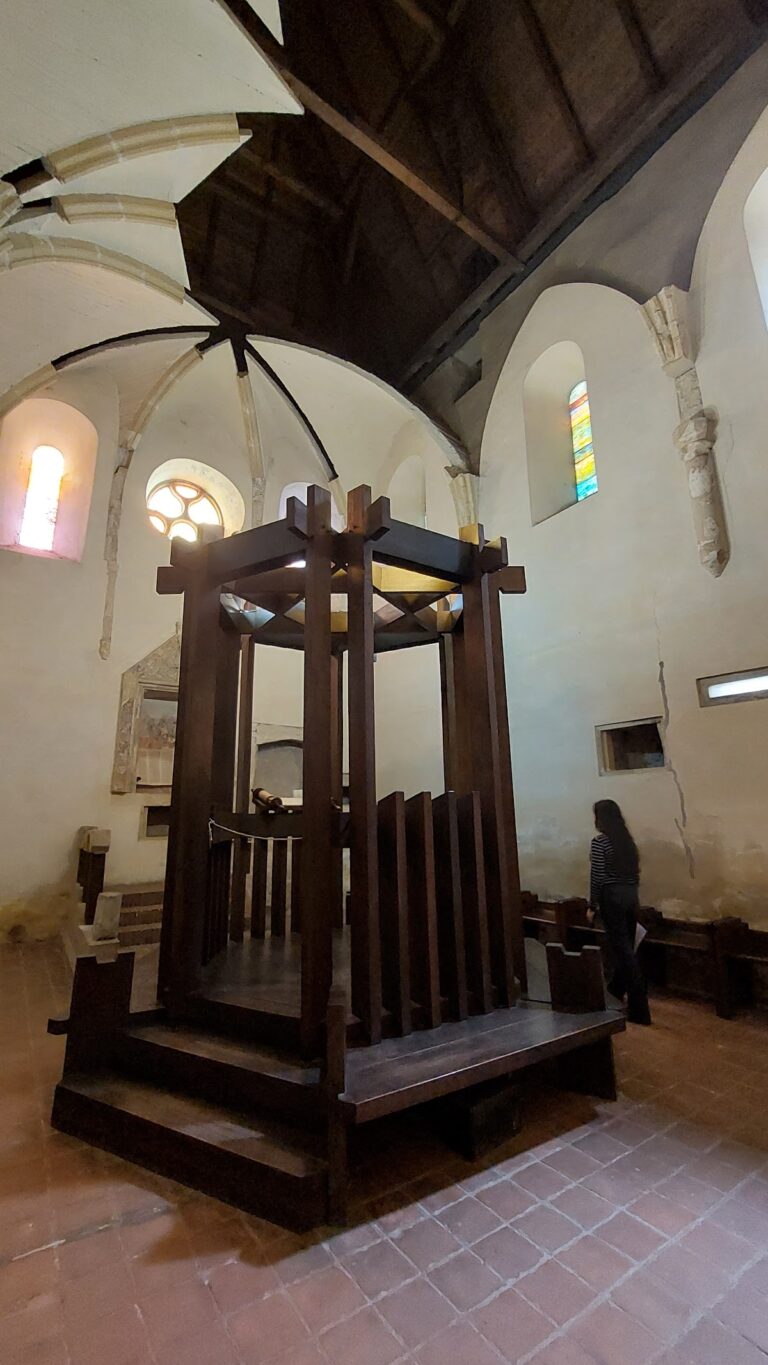
The free-standing Kobersdorf Castle Chapel consists of two chapels built beside one another. Their different dates and forms preserve several stages in the religious history of the complex, from the medieval fortification through the Protestant period and the later Catholic rebuilding.
Smaller chapel
The smaller chapel contains Romanesque and early Gothic features and probably originated with the medieval fortification between 1222 and 1229. It was later converted into the sacristy, the room used to store sacred vessels and prepare for worship, of the larger Gothic chapel.
Larger Gothic chapel
The larger chapel was built by the Weisspriach family in 1482 for Protestant worship. During the recatholicization associated with Johann Kery’s arrival in 1648, recatholicization being the restoration or enforcement of Roman Catholic practice, its Protestant gallery was removed, the Gothic entrance was blocked, and a new early Baroque entrance was made.
The interior was later redecorated in the Mannerist style. Its ceiling carries 48 individual angels suspended from above, with some figures strongly reflecting Renaissance grotesque ornament. The altar was made for the Esterházy family in the Baroque style at the beginning of the eighteenth century.
Medieval frescoes
Late Gothic frescoes were added around 1430 at the direction of the Forchtenstein family. One includes the family coat of arms, a heraldic emblem associated with a person, family, or territory, and is described as the oldest surviving representation of the later coat of arms of Burgenland.
Nearby sites