Saint Michael Church, Sopron: A Historic Gothic Parish Church in Hungary


Site at a Glance
- Rating
- 4.7
- Popularity
- Low
- Country
- Hungary
- Primary era
- Medieval
- Eras represented
- Medieval, Early Modern, Modern
- Civilizations
- Habsburg, Hungarian
- Site type
- Religious
- Remains
- Fortified Church
On this page15 sections
History
Saint Michael Church is Sopron’s oldest parish church, a Roman Catholic church in Hungary dedicated to the Archangel Michael and belonging to the Diocese of Győr. Built in the thirteenth century before the Mongol invasion, it stood beside a cemetery outside the fortified medieval town, following the early medieval practice of placing parish churches beyond town walls. The church is now regarded as one of Hungary’s most important Gothic churches and is protected as a listed historic monument.
Romanesque origins and medieval parish life
The first church was Romanesque. Its historical record of clergy reaches back to 1278, while the surrounding settlement may have been a small village beside the royal castle. Some researchers have proposed, cautiously, that a church used by Christian Avars, Avar-period communities that had adopted Christianity, may previously have occupied the site. This earlier possibility remains uncertain.
The cemetery beside the church had already been used during the Roman period and continued to serve medieval burials. When its enclosing wall became full and could not be extended, graves were exhumed and the remains were placed in an ossuary within the thirteenth-century Chapel of Saint James. The church and cemetery also formed part of Sopron’s defenses. A stone wall surrounded the burial ground, narrow loopholes were opened in the church’s thick walls, and galleries in the tower offered positions for observing or resisting attackers. A watchman used the upper gallery until the upper Renaissance section of Sopron’s Fire Tower was built in the fifteenth century.
Gothic expansion and religious conflict
From about 1450, the church was enlarged and rebuilt in the Gothic style. The transept and sanctuary were added during this transformation, and the building reached its present overall size in 1484. During the reign of Matthias Corvinus, king of Hungary from 1458 to 1490, the church may have contained twenty guild altars. Tradition also holds that Matthias may have attended its consecration.
In 1534, as Ottoman forces advanced toward Vienna and approached Sopron, townspeople proposed demolishing the church because they feared that its tower could be used to fire into the fortress. Two priests prevented the destruction. Catholics and Protestants shared the church from 1567 to 1584. István Bocskai’s Hajdú army plundered it in 1605, and Protestants took complete possession in 1608, using the building until it returned to the town parish in 1674. After the takeover, iconoclasts discarded and burned many valuable Gothic sculptures.
Fire, Baroque alteration, and Neo-Gothic restoration
Saint Michael Church survived Sopron’s great fire of 1676, but its roof burned in another fire in 1728. The building then received Baroque furnishings and underwent a Baroque rebuilding. Those furnishings were sold in 1864, while Baroque tomb monuments belonging to prominent people buried in the church were transferred to the Sopron Museum.
The restoration of 1859 to 1866 gave the church much of its present appearance. Neo-Gothic furnishings were produced according to designs by Ferenc Storno the Elder, a nineteenth-century architect, restorer, and designer associated with the building’s transformation. The church was extensively restored again from 2018 to 2020. The work renewed the roof, stone facade, flooring, copper decorative elements, furnishings, organ, sculpture, and about 1,500 square metres of wall painting. The church was subsequently rededicated by András Veres.
On 16 June 1946, József Mindszenty consecrated the parish priest Kálmán Papp as Bishop of Győr at Saint Michael Church. Mindszenty was a Hungarian Catholic prelate who later became Archbishop of Esztergom and a cardinal, while Papp served as Sopron’s parish priest before becoming bishop.
Remains
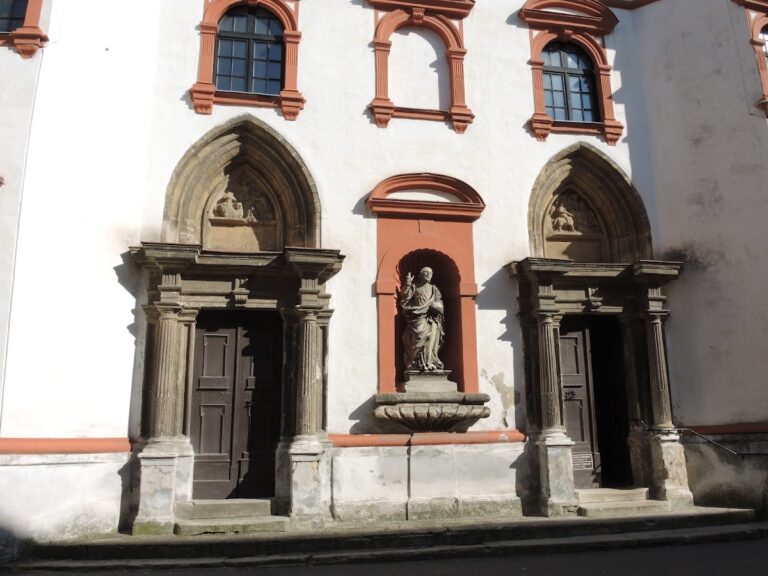
Saint Michael Church stands in Sopron’s Saint Michael’s Hill district, outside the line of the medieval town walls and along an important traffic route. Its surviving fabric combines Romanesque, Gothic, Baroque, Neo-Gothic, and Romantic elements. The interior is divided into three aisles by pairs of columns, while medieval buttresses reinforce the nave. The church has one tower and a stated capacity of approximately 470 people.
The church and tower
Medieval tower
The tower rises about 48 metres. Its square lower section and octagonal second and third levels date from the thirteenth century. The fourth level has large stone-tracery windows that give it an almost open appearance. A stone balcony above supports an octagonal stone spire. The entrance surround and upper levels are nineteenth-century, while the lower level remains visibly medieval. The tower was extensively rebuilt, most recently between 1979 and 1983.
Nave and sanctuary
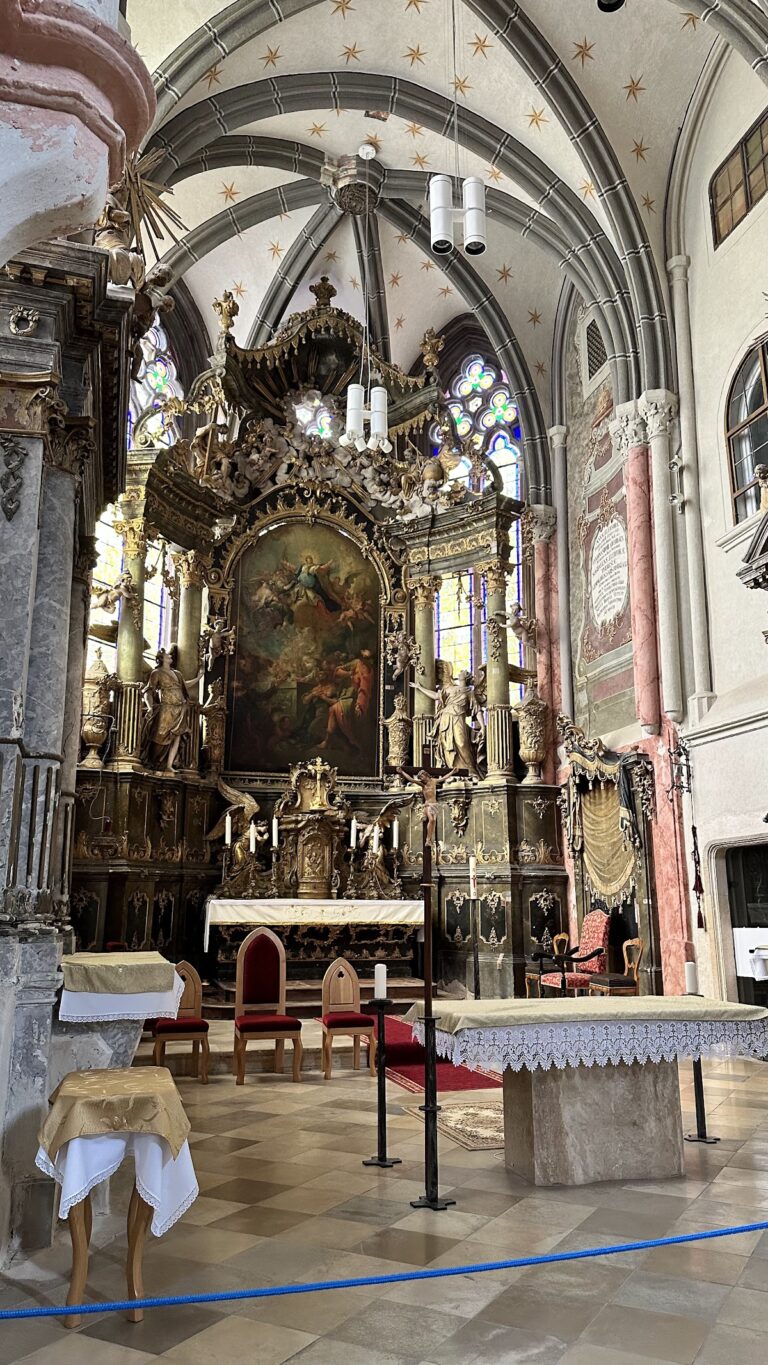
The nave preserves medieval buttresses, Gothic sedilia, which are seats or recesses for clergy beside a sanctuary, and Neo-Gothic arcades. Medieval carving survives in the capitals and corbels of the main nave, although these elements carry nineteenth-century painted decoration. In the sanctuary, the Neo-Gothic altar structure designed by Ferenc Storno the Elder rises against Gothic stone ribs. Fifteenth-century sculptures and wall paintings also survive, with several medieval murals preserved only as heavily renewed fragments.
Chapel and cemetery remains
Chapel of Saint James
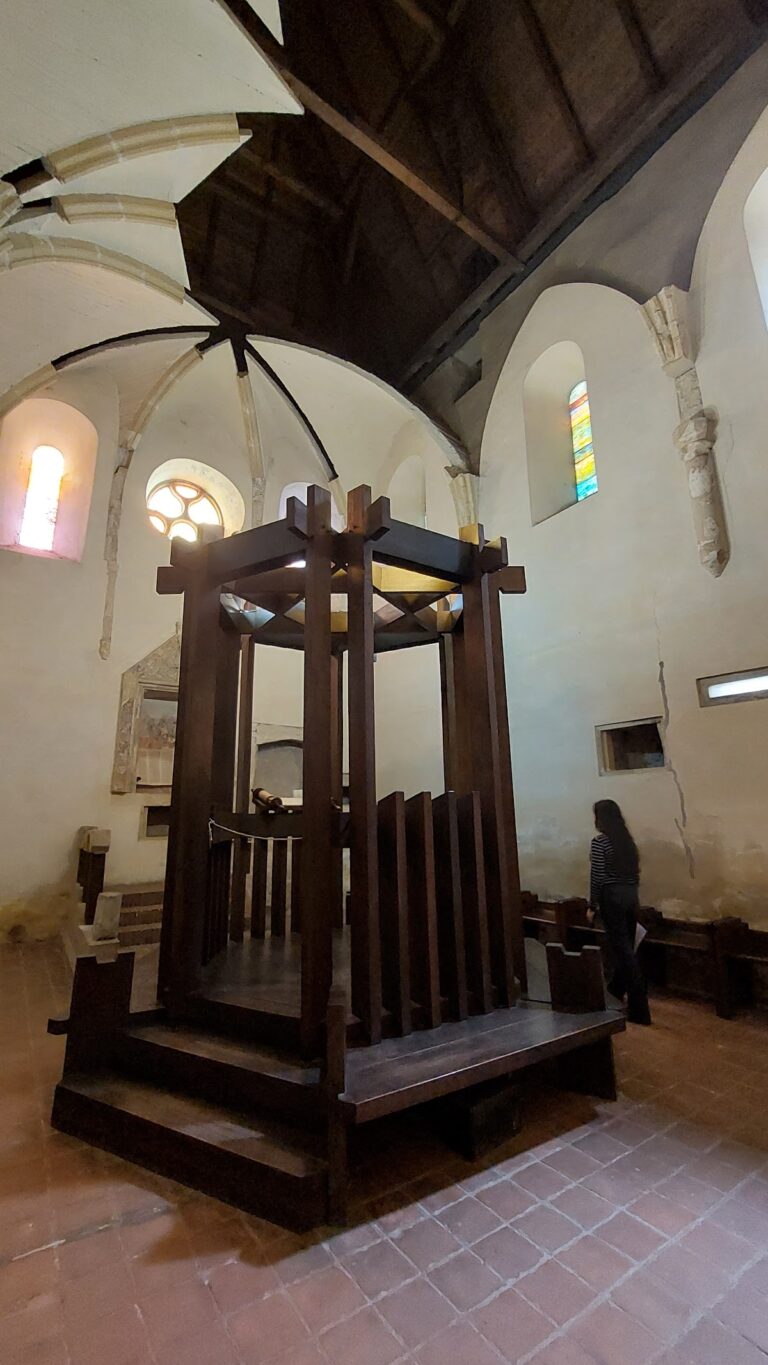
The octagonal Chapel of Saint James is a thirteenth-century structure that retains Romanesque features. It survives as part of a rotunda, a centrally planned circular or polygonal building, or of a former rotunda. The chapel contains the ossuary for human remains removed from the adjacent cemetery after the burial ground could no longer be enlarged.
Tree of Life carving
Facing the church, the chapel’s portal has a tympanum, the decorated field above or within a doorway. Its old stone carving shows a Tree of Life flanked by two confronting dragons. The dragons have two legs and tails shaped like those of aquatic animals.
The churchyard contains tombstones, including a seventeenth-century late Renaissance example. Inside the church, the left side aisle holds the former altarpiece from Sopron’s Church of Saint John the Baptist, fragments of a tombstone belonging to the Pejachevich counts, and the tombstone of György Primes, a town parish priest.
Artworks, furnishings, and treasury
Paintings and sculpture
The church preserves a wooden Madonna dated to about 1460 to 1470. It returned from Vienna’s Pázmáneum, a historic Catholic seminary, in 1868 through the intervention of Cardinal János Simor. A monumental suspended cross, also given by Simor, hangs in a Neo-Gothic frame designed by Ferenc Storno the Elder. Baroque altarpiece paintings remain in the church, including works by representatives of the schools of Bartolomeo Altomonte and Paul Troger.
Sacristy and treasury
The sacristy has a net vault from 1482. This late Gothic type of vault uses intersecting ribs to form a network, and the ends of its ribs carry painted coats of arms executed by Ferenc Storno. The treasury contains Mass jugs, silver chalices, and other goldsmiths’ works dating from the sixteenth to the eighteenth century. Its floor is described as Hungary’s only continuous ceramic floor of this scale.
Organ and bells
The organ was made in 1944 by the Rieger organ factory on commission from Kálmán Papp. The tower contains four bells cast by members of Sopron’s Seltenhofer bell-founding family. They hang from straight yokes: the 2,902-kilogram Michael Bell, 172.5 centimetres in diameter, dates from 1893; the approximately 1,650-kilogram Emeric Bell, measuring 145 centimetres, and the approximately 850-kilogram George Bell, measuring 114.3 centimetres, were cast in 1930; and the approximately 320-kilogram Our Lady Bell, 84 centimetres in diameter, was cast in 1922. The largest bell is used only on feast days.