Saint Catherine’s Church in Petrovo: The Skuoritsa Lutheran Parish Church
Site at a Glance
- Popularity
- Medium
- Country
- Russia
- Primary era
- Modern
- Eras represented
- Modern
- Civilizations
- Russian
- Site type
- Religious
- Remains
- Church
On this page8 sections
History
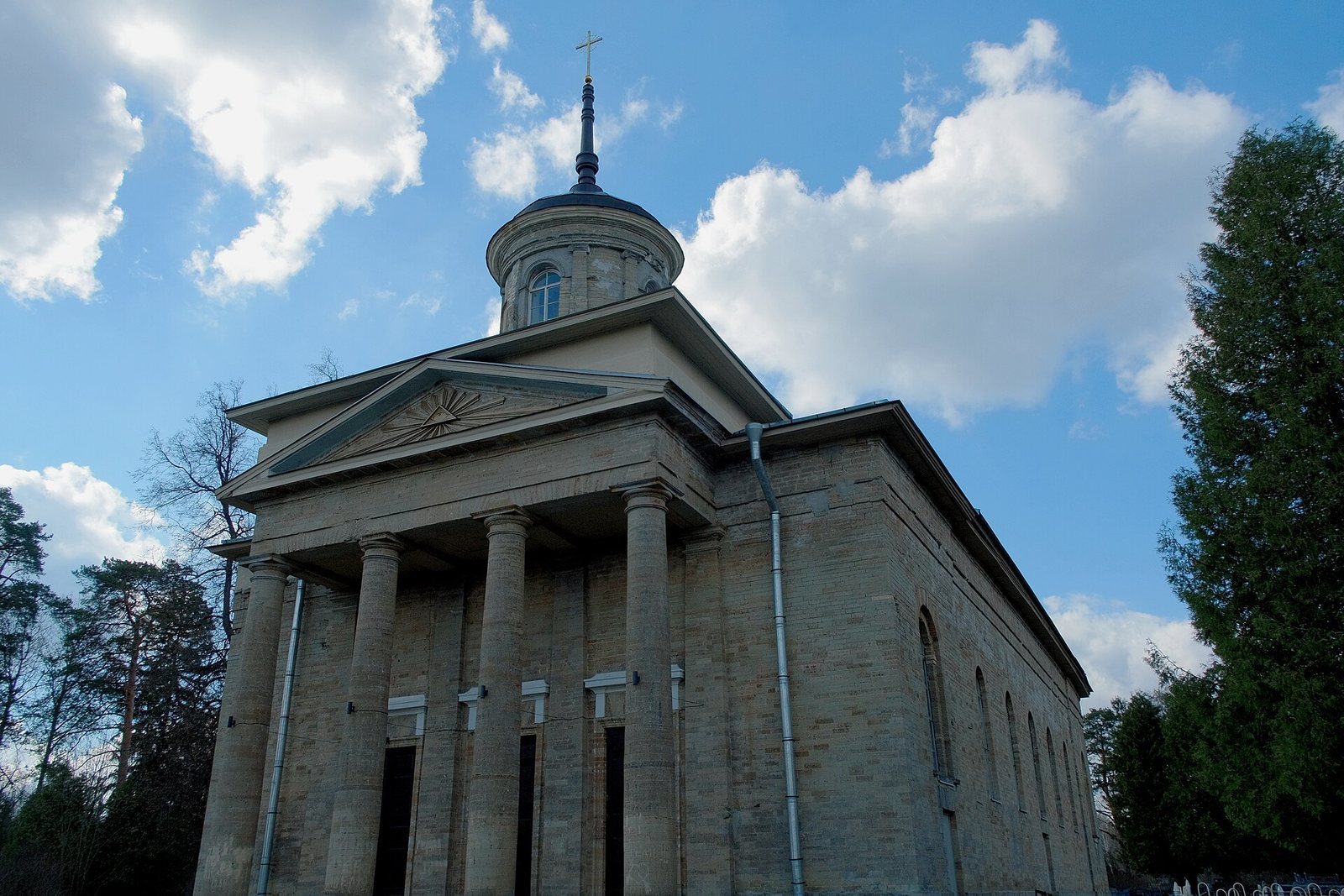
Saint Catherine’s Church in Petrovo is the stone church of the Skuoritsa Lutheran parish in Russia’s historic Ingrian region, built from 1834 to 1839 in the Classical style, with balanced forms inspired by ancient Greek and Roman architecture. The parish itself was established in 1624, during Swedish rule, and became a center of Lutheran worship for surrounding communities.
Parish under Swedish and Russian rule
King Gustav II Adolf of Sweden ordered the creation of Skuoritsa parish in 1624. It was formed from the northern part of Tääkeli parish, while the southern part became Spankkova parish. The first church and pastor’s residence stood at the Old Skvoritsa manor in Petrovo, and the parish also had a chapel at Kolppana. At first, the parish was under royal authority: the king selected its pastor.
After the 1617 Treaty of Stolbovo, a peace agreement between Sweden and Russia, Swedish authorities settled the area with two Ingrian Finnish groups. Savakot people from southern Finland made up about a quarter of the congregation, while Äyrämöiset from the northern Karelian Isthmus accounted for roughly three quarters. The parish eventually included 84 villages. Its population was about 4,700 in 1865, 8,086 in 1917 and 9,000 in 1928.
As the congregation expanded, it gained a chaplain in the mid-seventeenth century and a third pastor in 1681. After the Great Northern War, an early-eighteenth-century conflict between Sweden, Russia and their allies, the parish again had only one pastor. When the area came under the Russian Empire, the emperor appointed pastors and financed a new church. In 1865 the parish belonged to the East Ingrian deanery, a grouping of congregations. It later came under the Petersburg Consistory District, an ecclesiastical administrative jurisdiction, and now belongs to the West Ingrian deanery of the Evangelical Lutheran Church of Ingria.
Church rebuilding and parish growth
A second wooden church was built in 1762–1763 at the New Skvoritsa manor. It deteriorated quickly and was demolished in 1833. Construction of the stone church between the Old and New Skvoritsa manors began the following year by order of Emperor Nicholas I and was completed in 1839, with the emperor paying for the work.
The parish opened its first two-class elementary school in 1864, with 50 boys enrolled. Lessons covered religious instruction, reading and writing in Finnish and Russian, arithmetic, and singing. Because the parish could not afford teachers, the pastor taught religion without pay, while his mother taught the other subjects, including geography. The church underwent a major renovation in 1883–1886. A pastor paid for an almshouse in 1884 and began Sunday-school lessons in reading, writing and the Lutheran catechism the next year.
A ten-room parsonage was built in 1896 at Alapuraska, across the river, on a 27-hectare plot. The parish held its first Ingrian song festival in 1899 and its first all-Ingrian Christian youth congress in 1913. It also maintained a library of about 3,000 books and supported a medical assistant and a midwife. In 1925, rooms in the former parsonage were adapted for a school for peasant youth, a library, a club, a boarding facility and teachers’ apartments.
Closure, damage and revival
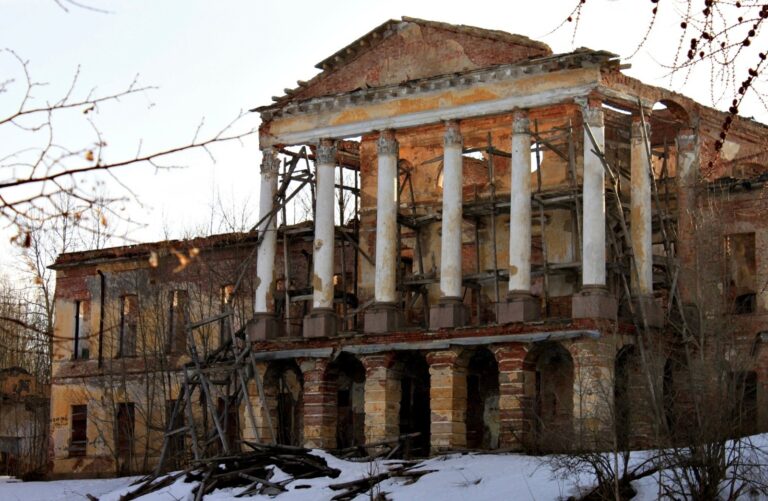
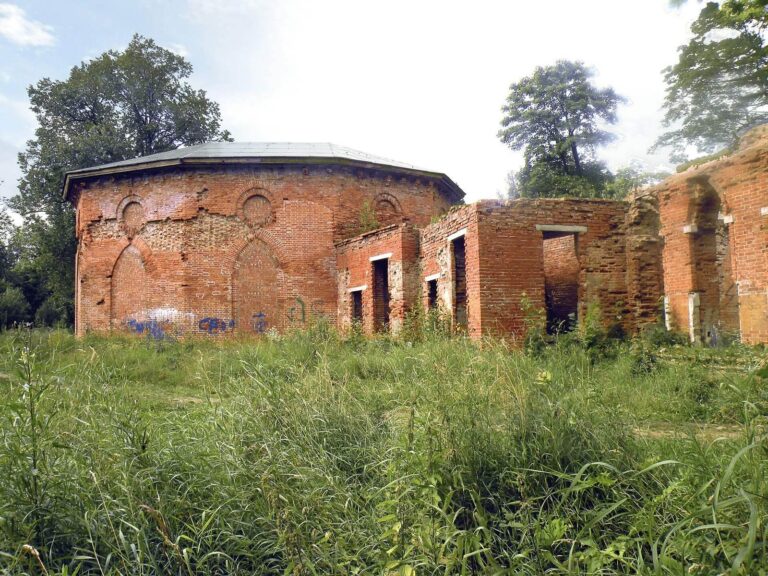
On 18 March 1935, the church bells were taken and transferred to the state. The church closed in 1937, and a club opened inside it that July; the organ was later broken. Worship returned briefly during the German occupation in 1942–1943, but the congregation was closed again afterward. The church suffered severe wartime damage and was further damaged by a fire in 1956.
Restoration plans were drawn up in the 1980s, and the first postwar service in the partly ruined church took place in 1989. The parish was re-registered in 1990. A Finnish partner parish in Rautalampi donated a wooden church, erected on 15 June 1991 and consecrated on 11 August as the Church of the Resurrection. In 1994, a parish commission was formed to oversee the restoration of Saint Catherine’s church.
Remains
Church buildings
Stone church of Saint Catherine
The church is a stone building in the Classical style, designed to serve a congregation of about 1,300 people. Its interior was heated by Dutch-style tiled stoves and lit by large chandeliers. The altar painting showed the Resurrection of Christ, with a copy of Leonardo da Vinci’s Last Supper below it.
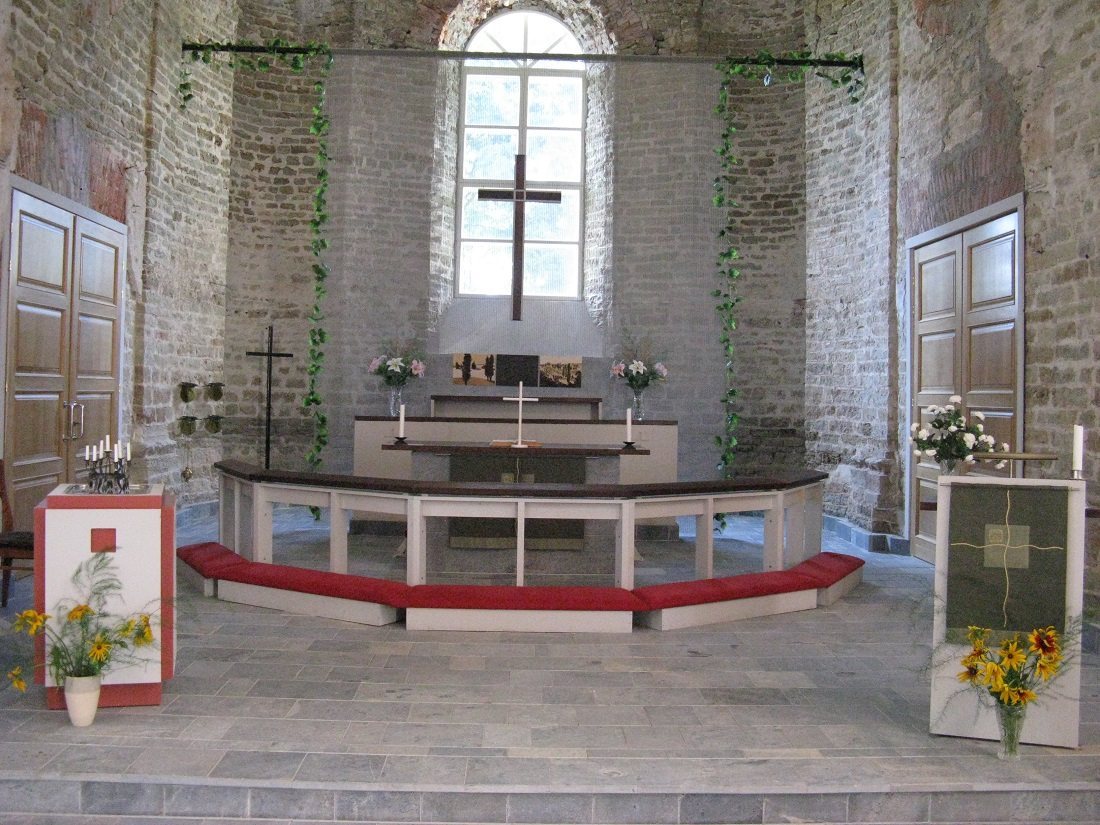
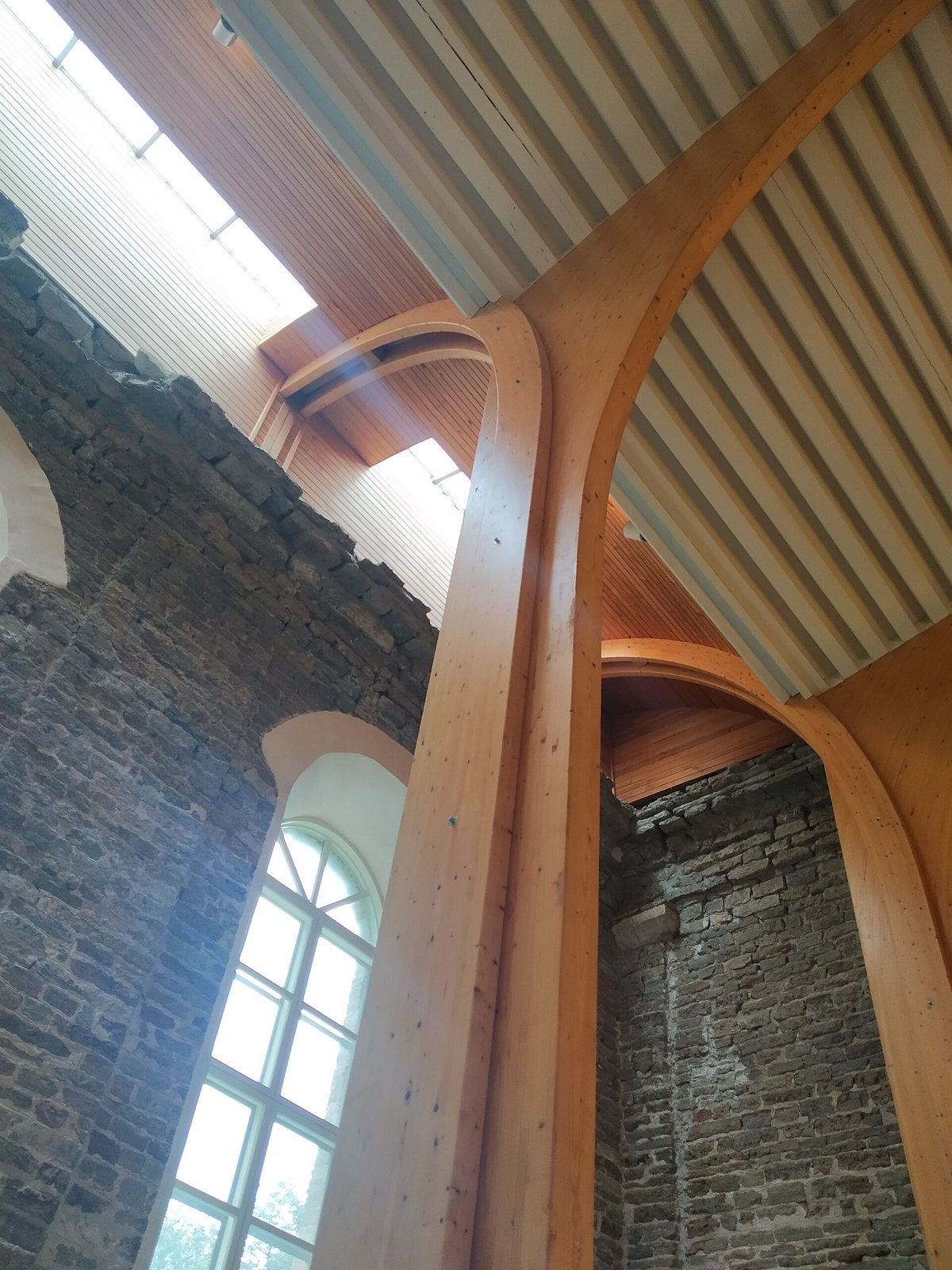
An organ made by the German craftsman Buchert was installed in 1841–1842 and was then the largest in Ingria. A replacement organ, made by the German firm Walcker, was installed in 1904 and ranked among the region’s largest. The building was partly restored in 2006, when a wooden casing was fitted inside to protect its historic walls. The bell tower, including its spire and cross, was restored in 2009, and the central part of the portal had been restored by 2012.
Church of the Resurrection
The parish’s separate Church of the Resurrection is a wooden building in a barrack-style form.