Janów Podlaski National Stud: Poland’s Oldest State Stud Farm
Site at a Glance
- Popularity
- High
- Country
- Poland
- Primary era
- Modern
- Eras represented
- Modern
- Civilizations
- Kingdom of Poland, Russian
- Site type
- Economic
- Remains
- Production Complex
On this page13 sections
History
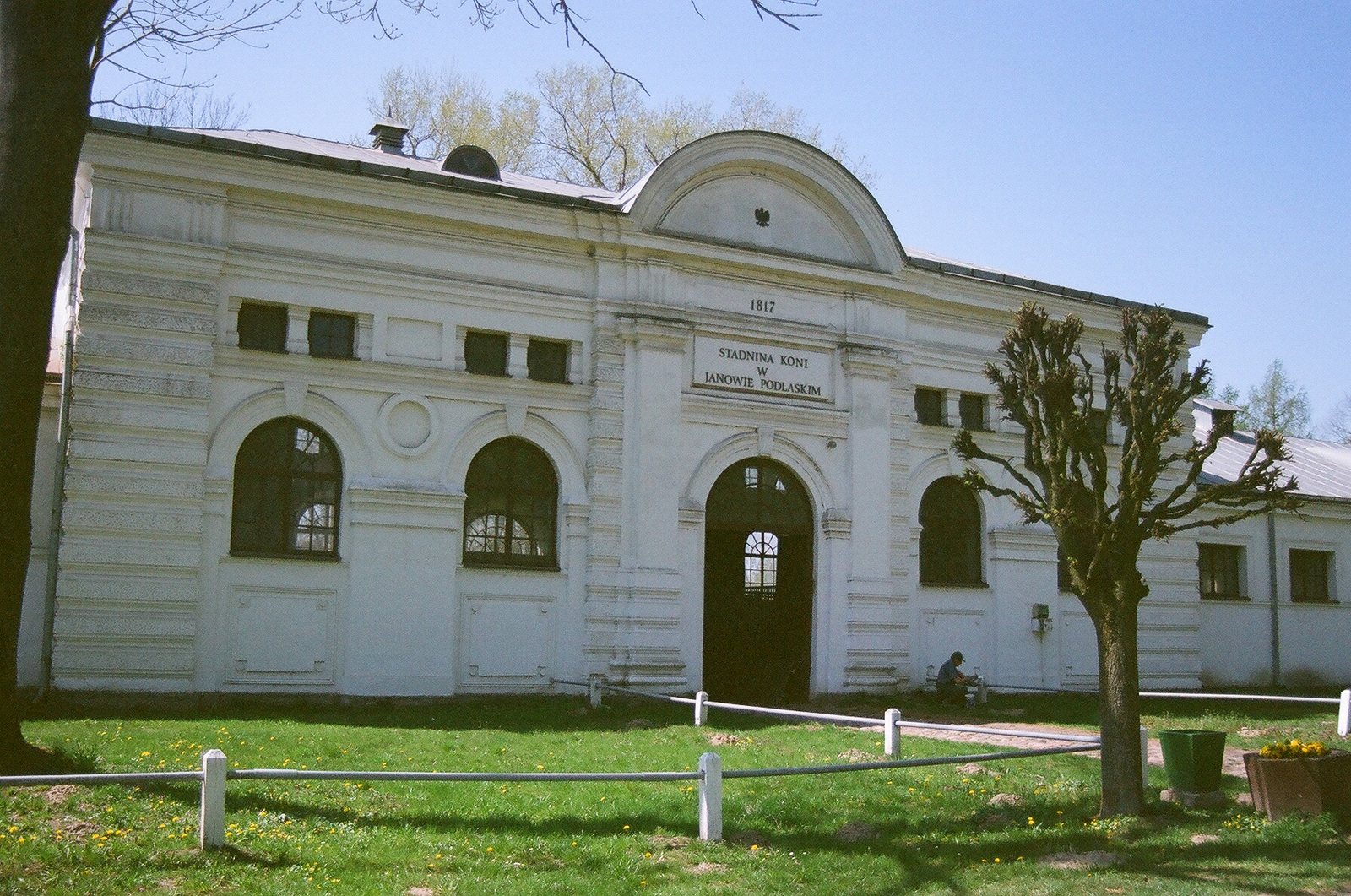
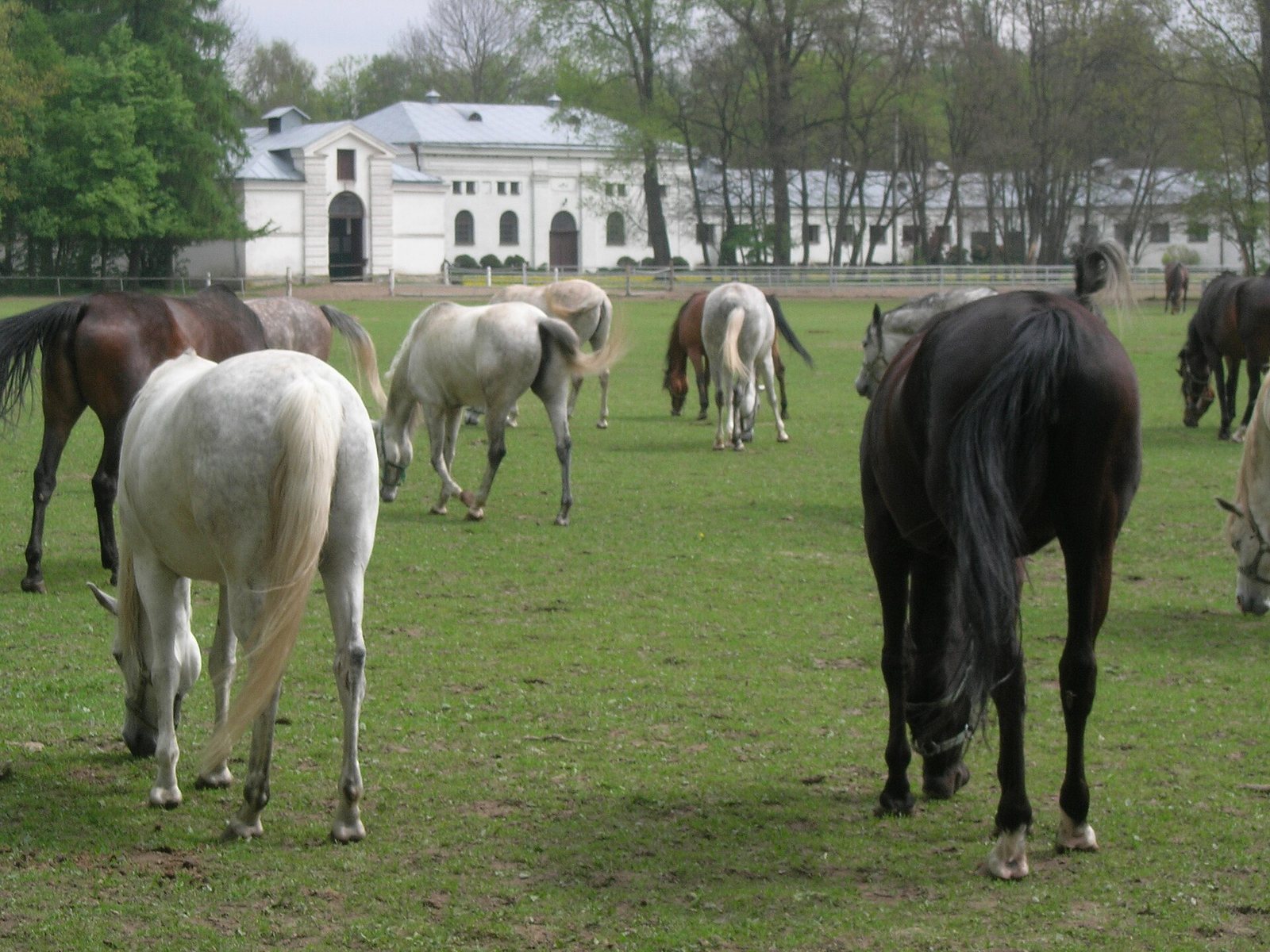
Janów Podlaski National Stud is a horse-breeding institution at Wygoda in Poland, founded in 1817 as a government herd in the Russian-ruled Kingdom of Poland, a constitutional kingdom under the Russian emperor. Its buildings include a complex of Classicist stables. The stud became Poland’s oldest state stud farm, and by the turn of the twentieth century it was a leading center for horse breeding and equine knowledge in the western Russian Empire.
Foundation and nineteenth-century growth
The government established the herd at the request of the Administrative Council of the Kingdom of Poland and by decree of Emperor Alexander I. Its creation followed a sharp decline in the horse population in Polish lands during the Napoleonic Wars. Wygoda was selected for its large estate and the presence of a former Austrian stud farm. Veterinarian Jan Ritz organized the new institution and managed it from 1816 to 1826. With the emperor’s permission, he acquired breeding horses from imperial studs and private Russian and English breeders.
In December 1817, Ritz brought 54 stallions, 100 mares and 33 foals to the stud. Among the stallions were 25 English horses, nine Arabians, a distinct horse breed, four Danish horses, two Mecklenburg horses, two Caucasian horses and one Italian horse. A veterinary school operated alongside the herd, and a practical school for horsemanship and dressage opened in 1824.
With support from Ivan Paskevich, the Russian governor of the Kingdom of Poland, the stud expanded into a major horse-breeding center in central Poland during the 1830s and 1840s. Filip Eberhardt managed the government herd until the end of the 1870s. From 1861, Janusz Rostworowski held the formal title of herd director.
In 1885, Count Alexander Nierodka brought valuable horses from western Europe, including Thoroughbreds and Arabians. The first Arabian horses arrived at Janów during this period. By the beginning of the twentieth century, the stud had become the leading center for horse breeding and equine knowledge in the western Russian Empire.
War, loss and rebuilding
In the early twentieth century, breeders developed a strongly built, resilient type known as the Janów horse, as well as two lines of mares. The First World War brought these achievements to an end. In February 1915, the herd was taken east, where almost all the horses died.
After 1918, Polish horse enthusiasts and equestrians worked to rebuild the stud. Arabian mares arrived at its empty, damaged stables in April 1919. Foreign studs, including those in Czechoslovakia and Germany, were again buying Janów horses by the 1920s. In 1924, the farm began to specialize in purebred Arabian horses.
The Second World War caused the loss of about 80 percent of the stud’s horses. About 200 were first evacuated to Volhynia. After the Soviet invasion of Poland on 17 September 1939, they were transported back toward Janów, and many disappeared along the way. The Red Army took control of the stud on 25 September, burned its buildings and sent horses evacuated from Janów deep into the Soviet Union, including to Tersk Stud. The mare Mammona and stallion Ofir became foundation stock for Tersk’s Arabian breeding program. In late September and early October, local residents looted the few Arabians still at Janów with the Soviet occupiers’ consent.
After German forces occupied the farm, horse-breeding commissioner Gustav Rau arranged for breeding stallions, including Witraż and Wielki Szlem, and other purebred horses to return. The stud held a horse parade and breeding review in 1940. Its commandant, Hans Fellgiebel, sought to protect the horses and their grooms despite wartime conditions. Zoologist Bernhard Grzimek led research that included studying horses’ instinct to return to their stable.
In July 1944, about 300 purebred Arabians were evacuated to Germany; some were lost during the bombing of Dresden. Horses from other Polish studs were also taken to Saxony. Horses began returning to Poland by sea from Lübeck to Gdynia in November 1946, but Janów’s 80 mares and foals did not arrive until 1 November 1950. Stallions dispersed among other studs returned by 1960. The Arabian stallion Witez II did not return to Poland and was sent to the United States as war booty by U.S. General George S. Patton.
Postwar recovery and auctions
The stud prospered from the late 1950s under director Andrzej Krzyształowicz, who had been associated with Janów since December 1939 and had cared for horses taken by the Germans. He organized the farm’s first Arabian-horse auction in autumn 1969. Nearly 1,000 Arabian horses were later sold abroad, earning foreign currency for Poland. Auctions run by Polish Prestige in the 1990s and early 2000s helped establish the farm’s international reputation. Its annual Arabian sale became known as Pride of Poland.
Several auction prices drew particular attention. The stallion El Paso sold for US$1 million in 1980, Bandos for US$806,000 in 1982 and the mare Pencylina for US$1.5 million in 1985. In 2015, the mare Pepita sold for €1.4 million, while total sales at that auction reached €4 million. The stud recorded a profit of PLN 3 million that year.
Recent management and status
Marek Trela, associated with the stud since 1978, served as its president from 2000 to 2016. In February 2016, he was dismissed following the death from colic of the mare Pianissima and replaced by Marek Skomorowski, an economist and political activist without a horse-breeding background. Two valuable mares owned by Shirley Watts died at the stud in April 2016; Watts then took her Arabian horses back to England. Breeders also made public appeals for Trela’s return.
Sławomir Pietrzak became president in June 2016 after a competition organized by the Agricultural Property Agency. He lost the post to Grzegorz Czochański in March 2018. The stud recorded losses of about PLN 1.5 million between 2016 and 2018. Czochański was also accused of offering the farm’s best mares at the 2019 Pride of Poland auction, a decision critics said weakened its breeding lines.
Marek Gawlik led the stud from April to September 2020 and had no horse-breeding experience. Under Lucjan Cichosz, who had specialist training, the farm’s financial position improved somewhat: after several years of multimillion-zloty losses, it made a small profit over the following two years. Hanna Sztuka held the presidency for several days in March 2023 before Marcin Oszczapiński succeeded her. Her appointment prompted protests and a widely supported strike.
The institution operated as a state agricultural farm under the name Janów Podlaski Stud Farm until 1994, then as State Treasury Stud Janów and later as Janów Podlaski Stud Farm LLC. A presidential regulation designated it a Historic Monument of Poland in November 2017.
Remains
Stable buildings and grounds
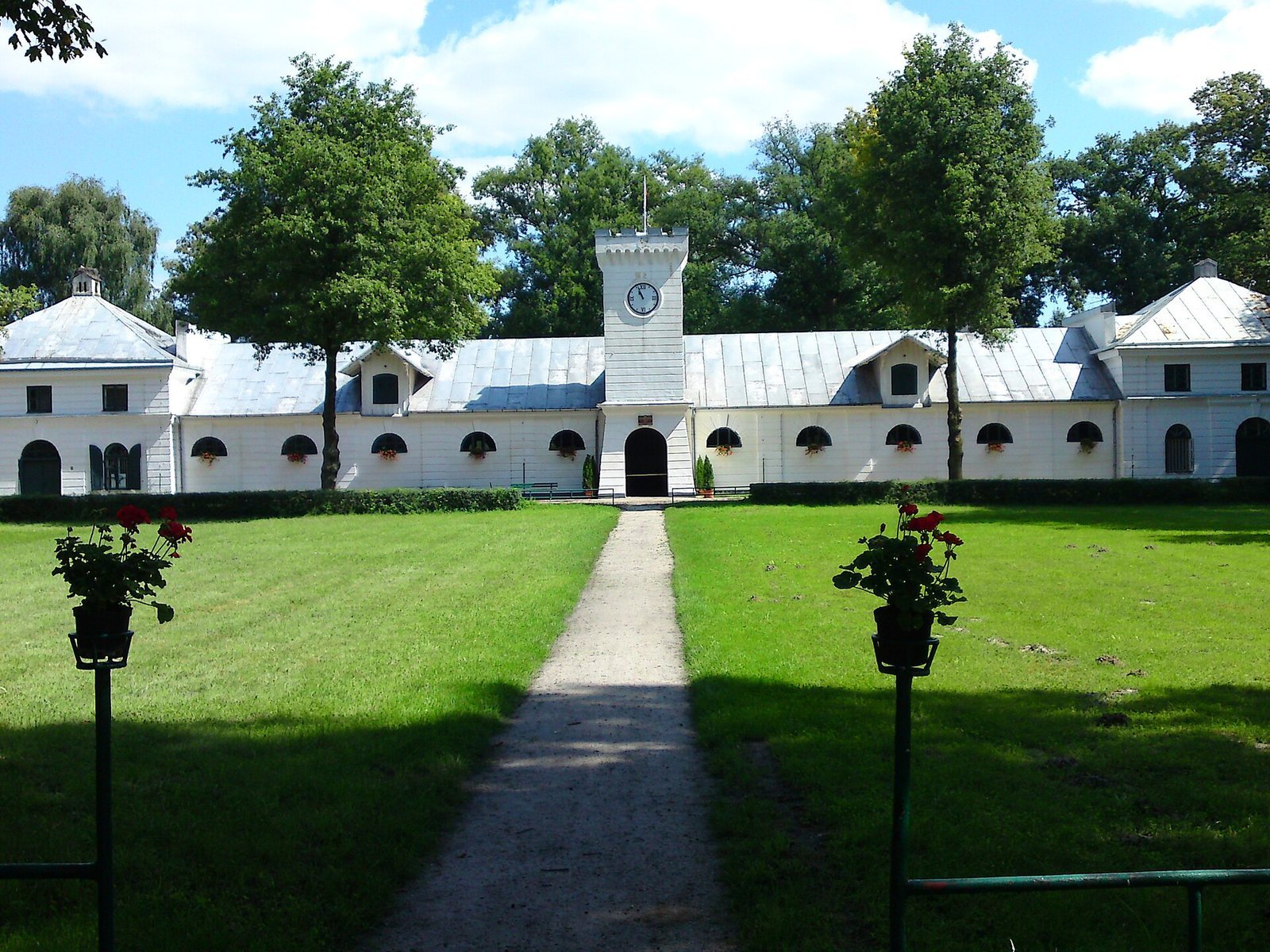
The stud is based at Wygoda, near Janów Podlaski, within a complex of Classicist stables established in 1817. Its grounds cover 2,500 hectares, about 18 percent of the area of Janów Podlaski municipality. The surviving building history includes brick stables of different dates and a stable assigned to racehorses.
First brick stable
The first brick stable was built in 1841 to plans by architect Enrico Marconi, who was active in Poland.
Second brick stable
A second brick stable followed in 1848. It had a Neo-Gothic clock tower, a revival of medieval Gothic design. The clock cost 363 rubles, then equivalent to 2,400 Polish złotys.
Stable built in 1885
A brick stable erected in 1885 contained 85 stalls, individual enclosed spaces for horses.
Racehorse stable
In 1887, one of the stables was assigned to racehorses.
Stable No. 7
Stable No. 7 is also part of the stud complex.
Historic equine collections
During the nineteenth century, the herd’s management held horse trophies and medals. These included silver cups associated with Armida, a mare that won multiple races in Warsaw. The collection also contained paintings on horse subjects and an equine library with Polish and German periodicals.