Sintashta: A Bronze Age Fortified Settlement in Russia
Site at a Glance
- Popularity
- High
- Country
- Russia
- Primary era
- Bronze Age
- Eras represented
- Bronze Age
- Civilizations
- Unclassified
- Site type
- Military
- Remains
- Fortified Town
On this page16 sections
History
Sintashta is a Bronze Age archaeological complex in Russia, on the right bank of the Sintashta River east of the southern Ural Mountains. Its principal occupation dates to about 2100–1800 BC. The settlement is the type site for the Sintashta culture, an archaeological classification based on material remains rather than proof of a single language or ethnic identity.
Settlement and regional setting
An earlier settlement associated with the Poltavka culture lay beneath Sintashta. People had lived there for centuries before the later fortification was built over the site and damaged parts of the older settlement.
Sintashta belonged to a cluster of nearly 30 fortified settlements spread across an area about 400 by 150 kilometres in the headwaters of the Ural and Tobol rivers. Archaeologist G. B. Zdanovich called this regional group the Country of Towns, a label for a cluster of settlements rather than one ancient city or state. Fortified communities were unusual in a steppe where many people lived as mobile pastoralists. Sintashta’s inhabitants may have adopted a settled way of life partly to defend their homes from mobile groups.
Community and cultural interpretations
Residents combined domestic life with copper and bronze production. Farming appears to have been uncommon, and only small quantities of grain have been found. Animal remains from refuse deposits at Sintashta and nearby Arkaim point to a diet based mainly on cattle, with sheep or goats and horses also present. Cemetery deposits show a different pattern, with horses more prominent. The available evidence does not establish whether people at Sintashta could digest milk.
Metallurgists made up about one-sixth of the cemetery burials. Their graves contained substantial goods, although the evidence indicates that metalworkers were not among the community’s elite. The settlement’s cultural and linguistic connections remain disputed. One interpretation proposes a Proto-Indo-Iranian connection; Indo-Iranian is a branch of the Indo-European language family. Another view emphasizes links with the Abashevo culture and the blending of Pit-grave, Catacomb, Poltavka, and northern Abashevo groups into the Novokumak horizon, and considers an exclusively Indo-Iranian explanation inadequate.
Some funerary practices at Sintashta have been compared with rituals described in the Rig Veda, an ancient collection of Sanskrit hymns. The meaning of the chariot burials is also debated: they may have contained actual vehicles or symbolic models connected with a mythical journey of the soul.
Research and heritage status
An expedition from Ural State University discovered Sintashta in 1968. The Ural-Kazakhstan Archaeological Expedition, directed by V. F. Gening and G. B. Zdanovich, researched and excavated the complex through 1986. An archaeological survey near the Large Sintashta Kurgan identified another burial complex, Sintashta IV, in 2015; an expedition investigated it the following year. Sintashta IV belongs to the Arkaim–Sintashta type of the Country of Towns culture. Sintashta is designated a cultural heritage site of federal significance in Russia.
Remains
The complex stands on the first terrace of the Sintashta River in a valley between the villages of Rymniksky and Mirny. The river crosses a sandy valley and can change course during spring floods; its lower course is called Želkuar. Reed and cattail growth in shallow water could provide fodder and material for roofs and mats, and these resources have been proposed as one reason for settling here. After the settlement was abandoned, the river shifted against it, eroding the banks and destroying about half the site.
Fortified settlement
Defences and entrances
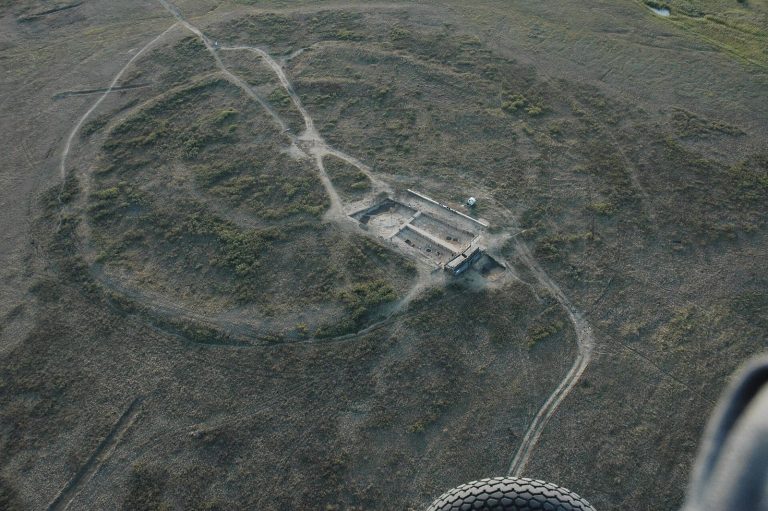
The settlement was roughly circular, about 140 metres across and covering approximately 14,500–15,000 square metres. A defensive wall enclosed a ring of rectangular houses, with a deep ditch along its outer edge. The main wall combined timber framing with unbaked clay, earth, and stone. The ditch’s surviving profile has a sharply V-shaped bottom, and remains indicate a lower outer wall more than a person’s height around it. Gate towers formed part of the defences. Two entrances survive: one on the south, facing the river, and another on the north, facing the temple-and-burial complex and cemetery.
Houses and metalworking
Of an estimated 50–60 houses, 31 remain. Excavated houses had a household oven, a cellar pit, a furnace, and a water well. Metal droplets and slag on house floors show that production took place there. Clay air pipes found in houses and graves were probably used with bellows to increase furnace heat. Among the analyzed objects, 36% were copper containing 0.1–1% arsenic, 48% were bronze with more than 1% arsenic, and 10% were pure copper.
Burial grounds north of the settlement
Five burial areas lie on the lower slope of the river valley north of the settlement. In total, 67 graves have been investigated, yielding approximately 200–250 human skeletons.
Sintashta Mogila
The largest burial ground, Sintashta Mogila, is a flat cemetery, meaning a burial ground without a large mound over it. It contains 40 graves and is slightly older than the Large Sintashta Kurgan, which was built partly across its northern edge. Underground chambers were built from interlocked logs and covered with a log roof, stones, and earth.
Seven graves, SM-4, SM-5, SM-12, SM-16, SM-19, SM-28, and SM-30, are identified as chariot burials, each with one chariot. Chambers generally also held one or more people interpreted as charioteers, two horses beside the chariot pole, weapons, and other grave goods. Animal remains were placed in or near some graves; SM-5 contained remains from eight horses.
Wood from graves at Sintashta Mogila has produced widely differing date ranges. Results are 1740–1520 BC for SM-5, 2900–2620 BC for SM-11, 2200–1650 BC for SM-19, 2400–1970 BC for SM-28, and 2900–2450 BC for SM-39. The early result for SM-39 has raised the possibility that it predates Sintashta’s main occupation, while the date for SM-5 allows for the possibility of later activity.
Large Sintashta Kurgan
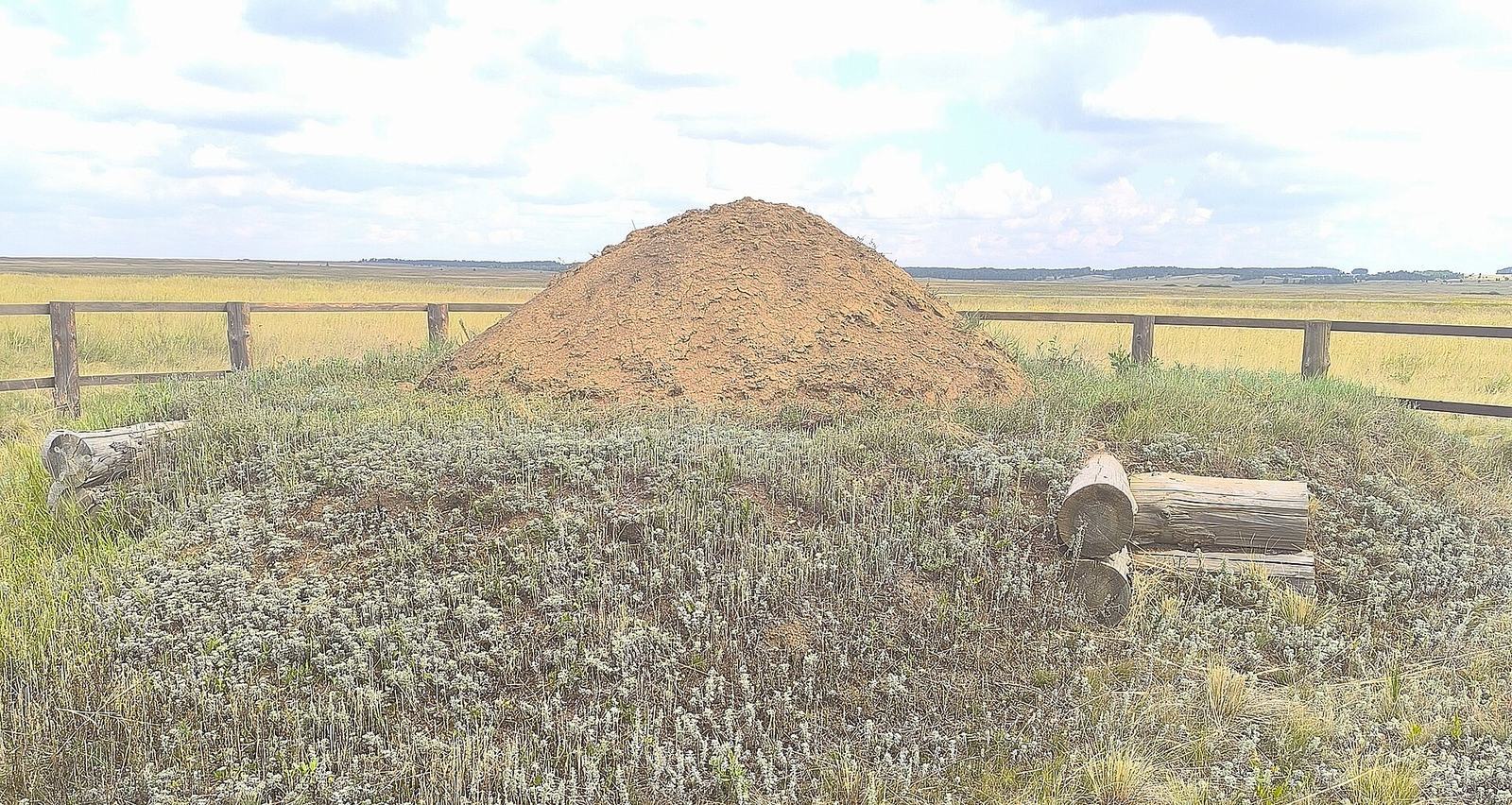
A kurgan is a burial mound. The Large Sintashta Kurgan has an almost circular base about 85 metres across and stands 4.5 metres high today; it may once have been taller. It was robbed in antiquity. If the surviving remains have been interpreted correctly, the mound covered one person in a central underground chamber made from interlocked logs, which was itself covered with logs, stones, and earth. Several metres of soil extended around the chamber over a radius greater than 40 metres. Construction has been estimated to have taken about 3,000 person-days.
Birch remains from beneath the mound yielded date ranges of 2140–1970 BC, 1890–1740 BC, and 1610–1450 BC, leaving its date uncertain.
Animal deposit near the mound
Near the Large Sintashta Kurgan, a pit about half a metre deep held heads and hooves from six horses, four cattle, and two rams. The remains, known as Sacrificial Complex 1, were arranged in two rows facing one another around an overturned ceramic vessel. The animals are estimated to have provided about 2,700 kilograms of meat, equivalent to roughly 0.9 kilograms each for 3,000 people. The deposit may relate to mound construction, or it may represent food for funeral guests.
Sintashta I
Sintashta I is a mound immediately north of the Large Sintashta Kurgan. It measures 32 metres across at its base and about one metre high, with 15 burials investigated beneath it.
Sintashta II
Sintashta II is a small flat cemetery on the upper river slope, just west of Sintashta III. About nine to ten burials are recorded there.
Sintashta III
Sintashta III is a small mound on a hilltop, 16 metres across at its base. Its central collective burial held five people and was the only grave in the mound.
Grave goods and animal remains
Male burials were accompanied by horses whose leg positions imitate running. Clay pottery carries swastika-shaped designs. The cemeteries have also yielded weapons made of stone, copper, and bronze, along with ornaments of silver and gold.