Saimyō-ji Temple: A Tendai Buddhist Temple in Japan


Site at a Glance
- Rating
- 4.4
- Popularity
- Medium
- Country
- Japan
- Primary era
- Medieval
- External website
- Open
- Eras represented
- Medieval, Early Modern
- Civilizations
- Ashikaga shogunate, Kamakura shogunate, Tokugawa, Yamato
- Site type
- Religious
- Remains
- Monastery
On this page19 sections
History
Saimyō-ji Temple is a Buddhist temple of the Tendai school in Japan, located in Kōra, Shiga Prefecture, east of Lake Biwa. Its foundation is traditionally dated to 834, in the early Heian period, and its principal deity is Yakushi Nyōrai, the Buddha associated with healing. Together with Kongōrin-ji and Hyakusai-ji, it forms the Kotō-sanzan group of three Buddhist temples east of Lake Biwa.
Traditional Foundation
Saimyō-ji is also known by the mountain name Ryūōzan Saimyōji and the associated name Kotō-sanzan Saimyōji. Tradition attributes its foundation to the monk Sanshū, an ascetic associated with Mount Ibuki, who established the temple at the request of Emperor Ninmyō, the 54th emperor of Japan. Surviving historical documentation does not confirm either the traditional date or the emperor’s role, while infrared investigation in 2020 raised the possibility that the temple’s origins reach substantially further back.
The foundation legend tells that Sanshū saw purple clouds and a brilliant light across Lake Biwa. He followed the phenomenon to a pond that seemed to emit the light and, after praying there, experienced a vision of Yakushi Nyōrai, the bodhisattvas Nikkō and Gakkō, and the Twelve Heavenly Generals, protective deities associated with Yakushi. The legend says that Emperor Ninmyō ordered a temple to be built at the place of the manifestation. The name Saimyō-ji was linked to the light shining westward, toward the imperial capital, while the name Ikedera was associated with the legendary pond.
Tradition further states that Emperor Ninmyō donated temple lands in 836 and ordered several halls to be constructed. The mountain name Ryūōzan reflects the belief that the temple stood under the protection of the Azure Dragon of the East, a guardian associated with the eastern direction.
Medieval Growth and Destruction
By the Kamakura period, Saimyō-ji had become a substantial Tendai institution. It is said that Minamoto no Yoritomo, founder and first shogun of the Kamakura shogunate, visited the temple to pray for military victory. At that time, the complex reportedly included 17 major buildings, about 300 resident priests, and lands assessed at 2,000 koku, a historical measure based traditionally on rice yield.
In 1571, during the Sengoku period of widespread warfare among regional powers, retainers of Oda Nobunaga attacked Saimyō-ji as part of a campaign against the warrior-monks of Enryaku-ji and other Tendai centers in Ōmi Province. A fire deliberately set near the entrance caused the attackers to believe that the entire complex was burning. The main hall and three-story pagoda survived the assault, although the temple declined afterward.
Edo-Period Restoration
Saimyō-ji gradually recovered during the Edo period with support from the monks Tenkai and Kōkai, the Mochizuki daimyō, and Tokugawa Iemitsu, the third shogun of the Tokugawa shogunate. Tenkai provided 12 koku for offerings, and Iemitsu granted the temple 30 koku of shuin land in 1648.
Between 1673 and 1681, Kōkai, the abbot of Bishamondō, ordered Mochizuki Yūkān to rebuild the temple. Saimyō-ji then became a subordinate temple of Bishamondō and regained its position as a center of Buddhist studies. The landscaped Hōrai Garden was created as a donation from the daimyō of the Mochizuki domain to commemorate the reconstruction begun in 1673.
Protection and New Evidence
The main hall became a National Treasure on 28 December 1897 under the Ancient Temples and Shrines Preservation Law. Its classification was confirmed under the 1950 Law for the Protection of Cultural Properties in 1952. The three-story pagoda received National Treasure status in 1900, also confirmed in 1952, while the Nitenmon became an Important Cultural Property in 1911.
In 1987, the temple precincts and garden were designated a Historic Site, Place of Scenic Beauty, and Natural Monument of Japan. The garden also received specific recognition as a National Place of Scenic Beauty. Several designated buildings were repaired during the 2000s through Japan’s state heritage-conservation program. Infrared investigation in 2020 revealed Buddhist pillar paintings in the main hall whose apparent Asuka-period date suggests that Saimyō-ji may have begun before the traditional foundation account.
Saimyō-ji is the 32nd stop on a 49-site Kansai pilgrimage dedicated to Yakushi Nyōrai. Established in 1989, the route begins at Yakushi-ji in Nara and ends at Enryaku-ji in Kyoto. A building near the main hall receives pilgrims, and the temple issues stamped certificates recording their visits.
Remains
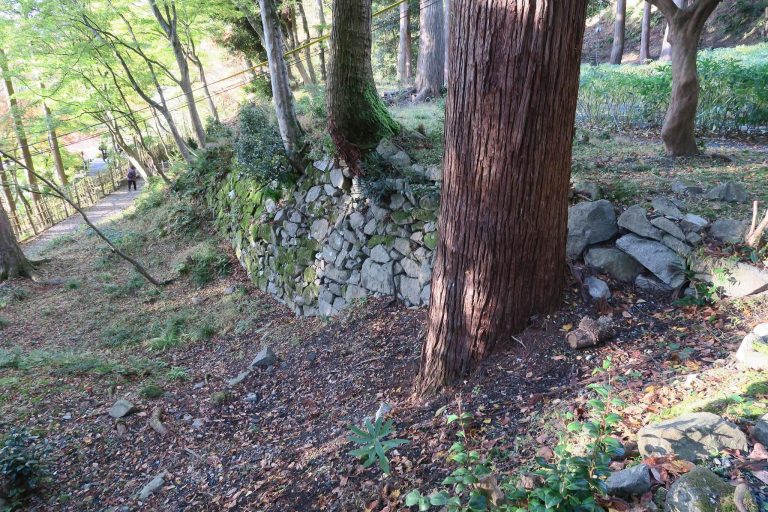
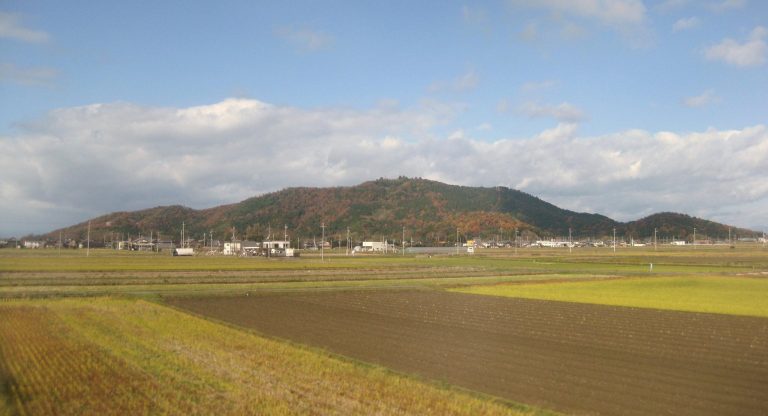
Saimyō-ji occupies a wooded hillside at the foot of the northwestern slope of the Suzuka Mountains, about 11 kilometres east of Lake Biwa. Wood and stone are the principal construction materials. The precincts are divided by the Meishin Expressway, while the western-facing entrance leads to a long, steep approach path called the sandō. The path crosses the expressway and passes the remains of former priestly residences before reaching the Nitenmon. Beyond that gate, the main hall stands ahead and the three-story pagoda lies to the right; the Honbō and its pond-centered garden are positioned to the left of the approach.
Entrance and Religious Grounds
Entrance Gates
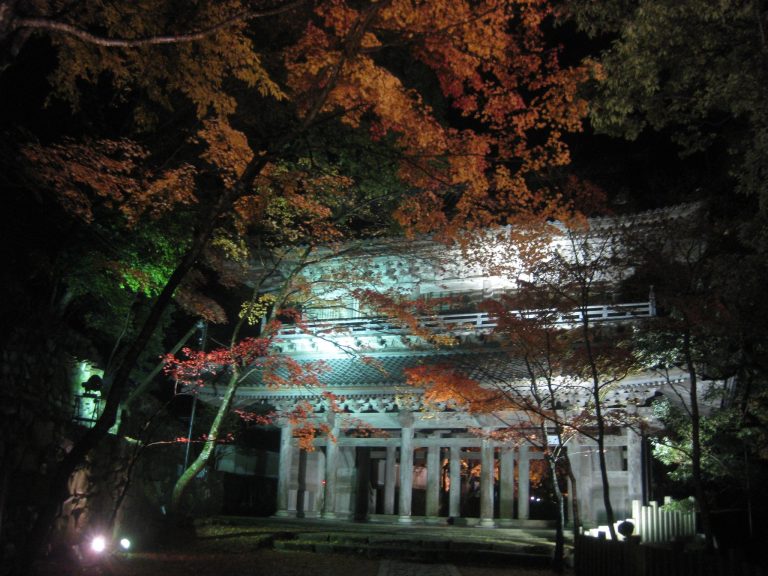
The western-facing sōmon, or entrance gate, begins the approach to the temple. Farther along the sandō stands the Nitenmon, a wooden niōmon, or gate guarded by paired protective figures, dated to 1407 in the Muromachi period. It is an eight-legged gate with an irimoya roof, a form combining a gabled center with hipped sections. Wooden statues of Zōjō-ten, guardian of the south, and Jikoku-ten, guardian of the east, stand on either side of the opening.
Precinct Features
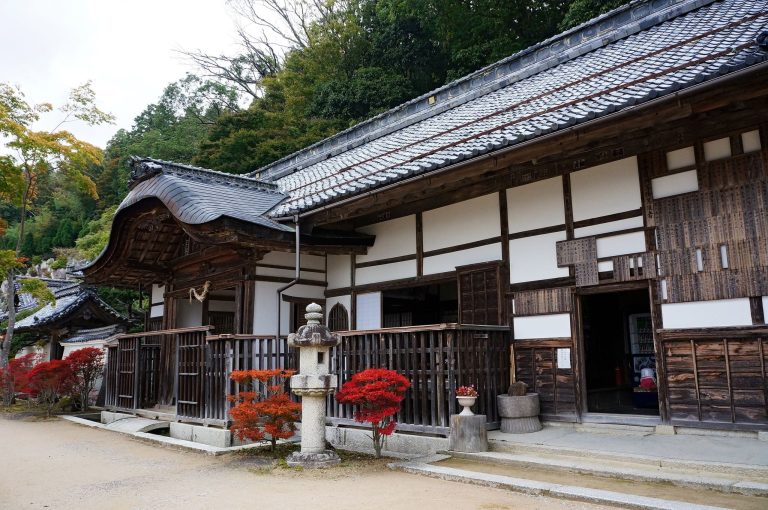
The moss-covered grounds include the entrance gates, two pagodas, a bell tower, an ablution pavilion, a priestly residence, reception and information offices, the Honbō Garden, and wooded plantings of cherry, Japanese maple, cedar, and cypress. Onigawara roof ornaments, a shachihoko ornament, Buddhist sculptures, stone lanterns, groups of Jizō figures, and other stone remains are distributed through the precincts. A statue of Saichō, founder of the Tendai school in Japan, stands beside the approach.
Two small shrines, or hokora, are located within the grounds. One is dedicated to the Eastern Guardian Dragon and the other to Inari. Together with the Buddhist buildings and images, they reflect Shinbutsu-shūgō, the historical blending of Buddhist and Shinto practices and institutions. A bronze statue of the eleven-faced Kannon stands on a stone pedestal near an offering box and candle stands, surrounded by panels and shelves carrying hundreds of small Kannon figures.
Main Hall and Sacred Images
Main Hall
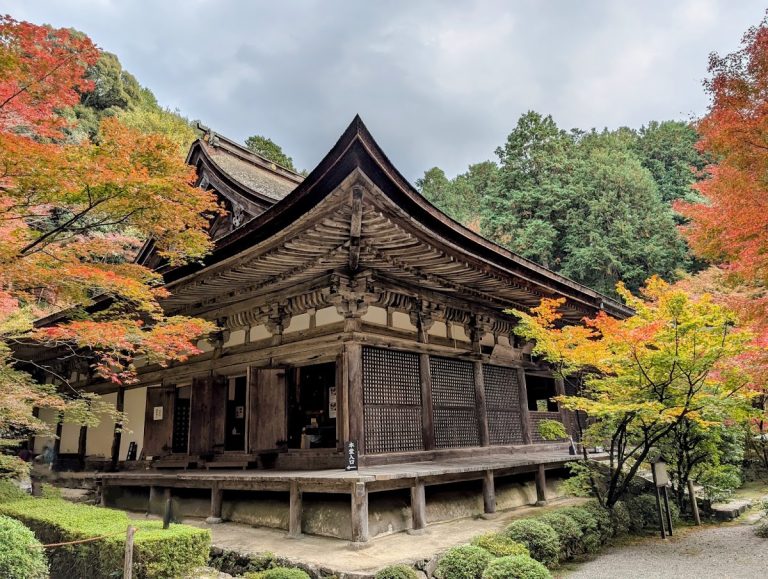
The main hall, also called the ruriden, dates from the end of the Kamakura period. It is a single-story wooden structure measuring seven by seven ken, a traditional interval between structural columns. Built from Japanese hinoki cypress and assembled without nails, it has an irimoya roof, a three-ken entrance canopy, and a bark-shingled roof. The building covers about 160 square metres and serves as a meditation hall for Tendai worshippers.
Sculptures and Paintings
The hall contains an extensive group of Buddhist images from several periods. These include a Heian-period image of Yakushi Nyōrai, gilded figures of Nikkō and Gakkō, and Kamakura-period wooden sculptures of the Twelve Heavenly Generals. A Pure Land triad of Amida Nyōrai, Kannon Bosatsu, and Seishi Bosatsu is also housed there, together with Kamakura-period statues of Shaka Nyōrai.
Other works include images of Fudō Myōō attributed to the monk Enchin and dated to the beginning of the Heian period, as well as Heian-period figures of Kōmoku-ten and Tamon-ten, two of the Four Heavenly Kings. Muromachi-period terracotta miniatures portray the monks Ryōgen and Shinran. Infrared investigation in 2020 identified eight standing bodhisattva figures in the pillar paintings before the Yakushi Nyōrai image, four on the west pillar and four on the south pillar. The paintings are attributed to the Asuka period and are among the earliest Buddhist paintings known in Japan.
Pagodas and Memorial Structure
Three-Story Pagoda
The three-story Japanese pagoda rises about 24 metres and has a plan measuring three by three ken. Built toward the end of the Kamakura period, probably by carpenters from the Hida region, it uses Japanese hinoki cypress and was assembled without nails. Murals on its first floor were painted by artists of the Kose school. They depict the Lotus Sutra, the central scripture of the Tendai religious corpus, together with Dainichi Nyōrai and 32 attendants. These are described as the only surviving Kamakura-period murals.
Memorial Pagoda
A wooden staircase behind the main hall leads to a clearing containing a granite hōtō, a Japanese Buddhist memorial pagoda. Dating from 1304, it commemorates the foundation of Saimyō-ji.
Honbō and Its Gardens
Honbō Garden
The moss-covered Honbō Garden is a wooded garden centered on a pond. It contains Japanese cedars, hinoki cypresses, Japanese maples, Yoshino and mountain cherries, spring cherries, Enkianthus, azaleas, and hydrangeas. Some of its ornamental cherry trees were planted in the middle of the eighteenth century.
Hōrai Garden
The Hōrai Garden forms part of the Honbō Garden. Its stones represent the Pure Land triad, Nikkō and Gakkō Bosatsu, and the Twelve Heavenly Generals. Together they create an allegory of Mount Penglai in Chinese mythology. In the garden’s koi pond, stones rising through vegetation on an island resemble a tortoise and a folded paper crane.
Paired Cedars
Near the Nitenmon, two Japanese cedars joined at the base form a pair of trees. A sacred shimenawa, a rope marking a spiritually important object or place, encircles them, and a younger cedar grows a few centimetres from their joined trunks. Local belief connects the trees with health, longevity, marital harmony, family prosperity, and painless childbirth.