Taga Taisha: A Historic Shinto Shrine in Japan


Site at a Glance
- Rating
- 4.4
- Popularity
- Medium
- Country
- Japan
- Primary era
- Early Modern
- External website
- Open
- Eras represented
- Early Modern, Modern
- Civilizations
- Japanese, Tokugawa
- Site type
- Religious
- Remains
- Sanctuary
On this page20 sections
History
Taga Taisha is a Shinto shrine in Taga, Shiga Prefecture, Japan, whose foundation date is unknown but is traditionally placed in antiquity. The shrine is associated with the worship of Izanagi and Izanami, creator deities in Japanese mythology, and is mentioned in the Kojiki and Nihon Shoki, chronicles compiled in the early eighth century. It became especially renowned for prayers for long life, while also being associated with childbirth, livelihood, occupational assistance, and protection from fire.
Origins and Early Records
The oldest surviving manuscript of the Kojiki contains a passage describing Izanagi as residing at “Taga in Afumi.” One interpretation identifies this place with Taga in Inukami District and connects it with the two-deity shrine listed in the Engishiki, a tenth-century compilation of court regulations and ritual procedures that includes a register of recognized shrines. Another manuscript tradition places the name in Awaji, and the location of Izanagi’s secluded palace remains disputed. The Nihon Shoki consistently refers to Awaji in this passage and does not connect Taga with the palace.
One tradition holds that the shrine first enshrined the ancestral deity of the Inukami clan, a powerful family that controlled the surrounding area and gave its name to Inukami District. The clan was traditionally descended from Inayoribetsu no Miko, a son of Yamato Takeru. Inukami no Mitasuki, associated with the clan’s history, served on missions to Sui China in 614 and Tang China in 630. The Engishiki, completed in 927, lists the shrine as an institution with two seats in Inukami District and ranks it as a minor shrine, without identifying those seats specifically as Izanagi and Izanami.
Medieval Development and Pilgrimage
During the medieval period, when Buddhist and Shinto institutions commonly operated together, Taga was widely revered as Taga Daimyojin and popularly called O-Taga-san. From the Kamakura period, its priests and hereditary warrior-retainers administered the shrine through a deliberative system. During the reign of Emperor Go-Daigo, Prince Moriyoshi prayed at Taga for the destruction of the emperor’s enemies and donated half of Taga Estate as shrine territory.
The shrine’s reputation for granting longevity was strengthened by a tradition concerning the Buddhist monk Chogen. While seeking divine aid for the rebuilding of Todai-ji, he was directed to pray at Taga. A leaf with worm-eaten marks was understood to promise another twenty years of life. Chogen was said to have completed the reconstruction and then died peacefully while seated on a stone at the shrine. This tradition gave rise to the Longevity Stone and to the shrine’s distinctive crest, which includes a worm-eaten, broken oak leaf.
In 1494, Takayori, the Rokkaku military governor, established Fudo-in, a Tendai Buddhist temple, as the shrine’s attached temple institution. Tendai is a major Japanese Buddhist tradition derived from Chinese Tiantai Buddhism. Fudo-in’s itinerant religious agents carried talismans throughout Japan and explained the shrine’s divine benefits, while administration shifted from the earlier deliberative system to the temple. From the medieval period into the early modern era, Taga became a major pilgrimage destination alongside Ise Grand Shrine and the Kumano Sanzan. Its prosperity was also linked to Omi Province’s position as a transportation junction.
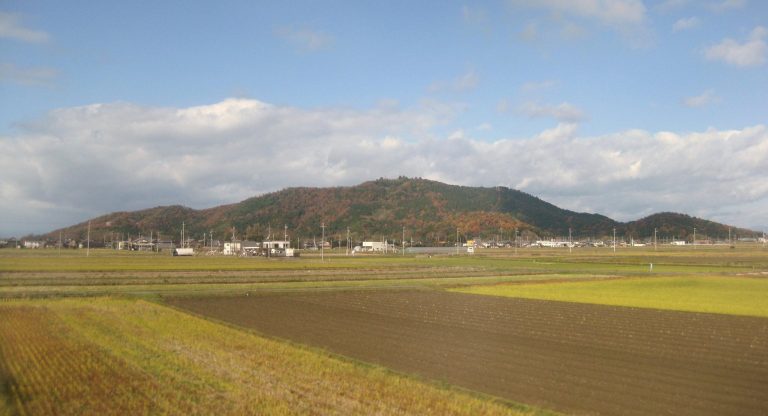
A separate sanctuary called Konomiya, or Taga Konomiya, stands about 2 kilometers south of Taga Taisha on a low hill regarded as a sacred mountain. It functioned as a detached sanctuary associated with childbirth, productive work, and fire prevention. During the reign of Emperor Bidatsu, a temple called Binmanji was established within its precinct, and it later became the inner sanctuary of Taga Taisha. The subsidiary Hinata Shrine is dedicated to Ninigi-no-Mikoto, while the outlying Yamada Shrine is dedicated to Sarutahiko Okami. Taga Taisha also performs a crow-feeding rite associated with the Yatagarasu tradition.
Early Modern Reconstruction
Toyotomi Hideyoshi was a devoted worshipper of Taga. In 1588, he prayed for the prolongation of his mother’s life. After her recovery was believed to have fulfilled the prayer, he donated rice equivalent to 10,000 koku to assist repairs and rebuilding.
The shrine buildings burned in 1615. Tokugawa Hidetada granted Taga 350 koku of shrine territory, and Tokugawa Iemitsu ordered reconstruction in 1633. Kobori Masaju, a hatamoto, or direct retainer of the shogun, and a third-generation master of the Kobori Enshu tea tradition, served as construction magistrate. The main sanctuary and the other halls, subsidiary shrines, and associated buildings were completed in 1638. In the same year, the Buddhist prelate Jisei of Fudo-in directed the construction of the arched stone bridge at the front of the precinct.
Ii Naotaka, lord of Hikone Domain, granted the shrine 150 koku for maintenance in 1651. Extensive roof and other renovation followed in 1766. A major fire destroyed most of the buildings in 1773, and another fire affected the complex in 1782. A storm caused many buildings to collapse in 1791. Support from the shogunate and Hikone Domain enabled repeated repairs, including reconstruction of the main sanctuary in 1808.
Modern Reorganization and Preservation
The Kurumado family served as the shrine’s priests from ancient times. At the end of the Edo period, Taga’s chief priest secretly assisted retainers of the Choshu and Tosa domains. He later received the posthumous Junior Fifth Rank. Members of the family also served the imperial household, court nobles, the Tokugawa family, Hikone Domain, and Hikone Castle.
The Meiji government’s separation of Shinto and Buddhism ended Fudo-in’s role as the shrine’s Buddhist temple institution. Its head returned to secular life in 1868, and Buddhist institutions within the precinct were removed. Many Buddhist images and ritual implements were sold or discarded, while others were transferred to nearby Shinnyoji Temple. The wooden seated statue of Amida Buddha that had been regarded as the shrine’s Buddhist principal image was moved there and is now designated an Important Cultural Property of Japan.
The shrine’s former pilgrim instructors and confraternities separated from it after the Meiji reforms. They founded the Taga Fellowship in 1876, which later joined Shinto Taiseikyo as the Taga Church. Its headquarters stood within the shrine precinct and returned to Taga after the Second World War as the Taga Fellowship Headquarters. Taga Taisha became a prefectural and district shrine in 1877, an Imperial shrine of the second rank in 1885, and an Imperial shrine of the first rank in 1914. It was renamed from Taga Shrine to Taga Taisha in 1947 and listed among the Shinto Honcho’s Beppyo shrines in 1948.
Improvements to the precinct took place from 1929 to 1933. A new main sanctuary was built in 1930, and the earlier sanctuary was moved in 1932 to Hakusan Shrine in Toyosato, where it became that shrine’s main sanctuary. Roof replacement with cypress-bark shingles and construction of an assembly hall followed between 1966 and 1972. A large-scale reconstruction and improvement project began in 2002 and continued over several years.
Ritual Traditions and Sacred Associations
The principal annual observance is the Korei-taisai, or Taga Festival, held on April 22. Other historically important events include the rice-planting festival on June 7 and the lantern festival held on the nights of August 3 to 5.
The Otaga-shakushi ladle amulet expresses the shrine’s association with health and longevity. Tradition says that priests presented Emperor Gensho with hard-cooked rice and a hornbeam ladle during the Yoro era, from 717 to 724, after which her illness was cured. The ladle became a talisman of health and long life, and its name is regarded as the origin of Japanese words for both a ladle and a tadpole. Two trees several kilometers west of the shrine, known as the male and female Imorogi, are traditionally said to have grown from a branch used to make the emperor’s ladle. The shrine’s sacred tree is instead identified as three cedars at Sugasaka Pass, about 6 kilometers east. According to legend, Izanagi planted his cedar chopsticks there after resting at the pass and receiving millet rice from a local elder.
Remains
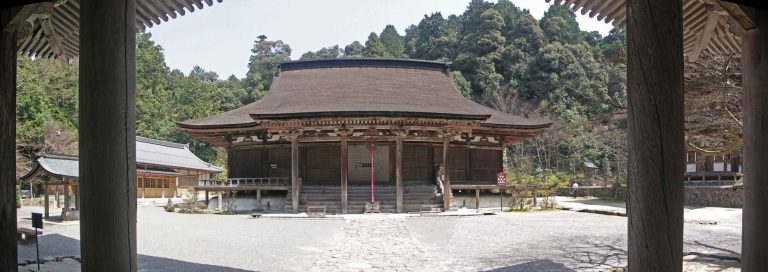
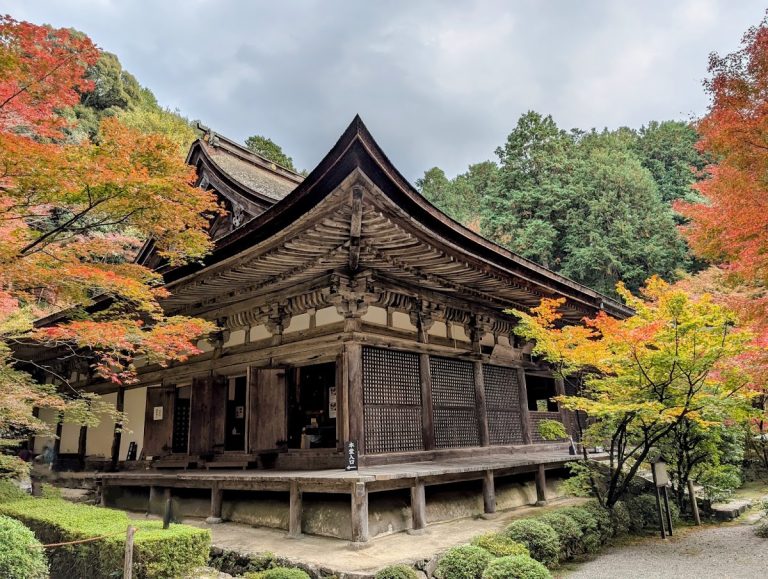
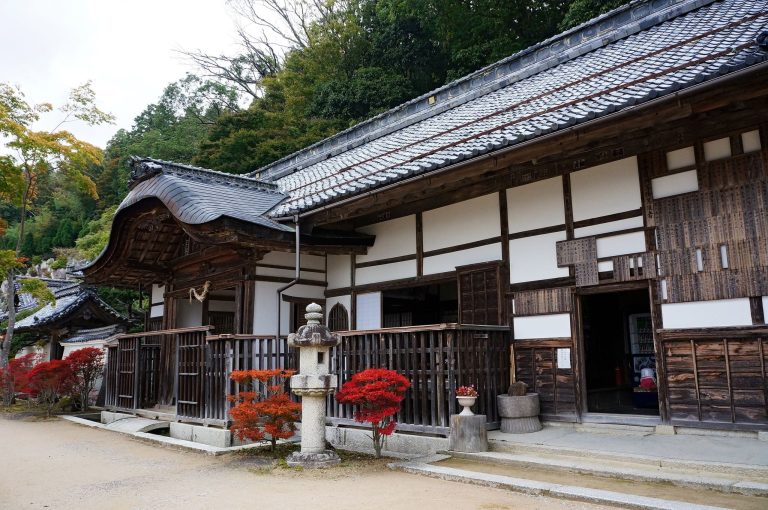
Taga Taisha’s surviving complex combines a central shrine precinct, associated halls and corridors, an Edo-period reception building, a Momoyama-period garden, and approach structures. The principal sanctuary uses the nagare-zukuri form, in which the forward roof slope extends beyond the entrance to create a covered porch. Its roof is finished with cypress-bark shingles. Buildings in the main complex date from the Meiji period through the early Showa period.
Main Shrine Precinct
Principal Sanctuary
The principal sanctuary is a three-bay nagare-zukuri building with a cypress-bark-shingled roof. An openwork fence is attached to it. The central group of buildings also includes a norito hall for the recitation of prayers, a heiden offering hall with east and west wing corridors, two additional corridors, and a worship hall with attached side corridors.
Service and Entrance Buildings
Other surviving structures include a water-purification pavilion, a stable for the sacred horse, and a front gate with two attached earthen walls. The first torii, or shrine gateway, stands in Takamiya approximately 1.5 kilometers from Taga Taisha. At the front of the precinct, the arched stone bridge built in 1638 is known as Taiko Bridge. It has 15 stone bridge piers and attached railings.
Inner Shoin and Garden
Inner Shoin
The inner shoin, a formal reception and study building, dates from the middle of the Edo period. It is a single-story structure measuring 14.05 meters in length and 8.96 meters in depth. The building has a hipped roof, lean-to eaves on its south and west sides, and a tiled roof. Its surviving late-Edo-period sliding-screen paintings form part of the shrine’s cultural-property collection.
Garden
The garden associated with the inner shoin dates from the Momoyama period and survives with the shoin complex. It was designated a National Place of Scenic Beauty in 1935. An additional designation in 2020 gave it its present name, Taga Taisha Garden.
Collections and Documentary Remains
Paintings, Scrolls, and Masks
The shrine’s cultural-property material includes a Momoyama-period painted pilgrimage mandala, three Edo-period scrolls illustrating the history of the Constant Practice Nembutsu Hall, and 72 noh and kyogen masks dating from the Muromachi period through the Showa period. Noh is a highly stylized masked drama, while kyogen is a shorter comic theatrical tradition.
Arms and Armour
Two large swords from the Edo period and an iron helmet coated in black lacquer and fitted with 28 ridges are also associated with the shrine’s designated collection. The helmet dates from the period between the Northern and Southern Courts and the Muromachi period.
Documents and Sacred Objects
The documentary collection contains 136 items dating from the Kamakura through Edo periods, together with a painted old plan of the shrine precinct. The plan preserves the earlier arrangement of the complex, while a Kamakura-period document is associated with Chogen’s repeated appeal for funds. The shrine’s traditional crest combines a three-comma motif with the broken, worm-eaten oak leaf linked to the story of Chogen’s extended life.
Sacred Trees and Ladle Tradition
Imorogi Trees
The two Imorogi trees west of the shrine are natural features associated with the tradition of the imperial ladle. They are identified as male and female trees and are linked to the branch said to have been used to make the ladle presented to Emperor Gensho.
Cedars at Sugasaka Pass
Three cedars at Sugasaka Pass, about 6 kilometers east of Taga Taisha, are identified as the shrine’s sacred tree. Their association with Izanagi and his cedar chopsticks forms a separate sacred-tree tradition from that of the Imorogi trees.