Kōjin-yama Kofun: A Keyhole-Shaped Burial Mound in Japan

Site at a Glance
- Rating
- 4
- Popularity
- Very Low
- Country
- Japan
- Primary era
- Classical
- Eras represented
- Classical
- Civilizations
- Yamato
- Site type
- Burial
- Remains
- Burial Mound
On this page6 sections
History
Kōjin-yama Kofun is a large keyhole-shaped burial mound in Hikone, Japan, built in the late fourth century AD during the early middle Kofun period. The Kofun period was an era, conventionally dated from the third to sixth centuries AD, when powerful leaders were commemorated with monumental burial mounds. Kōjin-yama belongs to a more standardized style associated with the expanding influence of the Yamato polity, the early state-forming political center of central Japan.
Construction and regional connections
The mound stands on a ridge descending from Mount Kōjin, an isolated hill on the eastern shore of Lake Biwa. In this part of the lake region, keyhole-shaped mounds developed after earlier burial mounds with square fronts and backs. Kōjin-yama represents a more fully standardized, Kinai-style example. Kinai was the historical core of central Japan around the later Nara and Kyoto areas.
The foot of Mount Kōjin was formerly approached by Lake Biwa, and the mound appears to have been planned for viewing from the lake. Its burial occupant is therefore conjectured to have controlled water transport on Lake Biwa. Along with the similarly large Chausuyama Kofun at Zeze, the mound helps illuminate connections between the Yamato, Japan Sea, and Tokai regions through the lake.
The Kōjin-yama Kofun cluster includes more than ten other known burial mounds on Mount Kōjin. About three kilometers south, the Inabe archaeological site contained a large building from the early Kofun period, with a maximum floor area of 188 square meters. A connection between that building site and Kōjin-yama Kofun has been proposed.
Later use and archaeological investigation
The area around Mount Kōjin was formerly part of a shoen, a private estate whose land and revenues were controlled by an institution or elite proprietor, belonging to Todai-ji in Nara. The mountain later contained Kōjinyama Castle, a castle of the Muromachi period, the medieval era associated with the Ashikaga shogunate from 1336 to 1573. Medieval documents also record a camp on Mount Kōjin. The flat surface at the mound’s summit is consequently thought to have resulted partly from leveling during this later use.
Survey and archaeological investigation took place between 2002 and 2007, with excavations conducted in four stages during fiscal years 2003, 2004, 2006, and 2007. The mound became a Hikone City Historic Site during the second investigation. Its 13,150-square-meter area was designated a National Historic Site of Japan on February 7, 2011, while the excavated haniwa became a Hikone City Tangible Cultural Property on March 20, 2015.
Remains
Kōjin-yama Kofun is a zenpo-koen-fun, a burial mound with a rounded rear section and a projecting rectangular front section that forms a keyhole-like outline from above. It is oriented toward the north-northwest and measures 124 meters in length. The mound was built in three tiers, with fukiishi, stones laid over an earthwork mound to protect its slopes, covering the exterior. Rows of haniwa, clay objects placed on or around burial mounds, were identified on every tier.
Mound structure and burial area
The circular rear section is approximately 80 meters in diameter and 16 meters high. Its three-tiered front section measures about 53 meters in length, 61 meters in width, and 10 meters in height. The connecting section is approximately 52 meters wide and 9 meters high. The summit is now flat, and a depression at the center of the rear section appears to be a robbing pit. The burial facility itself has not been excavated. Scattered stone slabs around the depression suggest that the mound probably contained a pit-type stone burial chamber.
Haniwa and stone finds
The haniwa recovered from the mound include ordinary cylindrical examples and morning-glory-shaped forms, which commonly formed rows around burial mounds. Figurative examples include representations shaped like houses, lids, and quivers, along with other unidentified forms. A total of 188 excavated haniwa are preserved at the Kaikoku Memorial Hall in Hikone, although they are not on permanent display.
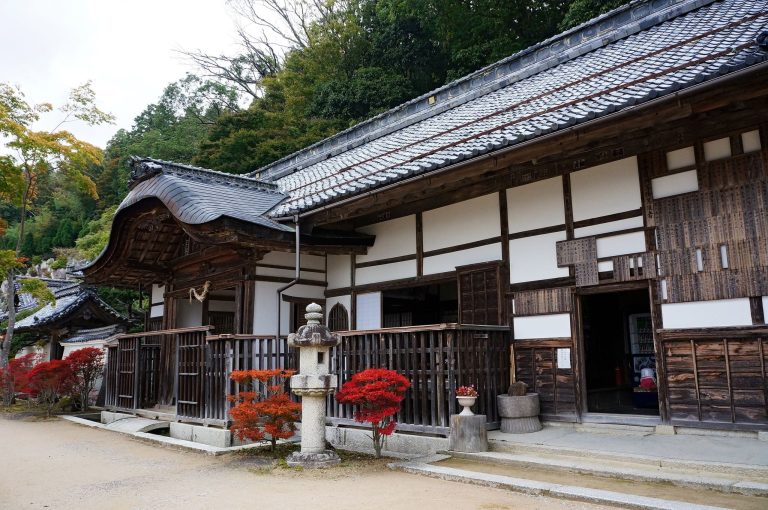
A fragment of a stone wheel traditionally attributed to Mount Kōjin is preserved at Enjuzen-ji at the foot of the mountain. Made of green tuff, it cannot be confirmed as a find from Kōjin-yama Kofun. Its typological date corresponds to the mound’s period, however, and similar stone wheels were used to seal burial chambers in kofun.