Hyakusai-ji Temple: A Tendai Buddhist Temple in Higashiomi, Japan


Site at a Glance
- Rating
- 4.3
- Popularity
- Medium
- Country
- Japan
- Primary era
- Early Modern
- External website
- Open
- Eras represented
- Early Modern, Modern
- Civilizations
- Japanese, Tokugawa
- Site type
- Religious
- Remains
- Fortified Monastery
On this page15 sections
History
Hyakusai-ji Temple is a Tendai Buddhist temple in Japan, located in Higashiomi on the western slope of the Suzuka Mountains east of Lake Biwa. Temple tradition dates its foundation to 606, during the reign of Empress Suiko, and attributes its establishment to Prince Shōtoku. The site is one of the Three Great Temples of eastern Lake Biwa, together with Kongōrin-ji and Saimyō-ji.
Foundation traditions and the Tendai period
The temple’s foundation legend tells that Prince Shōtoku and Hyeja, his tutor from the ancient Korean kingdom of Goguryeo, found a cedar tree shining with mysterious light. Shōtoku is said to have carved an eleven-faced Kannon into the living tree and built a hall around it. Kannon is the Buddhist bodhisattva associated with compassion, while an Eleven-Faced Kannon represents different aspects of that compassionate power. The temple was supposedly named after Ryuun-ji in the ancient Korean kingdom of Baekje, and the two principal images were traditionally believed to have been carved from the same giant tree.
Hyakusai-ji is also traditionally described as the oldest Buddhist temple in Ōmi Province. Another account attributes its foundation to a Baekje immigrant monk who later became Japan’s first sōjō, a high-ranking Buddhist cleric. In this tradition, the temple was established on approximately the same latitude as Ungjin, the former Baekje capital in present-day Gongju, so that it faced west toward the monk’s homeland. A related tradition associates a westward line from Hyakusai-ji with Tarōbō Mountain, Mount Hiei, and Jirōbō Mountain.
The temple first appears in historical documentation in 1089, leaving the historical basis of the Prince Shōtoku foundation tradition uncertain. During the Heian period, Hyakusai-ji came under the influence of Enryaku-ji, the principal institutional center of Tendai Buddhism on Mount Hiei. Tendai is a major Japanese Buddhist school derived from the Chinese Tiantai tradition. In 1174, a major fire damaged the temple.
Medieval expansion and destruction
Hyakusai-ji was drawn into the conflicts of medieval Japan. In 1183, during the Taira–Minamoto conflict, Minamoto no Yoshinaka stationed troops at Gamōno for about a month while observing developments around Enryaku-ji. He requested provisions from Hyakusai-ji, which sent his army 500 koku of rice, equivalent to 1,250 bales. Yoshinaka later built the shrine at Sakamoto in the Kitazakamoto settlement and donated the Oshitate Five Villages to the temple.
In 1213, Hyakusai-ji became a subsidiary temple of Mudō-ji, an Enryaku-ji institution, and developed as a Tendai training center. It became known as the “Mount Hiei of eastern Ōmi” and grew to nearly 1,000 subtemples across its North, East, West, and South valleys. More than 1,300 people were accommodated at the temple during this period.
A further major fire struck in 1274. Warfare affected the temple in 1492, and a fire in 1498 destroyed the main hall and its vicinity. Around 1503, conflict between Rokkaku Takayori, the shugo or military governor of Ōmi, and his deputy Iba Tadataka caused most of the temple to burn. These disasters destroyed much of the complex, including buildings, Buddhist images, treasures, records, and documents associated with its foundation period.
Fortification and Sengoku-period destruction
Hyakusai-ji later recovered its influence. During the Sengoku period, the era of prolonged civil warfare and political fragmentation before the Tokugawa shogunate, the Jesuit missionary Luis Frois described the temple in a letter as an “earthly paradise.” Between 1518 and 1523, it was fortified as a castle complex. Rokkaku Takayori placed his senior retainer Shindō Kazumori in charge of the work, reflecting the close relationship that the temple and the Rokkaku family had maintained since the Kamakura period.
Six of the temple’s scholar-monks were killed in the Tenbun Hokke Rebellion of 1536. In 1568, after Oda Nobunaga entered Ōmi with Ashikaga Yoshiaki and defeated Rokkaku Yoshikata, Nobunaga designated Hyakusai-ji as a place for prayers, treating it as an institution of exceptional standing.
In April 1573, Rokkaku Shōtei took refuge at nearby Namazue Castle. Hyakusai-ji supported the Rokkaku side by transporting provisions and sheltering the soldiers’ wives and children. It also reportedly seized rice intended for Nobunaga’s army. Nobunaga’s forces burned the temple completely on April 11. The principal image was moved to the Fudō Hall of the inner sanctuary, approximately 8 kilometers from the main temple, and survived the destruction.
Reconstruction under the Tokugawa shogunate
A temporary thatched hall was built in 1575 for the principal image. Hori Hidemasa constructed a temporary main hall in 1584, and Tanaka Yoshimasa provided funds for the principal image, ritual implements, and lamps in 1585.
Tokugawa Ieyasu granted Hyakusai-ji land assessed at 146.5 koku in 1602 for its estate and buildings, the Fudō-mae area, and the Kitabukuro area. He donated a further 100 koku in 1612, when the temple became part of Hikone Domain, and Shogun Tokugawa Hidetada confirmed another 100 koku of temple land in 1617. The koku was a land-yield assessment used to express agricultural revenue supporting an institution or domain.
In 1634, Ryosan, a disciple of the prominent Buddhist cleric Tenkai, entered the temple. The subtemple Senju-bo was renamed Kiken-in. In 1637, Ryosan and two other monks petitioned the imperial court for permission to rebuild the main hall and other buildings, and Empress Meishō granted authorization. Donations were solicited throughout the country rather than being supplied directly by the Edo shogunate. Support came from senior councillors, court and religious figures, the chief carpenter Kōra Muneyasu, and Lord Ii Naotaka of Hikone. The main hall, Niō Gate, and Red Gate were completed in 1650, and all present temple buildings date from the early-modern period or later.
Later changes and modern recognition
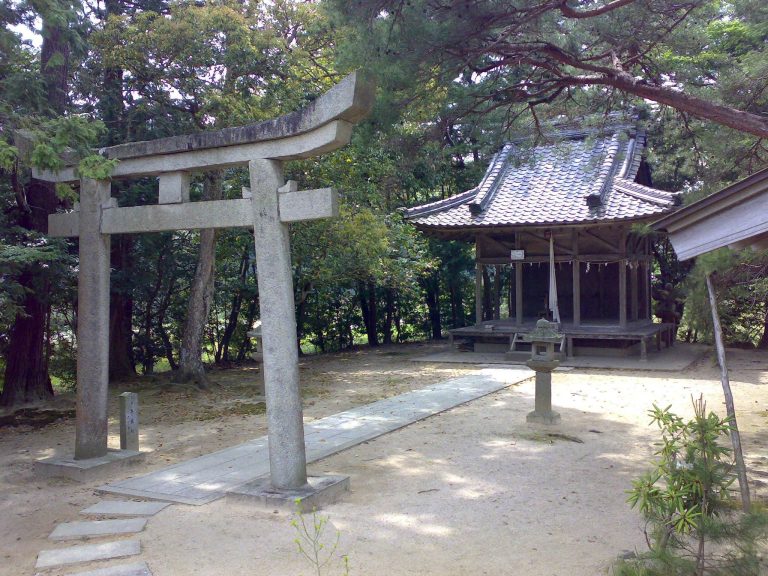
Ii Naoshige, disinherited by his father Ii Naotaka, entered Hyakusai-ji as a monk in 1658 and lived there in seclusion. Kiken-in burned at its former location in 1736 and moved in 1737 to the area below and left of the Niō Gate. In 1868, the separation of Buddhism and Shinto made the temple’s guardian shrines independent; the former Jūzenji Shrine is now Hiyoshi Shrine. Kiken-in moved to its present location in 1940, where it became the temple’s main clerical residence and a garden was created.
Before Nobunaga’s attack, the temple produced a sake called Hyakusai-ji Taru. Brewing ended after the burning, and a revival project began in 2017. The sake was completed in January 2018 and sold in limited quantities. Hyakusai-ji remains associated with several Buddhist pilgrimage circuits, including the Sixteen Circuit of the Thirty-Three Kannon Sites of Kōto and the Tenth Site of the Lake Country Eleven-Faced Kannon pilgrimage. The precinct was designated a National Historic Site in 2008.
In 2023, timber supporting the main hall floor broke during a rehearsal for filming a television drama. About 20 floorboards collapsed across approximately 5 meters. The failure was attributed to loading that exceeded the timber’s capacity and affected part of the hall’s historic fabric rather than destroying the building as a whole.
Remains
Mountain precinct and approach
Hyakusai-ji occupies a mountain slope and is enclosed by extensive stone walls, giving the precinct the appearance of a mountain castle. Along both sides of the approach are stone-lined foundations marking former subtemple sites known as the Hundred-Bō, Two Hundred-Bō, and Seven Hundred-Bō. These surviving foundations express the former scale of the temple community and its organization across the mountain valleys.
Red Gate
The principal approach enters through the Red Gate, one of the three principal buildings completed in 1650 during the early-modern reconstruction. From this entrance, the route continues toward the inner precinct, with Kiken-in standing partway along the approach on the left.
Kiken-in
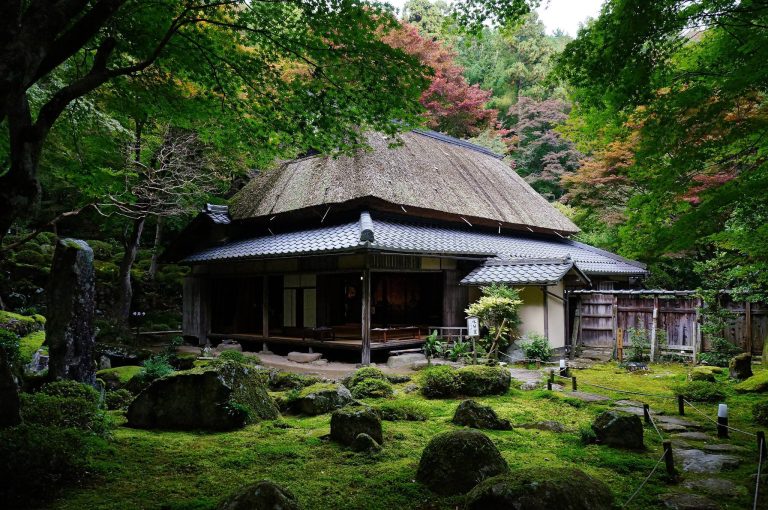
Kiken-in occupies the area below and to the left of the Niō Gate. It moved there in 1737 after a fire at its former location and was relocated again in 1940 to its present position. The current complex includes a garden and serves as the temple’s main clerical residence.
Niō Gate
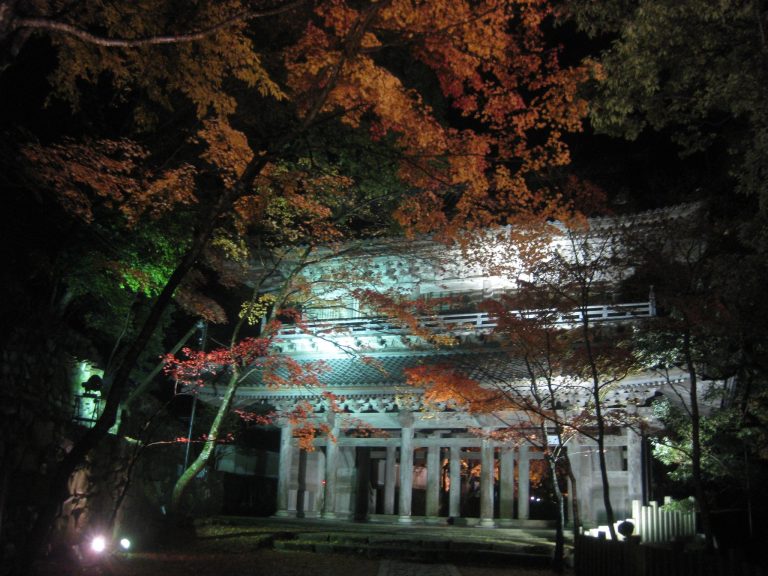
Stairs rise from the approach to the Niō Gate, whose paired guardian kings protect the entrance to many Buddhist temples. The gate was completed in 1650. A large straw sandal, now approximately 3 meters long, is dedicated there, together with smaller sandals and other straw footwear. Local worshippers renew the large sandal roughly once every ten years. The custom developed from offerings about 50 centimeters long, corresponding to the size of the Niō statues, and is associated with prayers for strong legs, bodily health, and longevity.
Main hall and sacred images
Main hall
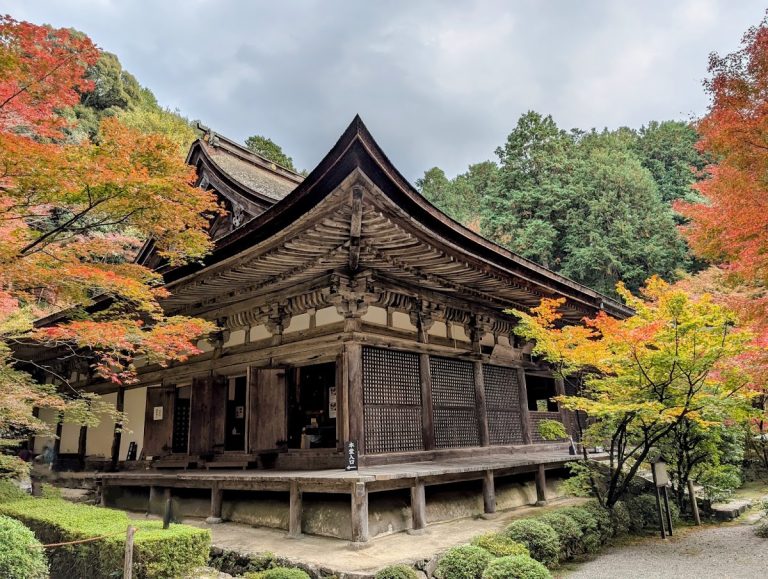
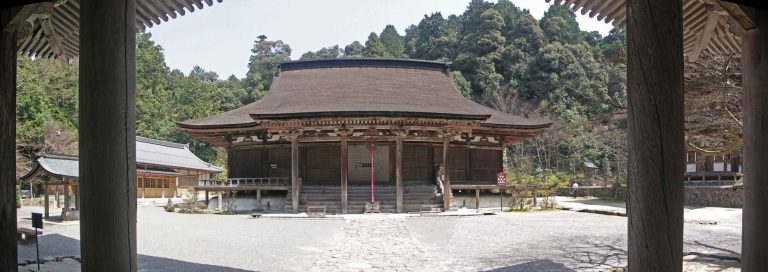
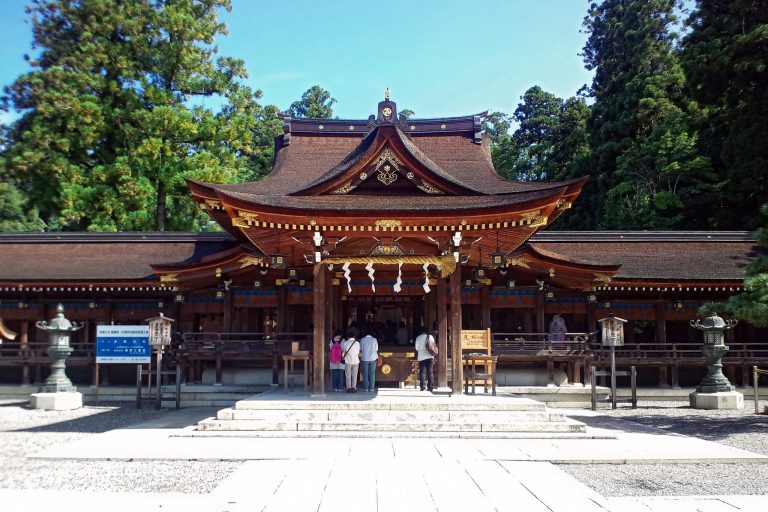
Further stairs lead from the Niō Gate to the main hall, which was completed in 1650 and is an Important Cultural Property. The building is part of the early-modern reconstruction that followed the complete destruction of the temple in 1573. In 2023, a floor-supporting timber broke and caused about 20 veranda floorboards to collapse over a length of approximately 5 meters, leaving a documented alteration in the surviving fabric.
Ueki Kannon
The main hall enshrines the principal image, a standing wooden Eleven-Faced Kannon known as the Ueki Kannon. It is a hidden image, meaning that the sacred statue is normally concealed and revealed only on restricted ritual occasions. Carved from a single tree, the image is a Nara-period work. Its image height is given as 2.49 meters, while a temple listing gives an overall height of 3.2 meters. It is described as the oldest wooden Buddhist image in Shiga Prefecture and as approximately the second largest among Nara-period wooden Buddhist images in Japan, after the 2.52-meter Eleven-Faced Kannon at Anshō-ji in Yamashina, Kyoto.
During the destruction of 1573, the Ueki Kannon was transferred to the inner sanctuary’s Fudō Hall, about 8 kilometers from the main temple. Its survival preserves a direct link with the temple’s earlier religious foundation and with the rebuilding that followed.
Inner sanctuary images
The inner sanctuary formerly housed an image of the Yellow Fudō, a work of the Kamakura period. The Fudō Hall also sheltered the Ueki Kannon during Nobunaga’s attack, allowing the principal image to survive the burning of the main complex.