Yodohime Shrine: A Historic Shinto Shrine in Saga, Japan


Site at a Glance
- Rating
- 4.3
- Popularity
- Low
- Country
- Japan
- Primary era
- Modern
- External website
- Open
- Eras represented
- Early Modern, Modern
- Civilizations
- Japanese
- Site type
- Religious
- Remains
- Sanctuary
On this page17 sections
History
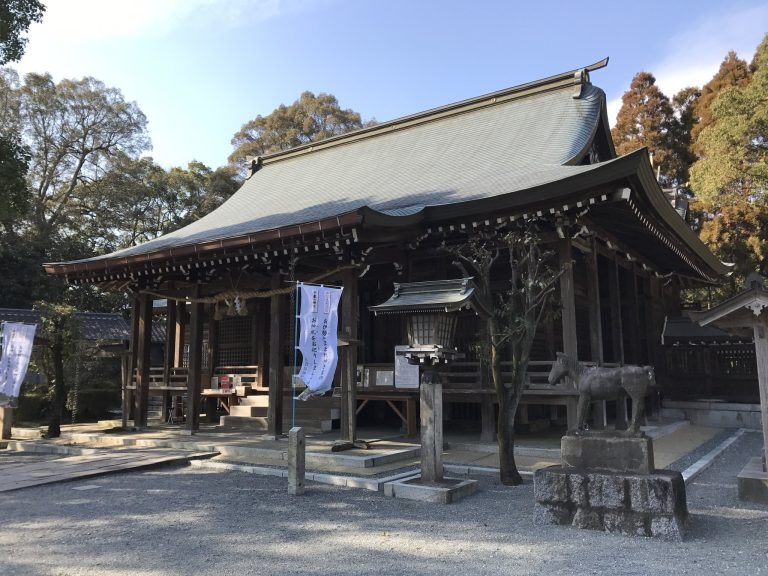
Yodohime Shrine is a Shinto shrine in Saga City, Japan, whose foundation tradition places the enshrinement of its deity in 564 and whose surviving core includes the nagare-zukuri shrine style, defined by a roof that projects forward over the entrance. Shinto is Japan’s indigenous religious tradition, centered on reverence for kami, sacred beings or powers associated with nature, places, ancestors, and cultural traditions. The shrine stands in Kawakami, in the former Hizen Province, and is dedicated to Yodohime-no-Mikoto, also called Yodohime or Yodohime Okami. It is also known as Kawakami Shrine and is popularly called Yodohime-san.
Origins and water traditions
A foundation tradition states that Yodohime-no-Mikoto became enshrined in Saga District on November 1, during the twenty-fifth year of Emperor Kinmei’s reign, conventionally dated to 564. The date and wording of the surviving foundation passage have been regarded as later additions, so the shrine’s exact origin remains uncertain.
The shrine’s religious identity is closely connected with water. The Hizen no Kuni Fudoki describes a stone deity called Setahime at Kawakami of the Saga River, where a crocodile-like sea deity was believed to lead fish upstream each year. People who respected the fish were said to avoid misfortune, while those who caught and ate them could die. Setahime has been identified with Yodohime-no-Mikoto, although that identification is interpretive. Another local tradition tells how a catfish rescued a fisherman and his son by swallowing a serpent-like monster called Kanawa. The family vowed never to eat catfish, which thereafter came to be regarded locally as a messenger of the shrine.
Hizen’s leading shrine
Yodohime Shrine was listed in the 927 Engishiki, a tenth-century compilation of court regulations and ritual procedures. It was the only registered shrine in Saga District and was classified as a small shikinaisha, meaning a shrine included in that register. The court awarded it Junior Fifth Rank, Lower Grade, on March 4, 860, Senior Fifth Rank, Lower Grade, on October 11, 873, and Senior First Rank on March 22, 1261.
During the Heian period, Tajima Shrine held greater prominence as a place associated with safe sea travel. From the medieval period, Yodohime Shrine’s position near the provincial government increased its practical importance, and it became revered as a leading shrine of Hizen. The first documentary reference calling it an ichinomiya dates to 1162. An ichinomiya was regarded as a province’s foremost or most prestigious shrine, although the historical basis of competing claims could be disputed. Yodohime Shrine’s claim was contested by Chiriku Hachimangu for roughly sixty years. In the early seventeenth century, Emperor Go-Yozei issued a large calligraphic plaque affirming the shrine as Hizen’s leading shrine. In 1623, Nabeshima Katsushige ordered both shrines to stop using the title in documents after 1613, and in 1754 and 1755 the two sides agreed not to use it.
Medieval religious complex and resources
In the medieval period, the shrine formed part of a religious complex that included Jintsuji, an attached Buddhist temple. Eleven-Headed Kannon served as its honji, the Buddhist identity associated with the shrine’s deity. In 1089, the monk Enjin cultivated wasteland and established Kawakami Bessho Mountain, the predecessor of Jintsuji. From the Muromachi period onward, Jintsuji’s subordinate temple, Jisso-in, became more powerful and exercised the shrine’s authority under the title of Kawakami Mountain abbot. The shrine was commonly called Kawakami Palace or Kawakami Shrine during the medieval and early-modern periods, and the official name remained Kawakami Shrine until registration under the Religious Corporations Ordinance in 1946.
Donations and tax exemptions provided the shrine with a substantial economic base. In 1076, Tachibana Toshikiyo donated three cho of tax-exempt rice land for a Nio Hannya religious association. The recorded total later reached 277 cho, four tan, and approximately 275 hectares. The shrine also held about 30 cho of permanently tax-exempt land distributed across several districts. In the mid-thirteenth century, it received an annual levy equal to one-tenth of the total tax revenue.
Construction was repeatedly delayed in the thirteenth century after Hizen became responsible for contributing to the rebuilding of Todai-ji. In 1281, the shrine received permission to collect a levy throughout the province, but the measure was not implemented successfully until 1292. Local settlements were then assessed 300 mon in cash and five sho of rice each. A main sanctuary completed in 1295 collapsed soon afterward and was repaired in 1299. Another construction effort began in 1322, but the sanctuary was moved before completion. Building work may again have been suspended between 1324 and 1350 in connection with a protest involving the shrine’s closure.
Warfare and rebuilding
After damage was inspected under the authority of Prince Kaneyoshi in 1367, an elder of Tomyo-ji was appointed construction commissioner in 1371, although the outcome is uncertain. A later rebuilding campaign, delayed by the provincial military governor Imagawa Nakaaki, was completed in the late fourteenth century. Further sanctuaries or temporary sanctuaries were built in 1400 and 1422, though their details are unknown. Fundraising monks assisted in constructing shrine buildings in 1477, 1494, 1499, 1504, and 1530. The Ryuzoji family began intervening in shrine construction in 1559.
The shrine was burned in 1570, when Otomo forces invaded Hizen and the Kawakami area became a battlefield. Before the destruction, Shibukawa Mitsuyori, Chiba Taneyasu, Shoni Masasuke, Ryuzoji Tanehide, and Kojiro Katsutoshi had donated land to the shrine. Nabeshima Katsushige later donated land producing 172 koku, four to, nine sho, and seven shaku in 1613.
The main sanctuary, intermediate hall, and worship hall burned in 1813. The Nabeshima family rebuilt them in 1816, creating the principal group that survives today.
Modern institutional history
In 1871, Yodohime Shrine became a prefectural shrine under Japan’s modern shrine-ranking system. It was designated eligible to receive state offerings in 1912. Repeated attempts to raise its status after 1924 failed, and a proposed promotion to a nationally ranked shrine was never realized before the end of the Second World War. In 1911, the formerly unranked Daimyojin Shrine in Higashiyamada was merged into Yodohime Shrine. The unranked Yodohime Shrine and Tenjin Shrine were also later merged with it.
The shrine’s traditional community included approximately 800 to 1,000 parish households. A 1925 record counted 856 households in Kawakami, Higashiyamada, and Ikeue, while worshippers were distributed through the Kase River basin and the wider areas of Kawakami, Saga District, Saga City, and Ogi City. Its annual religious life includes a principal festival on April 18, an autumn festival on October 10, and another festival on December 18. The spring grand festival takes place during Jisso-in’s Buddhist sutra assembly and includes visits by local representatives, parishioners, and worshippers. The Niiname-sai, a harvest thanksgiving festival, includes purification, offerings of newly harvested rice and other food, ritual prayers, dance, drums, flutes, Saga kagura, and the presentation of a sacred sakaki branch and offering wand.
In 2012, Yodohime Shrine was designated a Saga City Important Landscape Structure. Its associated archive, the Kawakami Shrine Documents, contains 247 documents and is an Important Cultural Property.
Remains
Yodohime Shrine stands on the right bank of the Kase River, in a valley-bottom plain at the foot of the Sefuri Mountains. It occupies an alluvial fan within the Kase River basin, in the area known as Kawakami Gorge. Historical boundaries recorded in 1623 extended east to the Shiro-no-tsuji ridge at Kasuga, south to Hirano Shrine, west to Hirutani on Mount Mizukami, and north to Kosaka Ridge. Before the separation of Shinto and Buddhism, the exempt domain included about four cho, six tan, and 28 bu of precinct land, about 30 cho of woodland, and between approximately 20.8 and 25.4 cho of fields. Recorded precinct measurements range from approximately 2,380 to 2,397 tsubo, while the official figure is approximately 2,795 tsubo.
Principal shrine buildings
Main sanctuary
The main sanctuary is five bays wide and four bays deep. It follows the nagare-zukuri form, whose principal roof slope extends forward to create a projecting entrance canopy. Rebuilt in 1816, the sanctuary originally carried a cypress-bark-thatched roof. Its recorded floor area varies between approximately 20 and 32 tsubo. Japanese cypress and camphor wood are used in the three principal buildings.
Intermediate hall
The intermediate hall is a one-bay-wide, three-bay-deep building with a kirizuma-zukuri roof, a simple gabled form. It has a tiled roof and covers approximately 10.99 tsubo. The hall links the main sanctuary with the worship hall.
Worship hall
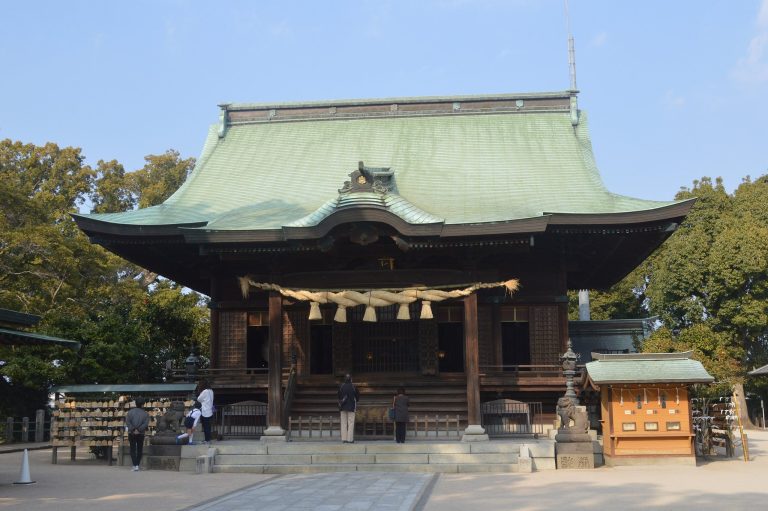
The worship hall is five bays wide and three bays deep. Its irimoya-zukuri roof combines hipped and gabled sections, and a karahafu, or projecting curved gable, forms the porch on the front. The hall originally had a tiled roof and covers approximately 30.34 tsubo. Together, the sanctuary, intermediate hall, and worship hall form a gongen-zukuri composition, an arrangement in which the main sanctuary and worship space are joined by an intervening building.
A plaque inscribed “Guardian of Hizen,” written by Soejima Taneomi, hangs in the worship hall. In 1926, a food-offering hall, a retreat hall, and an office were completed. The roofs of the main sanctuary and worship hall were subsequently covered with copper, and chigi and katsuogi roof ornaments were added.
Gates and torii
West gate
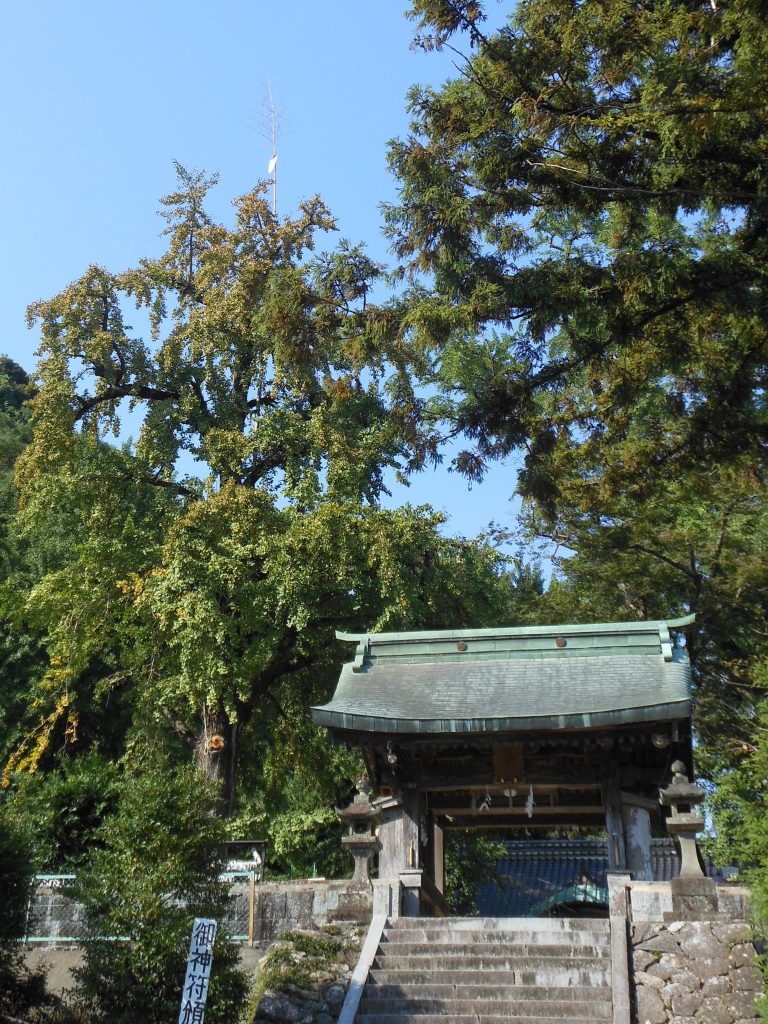
The west gate is a kirizuma-zukuri building with a tiled roof. It was constructed in March 1573 and is designated an Important Cultural Property of Saga Prefecture.
Torii structures
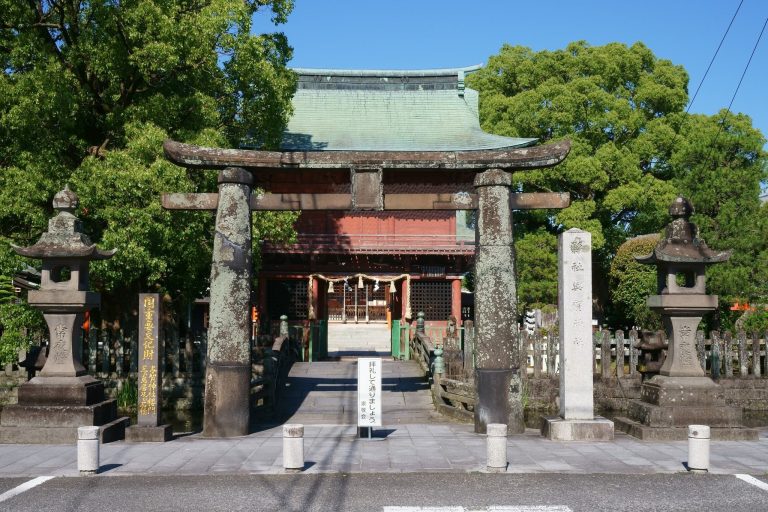
The third torii is a Hizen-style torii donated by Nabeshima Katsushige in 1608. It is designated an Important Cultural Property of Saga City. A first torii stands outside the main precinct near the Tateishi intersection.
Interior features and precinct tree
Ceiling paintings and votive plaques
The worship hall contains ceiling votive paintings, plaques depicting the Thirty-Six Immortal Poets, and other dedicatory plaques. The ceiling paintings consist of 250 panels arranged in two picture-scroll cycles. One concerns the origin story of the brothers traditionally known as Hoderi and Hoori, while the other is associated with the Tenjin subsidiary shrine and Sugawara no Michizane.
The Thirty-Six Immortal Poets plaques show each poet with a representative poem. The original plaques, made in the late Edo period, deteriorated and were replaced by newly painted plaques dedicated in 2015. Both the ceiling paintings and replacement poet plaques were produced by Yin Yusheng, a painter from Dalian who resides in Saga.
Camphor tree
A preserved camphor tree stands within the precinct. It is approximately 20 metres high and has a trunk circumference of approximately 8.6 metres.