Ruine Hohenberg: A Medieval Hilltop Castle in Austria


Site at a Glance
- Rating
- 4.5
- Popularity
- Very Low
- Country
- Austria
- Primary era
- Medieval
- External website
- Open
- Eras represented
- Medieval, Early Modern
- Civilizations
- Habsburg, Holy Roman Empire
- Site type
- Military
- Remains
- Castle
On this page10 sections
History
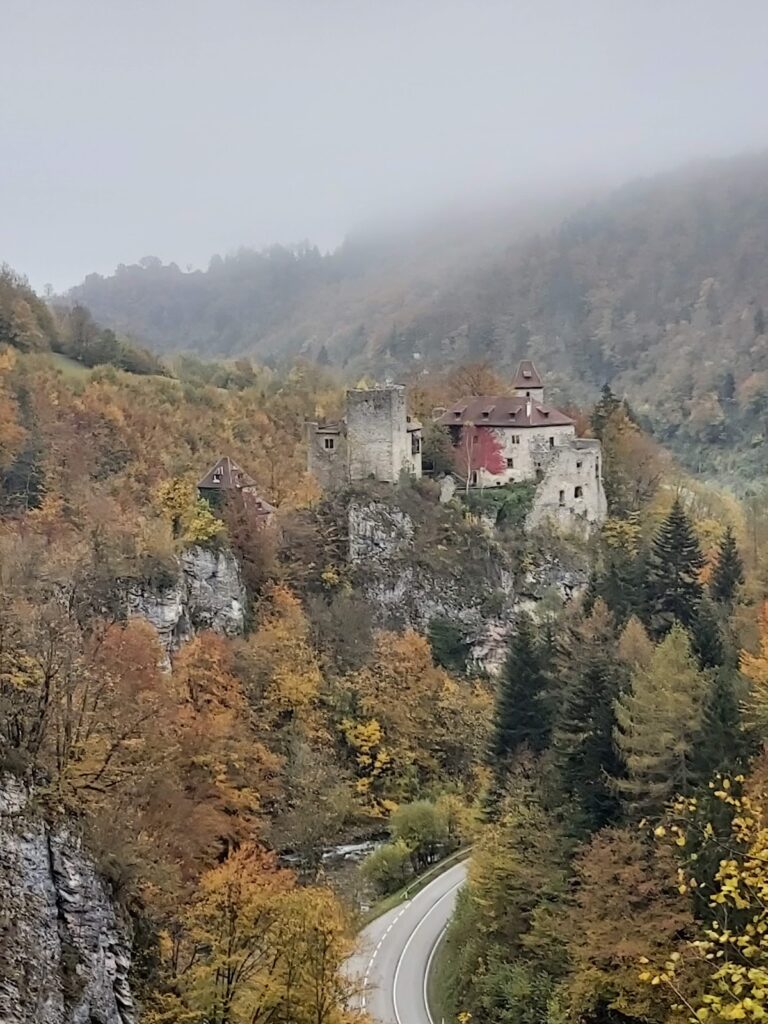
Ruine Hohenberg is the remnant of a medieval hilltop castle in Austria, probably erected in the thirteenth century by Dietrich von Hohenberg. The castle occupied an elevated defensive position in the municipality of Hohenberg, in the Lilienfeld District of southern Lower Austria. Its history is closely connected with the Hohenberg family, regional noble conflicts, and the political and religious struggles of the early modern period.
Origins and the Hohenberg family
Hohenberg is first demonstrably mentioned in 1000 in connection with Otto, Gottfried, and Herand of Hohenberg. This reference cannot be securely linked to the castle, since several places in the Traisen valley carried the name Hohenberg. The castle was probably built in the thirteenth century by Dietrich von Hohenberg, the son of the ministerial Leutold von Hohenstaff, who was also known as Leutold von Altenburg. A ministerial was a medieval administrative and military noble who served a higher-ranking lord and could hold castles. Along with his brother Heinrich, Dietrich is regarded as a founder of the Hohenberg family, part of the Hohenstaff, Altenburg, and Hohenberg dynastic line.
Wars of the fifteenth century
Hohenberg became involved in the Austrian civil war of 1407, fought over the guardianship of the underage Duke Albrecht V. The castle lord Hans I von Hohenberg supported Duke Ernst the Iron against Duke Leopold the Fat and compelled Lilienfeld Abbey to support Ernst as well. Leopold responded by sending a punitive expedition led by the Moravian knight Sokol. Hans I fled and hid in the abbey, while Sokol confiscated the Hohenbergs’ horses. Dissatisfied with the abbey’s support during the conflict, Hans I later plundered Lilienfeld Abbey in retaliation.
In 1482, during the war between Matthias Corvinus, the king of Hungary, and Frederick III, the Habsburg Holy Roman Emperor, Hans III von Hohenberg placed Hohenberg, Merkenstein, and Kreisbach at Matthias’s disposal. An imperial army then entered the Traisen valley and besieged Hohenberg Castle, but the attempt to capture it was unsuccessful.
Ownership, expansion, and destruction
After Erasmus von Hohenberg died in 1529, his branch of the family became extinct. The lordship passed to Wilhelm von Roggendorf, who was married to Erasmus’s daughter, Anna von Hohenberg, and then changed hands several times. In 1535 it passed to Sebald Pögl the Younger, Baron of Reiffenstein and Arenberg.
Baron Bernhard V von Jörger acquired the lordship in 1589. The Jörgers were a Protestant noble family from Upper Austria who expanded Hohenberg substantially. They became powerful landholders in the upper Traisen valley and rivaled Lilienfeld Abbey, traditionally the area’s largest and most influential landowner.
The Counter-Reformation, the Catholic Church’s early-modern campaign to reaffirm its authority in response to the Protestant Reformation, brought a decisive change. In 1619, Emperor Ferdinand II confiscated the Jörger estates, including Hohenberg. Imperial forces under Hans Balthasar von Hoyos captured the castle with gunfire and incendiary projectiles, causing severe damage. Hoyos received Hohenberg as a fief and acquired it as personal property in 1627.
Decline and conservation
The Hoyos family did not reside in the Traisen valley, and the castle received little maintenance. It gradually decayed. An engraving made by Georg Matthäus Vischer in 1672 already shows Hohenberg as a half-ruin, although its ancillary buildings, round towers, and defensive walls were still intact. Vischer was a seventeenth-century cartographer and topographical illustrator whose engravings recorded the appearance of many Austrian castles and landscapes.
The square Pfeil or Hungerturm on the right bank of the Traisen was demolished in 1892 for railway construction. It had formed part of a defensive barrier between Schlossberg and Rierkogel. In 1933, the Wittgenstein family acquired the forest estate and the ruin from the Hoyos family. Both remain under Wittgenstein forestry administration.
The surviving castle fabric was structurally secured between 1956 and 1964, but later deteriorated because responsibility for its maintenance was unclear. In the late 1980s, tourism-association chairman Paul Kropik led work to clear vegetation from the castle hill. A documentation site displaying the “Spielbichler pictures,” which depict the castle in earlier times, was established near the outer gate. Castle festivals and other events helped maintain local interest, although deterioration continued.
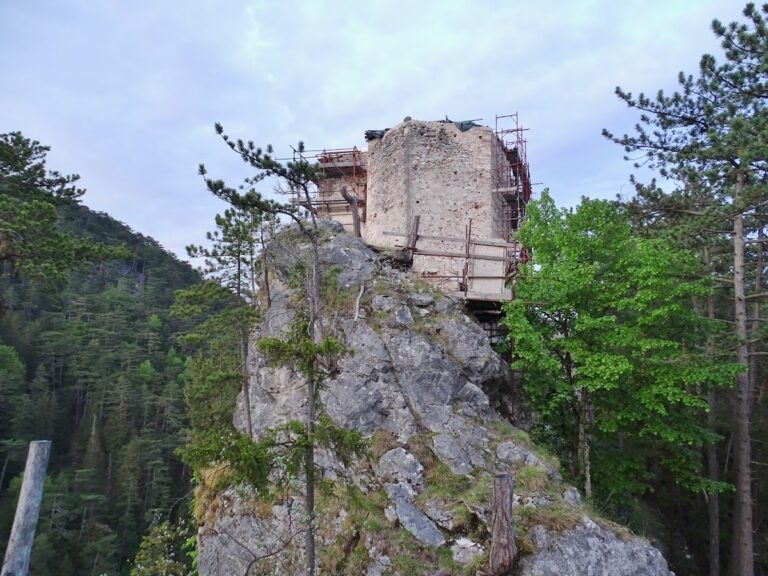
From 2005, volunteers and a scout association carried out conservation and access works. They removed overgrown vegetation, repaired paths, and installed railings, completing the work in 2007. Ruine Hohenberg is listed as a protected heritage object in Austria.
Remains
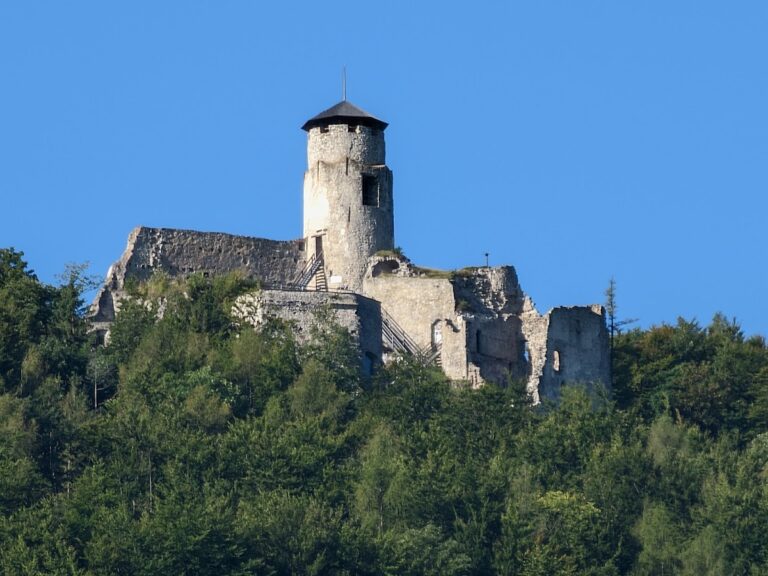
Hohenberg was a hilltop castle enclosed by substantial double walls and a ditch. Its defensive complex included a gate tower, a fortified passage between defensive walls known as a zwinger, an outer bailey, and a triangular courtyard. The surviving fabric is fragmentary, while the 1672 engraving provides evidence for the condition and arrangement of several parts of the complex before further decay.
Defensive complex and courtyard
The triangular courtyard survives only in fragments. The remaining features include part of the outer defensive wall and a remnant of a chimney flue. The wider complex formerly incorporated the gate tower, zwinger, outer bailey, double walls, and ditch, creating a layered defensive arrangement around the hilltop residence.
Ancillary buildings and towers
When Georg Matthäus Vischer depicted Hohenberg in 1672, the castle’s ancillary buildings, round towers, and defensive walls were still intact even though the complex already appeared as a half-ruin. This image preserves an important record of structures that later deteriorated. The ruin’s later physical condition was affected by vegetation growth and subsequent conservation work.
Pfeil or Hungerturm
The square Pfeil or Hungerturm stood on the right bank of the Traisen, where it formed part of the defensive barrier between Schlossberg and Rierkogel. Railway construction led to its demolition in 1892. The tower therefore survives in the historical description of Hohenberg’s wider defensive landscape rather than as part of the standing ruin.
Modern physical interventions
Late-twentieth- and early-twenty-first-century work changed the condition of the surviving site. Vegetation was cleared from the castle hill, paths were repaired, and railings were installed. The documentation site near the outer gate, with its images of the castle in earlier periods, also preserves evidence for interpreting the ruin’s changing appearance.