Losenheim Castle: A Medieval Hill Castle in Austria


Site at a Glance
- Rating
- 4.2
- Popularity
- Very Low
- Country
- Austria
- Primary era
- Medieval
- External website
- Open
- Eras represented
- Medieval
- Civilizations
- Duchy of Austria, Holy Roman Empire
- Site type
- Military
- Remains
- Castle
On this page6 sections
History
Losenheim Castle is a medieval hill castle in Austria, located near Losenheim in Lower Austria. It was probably built in the late twelfth century, and its early history is connected with the Gleißenfeld-Puchberg family’s establishment of territorial lordship in the Puchberg valley.
Origins and the Losenheim Family
The castle was probably constructed during the late twelfth century, although the Losenheim family first appears in written records in the first half of the thirteenth century. Dated archaeological finds support the earlier construction date. At the beginning of the thirteenth century, the Gleißenfeld-Puchberg family established control in the valley by constructing Puchberg Castle, Losenheim Castle, and another fortification on the Romaikogel.
The Losenheim family belonged to the ministerial nobility, a medieval service nobility whose members held status and responsibilities through service to a ruler or lord. The family served the Babenberg duke Leopold VI, who ruled Austria and Styria in the early thirteenth century. Wulfing von Losenheim appears in 1220, while Dietmar von Losenheim is recorded in 1222 and 1225.
Property Transfers and Lordship
Rüdiger von Losenheim transferred property at Höflein to Heiligenkreuz Abbey before 3 September 1264. The holdings included two and a half manse properties, meaning medieval landed or agricultural holdings, together with two gardens. The witnesses were Wisento, Rüdiger’s feudal dependent, Eberhard von Puchberg, his nephew, and Tuote, his wife.
On 3 September 1264, Rüdiger also transferred to the Cistercian Heiligenkreuz Abbey an advocacy right previously reserved over a manorial revenue claim at Höflein. An advocacy right was a secular authority’s legal and protective jurisdiction over an ecclesiastical institution or its property. Otto von Losenheim appears in 1278. In 1304, Johann von Losenhaim renounced in favor of the abbey a revenue holding at Höflein worth three pounds of pfennigs, a medieval monetary unit, which his father had sold to Heiligenkreuz.
Later Ownership and Reconstruction
The Lordship of Losenheim came to share its ownership with the Lordship of Puchberg from the middle of the fourteenth century. The castle apparently ceased early to function as the seat of the lordship. This change helped shape the later history of the site, which survives as a partly reconstructed castle complex rather than as a continuously maintained residence.
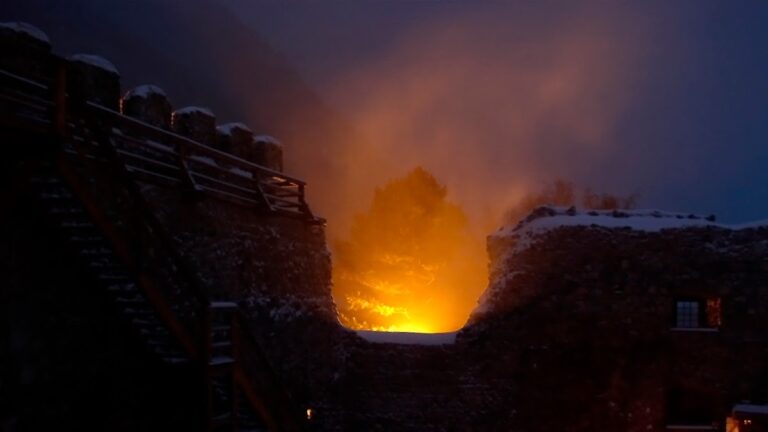
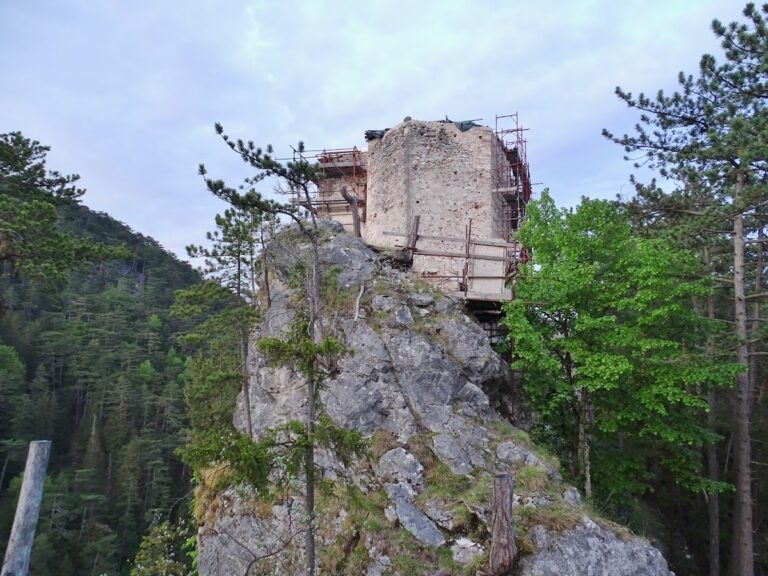
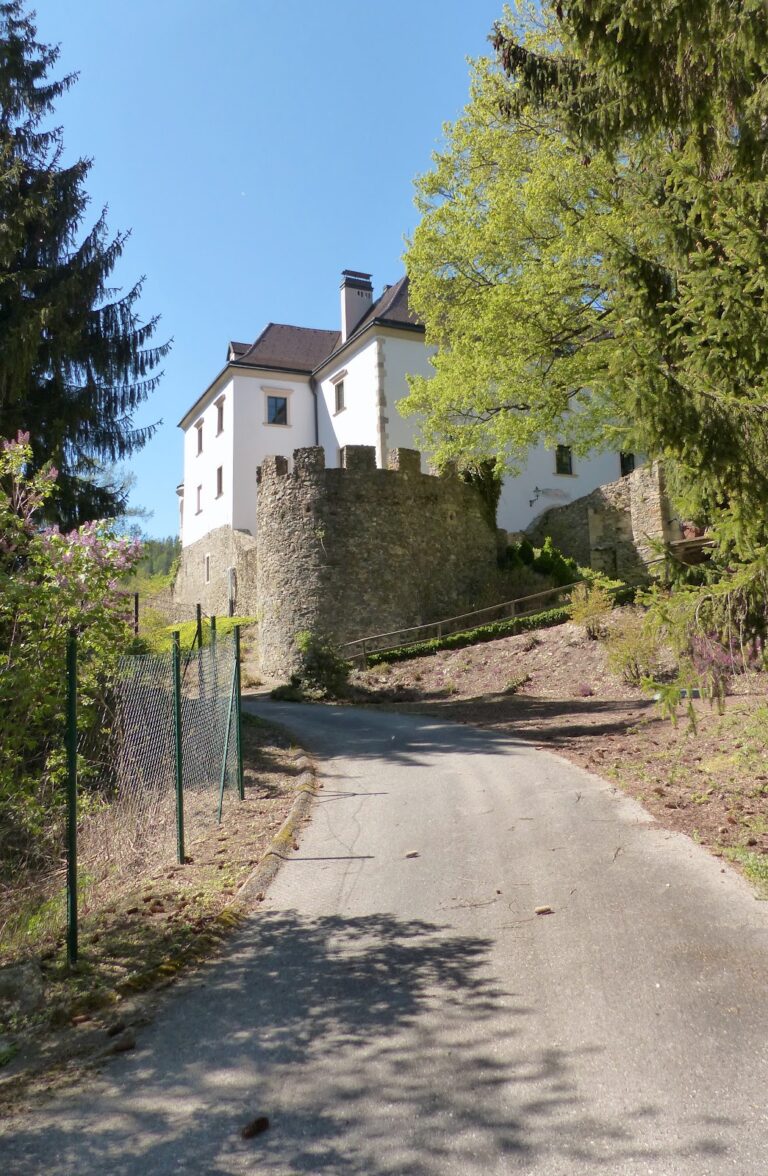
Private reconstruction of the complex began in the 1990s. By 2018, much of the castle had been rebuilt, while the site continued to be described as a ruin because historic masonry fragments remain within the reconstructed ensemble.
Remains
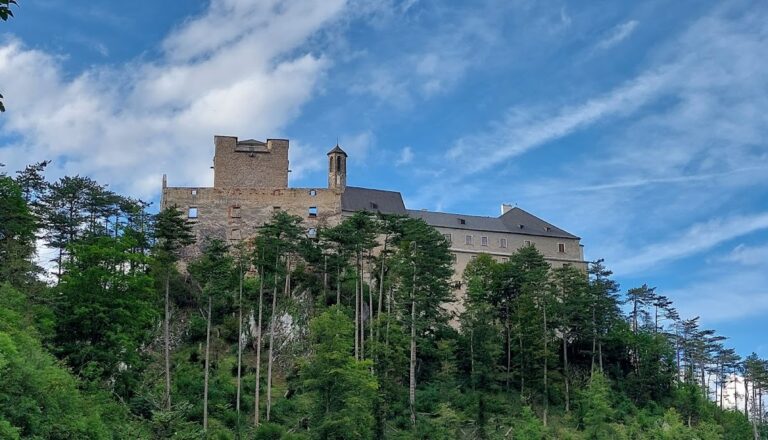
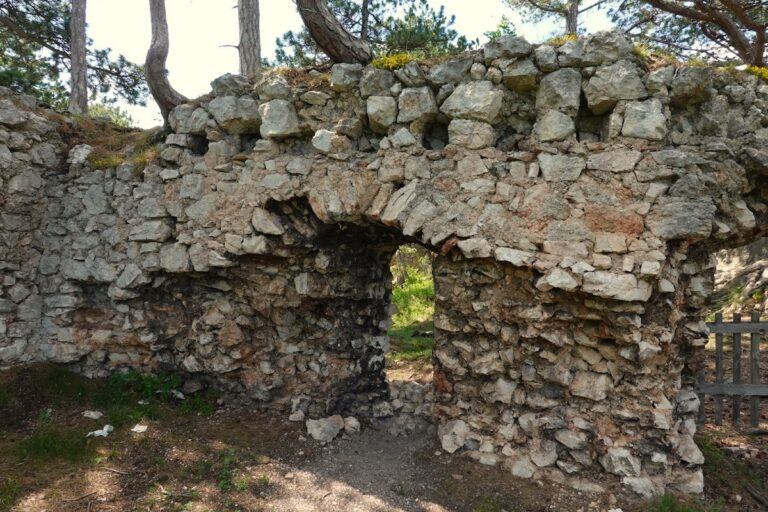
The remains of Losenheim Castle occupy an isolated rocky spur north of the hamlet of Losenheim, about 5 kilometres from Puchberg am Schneeberg in Lower Austria. The castle was a hill castle in a spur position, using the exposed rocky setting as part of its physical arrangement. Surviving masonry fragments are incorporated into extensive reconstruction work, producing an ensemble in which historic fabric and rebuilt sections stand together.
Archaeological Material
Archaeological material from the castle includes dated medieval finds, particularly ceramic material associated with its occupation. These finds help support the early date proposed for the castle’s construction. The recovered material is displayed at the Schneeberg Museum in Puchberg, while the surviving masonry remains at Losenheim form part of the reconstructed complex.