Lilienfeld Abbey: A Cistercian Monastery in Austria
Site at a Glance
- Rating
- 4.6
- Popularity
- Low
- Country
- Austria
- Primary era
- Medieval
- External website
- Open
- Eras represented
- Medieval, Early Modern
- Civilizations
- Habsburg, Holy Roman Empire
- Site type
- Religious
- Remains
- Monastery
On this page15 sections
History
Lilienfeld Abbey is an active Cistercian abbey in Lilienfeld, Austria, founded by Duke Leopold VI of Austria and Styria in 1202. Its church and monastery were built in the early Cistercian Gothic style by a building workshop from Heiligenkreuz Abbey, whose monks settled the new daughter house. The monastery was occupied in 1206, while its foundation charter was issued on 7 April 1209. As a Babenberg dynastic monastery, Lilienfeld acquired an important religious and political position in medieval Austria.
Foundation and Babenberg patronage
Lilienfeld belonged to the Cistercian filiation of Morimond, one of the order’s major early abbeys. Leopold VI’s son, Duke Frederick II of Austria and Styria, expanded his father’s endowment. In 1217 Leopold assembled nobles from his territories at Lilienfeld before they left for the Fifth Crusade, a campaign to recover Jerusalem and other Christian-held territories in the eastern Mediterranean. After the expedition, he gave the abbey a relic of the True Cross that he had received in Byzantium.
Leopold VI died in 1230 and was buried at Lilienfeld. His funeral on 30 November coincided with the consecration of the monastery church and abbey. Queen Margaret of Babenberg was buried in the abbey church in 1266 or 1267, while Cimburgis of Masovia, mother of Emperor Frederick III, was buried there after dying at Türnitz during a pilgrimage to Mariazell. These burials strengthened the church’s role as a place of Babenberg and Austrian dynastic memory.
Medieval religious and intellectual life
During the fourteenth century, Lilienfeld’s scriptorium, the monastic center for writing and producing manuscripts, became important through Abbot Ulrich of Lilienfeld and the monk Christanus, also called Christian. Ulrich wrote the Concordantiae caritatis. The monks also cared for poor and sick people and provided accommodation for guests.
The abbey later experienced a spiritual crisis during the sixteenth century. Repeated Hussite incursions led Abbot Peter Krotenthaler to fortify the monastery, while the Reformation caused many monks to leave. Only six remained in 1587. In the seventeenth century Lilienfeld became a regional center of the Counter-Reformation, the Catholic reform and confessional campaign that followed the spread of Protestantism.
Counter-Reformation and Baroque transformation
Abbot Ignaz Krafft founded a theological and philosophical school that continued into the nineteenth century. Matthaeus Kollweiss, abbot from 1650 to 1695, served as general abbot of the Cistercian order and as an imperial commissioner for Catholic re-Catholicization in Lower Austria. During the Ottoman advance toward Vienna in 1683, he converted the monastery into a fortress, installed a garrison, and offered shelter to fugitives. The abbey and the local population resisted looting by Ottoman and Tatar forces.
Between 1641 and 1716, the medieval complex was expanded with early Baroque buildings and wings. During the first half of the eighteenth century, the church tower, library, interior, and furnishings were rebuilt or renewed in the Baroque style. Abbot Chrysostomus Wieser directed further alterations between 1730 and 1746. The abbey also assumed extensive pastoral responsibilities during the Enlightenment, when new parishes were established. Its Saint Joseph lay confraternity was said to have 200,000 members in 1781.
Suppression, fire, and reconstruction
Emperor Joseph II suppressed the abbey in 1789 because of its heavy debts, which were reportedly connected in part with extensive building projects associated with parish properties. Emperor Leopold II restored it in 1790 after petitions from the people of Lilienfeld. During the suppression, valuable artworks, liturgical objects, manuscripts, and archival materials were removed or lost. Some Gothic stained-glass panels were transferred to Saint Stephen’s Cathedral in Vienna, and manuscripts were taken to the Imperial Court Library.
A major fire in 1810 destroyed or damaged almost the entire abbey. Reconstruction began in 1812 under Abbot Johann Ladislaus Pyrker, who later became Patriarch of Venice and Archbishop of Eger. Nineteenth-century abbots supported music and painting, while Abbot Ambros Becziczka established a botanical garden with exotic plants in 1826.
War, archaeology, and continuing religious life
The abbey suffered during the economic crises of the 1930s, under restrictions imposed by the Nazi regime, and during wartime destruction and looting in the final days of the Second World War in 1945. A Russian Bible and a Russian-language note in the Soviet commander’s visitors’ book are associated with the reported decision of Soviet occupying troops to spare the monastery from further plunder.
Excavations in the abbey church in 1974 clarified the location of the medieval burials. Leopold VI’s marble coffin is a cenotaph, an empty monument commemorating someone buried elsewhere. His actual grave lies at the northern edge of the altar area, in front of the balustrade, beside the burial of his daughter Margaret of Babenberg. Two inscriptions on the outside of the choir balustrade identify the graves. Cimburgis of Masovia was buried beneath the empty coffin attributed to Leopold, while Prince-Bishop Konrad IV of Freising lies in the presbytery.
Following postwar reconstruction, the abbey hosted the 1976 Lower Austrian exhibition 1,000 Years of the Babenbergs in Austria. In the same year, Pope Paul VI granted the church the title of minor basilica, an honorific designation for a church of particular historical, devotional, or architectural importance. The abbey’s 800th anniversary was marked in 2002 by the exhibition Cisto, devoted to its history.
Lilienfeld remains a spiritual and cultural center of the region. Its monks celebrate the Liturgy of the Hours and Mass, serve as pastors in 19 incorporated parishes, teach religion, work in theology, and administer monastic property. The abbey is also a pilgrimage station on the Via Sacra between Vienna and Mariazell. Since the early 1980s, it has hosted the Sommerakademie Lilienfeld, a summer music academy with master classes and concerts. In 2008, more than 160 people from 27 countries took part in its activities.
The abbey’s historic estates also extend beyond the monastery. Leopold VI’s endowment included land near Pfaffstätten between Baden and Gumpoldskirchen. There the monks established the Lilienfelderhof, a walled monastic estate with a Gothic church, manor house, and other buildings. The estate and vineyards were acquired in 2006 by the Kartause Gaming Private Foundation on a 99-year leasehold and have undergone restoration and revitalization.
Remains
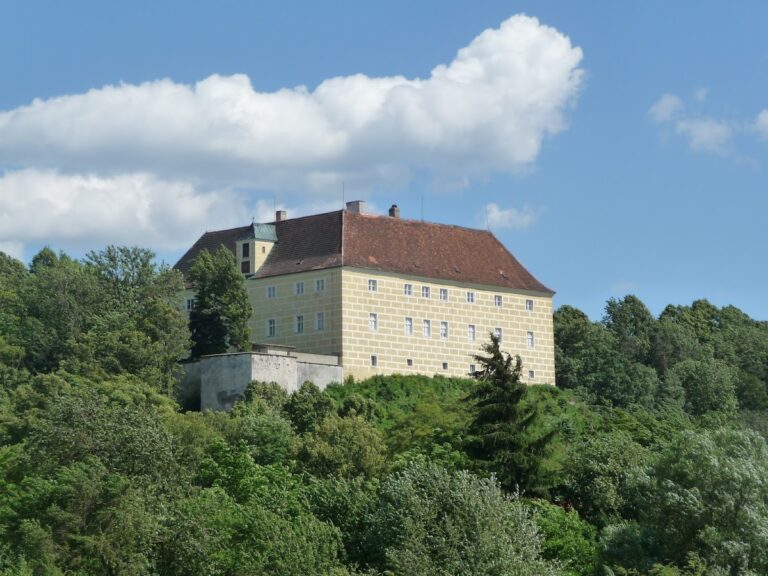
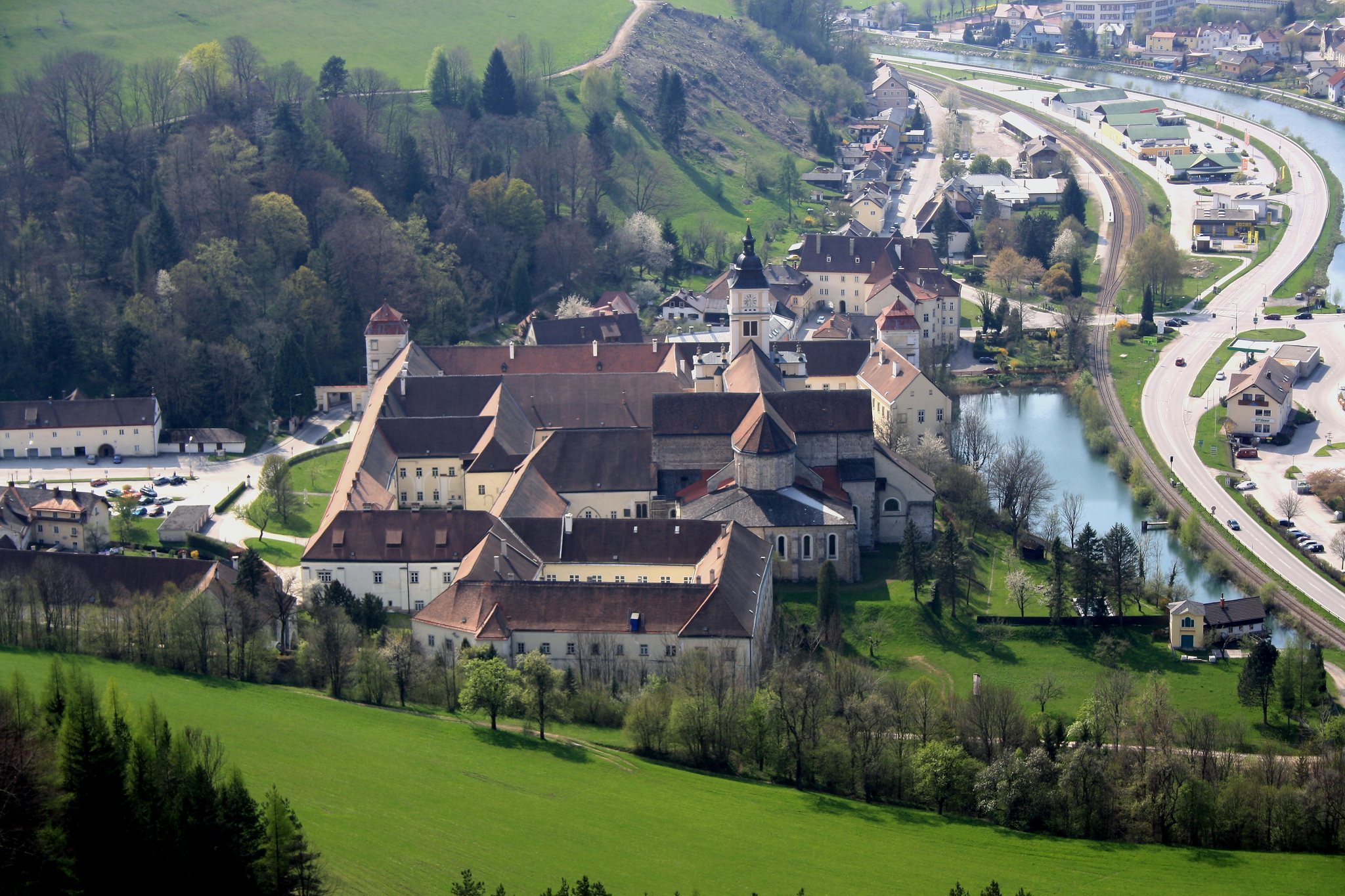
Lilienfeld stands in the foothills of the Alps, with the church on the northern side of the complex and most of the monastery buildings to its south. The ensemble combines an early Cistercian Gothic church and cloister with extensive Baroque additions. It is described as the largest preserved Cistercian monastic complex in Central Europe and as one of Austria’s notable surviving medieval monuments.
Medieval core
Abbey church
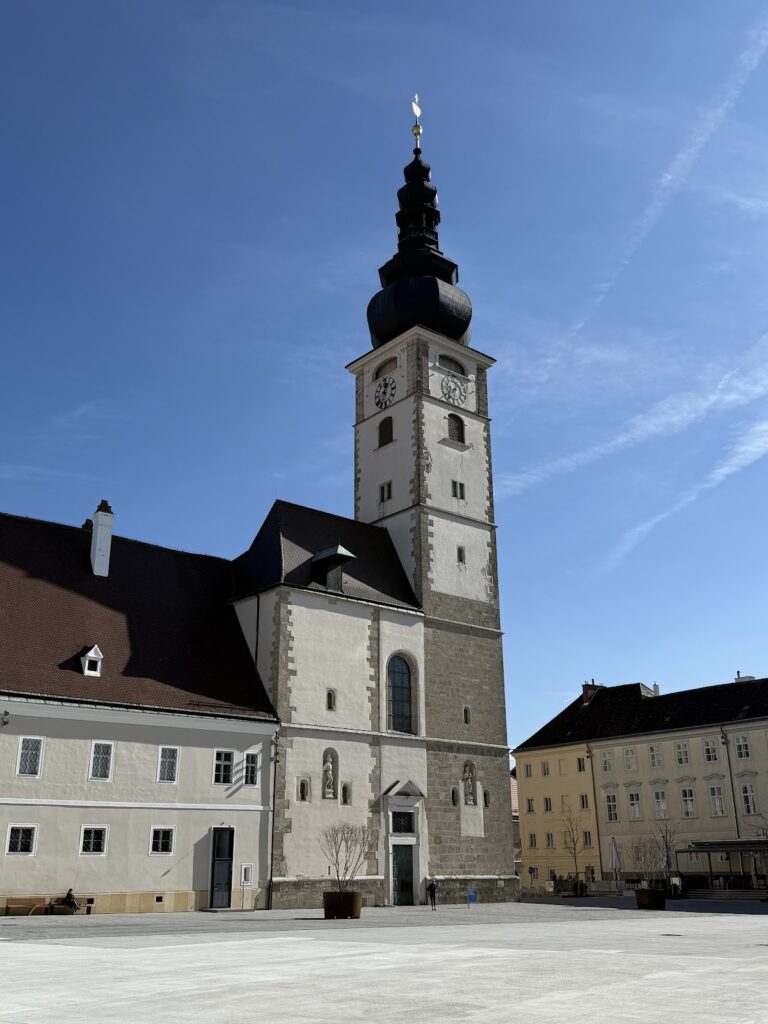
The original church is a three-aisled basilica with a transept and a rectangular choir. Its plan belongs to the early Cistercian Gothic tradition and has been compared with the churches of Clairvaux, Pontigny, and Cîteaux. At 83 metres long, the church is the largest standing church in Lower Austria. Its Gothic entrance facade has a stepped portal framed by a Baroque scroll-shaped gable carried on columns. Baroque statues of Leopold VI and Leopold III stand at the sides, while a sculptural group of the Holy Family with two angels occupies the cornice. Inscriptions identify the dedication to the Assumption of the Virgin Mary and refer to construction during the reign of Ferdinand III.
Cloister and chapter house
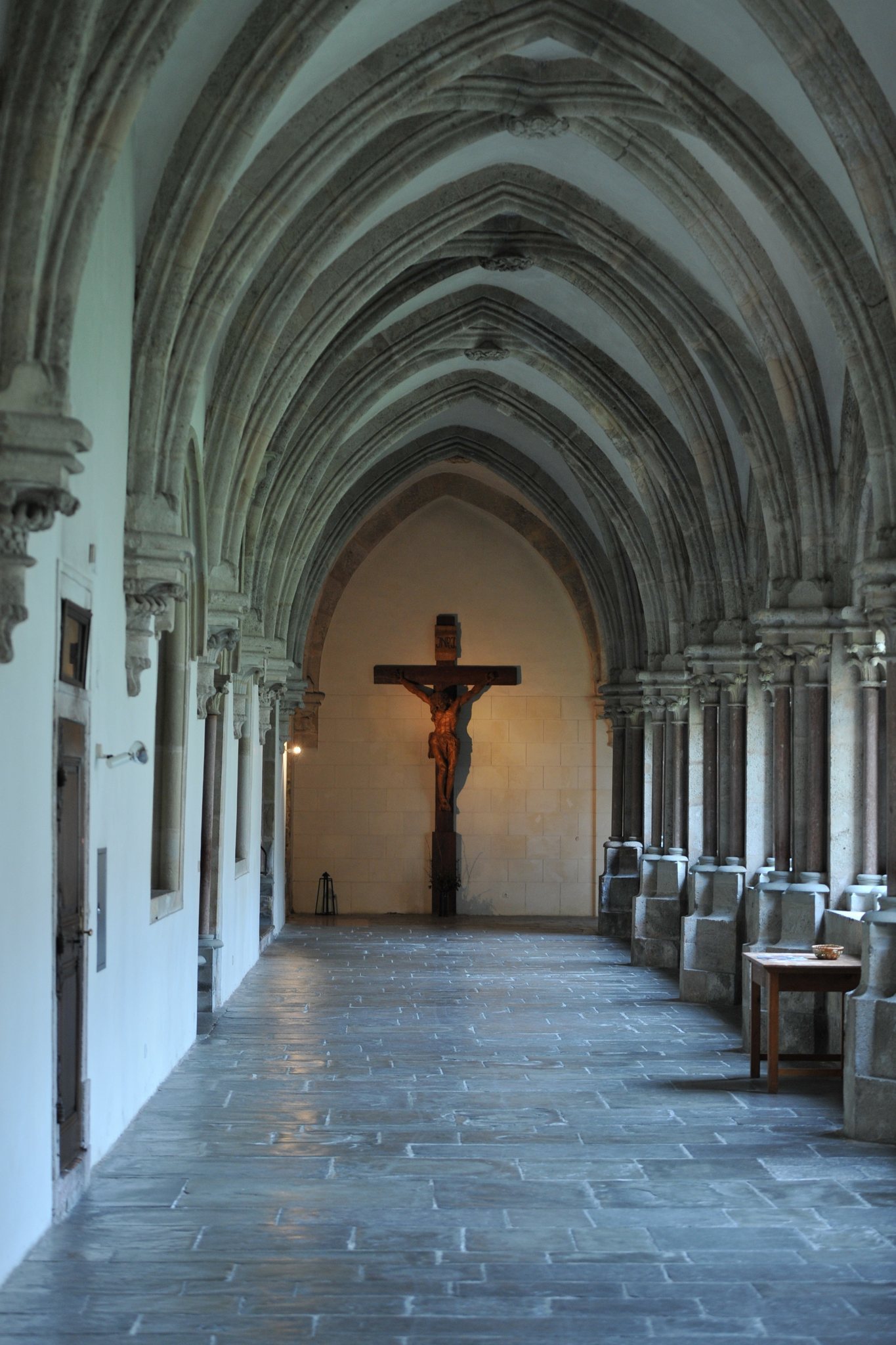
The south side of the transept adjoins the sacristy, followed by the chapter house, the room where the community met for readings, discipline, and administrative business. The chapter house is entered from the cloister, which connected the principal monastic spaces. Dating from approximately 1230 to 1260, the cloister has windows containing six Gothic stained-glass panels from the first third of the fourteenth century. The panels depict episodes from the lives of Christ and the Virgin Mary. Two further windows show the Annunciation, the Coronation of the Virgin Mary, and King Manasse. A Gothic sculpture of the Sorrowful Christ stands at the chapter-house entrance.
Service buildings and burials
A vaulted well house projects from the south cloister into the cloister garth. The cellarium, a monastic storage and service area, is a thirteenth-century, two-aisled hall with rib vaults. The medieval lay-brothers’ dormitory and cellarium are used for events. The church preserves the burial and memorial places associated with Leopold VI, Margaret of Babenberg, Cimburgis of Masovia, Prince-Bishop Konrad IV, and Frederick of Hohenberg.
Baroque buildings and interiors
Church furnishings and chapels
The church interior retains Early Gothic columns, rib vaults, and consoles alongside Baroque furnishings. Lay brother Ludwig Kogel made the main altar, choir stalls, and pulpit. Their marble elements use red Lilienfeld marble and black Türnitz marble, while the wooden parts are black-stained or natural and decorated with inlay. Daniel Gran painted the Assumption of the Virgin Mary with the apostles at the empty tomb. Martin Altomonte painted four altar pictures at the nave piers, and Johann Georg Schmidt, known as Wiener-Schmidt, painted the choir altar pictures.
The Gothic Caesarius Chapel contains an alabaster relief of Christ on the Mount of Olives set within a Baroque altar. The Saint Joseph Chapel has a Neoclassical altar from 1822. The early Baroque sacristy has scenes from the Old and New Testaments painted across its vault, while a Baroque column bearing a statue of the Immaculate Virgin stands in the courtyard. Leopold VI’s empty sarcophagus is made of Türnitz marble and serves as a Baroque cenotaph.
Monastic wings and library
Baroque additions were built on the eastern, southern, and western sides between 1641 and 1716. They include the conventual buildings, guest wing, west wing with imperial rooms, prelature, and library. The medieval crossing roof collapsed and was replaced by a tower in the early eighteenth century, while a western gallery was added.
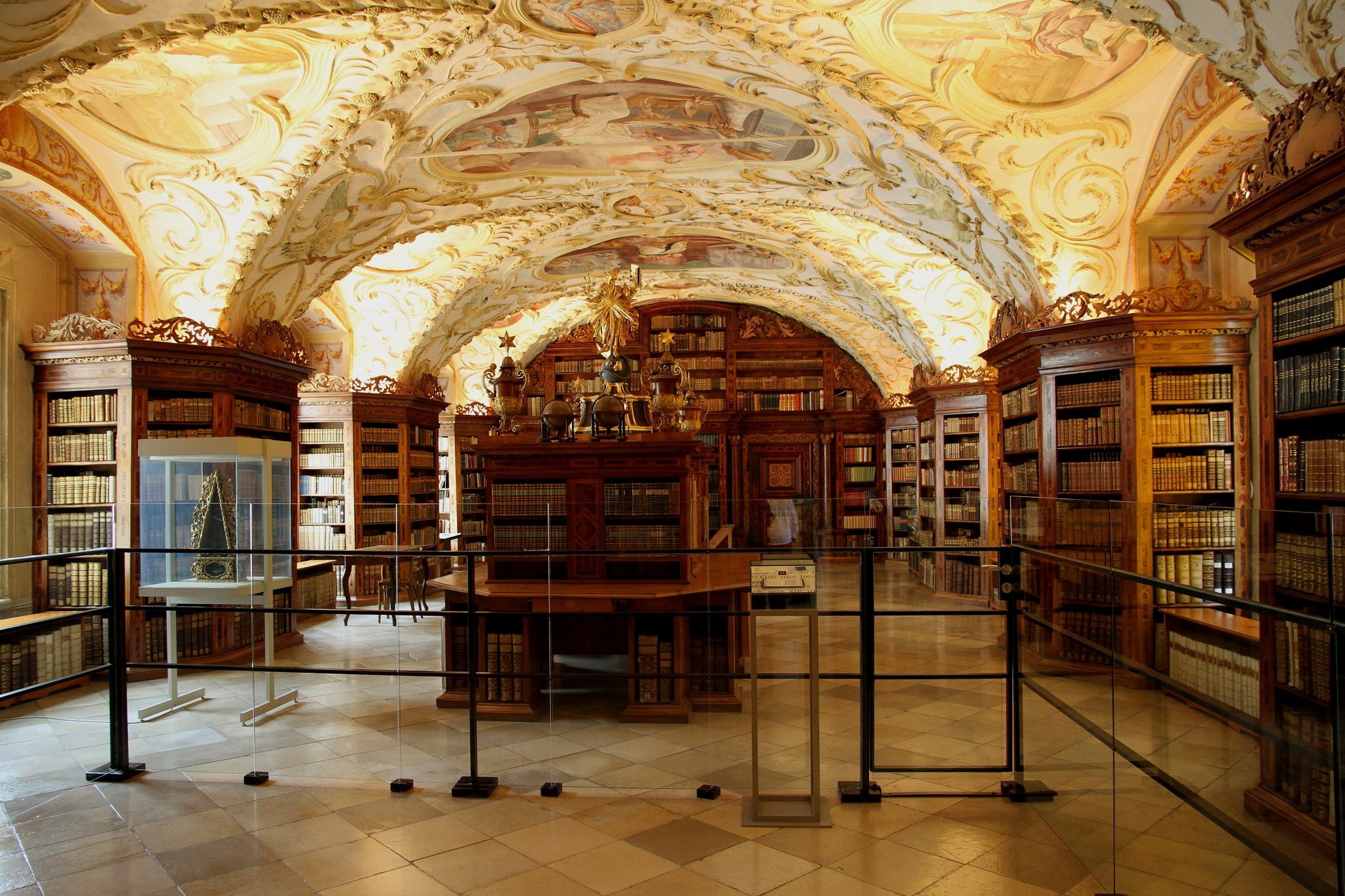
The monastic library was founded in the thirteenth century. Under Abbot Sigismund Braun, a Baroque hall library was installed on the first floor above the refectory, the community dining hall, and completed in 1716. It measures approximately 17.80 by 7.60 metres and is 4.70 metres high. Its design has strong similarities to the library at Lambach Abbey. The collection contains approximately 40,000 volumes, 120 incunabula, meaning books printed in Europe before 1501, and 229 manuscripts.
Organs
The western-gallery organ retains the case of an instrument built by Ignaz Gatto in 1767. That organ had 22 stops, or selectable sets of pipes, on two manuals and pedal. After several extensions and alterations, including unfinished work in 1940 and 1944, Gregor Hradetzky installed a new instrument in the historic case in 1962. It originally had 45 stops and 3,288 pipes on three manuals and pedal. A complete renovation in 1983 to 1985 left it with 44 stops, mechanical key action, and electrical stop action.
A choir organ made by Hradetzky in 1961 has 15 stops on two manuals and pedal and reuses a historic case. It stands opposite the pulpit.