Rocca Sforzesca: Medieval and Renaissance Fortress in Imola, Italy


Site at a Glance
- Rating
- 4.5
- Popularity
- Medium
- Country
- Italy
- Primary era
- Medieval
- External website
- Open
- Eras represented
- Medieval, Modern
- Civilizations
- Duchy of Milan, Italian
- Site type
- Military
- Remains
- Castle
On this page11 sections
History
Rocca Sforzesca is a medieval fortress in the center of Imola, Italy, built by the municipality and later transformed into an example of military architecture spanning the Middle Ages and Renaissance. Its first fortification followed a Bolognese statute requiring Imola to purchase land from the aristocratic Acquavia family, a transaction completed in 1261. Construction is also probably associated with 1332, when the fortress was erected on the remains of an eleventh-century tower.
Medieval lordships and fortification
During the fourteenth and fifteenth centuries, competing ruling families fought for control of Imola and its fortress. The Alidosi, who had previously governed the Santerno Valley, received the vicariate of Imola in 1334. A vicariate was a territory administered by a vicar for a higher lord or authority. The Alidosi promoted further defensive works at the fortress.
In 1424, the Visconti, the ruling dynasty of Milan, expelled the Alidosi from Imola, seized the fortress, and returned it to the pope. The Manfredi, formerly lords of Faenza, then became lords of Imola and reorganized the city’s defensive system. The fortress also functioned as a prison during this period. Antonio Ordelaffi, lord of Forlì, was held there for twelve years during the first half of the fifteenth century.
Renaissance military transformation
During the fifteenth century, the fortress was adapted for firearms and the new defensive methods required by gunpowder weapons. Gian Galeazzo Maria Sforza, duke of Milan, was followed in promoting this transformation by Girolamo Riario and Caterina Sforza. The first phase was directed by the ducal Sforza engineer Danese Maineri between 1472 and 1474. A second phase, less well documented, was probably carried out by an unnamed technician in the early 1480s.
When Caterina Sforza entered Imola on 1 May 1477, work was under way at the fortress, although the exact project being followed is unknown. Cesare Borgia, a papal military commander and territorial ruler during the Italian Wars, besieged and captured the fortress in 1499. After his artillery damaged it, he summoned Leonardo da Vinci in 1502 to prepare designs and strengthening works.
Prison, restoration, and museum use
After Imola came under direct papal rule, the fortress lost its original defensive function. From 1524, when Francesco Guicciardini arrived in Romagna as president of the Province of Romandiola, it became a papal prison. It retained this role after the establishment of the Kingdom of Italy. Nearly five centuries of imprisonment gave the fortress a harsh reputation in the Imolese community, where it came to represent repression by political authority. Andrea Costa’s utopian vision of Imola in 1881 therefore imagined the fortress demolished to its foundations.
During the Second World War, after 8 September 1943, the cells were used to imprison political opponents. Prisoners were taken from the fortress and later killed near the Becca well. The prison continued operating until its closure in 1958.
The state transferred the fortress to the Municipality of Imola in 1903. Between September 1940 and June 1941, the architect Arrigo Stanzani prepared a complete survey of the external curtain walls and a restoration plan for the monuments authority. A curtain wall is a defensive wall joining two towers. The plan was only partly carried out at first, but work between 1960 and 1972 completed it and introduced further alterations designed by Ettore Martini and Franco Schettini. The complex opened as a museum in 1973. Since 1975, it has housed collections of arms and ceramics, as well as the Accademia Pianistica Internazionale “Incontri col Maestro.” The collections belong to the Imola Musei network with Palazzo Tozzoni and the Museum of San Domenico, and are accredited within the National Museum System.
Remains
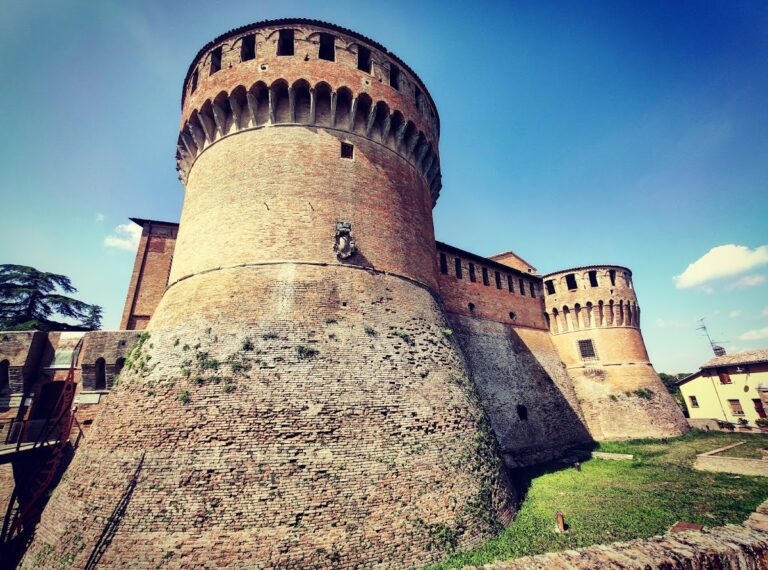
Rocca Sforzesca is built in brick masonry. Its original quadrangular plan had nine square towers, with four at the corners, four at the centers of the curtain walls, and an entrance tower on the eastern side. A massive central keep formed the core of the fortress. The keep was the principal fortified tower, serving as the strongest defensive and residential part of a castle. The fifteenth-century rebuilding enlarged the walls and moats and created the general form that survives today.
Fortress structure and defenses
Central keep and curtain walls
The central keep was lowered by several meters during the transformation for firearms, improving its resistance to gunfire. The square towers placed at the centers of the curtain walls were demolished. The four square corner towers were incorporated into new, thicker circular towers designed to withstand bombardment. By the early twentieth century, the fortress had lost its battlements along all four curtain walls because of prolonged lack of maintenance. Later restoration and alteration work repaired and modified the external perimeter.
Ravelins
Two external ravelins were built on the southern and eastern sides. A ravelin is a detached, usually triangular fortification positioned beyond a main wall or moat. These additions formed part of the fortress’s fifteenth-century response to artillery warfare.
Collections and excavated objects
Ceramics
The rooms of the keep and the southwest tower contain the ceramic collection. Archaeological excavations carried out during restoration work in the 1960s recovered late archaic ceramics, sgraffito ware, and maiolica associated with the Alidosi period. Sgraffito ceramics are decorated by scratching through a surface coating to reveal a contrasting layer, while maiolica is tin-glazed earthenware.
An important find is a complete table service of eighteen sgraffito plates from the beginning of the fifteenth century, discovered in a refuse well at the foot of the keep. The collection also contains a jug decorated with raised blue pigment in the zaffera technique and bearing the Manfredi arms, dating from the first half of the fifteenth century. An engobe-coated bowl from the keep’s dungeons dates from the second half of the fifteenth century. An engobe is a coating of liquid clay applied to a ceramic surface.
Arms
The arms collection contains approximately six hundred objects dating from the medieval period through the nineteenth century. It consists mainly of edged weapons, together with firearms such as Renaissance artillery intended for fixed positions. Two helmets and a bombard were found in a well at the fortress. A bombard was a large early firearm used chiefly in siege warfare. The wider collection was assembled by the Municipality of Imola from objects of diverse provenance and from occasional finds made at the fortress.
Nearby sites