Palazzo Tozzoni: A Late-Baroque Noble Residence and House Museum in Imola


Site at a Glance
- Rating
- 4.6
- Popularity
- Low
- Country
- Italy
- Primary era
- Early Modern
- External website
- Open
- Eras represented
- Early Modern, Modern
- Civilizations
- Papal States
- Site type
- Domestic
- Remains
- Palace
On this page9 sections
History
Origins and construction
Palazzo Tozzoni is a historic residence in Imola, Italy, built for the Tozzoni counts as a three-storey late-Baroque palace between 1726 and 1738. The family came to Imola from Tuscany at the end of the fifteenth century and first occupied two adjoining houses in what is now Via Garibaldi. Architect Domenico Trifogli unified these earlier houses into the present residence, with construction completed in 1738.
The palace was both a family home and a setting for the public life of a provincial noble family. Its reception rooms and apartments preserve the changing domestic and ceremonial arrangements through which the Tozzonis lived and represented their social position.
Family memory and public museum
Giorgio Barbato Tozzoni, a nineteenth-century member of the family, commissioned the palace library. He married Orsola Bandini of Faenza in 1819. Their only child, Alessandro, died at the age of two, and Orsola died in 1836, aged 39. After her death, Giorgio Barbato ordered a life-size mannequin made in her likeness and kept it in the apartment where they had lived. Restored in 2016, it retains her actual clothing and a hairstyle based on her own.
In 1978, Sofia Serristori Tozzoni, the last family member to live in the palace, donated the building and its furnishings to the Municipality of Imola. It opened to the public as a house museum in 1981. A house museum preserves a historic home with its rooms, furnishings, and associated objects so that the lives of its inhabitants can be understood in their domestic setting. Palazzo Tozzoni is part of the Imola Musei civic museum network and is accredited to the National Museum System. Since 28 February 2023, it has also belonged to the group known as the Houses and Studios of Illustrious Persons of Emilia-Romagna.
Remains
Palace layout and interiors
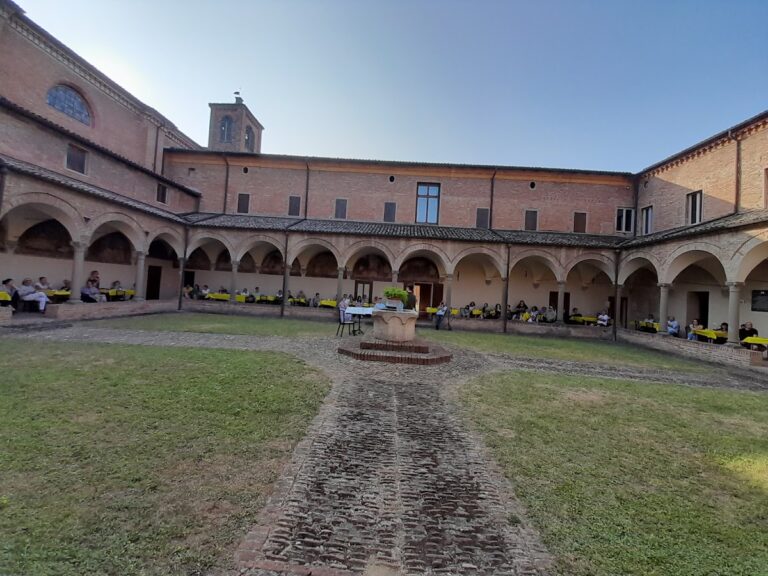
The surviving palace extends from the ground floor to the piano nobile, the principal residential floor containing the most important reception and living rooms. These levels are connected by a grand staircase decorated with sculptures by Francesco Janssens. The principal route through the residence includes the Barocchetto apartment, the Empire-style apartment, and the veranda apartment. Barocchetto is a lighter, more delicate form of eighteenth-century decoration, while the Empire style is the neoclassical style associated with the Napoleonic era and its aftermath.
Other surviving interiors include the ballroom, an Empire-style bedroom, the yellow parlour, the Rococo alcove room, the library antechamber, the dining room, former kitchens, parlours, the library, and the archive. The Red Parlour contains the gallery of Tozzoni family portraits. The Pope’s Parlour takes its name from its association with Pope Benedict XIV. Together, the rooms preserve both formal spaces connected with public life and more private areas of household activity.
Collections and archive
Library and family archive
The library contains historical, numismatic, agricultural, and literary works, including several books from the sixteenth century. Numismatic works concern coins and medals. The archive occupies a large room and includes cabinets containing documents connected with the family and the palace, dating from the late fifteenth century to the 1970s. It also houses the life-size mannequin of Orsola Bandini Tozzoni, dressed in her clothing and preserved as a distinctive object within the house museum.
Paintings
The painting collection contains approximately 170 works, mostly by artists from Bologna and Romagna, with other regional traditions also represented. The oldest paintings date from the sixteenth century. Among the works are the 1584 portrait of Pier Paolo Tozzoni, paintings by Girolamo Donnini, and Three Saints in Glory by Ignaz Stern. Other artists include Bartolomeo Cesi, Marcantonio Franceschini, Pietro Liberi, Antonio Zanchi, and Antonio Beccadelli.
The collection also includes Lavinia Fontana’s oil-on-canvas portrait of Pope Pius V, dated approximately 1603 to 1614, and Stern’s Penitent Magdalene, dated approximately 1700 to 1720. A Roman School bust of Benedict XIV dates from approximately 1740 to 1750, while Giuseppe Righini’s Christ and the Centurion is dated 1756. Fontana was a Bolognese painter known for portraits and religious works.
Photography and ethnography
Francesco Giuseppe Tozzoni’s interest in photography produced a collection containing albumen prints, aristotypes, platinotypes, ferrotypes, cyanotypes, pigment prints, gelatin-silver prints, photomechanical prints, a rare ivorytype, and a daguerreotype dated 1843. A daguerreotype is an early photograph made on a treated metal plate. One album records his voyage around the world aboard the steam corvette Vettor Pisani between 1882 and 1885.
The palace also preserves an ethnographic collection assembled by Francesco Tozzoni during his travels. Such a collection consists of objects gathered to document the cultures and everyday life of particular peoples or communities.
Nearby sites