Dozza Castle: A Medieval Fortress and Museum in Italy


Site at a Glance
- Rating
- 4.6
- Popularity
- Medium
- Country
- Italy
- Primary era
- Medieval
- External website
- Open
- Eras represented
- Medieval, Early Modern
- Civilizations
- Papal States
- Site type
- Domestic
- Remains
- Castle
On this page15 sections
History
Dozza Castle is a medieval castle in Italy, with construction placed around the middle of the thirteenth century. Built as a military complex, it probably incorporates older foundations and was rebuilt more than once, including after wartime damage. Its present form reflects the successive transformation of a fortress into a fortified Renaissance residence and, since 1960, a museum and cultural institution.
From Fortress to Renaissance Residence
The castle was strengthened and reshaped in the late fifteenth century during the rule of Caterina Sforza, the noblewoman who governed Imola and Forlì. She commissioned refurbishment from Giorgio Marchesi, who worked with military engineers in the service of the Sforza family. Their work included the defensive towers, moat, and raised sections of the battlements known as merlons. The principal outline of the castle dates from this late fifteenth-century rebuilding.
During the Renaissance, the fortified complex was converted into a noble residence. The Campeggi family took possession of the fortress in 1565. Annibale, Baldassarre, and Vincenzo Campeggi began the works that altered its function, while Antonio Campeggi completed them in 1594 at the request of the Bolognese Malvezzi family.
The Campeggi and Malvezzi-Campeggi Period
The castle remained inhabited by the Campeggi and Malvezzi families from the sixteenth century until 1960. In 1728, following the death of the last male Campeggi heir, ownership passed through the marriage of a Campeggi heiress to Matteo Malvezzi. Their son continued the combined family name, Malvezzi-Campeggi.
Napoleonic occupation brought the abolition of feudal domains in the region in 1798, but the castle remained in family possession until the municipality acquired it in 1960. The municipal purchase ended its long period as a private residence and began its development as a public cultural site.
Museum and Cultural Uses
After acquiring the castle-palace, the municipality converted it into a museum. The institution includes exhibitions devoted to the Bolognese painter Norma Mascellani and to Dozza’s Muro Dipinto contemporary-art biennial. A Study and Documentation Centre for the Muro Dipinto occupies the third floor, where more than 150 sketches, studies, archival documents, and bibliographic materials are preserved.
Ten years after the acquisition, the municipality established a regional wine-tasting center inside the building. Emilia-Romagna legislation recognized the Dozza enoteca, a wine institution devoted to presenting regional wines, in 1978 as a means of promoting the region’s wine in Italy and abroad. It was formally inaugurated as the Enoteca dell’Emilia-Romagna on 26 May 1990.
Since 2006, the museum has been recognized as a Museum of Quality by the Emilia-Romagna Region. It also belongs to the Regional Museum System, the Fondo Ambiente Italiano, a nonprofit organization devoted to preserving and promoting Italy’s cultural and natural heritage, and the National Association of Houses of Memory. The castle’s historical and artistic importance places it among historic buildings used for museums, exhibitions, and displays eligible to be governed by the Italian Ministry of Cultural and Environmental Heritage decree of 20 May 1992, no. 569.
Remains
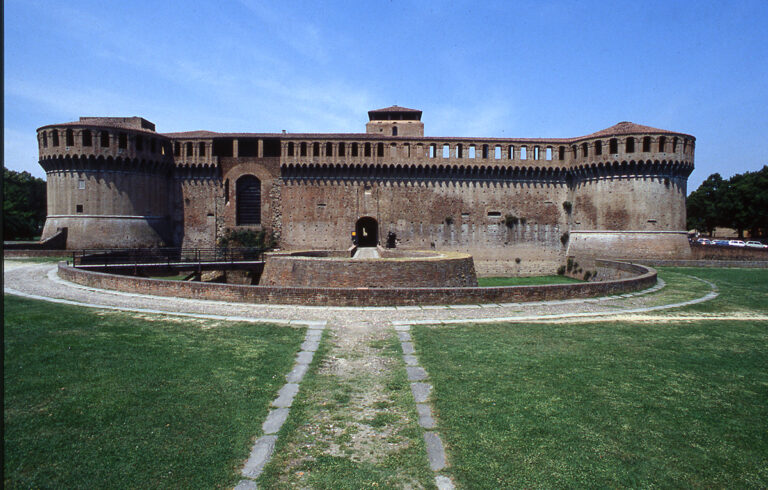
Dozza Castle has a hexagonal plan with a perimeter of approximately 200 meters. Its polygonal central body is connected to two circular corner towers, while the other two façades have heavily sloping outer walls that continue directly to the ground. Two rhomboidal bastions, a moat, and merlons form part of the defensive arrangement. Fourteenth-century elements include the Rivellino, an outlying defensive work, and the Rocchetta.
Walls and Defensive Towers
Torresino
Near the entrance bridge stands the large circular tower known as the Torresino. Some scholars identify it as the mastio, the principal or strongest tower of a medieval fortress, and therefore as the structure protecting the castle’s most important area. The tower measures 16 meters in diameter, with walls between 3 and 6 meters thick.
Torrione dei Bolognesi
The smaller circular tower, called the Torrione dei Bolognesi, measures 11 meters across. Its walls are between 2 and 4 meters thick. Together with the Torresino, it forms part of the castle’s principal towered defense, while the battered façades and rhomboidal bastions extend the defensive system around the central body.
Medieval and Residential Interiors
Medieval Rooms and Kitchens
The medieval structure, interiors, and kitchens remain exceptionally well preserved. The kitchens retain fireplaces, a well, and utensils attributed to the sixteenth century. These elements preserve the connection between the earlier fortified complex and its later life as a family residence.
Piano Nobile and Noble Rooms
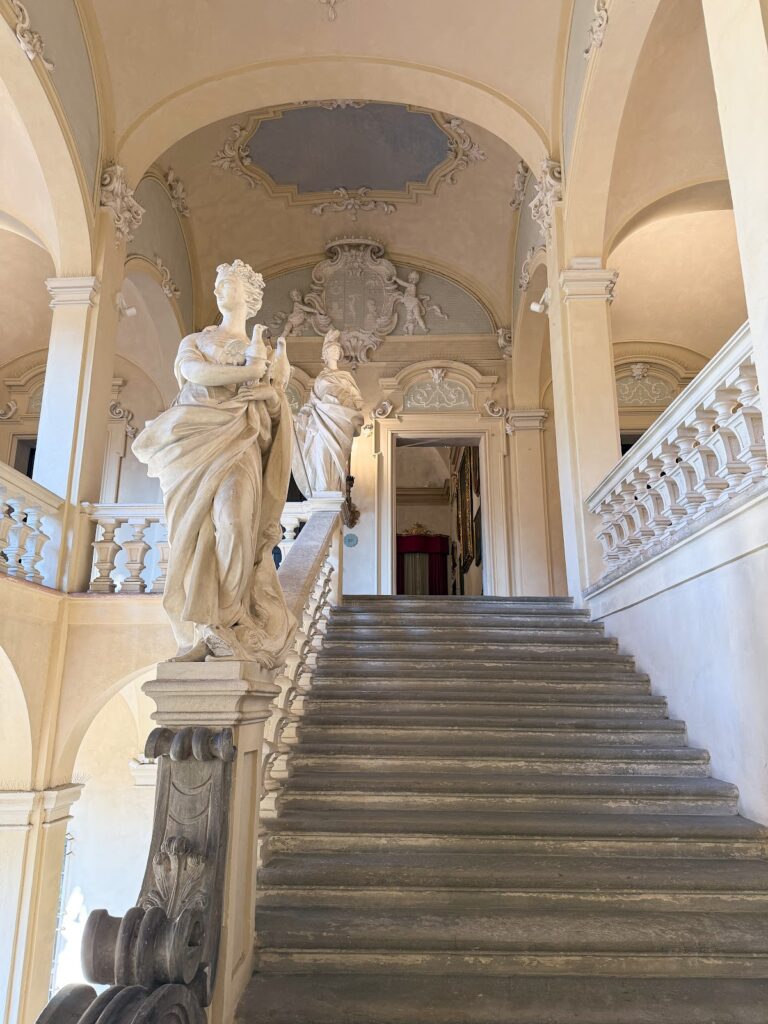
The piano nobile, the principal residential and reception floor of an Italian palace, contains ten rooms that retain their original appearance. The aristocratic rooms preserve high-quality furniture, eighteenth-century paintings, and eighteenth-century tapestries. The main hall contains portraits of members of the Malvezzi family and tapestries bearing the family coat of arms, as well as a portrait of the Campeggi family by Lorenzo Pasinelli.
Arms Room and Prisons
Other spaces include an arms room and prisons containing torture instruments. The castle also retains its characteristic razor well, a feature associated with the building’s defensive and judicial history.
Art Collections and Wine Center
Norma Mascellani Gallery
A small picture gallery on the second floor preserves a collection of works by Norma Mascellani. The collection complements the castle’s broader museum role and its association with exhibitions devoted to modern and contemporary artistic activity in Dozza.
Enoteca dell’Emilia-Romagna
The Enoteca dell’Emilia-Romagna occupies the entire basement and part of the ground floor, covering approximately 1,000 square meters. Its display case presents 10,000 bottles representing 450 labels, incorporating a modern regional wine institution into the historic castle-palace.
Nearby sites