Chiesa di Santa Maria Maggiore: Parish Church of Castel San Pietro Terme


Site at a Glance
- Rating
- 4.5
- Popularity
- Very Low
- Country
- Italy
- Primary era
- Early Modern
- External website
- Open
- Eras represented
- Medieval, Early Modern, Modern
- Civilizations
- Italian, Papal States
- Site type
- Religious
- Remains
- Church
On this page15 sections
History
Chiesa di Santa Maria Maggiore is a Roman Catholic parish church in Castel San Pietro Terme, Italy, dedicated to Saint Mary. Its origins reach back to a primitive chapel probably built at the beginning of the thirteenth century. After its completion, reportedly following about nine years of work, the chapel was placed under the Archdeacon of Bologna. In 1228, at the initiative of local citizens, it became a rectory.
Medieval parish development
A bell tower was added in 1364, expanding the church’s role within the settlement. In 1410, while a plague was severely affecting Bologna, the pope took refuge at Castel San Pietro. He granted the parish church the honorary title of cathedral during his stay. The title was lost later that year when the plague reached Castel San Pietro and the pope departed.
The church was subsequently entrusted to Monsignor Marcantonio Malvezzi. Parish priests elected by the citizens succeeded him until 1500. A baptismal font was documented by 1535, and in 1580 the church was raised to the rank of a pieve, a historically important parish church with responsibilities for surrounding settlements and baptismal communities.
Enlargements and rebuilding
The side chapel of Saint Vincent was built in 1641. At the request of Archpriest Alessandro Comelli, the parish church was enlarged and restored in 1649 and 1650 according to a design by Francesco Martini. Further expansion followed in 1699, commissioned by Don Ottavio Scarlattini and designed by Giuseppe Torri.
The present parish church emerged from a rebuilding commissioned by Don Giovan Battista Bertucci and carried out by Alfonso Torreggiani between 1752 and 1757. An earlier project by Giancarlo Bibiena was abandoned because it was considered too costly. The planned apse was not constructed, since doing so would have required the road behind the church to be closed.
Later works and religious continuity
The side chapels were constructed between 1775 and 1808, when the bell tower was also restored. The floor was replaced in 1897. The facade was rebuilt in 1942, followed by further renovation in 1954 and 1988.
Chiesa di Santa Maria Maggiore retains a close connection with Castel San Pietro’s devotion to the Madonna of the Rosary, who is described as the town’s patron saint. This devotion is also expressed in the first chapel on the left, dedicated to the Madonna of the Rosary.
Remains
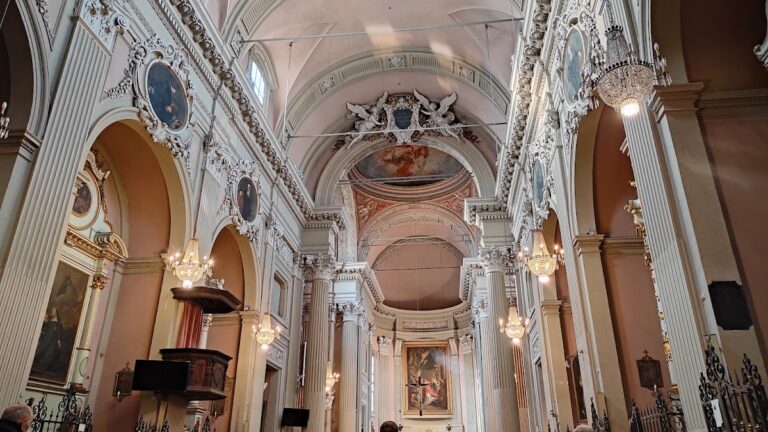
The church has a single large hall organized around a main altar, side altars, and chapels. Four altars occupy the right side, while the left side contains two altars and two chapels. The surviving interior brings together architectural elements and paintings from several periods, including works made for the eighteenth-century rebuilding and artworks transferred from earlier religious settings.
Principal altar and right side
Main altar
Alfonso Torreggiani made the main altar in 1751. It came from the Church of Sant’Ignazio in Bologna and is accompanied by Virgin in Glory with Saints, an altarpiece painted by Ubaldo Gandolfi between the eighteenth and nineteenth centuries.
Presbytery altar
On the right side of the presbytery, the area surrounding the main altar and traditionally reserved for clergy and liturgical functions, is an altar with Prospero Fontana’s Disputation of Saint Catherine. The oil painting belongs to the period between its commission in 1560 and its completion in 1575.
Right-hand chapels and altar
The first chapel on the right when descending from the presbytery contains Giuseppe Marchetti’s Infant Mary with Saints Anne, Agatha, and Joachim, an eighteenth-century oil painting on canvas. The next altar is dedicated to Saint Joseph and holds Giuseppe Varotti’s Passing of Saint Joseph, painted around the middle of the eighteenth century. Its subject derives from the apocryphal Gospels, early Christian writings about biblical figures and events that are outside the canonical New Testament.
Left chapels and altars
Chapel of the Madonna of the Rosary
The first chapel on the left was built in the seventeenth century and is dedicated to the Madonna of the Rosary. It contains a varnished wooden post-conciliar altar, an altar positioned according to liturgical reforms associated with the Second Vatican Council. Part of a fresco from an earlier oratory of the Confraternity of the Madonna of the Rosary was detached and transferred into the chapel. It depicts the Madonna of the Milk.
The chapel also preserves Bartolomeo Passerotti’s Madonna with the Fifteen Mysteries of the Rosary. Dominican friars commissioned the painting in 1578, and it was delivered in 1589. The canvas was moved and rehung several times. Its central section was cut out and placed in the adjacent rectory.
Other paintings on the left
A canvas showing Jesus Crucified between Saints Peter and Andrew is also preserved in the church, although its attribution remains uncertain. The left side contains Jacopo Alessandro Calvi’s eighteenth-century arched canvas Madonna and Child with Saints Francis of Paola and Rose, together with C. C. Baldi’s painting of Saint Rita of Cascia.
Second left altar
The second altar on the left contains Jacopo Alessandro Calvi’s Tobias and the Angel.
Chapel with the Madonna and Child
The following chapel on the left contains Gaspare Sacchi’s large Madonna and Child with Saints. Painted in oil on canvas in 1517, it is a Renaissance sacred conversation, a composition in which the Virgin and Child appear with saints in a unified setting. The painting depicts the Madonna and Child accompanied by eight saints.
Bell tower and later fabric
The bell tower, added in 1364, forms part of the church’s surviving architectural history. It was restored between 1775 and 1808. The present facade reflects the rebuilding of 1942, while the floor preserves the result of the replacement carried out in 1897.