Rieux Cathedral: A Former Cathedral and Parish Church in France


Site at a Glance
- Rating
- 4.7
- Popularity
- Low
- Country
- France
- Primary era
- Medieval
- Eras represented
- Medieval, Early Modern
- Civilizations
- French
- Site type
- Religious
- Remains
- Cathedral
On this page12 sections
History
Rieux Cathedral is a former Roman Catholic cathedral in Rieux-Volvestre, France, dedicated to the Nativity of Mary and standing beside the Arize River. Built as a cathedral in the fourteenth century, it developed through Romanesque, Gothic, southern Gothic, and early Renaissance phases. The church now serves as a parish church within the Archdiocese of Toulouse.
From priory to cathedral
Around the year 1000, Amelius Simplicius donated a small domain to Lézat Abbey. About a century later, a priory existed at the site. The priory church was elevated to cathedral status in 1317 by Pope John XXII, a fourteenth-century pope, as part of efforts to strengthen the Catholic Church in the Diocese of Toulouse, where Catharism, a Christian dualist movement opposed by the Catholic Church, still had adherents.
Rieux was formerly the capital of the Volvestre area and the seat of a royal judicial district. The creation of the Diocese of Rieux gave the church an episcopal role within this regional and administrative setting.
Revolution and later status
The Diocese of Rieux was abolished during the French Revolution in 1790. Its territory was formally incorporated into the Archdiocese of Toulouse on 29 November 1801 under Pope Pius VII’s bull Qui Christi Domini. Rieux Cathedral consequently ceased to be a cathedral, and since 1801 the building has functioned as the parish church of the Nativity of Mary.
The church was officially classified as a French historic monument in 1923. It is also known for its episcopal treasure, which includes reliquaries, statues, paintings, ecclesiastical vestments, and liturgical objects.
Remains
Rieux Cathedral presents a strongly fortified church complex shaped by successive building campaigns. Its medieval core includes a flat-ended eastern end, a Gothic nave and portal, defensive masonry, and a tall octagonal bell tower. Later additions and furnishings preserve the changing functions of the church after it became an episcopal seat and, subsequently, a parish church.
Medieval structure
Fortified eastern end
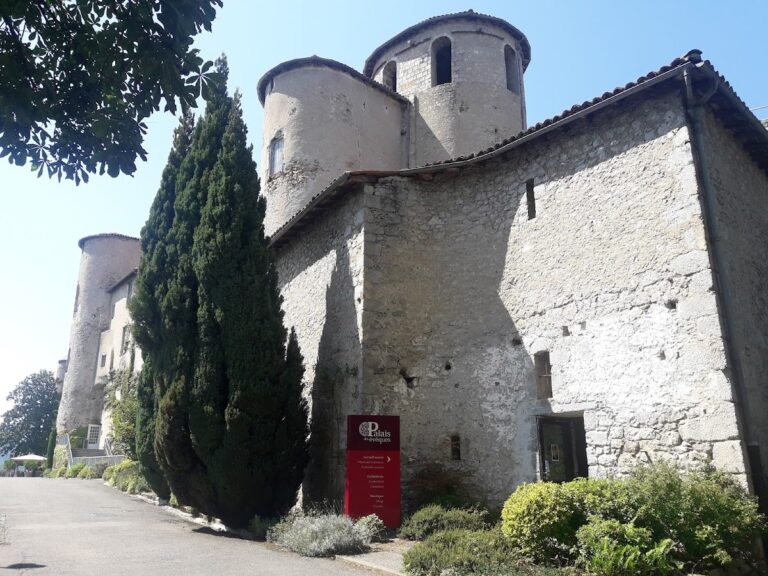
The earliest surviving part is the fortified chevet, the eastern end of a church, which terminates in a straight wall rather than a rounded apse. It belongs to an earlier church whose precise date remains uncertain. The building retains a massive defensive character, with walls reaching about three metres in thickness in places. Watch turrets and loopholes, narrow openings used for observation or weapons, were incorporated into the structure.
Gothic nave and portal
The principal nave belongs to the fourteenth-century Gothic rebuilding and is specifically dated to around 1330. Its portal opens in the central bay. The rebuilding gave the former priory church the principal architectural form associated with its period as a cathedral.
Bell tower
The octagonal bell tower is about 43 metres high and stands against the western gable of the nave. Associated with the regional Toulouse style, it is described as a fifteenth-century tower with openwork levels formed by paired bays covered by mitre arches, pointed arches whose two straight sides meet at an angle.
Later additions and interior furnishings
Renaissance doorway and sacristy
The sacristy dates from the fifteenth century. Around 1530, a carved door in the early Renaissance style was opened in the last chapel at the entrance to the bell tower. It provided a route between the bishops’ palace and the cathedral.
Canons’ choir
The canons’ choir, the area reserved for clergy serving a cathedral chapter, was built on the north side of the nave in the early seventeenth century. It contains 61 carved walnut choir stalls. The choir also holds an eighteenth-century marble high altar and an eighteenth-century marble funerary monument to the bishops of Rieux.
Organ and movable furnishings
The organ was made by the Puget firm and incorporates material from the seventeenth century. Restored in the early 2000s, it faces the canons’ choir. Other furnishings include two sixteenth-century cabinets, an eighteenth-century commode, and a seventeenth-century lectern.
Associated objects include two bells dating from the sixteenth and eighteenth centuries, a funerary slab from the fifteenth or sixteenth century, carved choir-stall elements including a misericord, choir paneling, and the episcopal treasure of reliquaries, statues, paintings, vestments, and liturgical objects.
Nearby sites