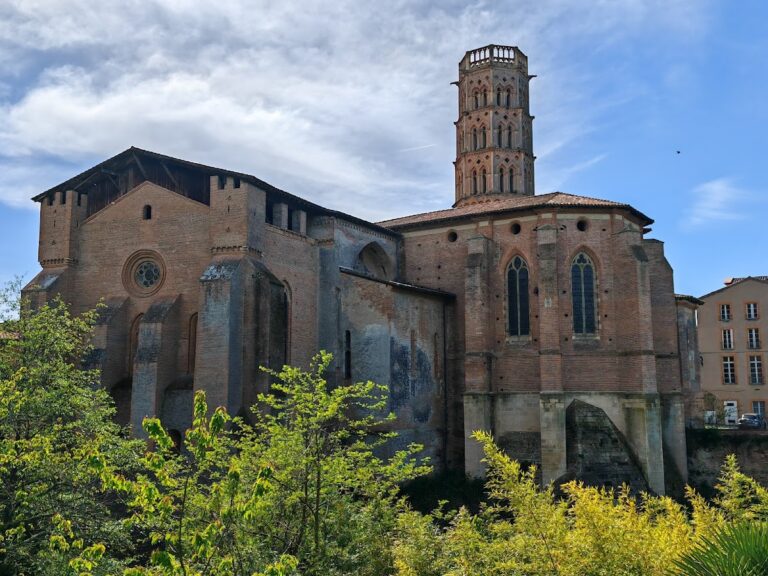
Palais des Évêques: The Episcopal Palace of Saint-Lizier, France


Site at a Glance
- Rating
- 4.4
- Popularity
- Low
- Country
- France
- Primary era
- Early Modern
- External website
- Open
- Eras represented
- Medieval, Early Modern, Modern
- Civilizations
- French
- Site type
- Religious
- Remains
- Palace
On this page14 sections
History
The Palais des Évêques is an episcopal palace in Saint-Lizier, France, built and enlarged between the thirteenth and seventeenth centuries as the residence of the bishops of Couserans. The palace belongs to the history of a bishopric, the territory and ecclesiastical institution governed by a bishop, whose succession at Saint-Lizier extended from the fourth to the nineteenth century. Seventy-seven bishops held the see, linking the building to the long religious history of this Pyrenean region.
The bishopric of Couserans
Valerius is traditionally regarded as the first bishop of Couserans and is identified with Saint Valier. His successor Glycerius, also known as Licerius and later canonized as Saint Lizier, became the patron saint of Couserans. The town’s religious importance developed further in the late eleventh century, when construction began on Notre-Dame-de-la-Sède Cathedral and the parish church of Saint-Lizier.
The medieval palace and later enlargement
The episcopal residence first took shape on a smaller scale during the thirteenth century. This earlier building is now known as the Palais Vieux. Bishop Bernard Coignet de Marmiesse commissioned an enlargement in 1660, while the beginning of the major construction phase is also dated to around 1675. The work brought the residence to approximately its present scale and transformed the relationship between the earlier palace and the later episcopal complex.
End of episcopal rule
The bishopric had already been without a bishop since 1792, when Dominique de Lastic de Fournels fled the French Revolution and took refuge in Münster. The 1801 Concordat, an agreement that reorganized relations between Napoleonic France and the Catholic Church, suppressed the bishopric of Couserans and ended the palace’s religious function.
Civic, penal, and hospital uses
After the bishops’ departure, the building passed through several institutional roles. It served successively as a town hall, a prison, a begging depot from 1811, an asylum, and a departmental psychiatric hospital. The hospital remained in use until 1969, when the deteriorated condition of the site brought that phase to an end. Parts of the former hospital later remained important to the interpretation of the palace, including the history of psychiatric care within its buildings.
Museum and heritage complex
In 1992, the Ariège departmental council installed the collections of the departmental museum in the former palace. The museum presents the history of Couserans and the building through four principal themes: Roman presence; the transition from the Gallo-Roman city to the bishopric of Couserans during Late Antiquity; the history and architecture of the palace from the eleventh to the eighteenth century; and life and economic activity in the Bethmale Valley during the early twentieth century. Gallo-Roman describes the culture that developed in Gaul under Roman rule, while Late Antiquity refers to the transition between classical antiquity and the early Middle Ages.
The museum’s Roman collection was enlarged after the accidental discovery of the Saint-Girons Treasure in 1994, a hoard containing nearly 14,000 Gallo-Roman coins. A restructuring project launched in 2004 established plans for tourist accommodation in former psychiatric-hospital buildings, a restaurant in the palace cellars, and a cultural complex centered on a new departmental museum and the restored cathedral. The palace is owned by the Ariège departmental council and now combines museum use with tourist accommodation and a restaurant.
The site was registered as a protected site in 1944 and was partially entered in the inventory of historic monuments by an order dated 13 January 1993. The episcopal palace also forms part of the French section of the Routes of Santiago de Compostela, inscribed on the UNESCO World Heritage List in 1998. The cathedral received historic-monument designation in 1994.
Remains
Palace setting and surviving fabric
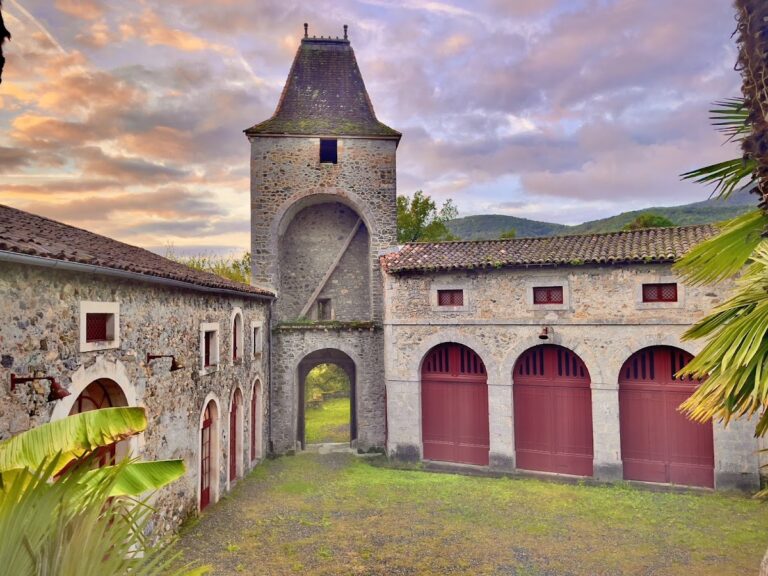
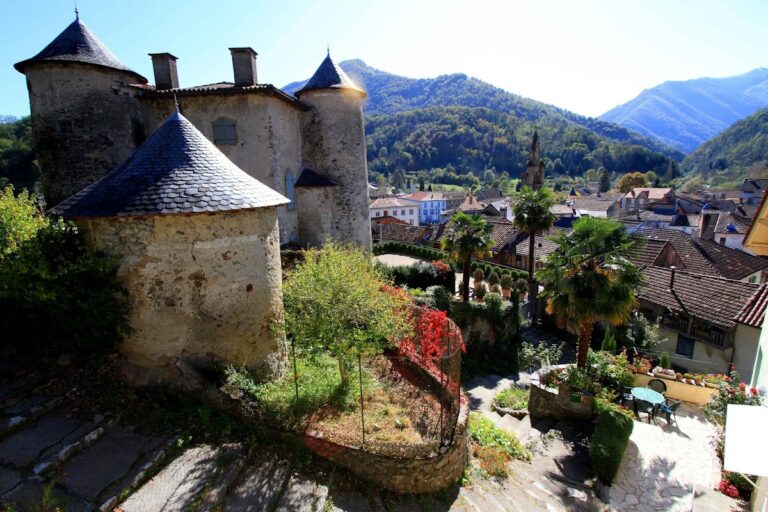
The Palais des Évêques occupies a commanding position above Saint-Lizier, and its terraces extend toward a broad view of the Pyrenees. The surviving complex brings together the smaller thirteenth-century Palais Vieux and the enlarged episcopal residence associated with the building campaigns of the seventeenth century. The later work gave the palace its present scale. Its cellars form part of the building’s continuing reuse and were designated for conversion into a restaurant during the restructuring project begun in 2004.
Gardens and former religious buildings
Former cloister and Gothic tomb
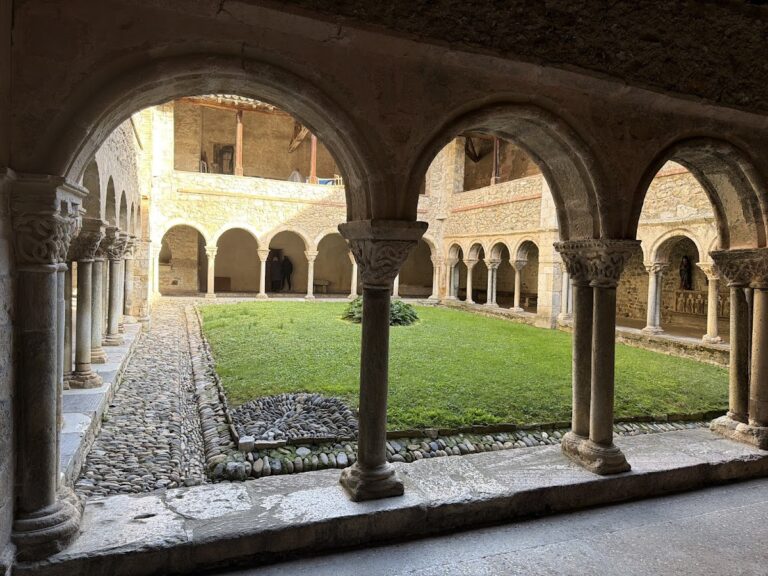
The palace gardens occupy the area of a former cloister built in the twelfth century. The cloister was still mentioned in nineteenth-century writings, and its remains now form part of the garden setting. A Gothic enfeu, a recessed wall tomb or funerary niche, also survives there, preserving a physical trace of the site’s medieval religious use.
Chapter house
The gardens also contain the former chapter house, the room where a cathedral or religious community’s chapter met. A building above it preserves the area of temporary isolation cells used during the psychiatric-hospital period for patients in crisis. The space later held temporary exhibitions and is now devoted to the psychiatric history of the palace.
Belvedere and hospital landscape
A belvedere from the psychiatric-hospital period survives on the site. It was built to give patients a calming and unobstructed view of the surrounding landscape, and it still preserves a wide panorama of the Pyrenees. The structure therefore reflects both the hospital’s treatment environment and the site’s wider relationship with its mountainous setting.
Departmental museum collections
The museum extends across four levels. Its Roman displays include amphorae, oil lamps, sculpted architectural elements, and coins. Objects from Late Antiquity and the early Middle Ages include marble sarcophagi, items of daily life decorated with Christian imagery, sculptures, and Merovingian belt plaques from the Tabariane necropolis at Teilhet. The Merovingians were a Frankish ruling dynasty that governed much of Gaul and the early Frankish kingdoms from approximately the fifth to the eighth century.
The Saint-Girons Treasure is presented with the Roman collection and consists of nearly 14,000 Gallo-Roman coins. The museum also contains ethnographic objects collected by Jacques Bégouën, which illustrate life and economic activities in the Bethmale Valley during the early twentieth century.
Cathedral paintings
The cathedral associated with the palace retains painted decoration from several periods. Its oldest surviving paintings may date from the twelfth century. The largest painted ensemble was produced during the episcopate of Jean d’Aule, from 1475 to 1515, and extends across the vault and much of the walls beneath later whitewash and nineteenth-century decoration. Restoration of the cathedral’s woodwork led to the discovery of these earlier wall paintings, which were recovered through successive restoration campaigns.
Twelve Sibyls appear on the cathedral vaults beside the Fathers of the Twelve Tribes of Israel. Sibyls were women associated with ancient prophetic traditions, whose words Christian theologians later interpreted as anticipating Christ. On the south wall, an imposing Tree of Jesse traces Christ’s ancestry through Jesse, the father of King David. The north wall presents episodes from the life of Saint James the Greater, including the transport of the apostle’s body by boat to Galicia. Saint James is the principal saint associated with the pilgrimage routes to Santiago de Compostela.
Nearby sites