Santa Maria di Monte Oliveto Maggiore: Abbey Church and Territorial Cathedral in Italy


Site at a Glance
- Rating
- 4.7
- Popularity
- Medium
- Country
- Italy
- Primary era
- Medieval
- External website
- Open
- Eras represented
- Medieval, Early Modern
- Civilizations
- Grand Duchy of Tuscany, Republic of Siena
- Site type
- Religious
- Remains
- Cathedral
On this page17 sections
History
Santa Maria di Monte Oliveto Maggiore is the abbey church and territorial cathedral of Monte Oliveto Maggiore Abbey in Italy. Built between 1400 and 1417 in the Italian Gothic style, it was solemnly consecrated in 1417 and serves as a parish church of the Roman Catholic Church and the Olivetan Congregation. As a territorial abbey, Monte Oliveto Maggiore is an abbey whose abbot exercises jurisdiction over a defined ecclesiastical territory comparable in some respects to that of a bishop. The church is an Italian national monument and is dedicated to the Nativity of the Blessed Virgin Mary.
Foundation and Olivetan Use
The church was constructed as the abbey church of the adjoining monastery. Its religious identity reflects the Olivetan tradition associated with Bernard Tolomei, an Italian religious founder and the principal figure connected with the Olivetan monastic reform. The devotional program also honors Saint Benedict of Nursia, the sixth-century founder of Western monasticism, and Saint Frances of Rome, a fifteenth-century Italian religious figure.
Renaissance Additions
During the early sixteenth century, the church received important furnishings and artworks. Fra Giovanni da Verona made the wooden choir between 1503 and 1505. An inlaid wooden lectern made in 1520 by Fra Raffaele da Brescia originally stood at the center of the choir before being transferred to the sacristy. The church’s artistic program also developed through sixteenth-century paintings by Jacopo Ligozzi and Francesco Vanni.
Baroque Transformation
In 1772, the interior was radically restored in the Baroque style according to designs by Giovanni Antinori of Camerino. The work substantially altered the church’s interior appearance while leaving its structure intact. The apse was completely rebuilt during the eighteenth century, and large windows were opened in the nave during the same period. The apse’s present artistic arrangement includes Jacopo Ligozzi’s Nativity of Mary, painted in 1598, while the right apse wall carries Luigi Boschi’s 1824 painting of Saint Benedict appearing to Saints Frances of Rome and Bernard Tolomei.
Organ History
The earlier organ was built between 1605 and 1608 by Cesare Romani of Cortona. In 1810, it was transferred to the Collegiate Church of Santi Quirico e Giulitta in San Quirico d’Orcia, where it replaced by then a nineteenth-century Agati organ. The present instrument, Tamburini opus 702, was built in 1975 using the Agati case.
Remains
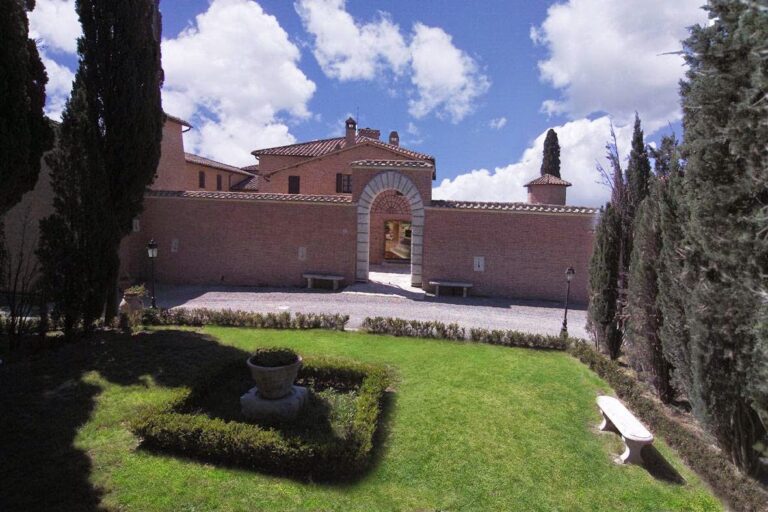
The church stands beside the abbey buildings and is attached to the large cloister. Its plan is a Latin cross, meaning that a long nave is crossed by a shorter transept. The exterior remains Gothic in character, with exposed red-brick walls, while the interior presents the Baroque appearance created by the eighteenth-century restoration.
Exterior and Bell Tower
The gabled facade has a pointed central portal surmounted by a slightly splayed circular rose window. Above the entrance is a fifteenth-century painted lunette, the semicircular area over a doorway, showing the Madonna and Child between angels. Gothic buttresses remain along the left side, together with blocked rose windows above the large openings made in the eighteenth century. Near the apse rises a tall bell tower. Its belfry opens through four three-light windows, one on each side, and ends in a central conical pinnacle surrounded by four smaller pyramidal pinnacles. The choir is the only Baroque element visible on the exterior, with an octagonal dome and lantern.
Interior Nave and Choir
Nave
The broad single nave is covered by a barrel vault, a continuous semicircular or segmental ceiling, and divided into three bays. Six rectangular windows, three on each side, are set between half-pilasters with Corinthian capitals. Above the monks’ side entrance in the first bay is a fifteenth-century fresco by an unknown artist showing Saint Bernard Tolomei with Patrizio Patrizi and Ambrogio Piccolomini. The vault carries Ermenegildo Costantini’s 1780 fresco, Vision of the Golden Staircase of Saint Bernard Tolomei.
Wooden Choir
The wooden choir contains 125 stalls arranged in two tiers, with 58 in the lower tier and 67 in the upper. Forty-eight stalls have inlaid decoration depicting musical instruments, landscapes, animals, and miscellaneous objects. The inlaid wooden lectern made by Fra Raffaele da Brescia in 1520 was formerly positioned at the choir’s center and is now in the sacristy.
Transept and Chapels
Transept Paintings
The transept is also covered by a barrel vault and joins the nave near the apse. Its central vault painting is a circular sixteenth-century canvas by Jacopo Ligozzi depicting the Assumption of Mary. Two flanking canvases by Francesco Vanni show the Consecration of the Church and the Vesting of the First Olivetan Monks.
Side Chapels
Two square chapels open from the transept beside the apse. The chapel on the left is dedicated to Saint Benedict of Nursia and contains Fabrizio Cartolari’s 1773 painting Glory of Saint Benedict and Saint Bernard. The chapel on the right is dedicated to Saint Frances of Rome and contains an eighteenth-century painting by an unknown artist depicting the saint with the Angel.
Chapel of the Blessed Sacrament
A doorway in the rear wall of the left transept arm leads to the Chapel of the Blessed Sacrament, whose interior is entirely frescoed. Its altar has a painted wooden antependium, a decorative facing attached to the front of an altar, imitating marble and centered on the Agnus Dei, the Christian symbol of the Lamb of God. Above the altar is a painted wooden fourteenth-century crucifix traditionally believed to have spoken several times to Bernard Tolomei. Its reverse bears a seventeenth-century painting of Saint Bernard Tolomei by Raffaele Vanni.
Apse and Organ
Apse
The apse at the end of the nave consists of a square domed section followed by a semicircular section. A large high altar of polychrome marble stands within it, with Jacopo Ligozzi’s Nativity of Mary, painted in 1598, as its altarpiece. The right wall displays Luigi Boschi’s 1824 painting of Saint Benedict appearing to Saints Frances of Rome and Bernard Tolomei.
Tamburini Organ
The 1975 Tamburini organ, opus 702, occupies the choir loft on the counterfaçade, the interior wall opposite the main altar. It has 31 stops and mixed transmission, with mechanical action for the manuals and electric action for the stops, combinations, and couplers. The instrument has two consoles: a window console with three keyboards and a pedalboard, and a second movable console in the choir.
Nearby sites