Rüti bei Lyssach Reformed Church: A Medieval Parish Church in Switzerland
Site at a Glance
- Popularity
- Very Low
- Country
- Switzerland
- Primary era
- Medieval
- Eras represented
- Medieval, Early Modern, Modern
- Civilizations
- Holy Roman Empire, Swiss
- Site type
- Religious
- Remains
- Church
On this page12 sections
History
Origins and medieval parish
The Rüti bei Lyssach Reformed Church stands on a hill spur above its village in Switzerland and is thought to have originated in the late 12th or early 13th century. Its foundation date is not known from written records. A local noble, probably from the von Rüti family, is considered its likely founder.
In 1242, Berchtold von Rüti appears in a record as provost of Solothurn Cathedral, a senior cleric who administered a cathedral chapter. By 1275, he held the parishes of Kirchberg, Koppigen, Wynigen, Oberburg, Steffisburg, and Kirchlindach. A church register from that year for the Diocese of Constance, a medieval Catholic diocese, names a priest at Rüti. His annual income, no more than six marks of silver, a medieval measure used for weighing and accounting, made him eligible for tax exemption.
Patronage and the Reformation
In 1350, Cuno am Ort, a citizen of Burgdorf, sold the church’s patronage rights, a form of authority over the church, along with a farm at Rüti and four Jucharts of land to Johann von Aarwangen for 420 pounds. A Juchart was a traditional land measure whose size varied by locality. In 1358, Johann transferred the same rights and property to Peter Fries of Solothurn, a citizen of Bern, for the same amount.
In 1360, the patronage passed to the Bern house of the Teutonic Order, a Catholic religious order with religious and military origins. After the house was suppressed in 1485, the right went to the collegiate chapter at Bern Minster, a body of clergy attached to a major church. Following the Bernese Reformation, Bern’s adoption of Protestant reform in 1528, patronage passed to the city and Republic of Bern. The palm branch in Rüti’s municipal coat of arms recalls Saint Vincent, Bern’s patron saint, whose attribute it is.
Pastoral and property changes
Rüti had its own parish from the church’s foundation until 1874, but its own priest only until the Reformation in 1528. For the following 410 years, an assistant pastor from Burgdorf, living in Kirchberg, conducted services with varying regularity. Under a contract dated 15 May 1874, the church, its grounds, burial place, and movable property passed to the Kirchberg parish. The cemetery later became municipal property. In 1898, the new owners sold the church’s communion vessels to a second-hand dealer because they were no longer in use. A second pastoral post was established in 1938, after which pastoral duties passed to Kirchberg. The church is now a subsidiary church, linked to a larger parish, within the Evangelical Reformed parish of Kirchberg.
Remains
Church fabric and furnishings
Plan and exterior
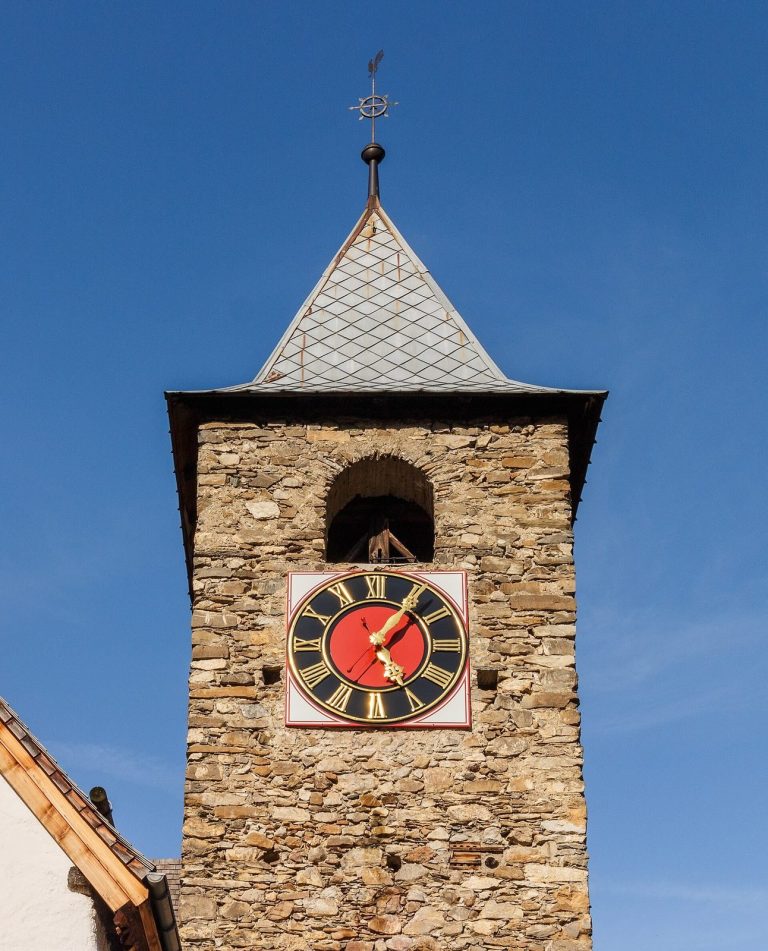
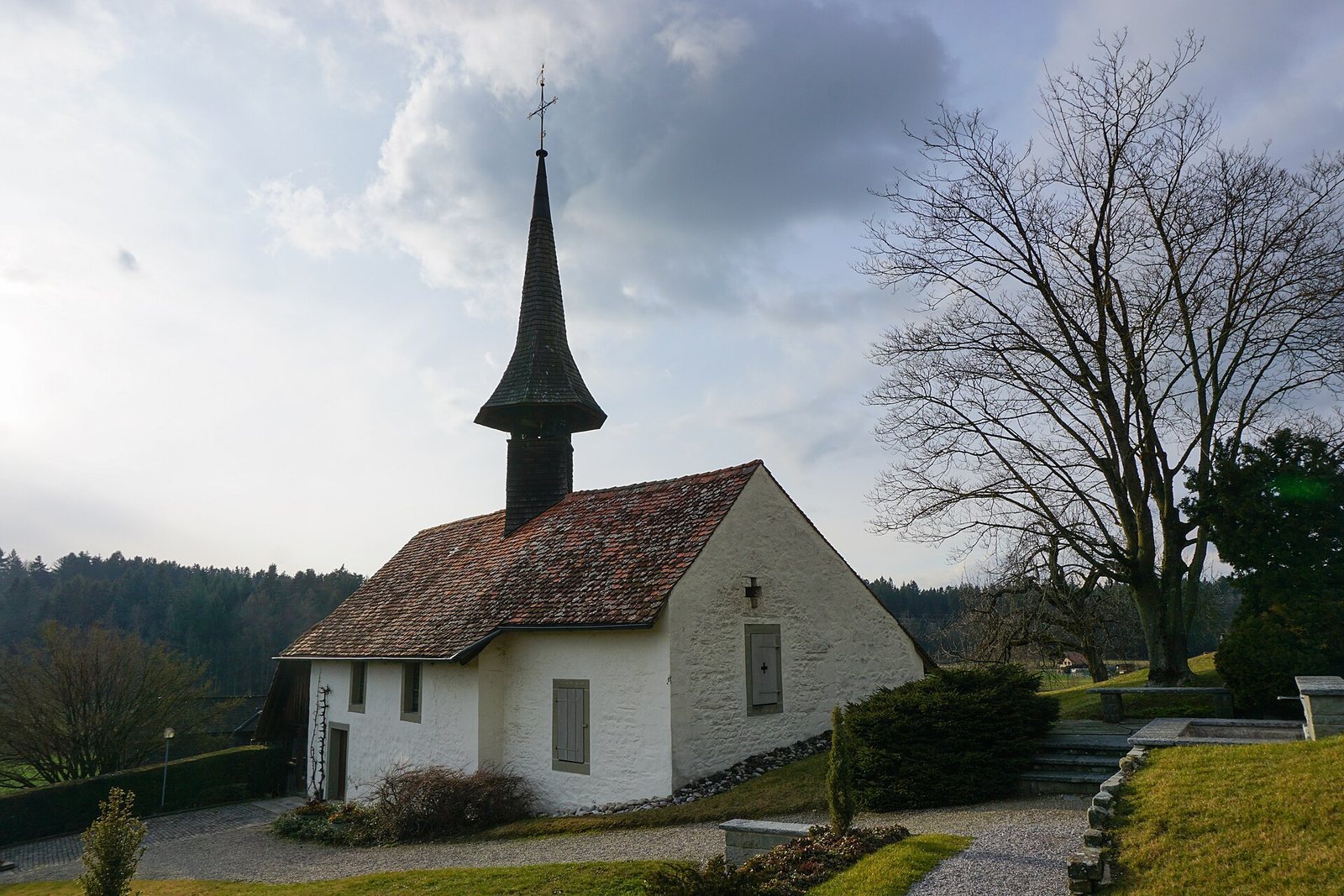
The church occupies a hill spur above the village, and its wooden porch faces the valley. Inside, a nave leads to a narrower choir. A roof turret covered with wooden shingles rises from the centre of the roof ridge and houses two bells. A projection on the choir’s north side may point to an earlier, smaller chapel, while the arrangement of the walls and windows indicates that the present building took shape in several phases.
Annex and gallery
An annex added on the northwest side in 1703 provides a waiting room for the pastor and for people involved in baptisms. A small gallery beside the south doorway can be reached from that side of the church.
Interior and glass
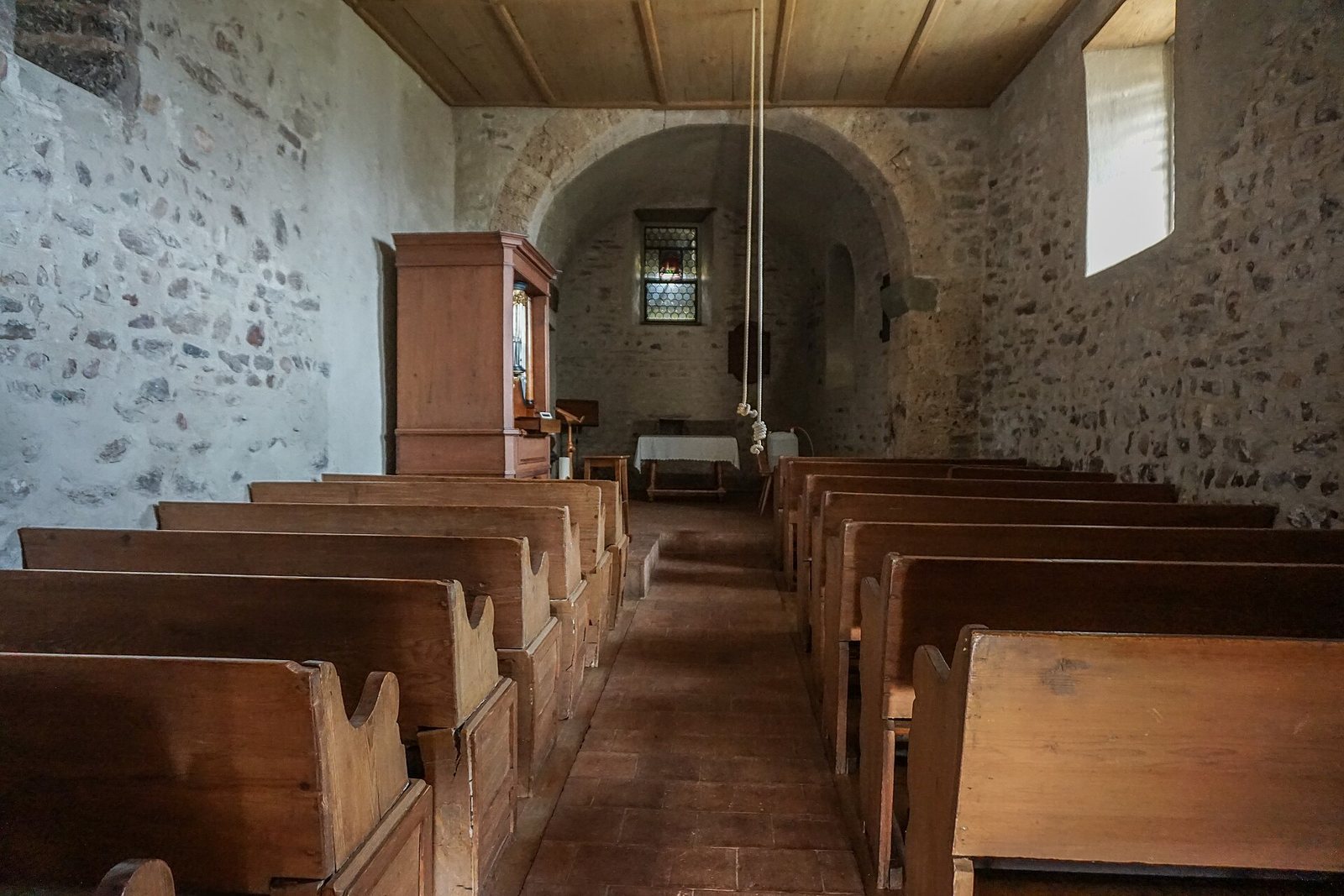
Clay tiles cover the underfloor heating, and old wooden pews provide seating for about 50 people. Engraved glass panes bearing the arms of two Burgdorf mayors, dated 1752 and 1753, were moved to the Knights’ Hall in Burgdorf in 1880. Since the 1930s, four donated heraldic panes have been fitted into the church’s bull’s-eye windows, which are made from circular glass panes with thicker centres. They bear the arms of Kirchberg, Rüti, Baertschi of Sumiswald, and Glauser of Rüti, each dated 1930.
Organ
The small organ dates from the 19th century. It has one manual, or keyboard, and six stops, controls for selecting the organ’s sound-producing ranks. Its keys and stops operate mechanically, and a slider chest regulates the flow of air to the pipes.
Bells
A lightning strike in 1666 caused both bells to fall from the turret, but neither was damaged. Thieves took one bell in 1711, and it was replaced with a larger one. Its inscription explains that the bell was recast that year and enlarged so it could call people to the Word. The bells are still rung by hand.
Associated building
The building below the church, once known as the parsonage cottage, now serves as a community room. The church has undergone several renovations and is in good condition.