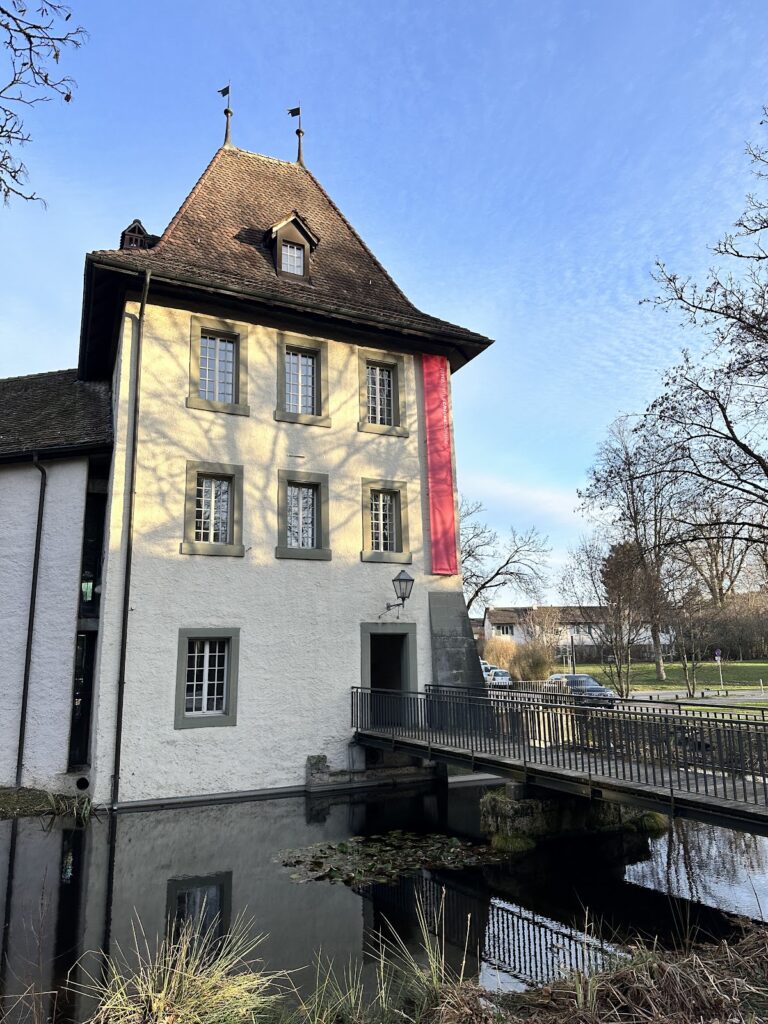
Bremgarten château: A Baroque Palace in Switzerland


Site at a Glance
- Rating
- 4.8
- Popularity
- Very Low
- Country
- Switzerland
- Primary era
- Early Modern
- Eras represented
- Medieval, Early Modern
- Civilizations
- Holy Roman Empire, Knights Hospitaller, Swiss
- Site type
- Domestic
- Remains
- Castle
On this page11 sections
History
Bremgarten château in Switzerland developed from the ancestral castle of the Barons of Bremgarten into a 16th-century complex whose present character is Baroque. The site stands at Bremgarten bei Bern, where it reflects the changing political, religious, and social history of the region.
The Barons of Bremgarten
The Barons of Bremgarten are first mentioned in the mid-12th century. Their territory extended along the Aare from Worblaufen to at least Kirchlindach, and the castle served as their ancestral seat. Their family church, St. Michael’s, was first mentioned in 1275, although the building probably dates from the 10th or 11th century.
In early 1298, the barons allied with Freiburg and fought Bern in the Jammer Valley at the Battle of Donnerbühl. Bern emerged victorious, and its forces conquered and burned the town of Bremgarten after a short siege. They also destroyed the castle. By 1306, the three Bremgarten brothers faced a ruined town, a ruined castle, and substantial debts. They therefore sold their lands, castle, rights, and ferry to the Hospitaller commandery of Buchsee at Münchenbuchsee. The Hospitallers, also known as the Knights Hospitaller, were a religious-military order that administered estates through local commanderies led by commanders.
Hospitaller residence and Bernese rule
The Buchsee commandery rebuilt the town and castle, making the complex the residence and headquarters of its commander. This arrangement ended during the Protestant Reformation in 1528, the religious movement through which Bern adopted Protestant institutions and secularized some church properties. Peter Englisberg, the last commander, transferred the lordship to Bern in support of the commandery’s secularization. A lordship was a territory together with the political and legal rights exercised by its lord. Englisberg retained a lifelong right of residence in the castle.
After Englisberg’s death in 1545, Bern sold the estate and castle to Hans Franz Nägeli for 5,000 pounds. The purchase rewarded Nägeli for his role in the conquest of Vaud. He demolished the older castle apart from the keep, the principal fortified tower, and the curtain walls, which were defensive walls enclosing the castle or its courtyard. In their place, he commissioned a Renaissance country manor.
From Renaissance manor to Baroque summer palace
A southern annex was added in 1549. It carries the coats of arms of Nägeli and his two wives. After Nägeli died in 1579, the property passed to his son-in-law Ludwig Brüggler, a banneret knight, meaning a high-ranking knight entitled to command a banner of troops. Following Brüggler’s death in 1598, the estate went to the banneret knight Niklaus Kilchberg and then to his son, also named Niklaus. The castle remained with the Kilchberg family until 1727.
Marc Elie de Chemilleret of Biel bought the castle in 1727 for 15,000 pounds. In 1743, it passed to Gabriel von Wattenwyl, the nephew of Chemilleret’s second wife, Magdalena von Watteville. Margarete von Wattenwyl held the lordship from 1745 to 1761, when the sculptor Johann August Nahl decorated the salon during a rebuilding phase. Fischer von Reichenbach acquired the property in 1761 for 80,000 pounds and sold it in 1765 to Albrecht Frisching.
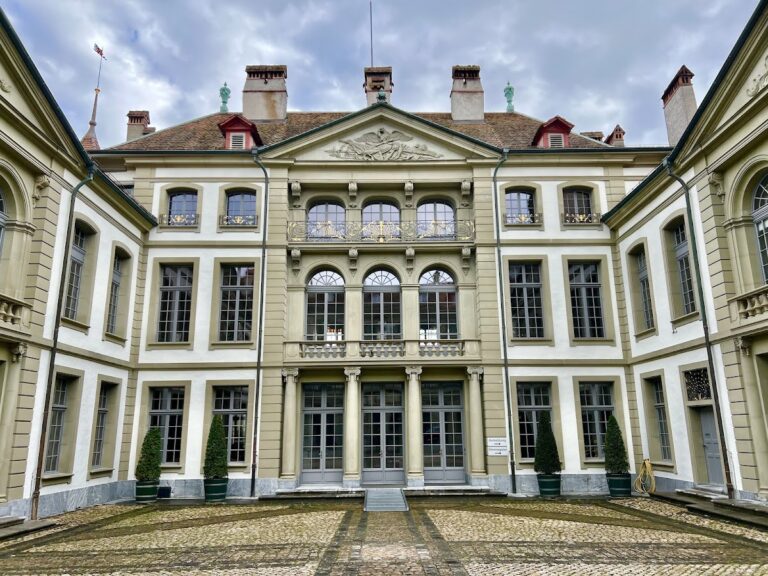
Frisching was a professor of Greek in Bern, a member of Bern’s Grand Council from 1775, and governor of Landshut from 1782 to 1789. During his tenure at Bremgarten from 1766 to 1798, he expanded the property. From 1780, he completely rebuilt the castle as a Baroque summer palace, enlarging the entrance and raising and leveling the castle hill to create a spacious courtyard and gardens around the palace.
Later history and cultural associations
The abolition of lordship rights in the Canton of Bern during the Revolution of 1798 brought further changes of ownership. After the Act of Mediation in 1803, Napoleon’s settlement that reorganized Switzerland and restored greater autonomy to the cantons, Frisching declined a seat on the Grand Council and retired to the castle. The building later served for a time as a restaurant. It is now privately owned and carefully maintained.
The Swiss painter Ricco grew up at Bremgarten château. His parents, Max and Tilli Wassmer, hosted gatherings there for poets, painters, and composers. Hermann Hesse evoked the site’s poetic atmosphere in his novella Journey to the East. Bremgarten château is listed as a Swiss cultural property of national significance.
Remains
Castle complex
Bremgarten château is a 16th-century complex whose surviving architectural character is Baroque. The present palace occupies the site of the earlier castle, while elements of the medieval defensive complex were retained during the Renaissance rebuilding. The arrangement includes the palace, the earlier fortified structures, a southern annex, and the expanded approach and grounds formed during the extensive work around 1780.
Keep and curtain walls
Nägeli’s rebuilding preserved the former keep and curtain walls when the older castle buildings were demolished. The keep is the principal fortified tower of the earlier castle, while the curtain walls enclosed the castle or its courtyard. These retained elements connect the Renaissance manor and later Baroque palace with the site’s medieval defensive phase.
Renaissance manor and southern annex
The Renaissance country manor replaced the earlier castle under Hans Franz Nägeli, while the southern annex was added in 1549. The annex bears Nägeli’s coat of arms together with those of his two wives, preserving a direct mark of the building’s 16th-century ownership and expansion.
Baroque palace
From 1780, the castle was extensively rebuilt and enlarged as a Baroque summer palace. Its entrance was expanded and rebuilt, and the castle hill was raised and leveled to form a spacious courtyard and gardens around the palace. During the mid-18th-century rebuilding phase, Johann August Nahl decorated the salon with sculpture.
Historic setting
The former domain extended along the Aare between Worblaufen and Kirchlindach. The castle’s physical and historical setting is also connected with the ferry and territory once controlled by the Barons of Bremgarten. The original town associated with the castle was burned during Bern’s conquest in 1298 and later rebuilt under the Hospitaller commandery.
Nearby sites