Landshut Castle: A Fortified Water Castle and Museum in Switzerland


Site at a Glance
- Rating
- 4.7
- Popularity
- Low
- Country
- Switzerland
- Primary era
- Early Modern
- External website
- Open
- Eras represented
- Medieval, Early Modern, Modern
- Civilizations
- Swiss
- Site type
- Domestic
- Remains
- Castle
On this page8 sections
History
Landshut Castle is a fortified water castle in Switzerland, north of Utzenstorf, whose origins probably date to the second half of the twelfth century. It was likely built for the Dukes of Zähringen, a medieval noble family that ruled territories in parts of present-day Switzerland and southwestern Germany. The castle became an administrative center for the surrounding township and later developed into the seat of successive territorial authorities.
Zähringen and Kyburg rule
The county of Utzenstorf was first recorded in 1009 as comitatus Uranestorfus, a territory extending from the Seeland to the Oberaargau. An earlier Burgundian castle may have stood in the area, but Landshut Castle was probably established during the later twelfth century. From 1175 to 1323, it was the seat of the Lords of Uzansdorf and served under the Zähringens as the administrative center of the township.
After the Zähringen line became extinct, the Counts of Kyburg, another major medieval noble house, inherited the township. They expanded and renovated the castle, probably during the thirteenth century. The castle first appears under the name Landeshuothe in 1253.
Destruction and the Landshut lordship
During the Gümmenen War in 1332, a fourteenth-century conflict involving Bern and Solothurn in the region of Gümmenen, troops from the two towns attacked and destroyed the castle. It was rebuilt soon afterward.
From the late fourteenth century, the Kyburgs pledged parts of the lordship to several creditors. Rudolf von Ringoltingen acquired these portions between 1406 and 1418 and united them into the Landshut lordship. The united lordship held all judicial rights in its territory and possessed its own banner, a military and political standard.
Bernese administration
Ludwig von Diesbach acquired the lordship in 1479. Bern then purchased it in two stages. In 1510, it acquired the Bätterkinden court, including Aefligen and Schalunen. In 1514, it purchased Utzenstorf, Wiler, and Landshut Castle. Bern subsequently established the Landshut bailiwick, an administrative district governed by a bailiff on behalf of a higher authority, and added Zielebach to it.
Under Bernese rule, Landshut Castle became the center of the Landshut bailiwick. The bailiwick was abolished in 1798, and its territory was incorporated into the district of Burgdorf and, from 1803, into the bailiwick of Fraubrunnen.
Country estate and museum
The castle was rebuilt on its earlier foundations between 1624 and 1630. Rudolf Niklaus von Wattenwyl acquired it for private use in 1798, and between 1812 and 1815 he commissioned its conversion into a country estate by the Bernese architect Ludwig Friedrich Schnyder. The surrounding park was laid out during the same period as an English landscape garden, following plans by Rudolf Samuel Karl von Luternau.
The Wattenwyl family retained the property until 1846, when it passed to the Sinner family. It changed hands several times before the Rütimeyer family acquired it in 1925. The estate was transferred to the Canton of Bern in 1958. The canton renovated the castle and installed René La Roche-Ringwald’s hunting-history collection there in 1959. René was the son of collector Louis La Roche, and the collection developed into the Swiss Museum of Hunting and Wildlife Conservation from 1968.
A foundation acquired the castle in 1988, redecorated it in a seventeenth-century style, and converted part of it into a museum. The institution is now the Swiss Museum of Wildlife and Hunting, with the Swiss Hunting Library attached to it. Landshut Castle is recognized as a Swiss heritage site of national significance.
Remains
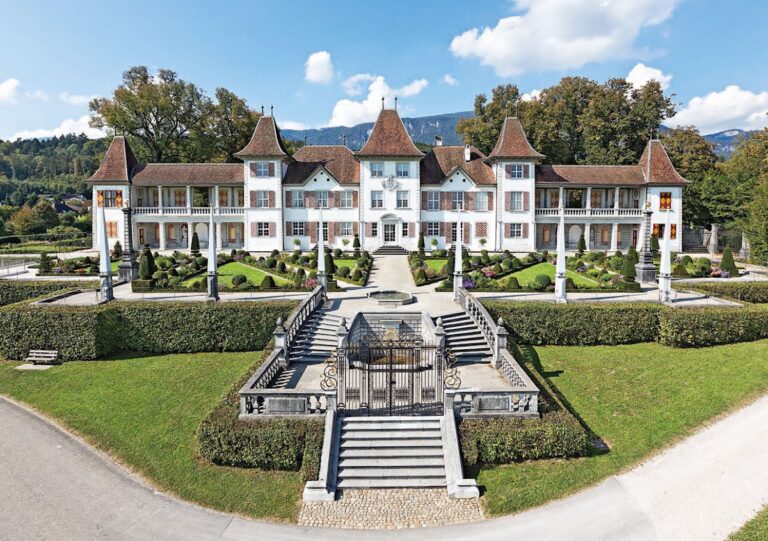
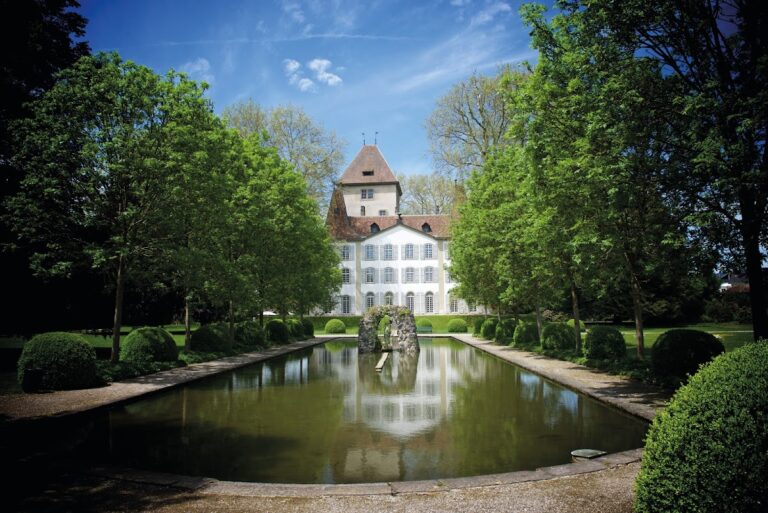
Landshut Castle survives as a fortified water castle surrounded by moats in the municipality of Utzenstorf. It lies north of the municipality and is described as the only castle in the Canton of Bern enclosed by moats. The principal building occupies the foundations of the earlier medieval castle and was remodeled in the seventeenth century. Its later transformation gave the complex the character of a romantic country estate.
Castle and landscape garden
The main building was reconstructed on the older foundations between 1624 and 1630, preserving the site of the earlier castle while creating the form associated with the early modern estate. Between 1812 and 1815, it was converted into a country residence. At the same time, the surrounding grounds were arranged as an English landscape garden according to plans by Rudolf Samuel Karl von Luternau.
Museum and library
Part of the castle houses the Swiss Museum of Wildlife and Hunting. The institution also includes the Swiss Hunting Library, which is attached to the museum and forms part of the castle’s continuing cultural use.
Nearby sites