Redon Abbey: A Benedictine Monastery in Brittany
Site at a Glance
- Popularity
- Medium
- Country
- France
- Primary era
- Medieval
- Eras represented
- Medieval, Early Modern, Modern
- Civilizations
- Carolingian, Duchy of Brittany, French
- Site type
- Religious
- Remains
- Monastery
On this page15 sections
History
Redon Abbey is a Benedictine monastery in Redon, France, founded in 832 by Conwoïon, a Breton monk and archdeacon, a senior cleric with delegated duties in a diocese. Established during the reign of Louis the Pious, it was a Carolingian foundation on the frontier of Brittany and Neustria. The Carolingians were a dynasty that ruled the Frankish Empire and its successor realms. The abbey’s architectural character is predominantly classical, drawing on ancient Greek and Roman forms, alongside Romanesque and Gothic medieval styles, with Gothic developing later.
Foundation and Carolingian support
Conwoïon left Vannes with companions to establish a monastery on land given by the local noble Ratwili. The foundation charter describes seven brothers entering the site and names Tethwin, Gerfroi, Fivetein, Conhouarn, Condeloc, Riowen, and Lohémel among the cofounders. The community followed the Benedictine Rule, the way of life established for the Benedictine monastic order. Gerfroi, who had practiced the rule at Saint-Maur-sur-Loire in Anjou, stayed for two years to help introduce it, then returned to his former monastery. Fivetein joined at the request of Nominoë, a Breton ruler regarded as Brittany’s first duke, and remained until his death. Conhouarn cared for foreign visitors, poor people, and the sick at a hospice near the monastery.
Ratwili later confirmed his original gift. After the monks cured him, he offered further land and sent his son Liberius to the monastery as an oblate, someone formally entrusted to monastic life. The abbey also gained property from local nobles and machtierns, Breton landholders or lords, including land east of the Vilaine. Some gifts prompted disputes with donors’ relatives.
The foundation initially faced opposition from Ricwin, count of Nantes, and Raginarius, bishop of Vannes, who turned Louis the Pious against the new community. Nominoë supported Conwoïon and in 834 recognized the abbey, granting it contested lands that included Ros, between the Oust and Vilaine. After advocacy by Ermor, bishop of Aleth, and Felix, bishop of Quimper, Louis recognized the monastery on 27 November 834 and granted it the parishes of Bain and Langon. A further royal grant in 836 added Renac, Platz, and Arthon. In 850, Charles the Bald, Louis’s successor as a Carolingian ruler, confirmed the abbey’s protection and granted it immunity.
Relations with the bishops of Vannes remained unsettled. Conwoïon challenged the conduct of Raginarius’s successor, Susannus, who held the office from 838 to 848, by appealing to the pope. Later, during the episcopate of Courantgern, from 850 to 868, episcopal supervision of the abbey ended because Norman raids made travel to Vannes for ordination too dangerous. Nominoë was buried at Redon after his death on 7 March 851.
Raids, retreat, and return
A tradition about an attack in 852 tells of Norman forces sailing up the Loire and taking refuge in an abandoned church during a storm. Some raiders lit candles at the altar and drank the communion wine. In the tale, those who drank became delirious and died, while the others survived.
In 863, Salomon, duke of Brittany, gave Redon an estate at Plélan. Conwoïon established a separate church and monastery there, dedicated to Saint Maixent and associated with relics of Saint Maxentius of Poitou. During Viking attacks in the 860s, the Redon monks also withdrew to the wooded area of Maxent under Salomon’s protection. Conwoïon resigned as abbot in 867 because of his age and died on 5 January 868; Ritcant succeeded him. By 870, the community numbered 25 monks.
Further Norman incursions drove the monks from Redon, first to Auxerre in 921 and then to Poitou in 924. They returned to the abbey only toward the end of the tenth century. The abbey’s beginnings are recounted in the Gesta sanctorum Rotonensium (Deeds of the Saints of Redon), composed between 868 and 917 or 920 by an unknown author. The Vita Conuuoionis (Life of Conwoïon), probably written in the mid-eleventh century, retold the events and presented the Breton element less harshly.
Medieval growth and ducal authority
Redon reached the height of its influence in the late eleventh and twelfth centuries. It governed 27 priories, monastic houses generally subordinate to an abbey, and 12 parishes across Brittany, and drew pilgrims. In 1050, Draolius, lord of Migron, made a pilgrimage to Redon and gave the monks the priory of Sainte-Marie and its chapel, both of which have since been destroyed.
Between 1073 and 1084, Pope Gregory VII confirmed the abbey’s right to elect its abbot under the authority of the Roman Church, during a period of church reform. The ruling did not secure exemption from episcopal oversight. In 1147, Pope Eugene III confirmed the abbey’s extensive holdings, which included priories, churches, and other property throughout Brittany.
The monastery encountered growing difficulties in the thirteenth century as ducal authority in Redon strengthened. The town had enjoyed privileges and tax exemptions as an abbey town, but from 1398 ducal officials challenged its exemption. The monks struggled to defend it because they lacked the documents needed to support their claim. In 1406, Duke John V issued a mandate concerning the right of ban, a lord’s power to issue binding commands and prohibitions, and control of the salt trade. By the fifteenth century, Redon was a ducal town where the duke could reside and the Breton Estates, the duchy’s representative assembly, could meet.
In 1449, Duke Francis I of Brittany proposed making Redon a diocese, with the abbot as bishop. Pope Eugene IV approved the plan on 10 June, but reversed it on 20 December after neighboring bishops protested. Francis I was nevertheless buried in the abbey church after his death on 18 July 1450. In 1461, Louis XI, king of France, granted the convent 600 gold écus.
Rebuilding and later use
In 1478, Redon came under commendatory abbots, who held an abbey’s revenues and office without necessarily leading its community. Cardinal Richelieu, a French cardinal and statesman, became commendatory abbot in 1622 and initiated extensive rebuilding of the conventual buildings under the direction of a Maurist monk-architect. In 1628, Redon joined the Congregation of Saint-Maur, a Benedictine reform congregation. During the 1670s and the rest of that century, the abbey remained associated with 36 monasteries in Brittany.
A fire in 1780 damaged the western end of the nave. The abbey was suppressed in 1790 during the French Revolution. A municipal college in the former abbey dates from 1804, when the priest Lefranc became its principal. The Eudists, a Catholic congregation of priests, acquired the conventual buildings in 1839 and converted them into a school. The former abbey continues in use as a private Catholic school.
The church was classified as a historic monument in 1862, and its detached bell tower received the same status in 1875. The conventual buildings and the abbey complex were classified in 1990.
Remains
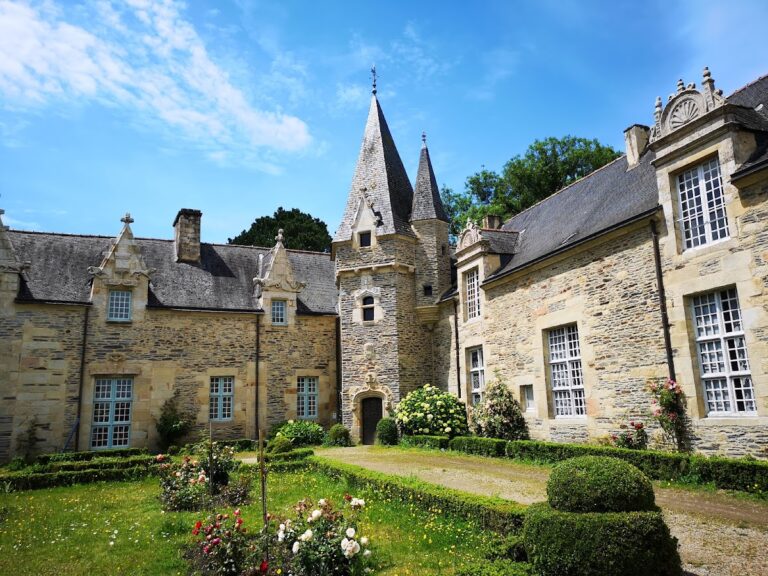
The abbey occupies a hill overlooking the meeting of the Oust and Vilaine rivers. Its surviving ensemble brings together the church, a bell tower now detached from it, and the conventual buildings with their cloister. The church preserves work from several medieval phases, while the conventual precinct reflects major rebuilding in the seventeenth century.
The abbey church
Early churches and relics
Under Conwoïon, two churches were built, one dedicated to Christ the Saviour and another to the Virgin Mary. The Romanesque church of the Saviour was dedicated on 28 October 832 or 833. A separate church dedicated to Saint Stephen was built around 848, east of the present church and above the Vilaine. Relics associated with Saint Epetème or Apodème, a bishop of Angers, were kept at the Saviour church’s altar. The abbey also acquired relics associated with Saint Marcellinus during the ninth century and held relics of Saint Melor of Brittany from 849.
Nave and transept
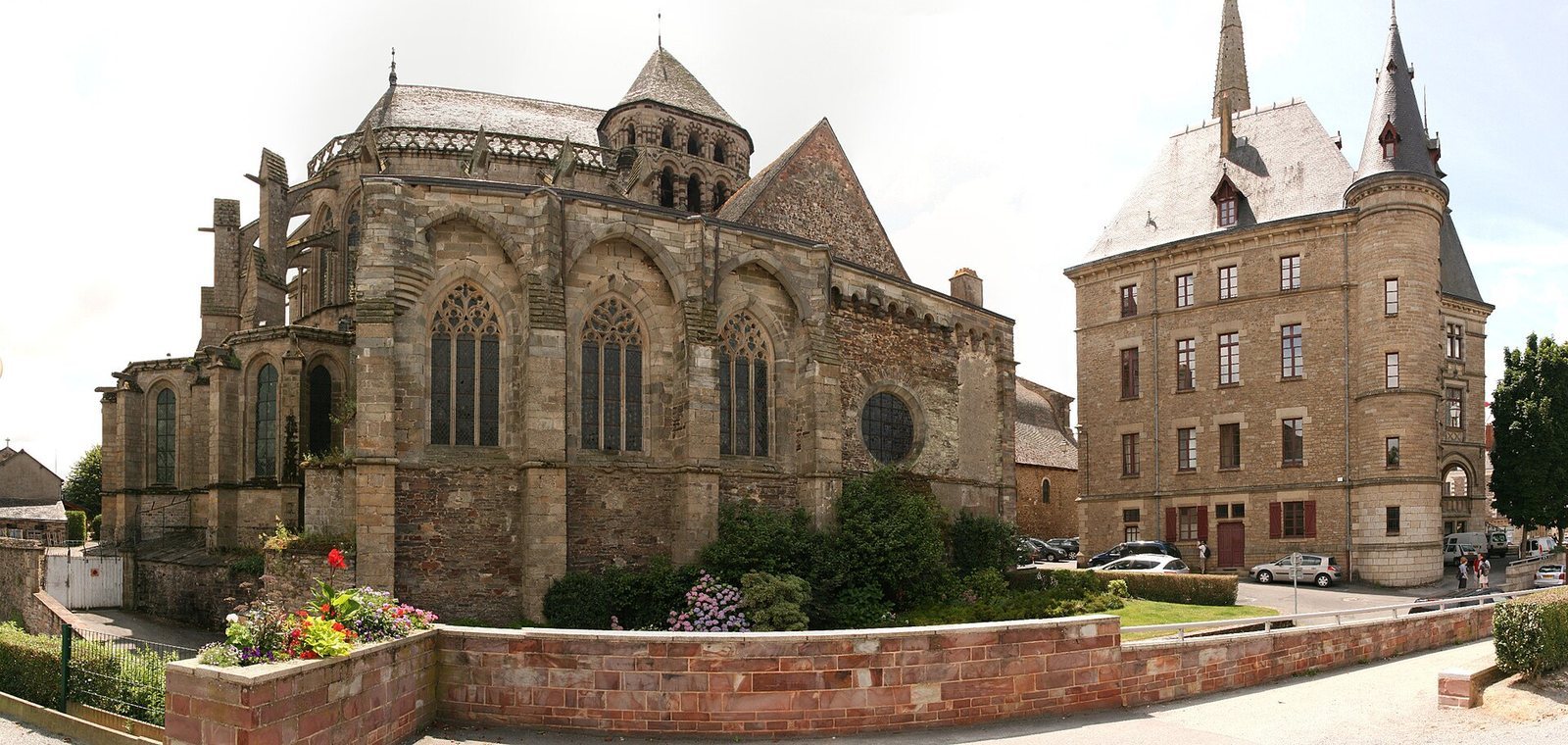
The nave was rebuilt in the eleventh century and extended during the twelfth, when an octagonal dome-like roof and Gothic features were added. The transept, the crosswise arm of the church, also belongs to the twelfth-century works. Masonry in the north-aisle wall may incorporate parts of the ninth-century church.
Choir and crossing tower
The present choir dates to the thirteenth century, when a Gothic sanctuary end replaced the earlier Romanesque apse, the end of the church containing the sanctuary. Its design was influenced by Norman Gothic architecture. A two-storey Romanesque tower of the eleventh century rises above the crossing, where the nave and transept intersect. Abbot Hervé oversaw restoration of the church in the twelfth century.
Porch and façade tower
Parts of the porch date to the eleventh century and are Romanesque. A Gothic bell tower was added to the church façade in the early fourteenth century. It was attached to the church until a fire in 1780 damaged the western nave. The nave was rebuilt at a shorter length, leaving the tower detached from the church.
Conventual buildings and records
Cloister and convent
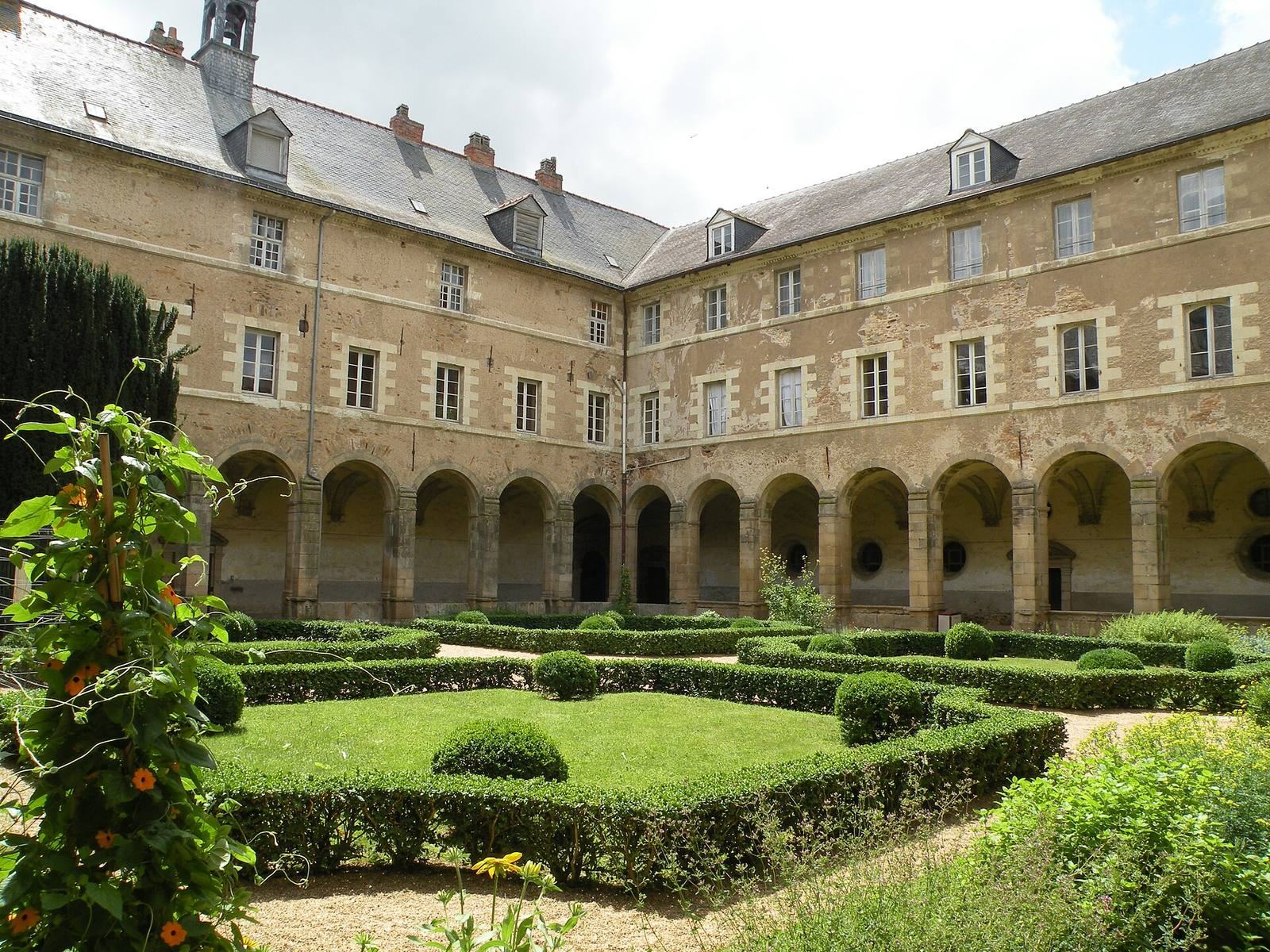
The cloister was built in the seventeenth century under Richelieu. Its doorways have elaborate pediments decorated with the arms of France, Brittany, the Congregation of Saint-Maur, and Richelieu. A subterranean passage connects the cloister with the Vilaine. The conventual buildings were rebuilt in the seventeenth century and now serve as the school. The monastery’s buildings included a dormitory, gatehouse, guesthouse, infirmary, and garden.
Chapter house and later decoration
The former chapter house, the room where the monastic community met for business, is now a separate chapel known as the Chapel of the Congregation. Modern stained-glass windows were made by the glass artist Jean-Jacques Grüber. Restoration work in 1950 revealed medieval frescoes, and the cloister underwent a complete renovation from 2009 to 2016.
Documents and seals
By Conwoïon’s death, the abbey held an archive of several hundred documents. About 350 manuscripts from the period have been preserved. The Redon cartulary, a register of copied charters and documents now held in the Historical Archives of the Diocese of Rennes, consists of 147 parchment pieces containing texts of 391 acts from the eighth to the twelfth century. Two seals belonging to the abbey are also preserved. One shows a rosette and two roses, with the letter R at the base of a hooked staff on its right; the other depicts a hooked staff and two palm branches.