Castle of Rieux: A Medieval Stronghold in France

Site at a Glance
- Rating
- 4.3
- Popularity
- Low
- Country
- France
- Primary era
- Medieval
- Eras represented
- Medieval
- Civilizations
- Duchy of Brittany
- Site type
- Military
- Remains
- Castle
On this page9 sections
History
The Castle of Rieux is a ruined medieval stronghold in Rieux, France, built by Breton lords on a rocky site overlooking the Vilaine. Its history began in the ninth century, when a castle was established on an ancient oppidum, a fortified settlement or stronghold associated with the Iron Age and Roman periods. The position controlled movement along the river and through the surrounding area, linking the castle’s development to the authority of the Rieux family, the Breton noble family that held the surrounding lands.
Early stronghold and medieval rebuilding
The site’s earlier medieval history is also connected with a castle mound. Alan the Great, ruler of Brittany, is traditionally said to have lived there in the ninth century while fighting the Normans. The Normans destroyed the mound in the tenth century, and Alan’s descendants later built a stone castle on the site.
This rebuilt fortress became the seat of the Rieux family’s regional authority. Its position above the Vilaine supported control of movement on the river and access across the surrounding territory.
Destruction during the late fifteenth century
Jean IV de Rieux, who lived from 1447 to 1518, commanded the Breton army at the Battle of Saint-Aubin-du-Cormier in 1488. That battle formed part of the conflict between Breton forces and the French crown. The same year, at the end of the Mad War, a late-fifteenth-century conflict in Brittany against French royal intervention, French troops destroyed the castle.
In 1490, Anne of Brittany, who had become duchess after her father’s death, granted Jean IV de Rieux 100,000 gold écus to rebuild his castles. The money also supported reconstruction at Elven, Rochefort-en-Terre, and Ancenis. The castle at Rieux remained inhabited during the sixteenth century, but it was abandoned after the Wars of the League, when the Rieux family died out.
Demolition and later history
Cardinal Richelieu, a French churchman and statesman who served as governor of Brittany, ordered the castle’s demolition in 1629. The work was extensive, although sections of wall and the external towers remained at that stage. Weakened foundations eventually caused the keep, the principal fortified tower of a medieval castle, to collapse in 1799 after an earthquake.
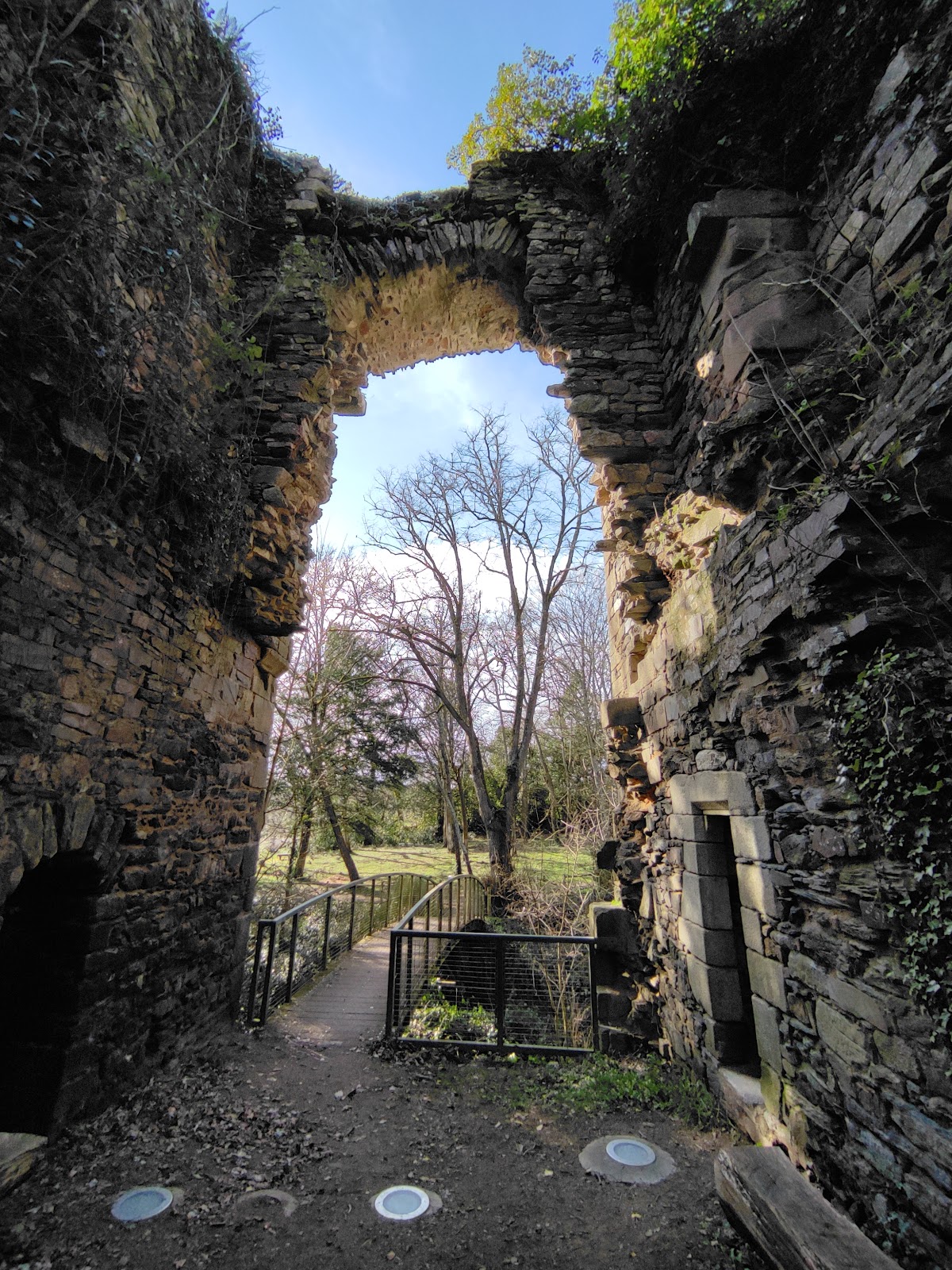
During the nineteenth century, part of the ruins was incorporated into an English-style garden surrounding the entrance postern. In the twentieth century, the municipality added an interpretive trail. The castle and its surroundings received classified natural-site status through an order dated 12 October 1971, recognizing their artistic, picturesque, scientific, historical, and legendary interest.
Remains
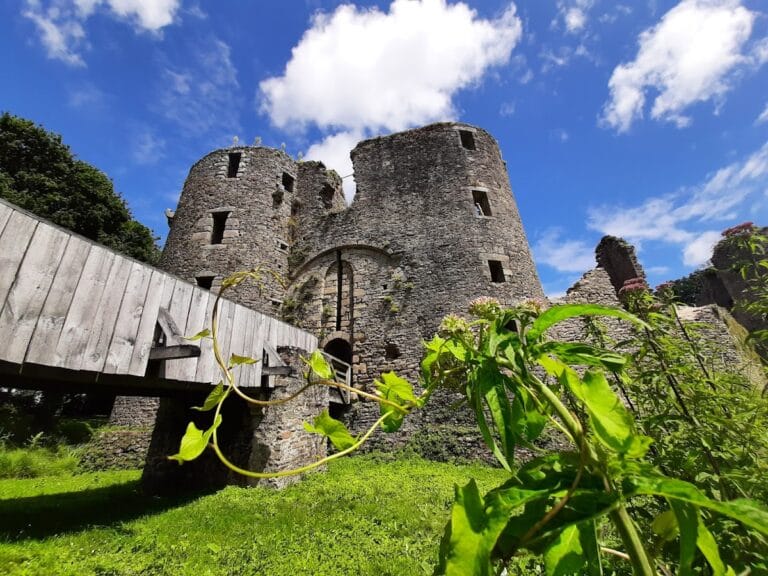
The ruins occupy a rocky spur east of Rieux and overlook the Vilaine. The surviving evidence suggests a generally trapezoidal plan. Four corner towers strengthened the enclosure, while an additional tower flanked each of the two longer curtain walls, the enclosing defensive walls of the castle. The keep stood at the eastern end, opposite the entrance postern on the west. Today, the postern is the only surviving standing vestige, while fragments of walls and towers lie among trees.
Entrance and fortified enclosure
Entrance postern
The western entrance was a postern, a smaller controlled entrance rather than a ceremonial gateway, equipped with a drawbridge. It survives as the principal standing element of the ruined castle and forms the focus of the nineteenth-century garden landscape.
Keep, walls, and towers
The keep occupied the eastern end of the enclosure and was supported within a defensive arrangement of trapezoidal curtain walls and towers. The corner towers and the towers set along the longer walls formed the castle’s principal fortified framework. Fragments of these walls and towers survive among the trees, while the keep fell in 1799 after an earthquake.
River installations and crossings
The castle’s position was connected with movement along and across the Vilaine. A port formerly stood north of the castle, where boats travelling on the river paid dues and the lords of Rieux collected crossing tolls. A wooden bridge crossed the river south of the castle until it collapsed into the water in 1543. A ferry then replaced it.