Shore Temple: A Pallava Hindu Temple Complex in India
Site at a Glance
- Popularity
- Very High
- Country
- India
- Primary era
- Medieval
- Eras represented
- Medieval
- Civilizations
- Unclassified
- Site type
- Religious
- Remains
- Temple
On this page19 sections
History
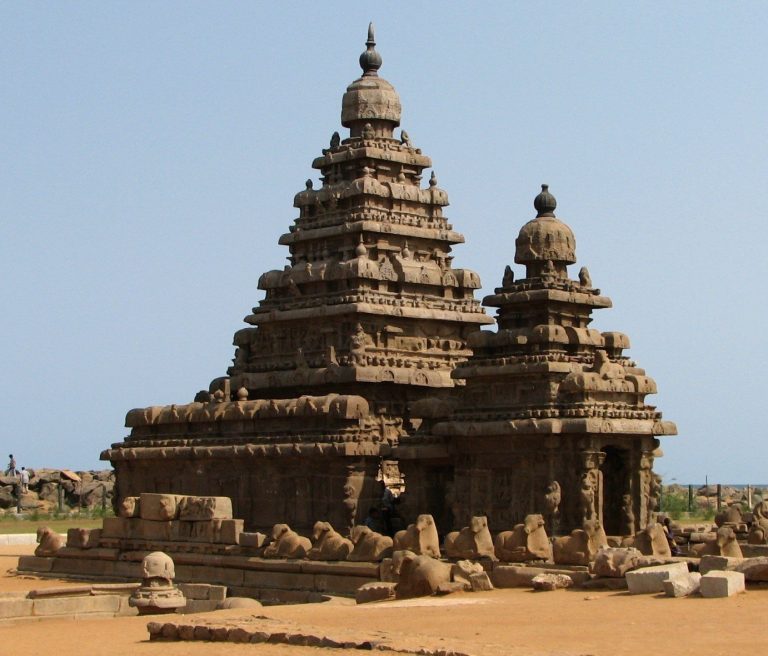
The Shore Temple is a Pallava Hindu temple complex at Mamallapuram on India’s Coromandel Coast, built around AD 725 under King Narasimhavarman II, also known as Rajasimha. It is among South India’s earliest major temples built from assembled stone rather than carved directly from rock. The complex brought to a culmination an architectural program begun in the mid-seventh century under Narasimhavarman I, whose title Mamalla gave Mamallapuram its name. His builders had developed cave temples and monolithic temple monuments before constructing the Shore Temple.
Pallava Port and Temple
At the time, Mamallapuram, also called Mahabalipuram, was a busy port and trading harbor. The Pallava kingdom’s capital was at Kanchipuram. After defeating the Pallavas, the Cholas continued the Shore Temple’s architectural style in temples of their own.
Names, Traditions, and Inscriptions
Marco Polo and later European merchants referred to Mamallapuram as the Seven Pagodas. The Shore Temple is thought to have been one of them, and its pagoda-like outline may have helped seafarers use it as a navigational landmark. A Hindu tradition connects the city’s foundation to the story of Hiranyakashipu and his son Prahlada. In the legend, Vishnu appears from a pillar as Narasimha, a man-lion, and kills Hiranyakashipu; Prahlada then becomes king, and his grandson Bali is said to have built Mamallapuram. Another tradition explains the city’s submerged monuments as the result of gods flooding it out of jealousy.
Inscriptions on a slab in the smaller Shiva shrine give names for the three shrines: Kshatriyasimha Pallavesvara-gruham, Rajasimha Pallavesvara-gruham, and Pallikondaruliya-devar. The slab calls the complex Jalashayana, meaning “lying in water.” An inscription on the Vishnu shrine’s lintel names it Narapatisimha Pallava Vishnu Griha. Narapatisimha was a title of Rajasimha, and the inscription identifies the Vishnu shrine as the complex’s earliest.
Archaeology and Heritage
The Archaeological Survey of India discovered a miniature shrine in 1990, and excavations in the early 2000s revealed structures buried under sand. The December 2004 Indian Ocean tsunami exposed remains of a collapsed granite temple and ancient stone sculptures on the Coromandel coast. The finds renewed speculation that the Shore Temple belonged to a group of seven coastal temples, with six others submerged; outlines of possible sister temples were also observed offshore. One archaeological interpretation links the temple’s exposed position by the sea to its builders’ belief in supernatural forces.
The Shore Temple forms part of the Group of Monuments at Mahabalipuram, inscribed as a UNESCO World Heritage Site in 1984.
Remains
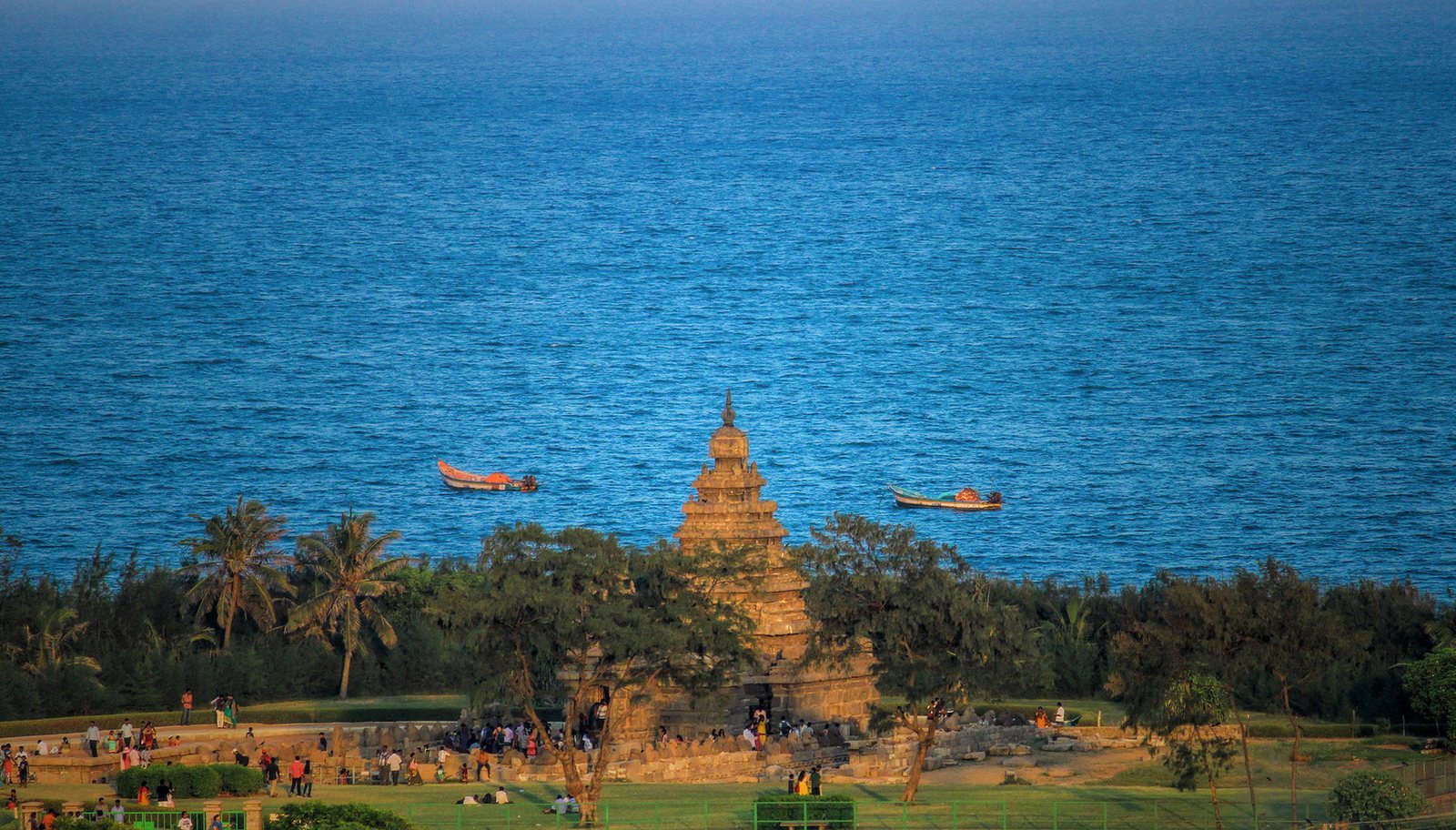
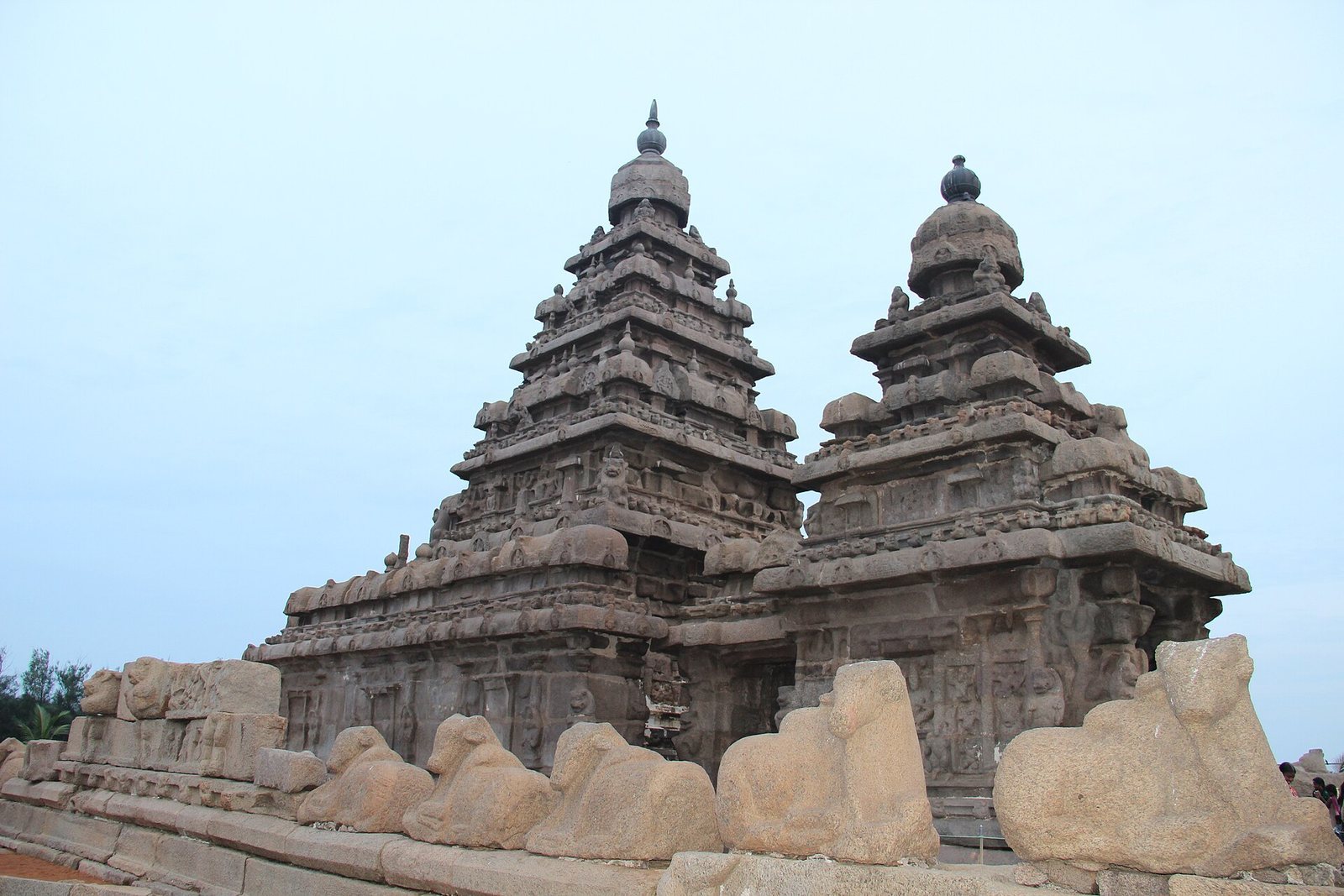
The complex stands on an elevated promontory projecting toward the Bay of Bengal. Three temples share a single platform: the principal Shiva temple, a smaller Shiva shrine behind it, and a small shrine to reclining Vishnu between them. The main temple faces east, so sunlight reaches the Shiva lingam in its sanctuary. Viewed from the north, the temples’ outline resembles the nearby Dharmaraja Ratha, a monolithic temple monument.
Platform and Exterior
Granite Buildings and Towers
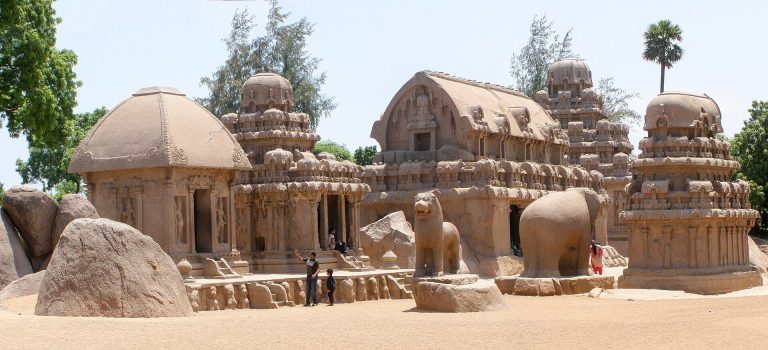
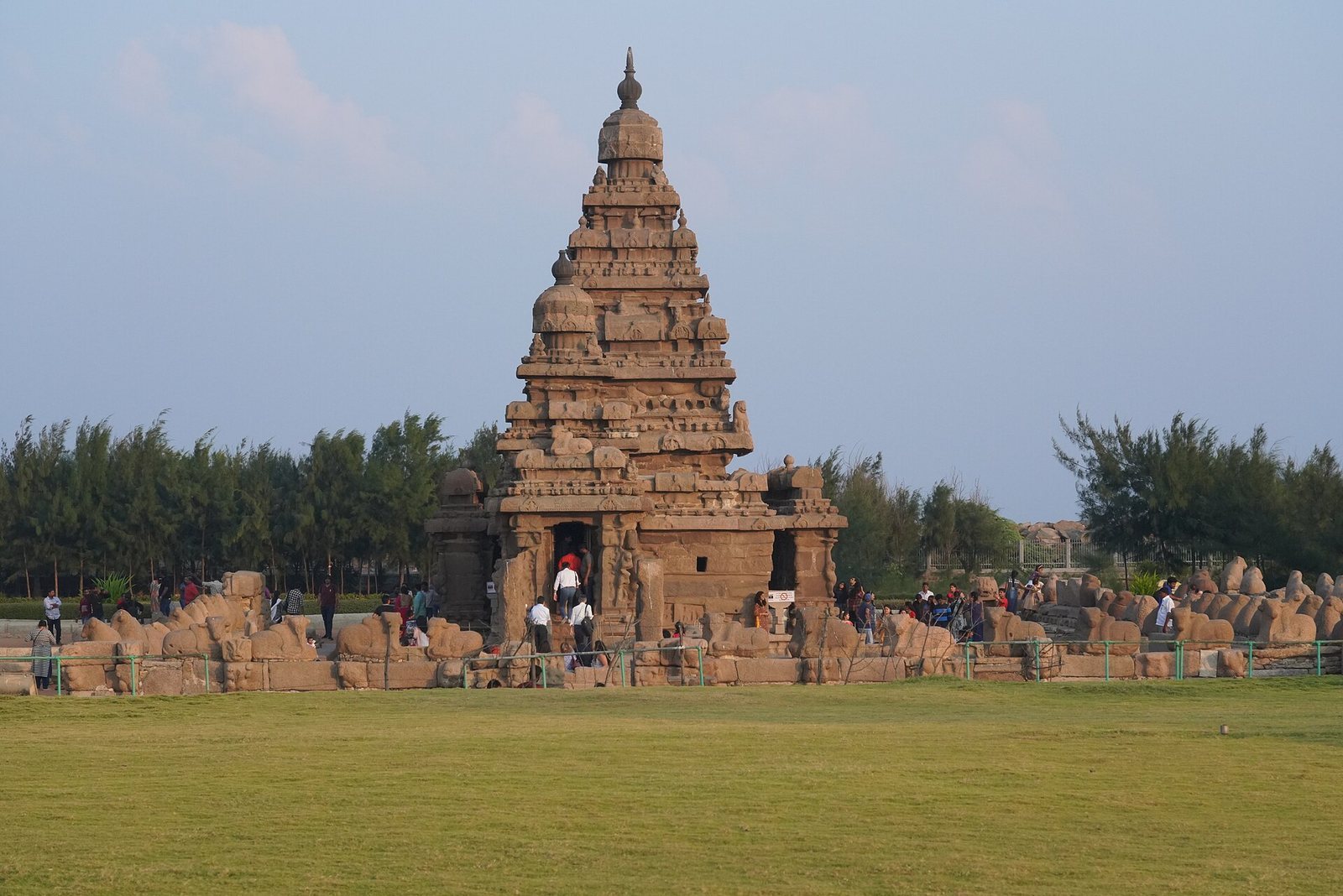
The principal temple is a five-storey structure made from carved granite blocks brought from a nearby quarry. Its pyramidal upper structure rises about 60 feet (18 metres) above a square platform roughly 50 feet (15 metres) across. A smaller granite building in front served as the original porch. The entrance passes through a crosswise gateway with a barrel-shaped vaulted roof. Both Shiva towers have stepped pyramidal tiers and projecting eaves, with octagonal upper sections in the Dravidian style, a South Indian temple-architecture tradition. Their roofs carry ornament resembling that of the Pancha Rathas, a group of monolithic temple monuments, and are topped with decorative finials.
Carved Walls and Boundaries
The Vishnu shrine’s outer wall and the inner face of the compound wall carry extensive carvings. Shallow projecting wall supports divide the exterior into panels, with rows of rearing lions along their lower sections. Large figures of Nandi, Shiva’s bull, appear on temple walls and around the compound. The enclosure also bears carvings of boars and mythical composite guardian creatures called yalis.
Principal Shiva Shrine
Sanctuary
The principal sanctuary contains a Shiva lingam, a symbolic representation of the deity, and is enclosed by a heavy outer wall. A narrow passage allows worshippers to walk around the shrine. At the rear, shrines face in opposite directions: the east-facing Shiva shrine named Kshatriyasimhesvara is reached by a passage, while the Vishnu shrine faces outward. The Kshatriyasimhesvara sanctuary measures 12 feet (3.7 metres) square and 11 feet (3.4 metres) high. Its black basalt lingam has sixteen faces with shallow fluting. The top is damaged; the six-foot (1.8-metre) carving extends a foot into the foundation for support.
Reliefs and Deities
A small shrine contains a Somaskanda relief, a family scene showing Shiva, Parvati, and their son Kartikeya; two related panels decorate the temple’s entrance porch. A similar panel appears at nearby Dharmaraja Ratha, associated with the period of Pallava king Paramesvaravarman. In the chamber before the main sanctuary, Brahma is carved on the south wall and Vishnu on the north. The rear of the sanctuary’s north wall shows Shiva in his Tripurantaka form and the goddess Durga. Durga also appears seated on a lion, whose chest has a cavity that may have held a small shrine.
Other Shrines and Sculpture
Smaller Shiva Shrine
The smaller Shiva temple behind the principal building has two storeys and a stepped pyramidal tower, with a round neck-like section below its octagonal upper part. A finial and pot-shaped ornament crown the tower. Horseshoe-arched projections and small shrine forms decorate the cornices on both levels. A Somaskanda scene appears on the inner shrine’s rear wall. Its exterior panels show Shiva in a one-legged form, with Brahma and Vishnu emerging from his sides, and Nagaraja, a king of serpents, beneath a five-hooded serpent.
Reclining Vishnu Shrine
The small rectangular shrine lies between the two Shiva temples. Its image shows four-armed Vishnu reclining on the serpent Ananta. A channel may have supplied water to the shrine. Carvings on its exterior depict Krishna killing the demon Kesi, Krishna dancing on the seven-headed serpent Kaliya, and Vishnu riding Garuda to rescue Gajendra from a crocodile.
Miniature Shrine
The miniature Shiva shrine is carved from the bedrock that also bears the reclining Vishnu. It has a sixteen-sided base, a circular built wall and upper structure, and lions on its shallow wall supports. Its round tower rises above a circular neck; each of its four sides has a large horseshoe-shaped projection containing an image of Ganesha. An elliptical well built during Rajasimha’s reign encloses the shrine. A broken Bhuvaraha carving shows Vishnu as a boar diving to rescue Bhudevi, who personifies Earth. The unusual scene has been interpreted as a reference to the temple’s submergence. An inscription at the carving’s base gives titles of Rajasimha, while another on the well’s upper stone course compares the king to Arjuna. The enclosing wall also helped keep sand carried from the sea out of the shrine.
Lion Sculpture
A partly carved and partly sculpted stone lion stands inside the compound wall. An opening in its torso contains a small image of Durga in her form as the slayer of the buffalo demon. A female guardian holding a bow is carved on one of the lion’s legs.
Coastal Condition
Tsunami Effects
The 2004 tsunami damaged the foundation of the sacrificial altar in front of the temple, the steps leading to the boat jetty, and a small shrine with a Varaha sculpture at the temple’s basement. The principal temple’s foundation rests on hard granite bedrock, which helped it withstand the waves; coastal groynes also contributed to its protection.
Erosion and Conservation
Salt-bearing winds have partly worn the exterior carvings. The Archaeological Survey of India protects the complex with coastal barriers and groynes. Conservation work has included absorbent pulp to draw saline water from the stone, chemical treatments to limit seepage and remove moisture, and planting along the shore. An 11-acre (4.4-hectare) lawn was established around the temple.