Michaelskapelle: Alken’s Historic Roman Catholic Church
Site at a Glance
- Rating
- 4.8
- Popularity
- Very Low
- Country
- Germany
- Primary era
- Medieval
- External website
- Open
- Eras represented
- Medieval, Early Modern
- Civilizations
- Holy Roman Empire
- Site type
- Religious
- Remains
- Church
On this page15 sections
History
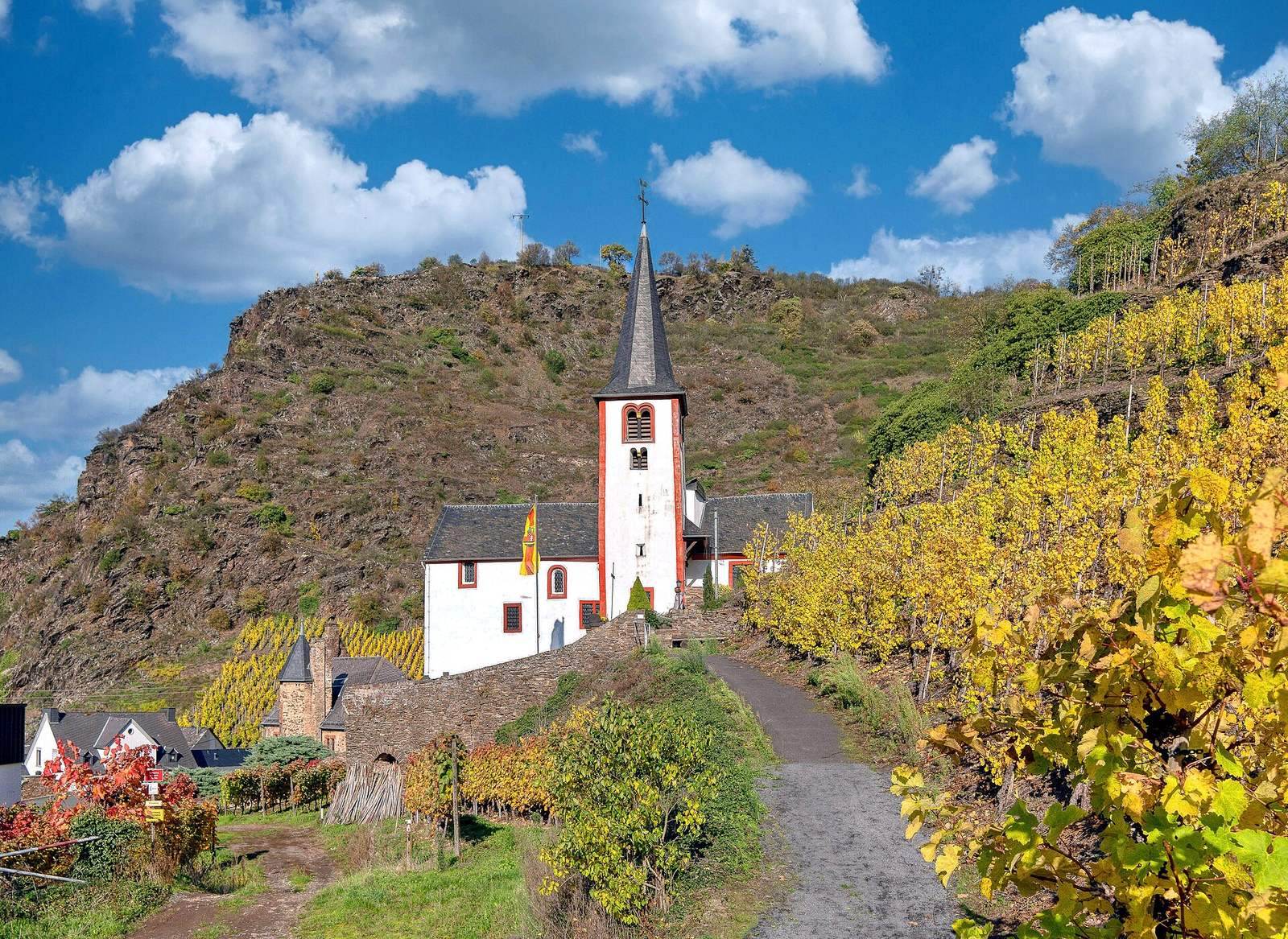
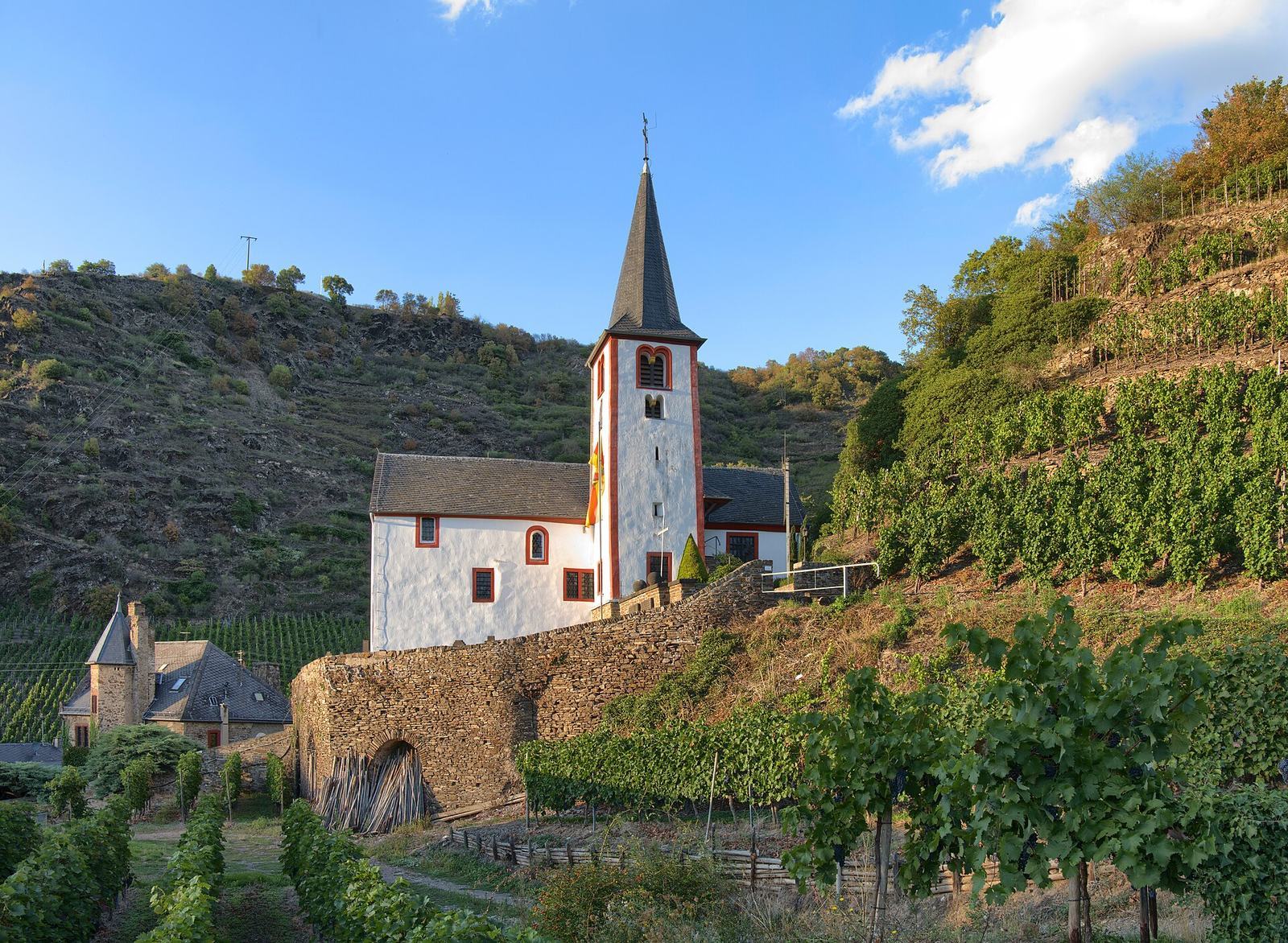
Michaelskapelle, also known as the Old St. Michael’s Church, is a Roman Catholic church in Alken, Germany, built around a Romanesque core and dedicated to the Archangel Michael. More than 1,000 years old, it was Alken’s first parish church and is regarded as one of the oldest churches in the Moselle region.
Medieval parish church
The church is first mentioned in 1015 in a document concerning the anniversary foundation of Megingaud, Archbishop of Trier. Its precise construction date is unknown. Michaelskapelle appears again in an indulgence document issued in 1296 and signed and sealed by twelve Roman prelates. An indulgence was a formal grant connected with the remission of penitential punishment in the medieval Western Church.
For more than 800 years, the church stood at the center of Catholic parish life in Alken. Its west tower belongs to the thirteenth century, while the sacristy bears the date 1547. The church’s cemetery was periodically cleared because space was limited, and the remains removed from graves were placed in the ossuary.
Later parish use and preservation
The church’s role changed after the new parish church was completed and consecrated in 1849. Michaelskapelle then ceased to serve as the parish church and was abandoned, although it was not demolished. Renovation began in 1898, followed by further preservation work in 1928, when some of the frescoes were uncovered. After an extended restoration, a service was held in the church again on 28 May 1935.
Since around 1980 and 1981, the St. Michael Brotherhood has cared for Michaelskapelle. Its work has included maintenance, restoration, the uncovering of ceiling paintings, and efforts to recover the interior as faithfully as possible. During the second half of the twentieth century, local citizens helped re-establish recognition of the church’s historical importance. A monthly Mass is celebrated there, and the church is also used for weddings. In 2015, a multimedia presentation on its thousand-year history was completed and began to be shown there at scheduled times.
Devotional route and cemetery
In 1648, a Stations of the Cross route was established from the church along a steep footpath to the pilgrimage church on the Bleidenberg. A Stations of the Cross route is a sequence of devotional stations commemorating episodes from Christ’s Passion. The church cemetery also preserves the history of earlier burials. An investigation by the Anthropological Institute of the University of Mainz in the 1970s found that the oldest remains in the ossuary dated from the beginning of the fourteenth century. Blood groups could still be determined in 126 of the 151 skeletons examined.
Remains
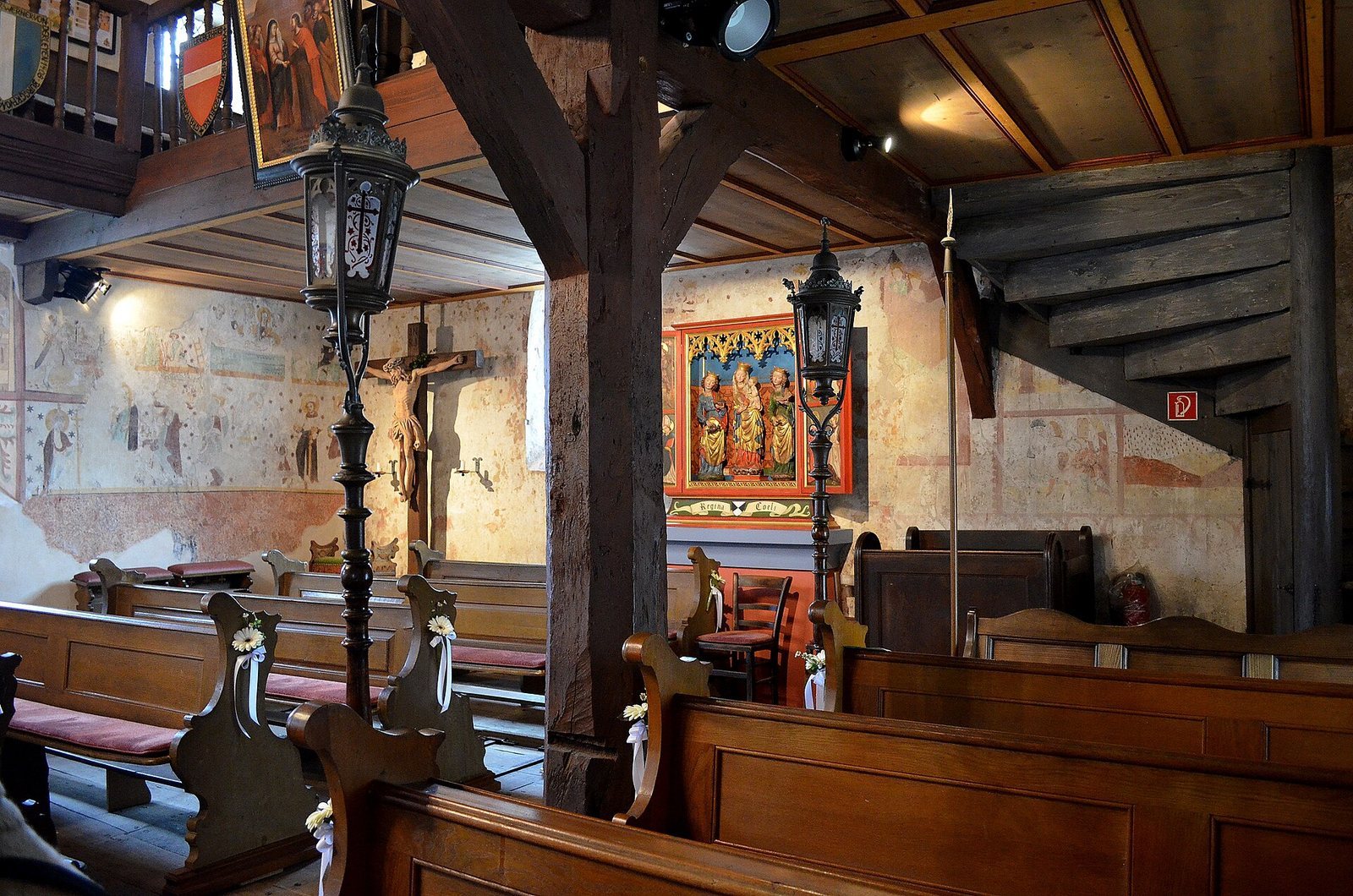
Michaelskapelle is a hall church, meaning that its interior forms a unified, hall-like space. Its Romanesque core, thirteenth-century west tower, and sixteenth-century sacristy are substantially preserved and have been restored in a manner faithful to the original. Because the church occupies a narrow valley with little room for expansion, galleries were added inside the nave in several phases. The southern gallery, the final enlargement, dates from 1622.
Entrance, staircase, and ossuary
A steep staircase leads to the entrance, with fourteen Stations of the Cross arranged along it. Near the upper end, behind a cast-iron gate, stands a Pietà dated 1686. A Pietà shows the Virgin Mary mourning over the dead Christ. The route ends with a large Ecce Homo figure dated 1787. An Ecce Homo image represents Christ presented for condemnation, traditionally wearing the crown of thorns.
The northern opening of the ossuary lies beneath the Pietà, while a second opening on the southern side allows the chamber to be viewed. An ossuary is a room for human bones removed from overcrowded or reused graves. Inside, skeletal remains from the old cemetery are stacked in layers and date from the fourteenth to the eighteenth century.
Frescoes and choir decoration
Choir vault
The choir vault contains a Last Judgment fresco dating from 1350. Christ appears as the enthroned Judge, accompanied by the Virgin Mary and John the Baptist. Below them, the dead rise from their coffins. Peter leads the saved, under the guidance of a bishop, through the gates of heaven, while an angel drives the condemned toward hell with a sword. The other vault compartments contain representations of the twelve apostles, although some can no longer be identified.
Choir wall and nave paintings
Behind the altar is a fresco of the Archangel Michael, the Christian archangel associated with protection and the defeat of evil. Beside it is another fresco that probably depicts the Virgin Mary with the infant Jesus. The nave frescoes date from the fifteenth century and were overpainted in the seventeenth century. Their earlier decoration included scenes from the Passion of Jesus on the south wall and the Ten Plagues on the north wall. Later uncovering has revealed surviving sections of these paintings.
Altars and Marian imagery
High altar and choir statues
The present high altar has a central scene of the Adoration of the Magi. Its wings show Saints Maximilian, Lucia, Cecilia, and Anthony. A winged altar carved in South Tyrol was installed on 5 October 1987. In an upper niche of the choir wall, a statue of the Virgin and Child stands on the head of a serpent. Below it hangs a copy of a painting by Lucas Cranach the Elder, a German Renaissance painter and printmaker known for religious subjects.
On the opposite side wall is a painting dated 1662, donated by Count van Wiltberg. It depicts the Coronation of Mary, with the count, his wife, and their thirteen children beneath the scene. Two further Marian statues are attached to the chancel arch. One is a Madonna enthroned, while the other represents Our Lady of Sorrows.
Side altars and epitaph
The Baroque left side altar, dedicated to the church’s patron saint, dates from 1622. A former Marian altar was removed in 1571 to make room for the epitaph of Count Henry van Wiltberg. The epitaph was sold in 1883 and is now held in the Landesmuseum in Bonn. Three additional altars stand in the nave: an altar of the Passion, an altar of the saints, and a Marian altar. Further paintings, painted wood carvings, and free-standing statues remain in the church.
Tower and sacristy furnishings
Baptismal font and South Tyrolean altar
A baptismal font stands in a niche in the tower and dates from the period when Alken became an independent parish in 1616. Beside it is a side altar made in South Tyrol. Its imagery relates to the Moselle region, showing Saint Nicholas, the patron of boatmen, on the left and Saint Urban, the patron of winegrowers, on the right. Saints Mark, Matthias, and Stephen occupy the central section. A nearby triptych, an artwork made of three connected panels, depicts the martyr Saint Stephen with two Evangelists, Saint Nicholas, and Saint Urban.
Cemetery crosses and sacristy treasury
The cemetery contains old basalt grave crosses, with the oldest dated 1557. Some were inscribed on both sides to reduce costs, while others bear house marks instead of personal names. A table in the sacristy recorded the families associated with these marks. The sacristy also contains a small treasury with old vestments, chalices, relics, seals, a missal, and other historic objects.